Experimental Investigation of the Effect of Boundary Conditions on the Vibration Response of an Aluminum Pipe Conveying Pulsating Flow
DOI:
https://doi.org/10.71229/rhmzcp14Keywords:
Pulsatile flow, , Pipe vibration,, Boundary conditions,, Fluid–structure interaction.Abstract
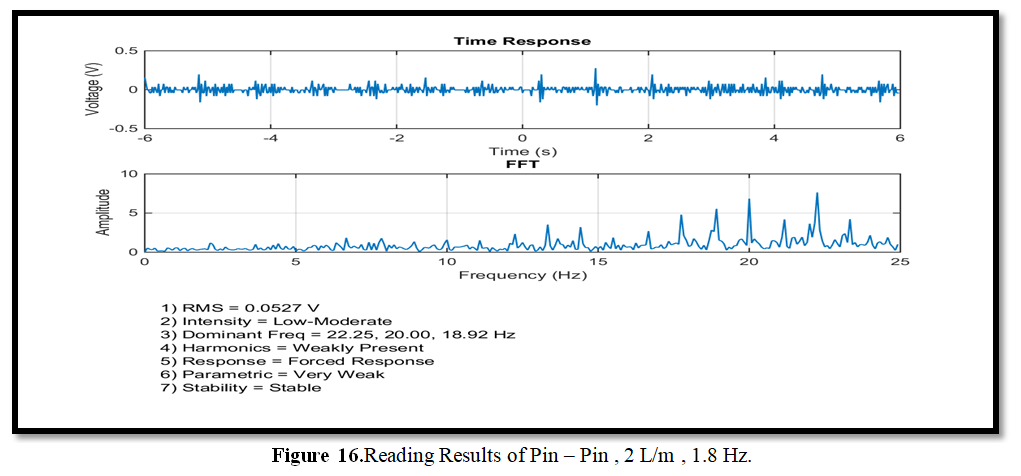
This study experimentally investigates the influence of boundary conditions on the vibration response of a circular pipe conveying pulsatile internal water flow. An inner diameter of a pipe is 0.011 m and outer diameter is 0.013 m, is examined under three classical support configurations: simply supported, clamped–clamped, and cantilever. Pulsatile flow is generated using a solenoid valve operating in on–off mode. Two volumetric flow rates, 2 L/min and 10 L/min, corresponding to mean velocities of approximately 0.35 m/s and 1.75 m/s, are considered. The excitation frequency is changed from 1Hz to 1.8Hz to study the effect of flow pulsation and structural response. Vibration measurements are obtained using acceleration sensors, and the response is analyzed in both time and frequency domains. The results indicate that the boundary conditions do significantly affect vibrations characteristics. The cantilever configuration exhibits the highest vibration amplitudes, particularly at higher flow rates, whereas the clamped–clamped configuration provides the lowest response levels and highest stability. Furthermore, the sensitivity of vibration amplitude to flow velocity is strongly dependent on the support condition. These findings demonstrate that boundary conditions play a dominant role in the dynamic behavior of pipes conveying pulsatile flow and can influence vibration response more significantly than moderate variations in operating parameters. The study provides practical insights for the design and support of piping systems subjected to unsteady internal flow.
References
[1] M. P. Païdoussis, Fluid-Structure Interactions: Slender Structures and Axial Flow, vol. 1. San Diego, CA, USA: Academic Press, 1998. DOI: https://doi.org/10.1016/S1874-5652(98)80003-3
[2] M. P. Païdoussis, “Dynamics of tubular cantilevers conveying fluid,” Journal of Mechanical Engineering Science, vol. 12, no. 2, pp. 85–103, 1970. DOI: 10.1243/JMES_JOUR_1970_012_017_02. DOI: https://doi.org/10.1243/JMES_JOUR_1970_012_017_02
[3] S. S. Chen, “Flow-induced vibration of circular cylindrical structures,” Journal of Fluids and Structures, vol. 1, no. 2, pp. 123–145, 1987.
[4] R. H. Plaut and H. Suherman, “Parametric resonance of pipes conveying pulsating fluid,” Journal of Sound and Vibration, vol. 189, no. 2, pp. 189–202, 1996. DOI: 10.1006/jsvi.1996.0012. DOI: https://doi.org/10.1006/jsvi.1996.0012
[5] A. K. Bajaj and B. K. Singh, “Experimental investigation of pipes conveying pulsating fluid,” Journal of Fluids and Structures, vol. 16, no. 8, pp. 1109–1125, 2002. DOI: 10.1006/jfls.2002.0450. DOI: https://doi.org/10.1006/jfls.2002.0450
[6] M. P. Païdoussis and G. Li, “Pipes conveying fluid: A model dynamical problem,” Journal of Fluids and Structures, vol. 7, no. 2, pp. 137–204, 1993. DOI: 10.1006/jfls.1993.1009. DOI: https://doi.org/10.1006/jfls.1993.1011
[7] R. D. Blevins, Flow-Induced Vibration, 2nd ed. New York, NY, USA: Van Nostrand Reinhold, 1990.
[8] R. D. Blevins, Formulas for Natural Frequency and Mode Shape, 2nd ed. Malabar, FL, USA: Krieger Publishing Company, 2001.
[9] A. H. Nayfeh and D. T. Mook, Nonlinear Oscillations. New York, NY, USA: Wiley-Interscience, 1979.
[10] N. W. McLachlan, Theory and Application of Mathieu Functions. Oxford, UK: Clarendon Press, 1974.
[11] A. W. Leissa, Vibration of Plates. Washington, DC, USA: NASA Scientific and Technical Information Office, 1969.
[12] J. S. Rao, Dynamics of Plates and Shells. New Delhi, India: Narosa Publishing House, 1999.
[13] D. J. Inman, Engineering Vibration, 4th ed. Upper Saddle River, NJ, USA: Pearson, 2014.
[14] L. Meirovitch, Elements of Vibration Analysis, 2nd ed. New York, NY, USA: McGraw-Hill, 1986.
[15] D. J. Ewins, Modal Testing: Theory and Practice. Taunton, UK: Research Studies Press, 1984.
[16] M. Géradin and D. Rixen, Mechanical Vibrations: Theory and Application to Structural Dynamics, 3rd ed. Chichester, UK: Wiley, 2015.
[17] S. Timoshenko, D. H. Young, and W. Weaver, Vibration Problems in Engineering, 5th ed. New York, NY, USA: Wiley, 1990.
[18] W. T. Thomson, Theory of Vibration with Applications, 3rd ed. Englewood Cliffs, NJ, USA: Prentice Hall, 1988.
[19] J. P. Den Hartog, Mechanical Vibrations, 4th ed. New York, NY, USA: McGraw-Hill, 1956.
[20] A. K. Chopra, Dynamics of Structures: Theory and Applications to Earthquake Engineering, 4th ed. Upper Saddle River, NJ, USA: Prentice Hall, 2011.
Downloads
Published
Issue
Section
License
Copyright (c) 2026 Al-Noor Journal of Engineering Management and Computer Science

This work is licensed under a Creative Commons Attribution-NonCommercial-ShareAlike 4.0 International License.
How to Cite