Advancements in Medical Image Processing: Integrating Physics With Convolutional Neural Networks (CNN) for Enhanced Diagnostic
DOI:
https://doi.org/10.71229/vc3qaj25Keywords:
Medical Imaging, , Deep Learning, , Physics-Informed Neural Networks,, Brain Tumor Classification, , Convolutional Neural Networks (CNN)Abstract
Background: Medical imaging has innovatively changed the healthcare set-up through the facilitation of early and non-invasive analysis. Despite all these, the developing complexity of imaging information needs qualitative diagnosis tools. Although deep learning, especially with the use CNNs, has indicated possible, challenges such as data dependency and interpretation may hamper its clinical acceptability.
Objective: The major focus of this study may add physical limitations to CNNs to improve consistency and healthcare organizational adoption of deep learning frameworks. The main scope of this work may include the growth of a physics-Informed Convolutional Neural Network (Pi-CNN) for sort of brain tumour categorization from MRI images and followed by its testing framework.
Methodology: Scientists employed baseline CNN model and Pi-CNN with the same parameters to MRI brain tumor exercise procedures. With spatial consonance limitation being integrated into the Pi-CNN it can enable the medical image forecast through the method of anatomy. Homogenous metric evaluations were carried out on their experimentation plan by several researchers who applied the two different model types.
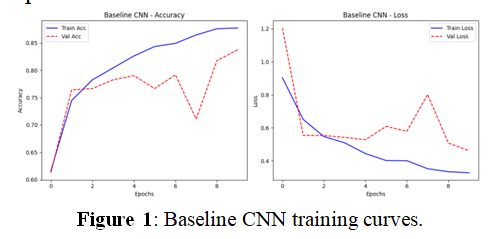
Results: At the testing stage, the Baseline CNN may set out to attain a slightly better precision rate at 84% than Pi-CNN which achieved at 80.0%. Information detection precision and generalization abilities were better in the Pi-CNN which affirmed that the status is the good choice for the purpose of medical application.
Specific Contribution: The precise input delivers a replication to Physics-Informed CNN model, which maintains a precise results whereas tempting to enhance the quality of the results and clinical trust phases. The base framework will enable deep learning approaches at numerous levels to combine clinical perfection with outcomes which can enhance diagnostic imaging performance.
Conclusion: Medical professionals applying limitations for CNNs identified enhancement in more efficient models which can enhance clinical utility and consistency. Future AI model innovation may involve improved pre-existing purview of knowledge of biological pedigree for physics in connection with enhanced health record translation because of the presumed combination and it will assist physicians in their investigation procedures.
References
[1] Das, J. (2019). Revolutionizing Medical Imaging with Artificial Intelligence: Advancements, Challenges, and Future Directions in Diagnostic Precision. International Journal of Enhanced Research in Management & Computer Applications, 8, 11-26.
[2] Dutta, P., Upadhyay, P., De, M., &Khalkar, R. G. (2020, February). Medical image analysis using deep convolutional neural networks: CNN architectures and transfer learning. In 2020 International Conference on Inventive Computation Technologies (ICICT) (pp. 175-180). IEEE. DOI: https://doi.org/10.1109/ICICT48043.2020.9112469
[3] Hammernik, K., Küstner, T., Yaman, B., Huang, Z., Rueckert, D., Knoll, F., &Akçakaya, M. (2023). Physics-driven deep learning for computational magnetic resonance imaging: Combining physics and machine learning for improved medical imaging. IEEE signal processing magazine, 40(1), 98-114. DOI: https://doi.org/10.1109/MSP.2022.3215288
[4] Huang, Z., Li, Q., Lu, J., Feng, J., Hu, J., & Chen, P. (2021). Recent advances in medical image processing. Acta cytologica, 65(4), 310-323. DOI: https://doi.org/10.1159/000510992
[5] Ilesanmi, A. E., Ilesanmi, T. O., & Ajayi, B. O. (2024). Reviewing 3D convolutional neural network approaches for medical image segmentation. Heliyon. DOI: https://doi.org/10.1016/j.heliyon.2024.e27398
[6] J. Zhang, M. H. Cho, R. Shen, et al., “Integrating Radiomics and Deep Learning for Lung Cancer Diagnosis,” IEEE Access, vol. 9, pp. 38824–38834, 2021.
[7] Kshatri, S. S., & Singh, D. (2023). Convolutional neural network in medical image analysis: a review. Archives of Computational Methods in Engineering, 30(4), 2793-2810. DOI: https://doi.org/10.1007/s11831-023-09898-w
[8] Kumar, A. (2022). Deep learning for multi-modal medical imaging fusion: Enhancing diagnostic accuracy in complex disease detection. Int J Eng Technol Res Manag, 6(11), 183.
[9] Li, M., Jiang, Y., Zhang, Y., & Zhu, H. (2023). Medical image analysis using deep learning algorithms. Frontiers in public health, 11, 1273253. DOI: https://doi.org/10.3389/fpubh.2023.1273253
[10] Liu, X., Gao, K., Liu, B., Pan, C., Liang, K., Yan, L., ... & Yu, Y. (2021). Advances in deep learning-based medical image analysis. Health Data Science, 2021, 8786793. DOI: https://doi.org/10.34133/2021/8786793
[11] Mahmood, T., Rehman, A., Saba, T., Nadeem, L., & Bahaj, S. A. O. (2023). Recent advancements and future prospects in active deep learning for medical image segmentation and classification. IEEE Access, 11, 113623-113652. DOI: https://doi.org/10.1109/ACCESS.2023.3313977
[12] Mall, P. K., Singh, P. K., Srivastav, S., Narayan, V., Paprzycki, M., Jaworska, T., &Ganzha, M. (2023). A comprehensive review of deep neural networks for medical image processing: Recent developments and future opportunities. Healthcare Analytics, 4, 100216. DOI: https://doi.org/10.1016/j.health.2023.100216
[13] Mohammed, F. A., Tune, K. K., Assefa, B. G., Jett, M., & Muhie, S. (2024). Medical image classifications using convolutional neural networks: a survey of current methods and statistical modeling of the literature. Machine learning and knowledge extraction, 6(1), 699-735. DOI: https://doi.org/10.3390/make6010033
[14] Najjar, R. (2023). Redefining radiology: a review of artificial intelligence integration in medical imaging. Diagnostics, 13(17), 2760. DOI: https://doi.org/10.3390/diagnostics13172760
[15] Obuchowicz, R., Strzelecki, M., & Piórkowski, A. (2024). Clinical applications of artificial intelligence in medical imaging and image processing—A review. Cancers, 16(10), 1870. DOI: https://doi.org/10.3390/cancers16101870
[16] Reddy, Y. A., Dubey, R. S., Prakash, R. V., & Padder, A. (2026). MRI-based brain tumor prediction using convolutional neural network framework. Scientific Reports, 16, 15904.
DOI: 10.1038/s41598-026-47044-1. DOI: https://doi.org/10.1038/s41598-026-47044-1
[17] Salah Eldin, W., &Kaboudan, A. (2023). Ai-driven medical imaging platform: advancements in image analysis and healthcare diagnosis. Journal of the ACS Advances in Computer Science, 14(1). DOI: https://doi.org/10.21608/asc.2023.328064
[18] Sarvamangala, D. R., & Kulkarni, R. V. (2022). Convolutional neural networks in medical image understanding: a survey. Evolutionary intelligence, 15(1), 1-22. DOI: https://doi.org/10.1007/s12065-020-00540-3
[19] Soni, V. D., & Soni, A. N. (2021, September). Cervical cancer diagnosis using convolution neural network with conditional random field. In 2021 third international conference on inventive research in computing applications (ICIRCA) (pp. 1749-1754). IEEE. DOI: https://doi.org/10.1109/ICIRCA51532.2021.9544832
[20] Thakur, G. K., Thakur, A., Kulkarni, S., Khan, N., & Khan, S. (2024). Deep learning approaches for medical image analysis and diagnosis. Cureus, 16(5). DOI: https://doi.org/10.7759/cureus.59507
[21] Ullah, F., Nadeem, M., Abrar, M., Al-Razgan, M., Alfakih, T., Amin, F., & Salam, A. (2023). Brain tumor segmentation from MRI images using handcrafted convolutional neural network. Diagnostics, 13(16), 2650. DOI: https://doi.org/10.3390/diagnostics13162650
[22] Anand, V., Khajuria, A., Pachauri, R. K., & Gupta, V. (2026). Multi-class classification of brain tumors using optimized CNN and transfer learning techniques. Scientific Reports, 16, 4709.DOI: 10.1038/s41598-025-34806-6. DOI: https://doi.org/10.1038/s41598-025-34806-6
[23] Xi, P., Guan, H., Shu, C., Borgeat, L., &Goubran, R. (2020). An integrated approach for medical abnormality detection using deep patch convolutional neural networks. The Visual Computer, 36(9), 1869-1882. DOI: https://doi.org/10.1007/s00371-019-01775-7
[24] Xia, K. J., Yin, H. S., & Wang, J. Q. (2019). A novel improved deep convolutional neural network model for medical image fusion. Cluster Computing, 22, 1515-1527. DOI: https://doi.org/10.1007/s10586-018-2026-1
[25] Yao, X., Wang, X., Wang, S. H., & Zhang, Y. D. (2022). A comprehensive survey on convolutional neural network in medical image analysis. Multimedia Tools and Applications, 81(29), 41361-41405.
[26] Yu, H., Yang, L. T., Zhang, Q., Armstrong, D., & Deen, M. J. (2021). Convolutional neural networks for medical image analysis: state-of-the-art, comparisons, improvement and perspectives. Neurocomputing, 444, 92-110. DOI: https://doi.org/10.1016/j.neucom.2020.04.157
[27] Yadav, A. C., & Kolekar, M. H. (2026). Deep feature-based approaches for brain tumor classification and segmentation in medical imaging. Biomedical Signal Processing and Control, 117, 109603. DOI: https://doi.org/10.1016/j.bspc.2026.109603
[28] A. M. Winkler, J. T. Doshi, et al., “Interpretability of Deep Learning Models in Medical Applications,” Radiology: Artificial Intelligence, vol. 3, no. 6, pp. e200019, 2021.
[29] Uthra, B., & Sivashankari, R. (2026). Query-guided learning for efficient and interpretable multi-class brain tumor classification in MRI. Frontiers in Artificial Intelligence, 9, 1849051.DOI: 10.3389/frai.2026.1849051. DOI: https://doi.org/10.3389/frai.2026.1849051
[30] Antropova, N., Abe, H., & Giger, M. L. (2018). Use of clinical MRI maximum intensity projections for improved breast lesion classification with deep convolutional neural networks. Journal of Medical Imaging, 5(1), 014503-014503. DOI: https://doi.org/10.1117/1.JMI.5.1.014503
[31] Addimulam, S., Mohammed, M. A., Karanam, R. K., Ying, D., Pydipalli, R., Patel, B., ... &Natakam, V. M. (2020). Deep Learning-Enhanced Image Segmentation for Medical Diagnostics. Malaysian Journal of Medical and Biological Research, 7(2), 145-152.
[32] Anwar, S. M., Majid, M., Qayyum, A., Awais, M., Alnowami, M., & Khan, M. K. (2018). Medical image analysis using convolutional neural networks: a review. Journal of medical systems, 42, 1-13. DOI: https://doi.org/10.1007/s10916-018-1088-1
[33] Abbas, M., Hassan, M., Wang, R.-Z., & Teng, C.-H. (2026). Brain Tumor Classification in MRI Images Using Combined Transfer Learning and Convolutional Neural Networks. Journal of Imaging, 12(6), 233.DOI: 10.3390/jimaging12060233. DOI: https://doi.org/10.3390/jimaging12060233
[34] Ajlouni, N., Özyavaş, A., Takaoğlu, M., Takaoğlu, F., & Ajlouni, F. (2023). Medical image diagnosis based on adaptive Hybrid Quantum CNN. BMC Medical Imaging, 23(1), 126. DOI: https://doi.org/10.1186/s12880-023-01084-5
[35] Cui, H., Hu, L., & Chi, L. (2023). Advances in computer-aided medical image processing. Applied Sciences, 13(12), 7079. DOI: https://doi.org/10.3390/app13127079
[36] Yao, X., Wang, X., Wang, S. H., & Zhang, Y. D. (2022). A comprehensive survey on convolutional neural network in medical image analysis. Multimedia Tools and Applications, 81(29), 41361-41405. DOI: https://doi.org/10.1007/s11042-020-09634-7
[37] J. O. Williams, “Narrow-band analyzer,” Ph.D. dissertation, Dept. Elect. Eng., Harvard Univ., Cambridge, MA, 1993.
[38] B. Klaus and P. Horn, Robot Vision. Cambridge, MA: MIT Press, 1986.
Downloads
Published
Issue
Section
License
Copyright (c) 2026 Al-Noor Journal of Engineering Management and Computer Science

This work is licensed under a Creative Commons Attribution-NonCommercial-ShareAlike 4.0 International License.
How to Cite