Deep Learning-Based Intrusion Detection in IoT: A Comprehensive Review of Architectures, Attacks, Challenges, and Future Directions
DOI:
https://doi.org/10.71229/e60hg537Keywords:
Convolutional Neural Network , Deep Learning , Explainable Artificial Intelligence , Federated Learning, Long Short-Term Memory, Internet of Things, Intrusion Detection SystemAbstract
The rapid proliferation of Internet of Things (IoT) devices across critical domains including healthcare, smart cities, industrial control systems, and intelligent transportation has fundamentally transformed the cybersecurity threat landscape. The inherent characteristics of IoT environments, namely resource-constrained devices, heterogeneous architectures, and large-scale deployment, render traditional Intrusion Detection Systems (IDS) inadequate for the sophisticated and evolving attack vectors targeting these networks. Deep learning (DL) has emerged as a compelling paradigm for next-generation IoT IDS, offering automated feature extraction, temporal pattern recognition, and adaptive threat detection capabilities that address the limitations of conventional approaches.
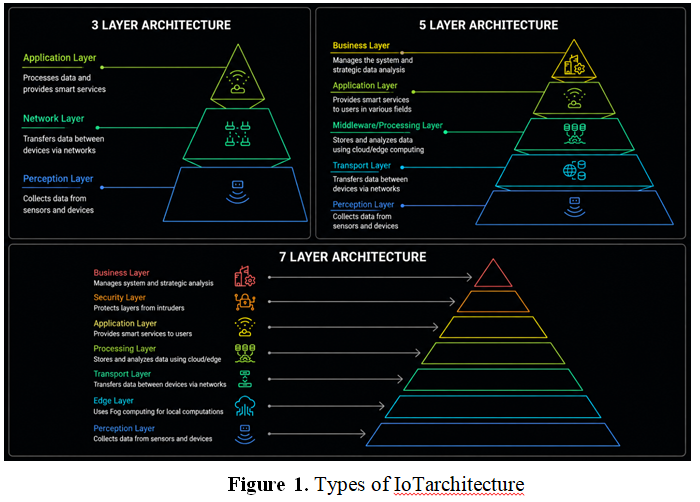
This paper provides a thorough and systematic review of the existing DL methods for IoT intrusion detection. The paper explore the IoT architectural paradigms, outline a four layered taxonomy for types of IoT attacks across its three primary layers Perception, Network and Application as well as Adversarial Machine Learning attacks, and systematically review seven classes of DL architectures Convolutional Neural Networks (CNN), Long Short-Term Memory (LSTM) networks, Gated Recurrent Units (GRU), Autoencoders, Generative Adversarial Networks (GAN), models based on Transformer architecture and Federated Learning frameworks. In a comparative review of forty peer-reviewed studies, we demonstrate that hybrid DL models provide excellent detection performance (99-100% classification accuracy on benchmark datasets) as well as practical viability for deployment with privacy-preserving Federated Learning for large-scale data. The study additionally highlights five enduring challenges class imbalance, adversarial vulnerability, zero-day detection limitations, computational constraints and the absence of standardized benchmarking protocols that together account for the gap between performance benchmarks and real-world deployment efficacy. It outlines future research avenues targeting on five key axes with a particular focus in the integration of Explainable AI (XAI), lightweight edge-deployable architectures, and adversarial robustness mechanisms. This survey identifies a structured reference to advance the state of IoT intrusion detection from research to operationally viable and deployable systems.
References
[1] S. O. Folorunsho, O. A. Adenekan, and C. Ezeigweneme, “Ensuring Cybersecurity in telecommunications : Strategies to protect digital infrastructure and sensitive data,” vol. 5, no. 8, pp. 1855–1883, 2024, doi: 10.51594/csitrj.v5i8.1448. DOI: https://doi.org/10.51594/csitrj.v5i8.1448
[2] Z. H. Joy, “ADVANCED CYBERSECURITY PROTOCOLS FOR SECURING DATA MANAGEMENT SYSTEMS IN INDUSTRIAL AND HEALTHCARE ENVIRONMENTS,” 2024, doi: 10.62304/jbedpm.v3i4.147. DOI: https://doi.org/10.62304/jbedpm.v3i4.147
[3] A. Ahmad, R. Maulana, and M. Yassir, “Cybersecurity Challenges in the Era of Digital Transformation A Comprehensive Analysis of Information Systems,” vol. 6, no. 1, p. 61992, 2024. DOI: https://doi.org/10.61992/jiem.v6i1.57
[4] A. Choudhary, Discover Internet of Things Internet of Things : a comprehensive overview , architectures , applications , simulation tools , challenges and future directions. Springer International Publishing, 2024. DOI: https://doi.org/10.1007/s43926-024-00084-3
[5] D. Canavese, L. Mannella, and L. Regano, “Security at the Edge for Resource-Limited IoT Devices,” pp. 1–16, 2024. DOI: https://doi.org/10.3390/s24020590
[6] A. Ghaffari, N. Jelodari, and B. Arasteh, “Securing internet of things using machine and deep learning methods : a survey,” pp. 9065–9089, 2024. DOI: https://doi.org/10.1007/s10586-024-04509-0
[7] M. Altaibek, A. Issainova, T. Aidynov, D. Kuttymbek, and G. Abisheva, “A Survey of Cross-Layer Security for Resource-Constrained IoT Devices,” pp. 1–43, 2025. DOI: https://doi.org/10.3390/app15179691
[8] S. K. R. Kumar and R. R. Ramisetty, Advancements in training and deployment strategies for AI ‑ based intrusion detection systems in IoT : a systematic literature review. Springer International Publishing, 2025.
[9] A. Kumar and P. P. Kumar, “The Impact of IoT on Cyber Security,” no. May, 2025. DOI: https://doi.org/10.22214/ijraset.2025.71771
[10] K. S. Adewole and A. Jacobsson, “Intrusion Detection Framework for Internet of Things with Rule Induction for Model Explanation,” pp. 1–27, 2025. DOI: https://doi.org/10.3390/s25061845
[11] C. Zhang, J. Li, N. Wang, and D. Zhang, “Research on Intrusion Detection Method Based on Transformer and CNN-BiLSTM in Internet of Things,” no. January, 2025. DOI: https://doi.org/10.3390/s25092725
[12] A. Hossain, “Deep learning ‑ based intrusion detection for IoT networks : a scalable and efficient approach,” 2025. DOI: https://doi.org/10.21203/rs.3.rs-6042512/v1
[13] M. Adam, M. Hammoudeh, S. Member, and B. Alsulaimy, “A Survey on Security , Privacy , Trust , and Architectural Challenges in IoT Systems,” IEEE Access, vol. PP, p. 1, 2024, doi: 10.1109/ACCESS.2024.3382709. DOI: https://doi.org/10.1109/ACCESS.2024.3382709
[14] I. Applications, “Internet of Things for System Integrity : A Comprehensive Survey on Security , Attacks and Countermeasures for Industrial Applications,” 2021.
[15] I. M. et al. E. Elikem, E. Akansah, “Monitoring and Control Framework for IoT, Implemented for Smart Agriculture,” pp. 1–32, 2023.
[16] D. Calder and F. J. Folgado, “Implementation and Experimental Application of Industrial IoT Architecture Using Automation and IoT Hardware / Software,” 2024. DOI: https://doi.org/10.3390/s24248074
[17] N. Khezemi, “A Systematic Literature Review of IoT System Architectural Styles and their Quality Requirements,” pp. 1–20.
[18] P. K. Sadhu and V. P. Yanambaka, “Internet of Things : Security and Solutions Survey,” pp. 1–51, 2022. DOI: https://doi.org/10.3390/s22197433
[19] S. K. Sahu and K. Mazumdar, “Exploring security threats and solutions Techniques for Internet of Things ( IoT ): from vulnerabilities to vigilance,” no. May, pp. 1–16, 2024, doi: 10.3389/frai.2024.1397480. DOI: https://doi.org/10.3389/frai.2024.1397480
[20] N. Singh and R. Buyya, “Securing Cloud-Based Internet of Things : Challenges and Mitigations,” pp. 1–45, 2025. DOI: https://doi.org/10.3390/s25010079
[21] N. Mishra, “Internet of Things Applications , Security Challenges , Attacks , Intrusion Detection , and Future Visions : A Systematic Review,” pp. 59353–59377, 2021, doi: 10.1109/ACCESS.2021.3073408. DOI: https://doi.org/10.1109/ACCESS.2021.3073408
[22] M. Asam, S. H. Khan, T. Jamal, and A. Khan, “IoT Malware Detection Architecture using a Novel Channel Boosted and Squeezed CNN.”
[23] M. Gelgi, Y. Guan, and S. Arunachala, “Systematic Literature Review of IoT Botnet DDOS Attacks and Evaluation of Detection Techniques,” 2024. DOI: https://doi.org/10.3390/s24113571
[24] M. O. M. Ouaissa, “Analyzing and Mitigating Attacks in IoT Smart Home Using a Threat Modeling Approach-Based STRIDE,” Int. J. Interact. Mob. Technol., vol. 19, no. 2, pp. 126–142, 2025. DOI: https://doi.org/10.3991/ijim.v19i02.52377
[25] E. Anthi, L. Williams, and V. Ieropoulos, “IoT Investigating Radio Frequency Vulnerabilities in the Internet of Things ( IoT ),” pp. 356–380, 2024. DOI: https://doi.org/10.3390/iot5020018
[26] E. Carlos et al., “CICIoT2023 : A Real-Time Dataset and Benchmark for Large-Scale Attacks in IoT Environment,” 2023.
[27] S. H. Javed, M. Bin Ahmad, M. Asif, S. H. Almotiri, K. Masood, and M. A. Al Ghamdi, “An Intelligent System to Detect Advanced Persistent Threats in Industrial Internet of Things ( I-IoT ),” pp. 1–25, 2026.
[28] Y. S. et al. Z. CHEN, J. LIU, “Machine Learning-Enabled IoT Security : Open Issues and Challenges Under Advanced Persistent Threats,” no. 2022, pp. 1–35. DOI: https://doi.org/10.1145/3530812
[29] S. H. Javed, M. B. I. N. Ahmad, and M. Asif, “APT Adversarial Defence Mechanism for Industrial IoT Enabled Cyber-Physical System,” IEEE Access, vol. 11, no. June, pp. 74000–74020, 2023, doi: 10.1109/ACCESS.2023.3291599. DOI: https://doi.org/10.1109/ACCESS.2023.3291599
[30] M. Almutairi, “IoT – Cloud Integration Security : A Survey of Challenges , Solutions , and Directions,” 2025. DOI: https://doi.org/10.3390/electronics14071394
[31] S. Ul, H. Yashwant, S. Amit, S. Rahul, and G. Dipak, “Discover Internet of Things A survey on IoT & embedded device firmware security : architecture , extraction techniques , and vulnerability analysis frameworks,” Discov. Internet Things, 2023, doi: 10.1007/s43926-023-00045-2. DOI: https://doi.org/10.1007/s43926-023-00045-2
[32] T. Sasi, A. Habibi, R. Lu, and P. Xiong, “A comprehensive survey on IoT attacks : Taxonomy , detection mechanisms and challenges,” J. Inf. Intell., vol. 2, no. 6, pp. 455–513, 2024, doi: 10.1016/j.jiixd.2023.12.001. DOI: https://doi.org/10.1016/j.jiixd.2023.12.001
[33] B. Alotaibi, “A Survey on Industrial Internet of Things Security: Requirements, Attacks, AI-Based Solutions, and Edge Computing Opportunities,” vol. 23, 2023, doi: 10.3390/s23177470. DOI: https://doi.org/10.20944/preprints202307.0771.v1
[34] V. E. Trifonov, A. F. Ponomareva, A. B. Levina, and K. S. Krasov, “Architectural vulnerabilities of IoT devices in the context of side channel attacks,” 2025 Int. Conf. Artif. Intell. Comput. Data Sci. Appl., no. August, pp. 1–6, 2025, doi: 10.1109/ACDSA65407.2025.11165979. DOI: https://doi.org/10.1109/ACDSA65407.2025.11165979
[35] D. Lightbody, D. Ngo, A. Temko, C. C. Murphy, and E. Popovici, “Attacks on IoT : Side-Channel Power Acquisition Framework for Intrusion Detection,” 2023. DOI: https://doi.org/10.3390/fi15050187
[36] W. K. Al-zubaidi and M. Almaayah, “Resilient IoT Authentication Against Physical Tampering and Side Channel Attacks,” vol. 15, no. 6, pp. 28787–28795, 2025. DOI: https://doi.org/10.48084/etasr.13464
[37] B. Bala and S. Behal, “AI techniques for IoT-based DDoS attack detection: Taxonomies, comprehensive review and research challenges,” Comput. Sci. Rev., vol. 52, p. 100631, 2024. DOI: https://doi.org/10.1016/j.cosrev.2024.100631
[38] M. R. Kadri, A. Abdelli, J. Ben Othman, and L. Mokdad, “Survey and classification of Dos and DDos attack detection and validation approaches for IoT environments,” Internet of Things, vol. 25, p. 101021, 2024. DOI: https://doi.org/10.1016/j.iot.2023.101021
[39] J. A. Perez-diaz and J. A. Cantoral-ceballos, “Transport and Application Layer DDoS Attacks Detection to IoT Devices by Using Machine Learning and Deep Learning Models,” vol. 22, 2022, doi: 10.3390/s22093367. DOI: https://doi.org/10.3390/s22093367
[40] M. Ahmed, A. Salah, A. Hussein, and A. Sharafi, “Intrusion detection in IoT networks using machine learning and deep learning approaches for MitM attack mitigation,” Discov. Internet Things, 2025, doi: 10.1007/s43926-025-00104-w. DOI: https://doi.org/10.1007/s43926-025-00104-w
[41] O. Pospisil, R. Fujdiak, K. Mikhaylov, and H. Ruotsalainen, “applied sciences Testbed for LoRaWAN Security : Design and Validation through Man-in-the-Middle Attacks Study,” 2021. DOI: https://doi.org/10.3390/app11167642
[42] H. A. Noman and O. M. F. Abu-sharkh, “Code Injection Attacks in Wireless-Based Internet of Things ( IoT ): A Comprehensive Review and Practical Implementations,” 2023. DOI: https://doi.org/10.3390/s23136067
[43] H. Y, T. I, T. S, and R. T, “SPOT : In-depth Analysis of IoT Ransomware Attacks Using Bare Metal NAS Devices,” vol. 32, pp. 23–34, 2024, doi: 10.2197/ipsjjip.32.23. DOI: https://doi.org/10.2197/ipsjjip.32.23
[44] J. Jeon, S. Baek, B. Jeong, and Y. Jeong, “Early prediction of ransomware API calls behaviour based on GRU-TCN in healthcare IoT,” vol. 0091, 2023, doi: 10.1080/09540091.2023.2233716. DOI: https://doi.org/10.1080/09540091.2023.2233716
[45] O. Aslan, S. Serkant, “A Comprehensive Review of Cyber Security Vulnerabilities, Threats, Attacks, and Solutions,” vol. 12, 2023, doi: 10.3390/electronics12061333. DOI: https://doi.org/10.3390/electronics12061333
[46] M. A. Ferrag, O. Friha, and D. Hamouda, “Edge-IIoTset : A New Comprehensive Realistic Cyber Security Dataset of IoT and IIoT Applications for Centralized and Federated Learning,” IEEE Access, vol. 10, pp. 40281–40306, 2022, doi: 10.1109/ACCESS.2022.3165809. DOI: https://doi.org/10.1109/ACCESS.2022.3165809
[47] X. Zhou, W. Liang, W. Li, K. Yan, S. Shimizu, and K. I. Wang, “Hierarchical Adversarial Attacks Against Graph-Neural-Network-Based IoT Network Intrusion Detection System,” IEEE Internet Things J., vol. 9, no. 12, pp. 9310–9319, 2022, doi: 10.1109/JIOT.2021.3130434. DOI: https://doi.org/10.1109/JIOT.2021.3130434
[48] H. Khazane, M. Ridouani, and F. Salahdine, “A Holistic Review of Machine Learning Adversarial Attacks in IoT Networks in Figure,” 2024. DOI: https://doi.org/10.3390/fi16010032
[49] A. Alajaji, “FortiNIDS : Defending Smart City IoT Infrastructures Against Transferable Adversarial Poisoning in Machine Learning-Based Intrusion Detection Systems,” 2025. DOI: https://doi.org/10.3390/s25196056
[50] G. Liu, W. Zhang, X. Li, K. Fan, and S. Yu, “VulnerGAN : a backdoor attack through vulnerability amplification against machine learning-based network intrusion detection systems,” vol. 65, no. July, pp. 1–19, 2022. DOI: https://doi.org/10.1007/s11432-021-3455-1
[51] B. Ma, J. Shi, N. Zhu, C. Fang, and Y. Hu, “Backdoor AttackandDefenseMethodsforAI–Based IoT Intrusion DetectionSystem,” vol. 2025, no. Ml, 2025, doi: 10.1049/ise2/6664900. DOI: https://doi.org/10.1049/ise2/6664900
[52] B. Isong and O. Kgote, “Insights into Modern Intrusion Detection Strategies for Internet of Things Ecosystems,” 2024. DOI: https://doi.org/10.3390/electronics13122370
[53] S. Arisdakessian, O. A. Wahab, A. Mourad, H. Otrok, and M. Guizani, “A survey on IoT intrusion detection: Federated learning, game theory, social psychology, and explainable AI as future directions,” IEEE Internet Things J., vol. 10, no. 5, pp. 4059–4092, 2022. DOI: https://doi.org/10.1109/JIOT.2022.3203249
[54] Q. A. Al‐Haija and A. Droos, “A comprehensive survey on deep learning‐based intrusion detection systems in Internet of Things (IoT),” Expert Syst., vol. 42, no. 2, p. e13726, 2025. DOI: https://doi.org/10.1111/exsy.13726
[55] S. Fraihat, S. Makhadmeh, M. Awad, M. A. Al-Betar, and A. Al-Redhaei, “Intrusion detection system for large-scale IoT NetFlow networks using machine learning with modified Arithmetic Optimization Algorithm,” Internet of Things, vol. 22, p. 100819, 2023. DOI: https://doi.org/10.1016/j.iot.2023.100819
[56] F. Genuario, G. Santoro, M. Giliberti, S. Bello, E. Zazzera, and D. Impedovo, “Machine Learning-Based Methodologies for Cyber-Attacks and Network Traffic Monitoring : A Review and Insights,” pp. 1–27, 2024. DOI: https://doi.org/10.20944/preprints202407.0029.v1
[57] H. Satilmiş, “A Systematic Literature Review on Host-Based Intrusion Detection Systems,” no. January, pp. 27237–27266, 2024, doi: 10.1109/ACCESS.2024.3367004. DOI: https://doi.org/10.1109/ACCESS.2024.3367004
[58] R. de O. A. Francisco Lopes de Caldas Filho, Samuel Carlos Meneses Soares, Elder Oroski and and R. T. de S. J. , Rafael Zerbini Alves da Mata, Fábio Lúcio Lopes de Mendonça, “Botnet Detection and Mitigation Model for IoT Networks Using Federated Learning Francisco,” vol. 23, no. 14, pp. 1–35, 2023, doi: 10.3390/s23146305. DOI: https://doi.org/10.3390/s23146305
[59] A. Efe, “Comparison of the Host-Based Intrusion Detection Systems and Network-Based Intrusion Detection Systems,” vol. 18, no. 1, pp. 23–32, 2022, doi: 10.18466/cbayarfbe.832533. DOI: https://doi.org/10.18466/cbayarfbe.832533
[60] Y. Yang and K. Chang, “Hybrid Neural Network-Based Intrusion Detection System : Leveraging LightGBM and MobileNetV2 for IoT Security,” pp. 1–19, 2025. DOI: https://doi.org/10.3390/sym17030314
[61] M. Sahi, N. Auluck, A. Azim, and M. Al Maruf, “Dynamic hierarchical intrusion detection task offloading in IoT edge networks,” Softw. Pract. Exp., vol. 54, no. 11, pp. 2249–2271, 2024. DOI: https://doi.org/10.1002/spe.3338
[62] V. K. Ravindran, S. S. Ojha, and A. Kamboj, “A Comparative Analysis of Signature-Based and Anomaly-Based Intrusion Detection Systems,” vol. XIV, no. V, pp. 209–214, 2025, doi: 10.51583/IJLTEMAS. DOI: https://doi.org/10.51583/IJLTEMAS.2025.140500026
[63] M. Schrötter, A. Niemann, and B. Schnor, “A Comparison of Neural-Network-Based Intrusion Detection against Signature-Based Detection in IoT Networks,” 2024. DOI: https://doi.org/10.36227/techrxiv.170751744.48685929/v1
[64] A. Lara, V. Mayor, R. Estepa, A. Estepa, and J. E. Díaz-verdejo, “Internet of Things Smart home anomaly-based IDS : Architecture proposal and case study,” Internet of Things, vol. 22, no. January, p. 100773, 2023, doi: 10.1016/j.iot.2023.100773. DOI: https://doi.org/10.1016/j.iot.2023.100773
[65] T. Saba, A. Rehman, T. Sadad, H. Kolivand, and S. A. Bahaj, “Anomaly-based Intrusion Detection System for IoT Networks through Deep Learning Model.”
[66] M. Bhavsar, K. Roy, J. Kelly, and O. Olusola, “Discover Internet of Things Anomaly ‑ based intrusion detection system for IoT application,” Discov. Internet Things, no. May, 2023, doi: 10.1007/s43926-023-00034-5. DOI: https://doi.org/10.21203/rs.3.rs-2846147/v1
[67] S. H. Rafique, A. Abdallah, N. S. Musa, and T. Murugan, “Machine Learning and Deep Learning Techniques for Internet of Things Network Anomaly Detection—Current Research Trends,” vol. 24, 2024, doi: 10.3390/ s24061968. DOI: https://doi.org/10.3390/s24061968
[68] B. S. A. Ayan Chatterjee and Dept, “IOT ANOMALY DETECTION METHODS AND APPLICATIONS: A SURVEY,” 2022, doi: 10.1016/j.iot.2022.100568. DOI: https://doi.org/10.1016/j.iot.2022.100568
[69] E. Altulaihan, M. A. Almaiah, and A. Aljughaiman, “Anomaly Detection IDS for Detecting DoS Attacks in IoT Networks Based on Machine Learning Algorithms,” 2024. DOI: https://doi.org/10.3390/s24020713
[70] M. Sajid, K. R. Malik, A. Almogren, T. S. Malik, and A. H. Khan, “Enhancing intrusion detection : a hybrid machine and deep learning approach,” J. Cloud Comput., 2024, doi: 10.1186/s13677-024-00685-x. DOI: https://doi.org/10.1186/s13677-024-00685-x
[71] S. Racherla, P. Sripathi, and N. Faruqui, “Deep-IDS : A Real-time Intrusion Detector for IoT Nodes using Deep Learning,” IEEE Access, vol. PP, p. 1, 2024, doi: 10.1109/ACCESS.2024.3396461. DOI: https://doi.org/10.1109/ACCESS.2024.3396461
[72] Z. Wang, H. Chen, S. Yang, X. Luo, D. Li, and J. Wang, “A lightweight intrusion detection method for IoT based on deep learning and dynamic quantization,” pp. 1–34, 2023, doi: 10.7717/peerj-cs.1569. DOI: https://doi.org/10.7717/peerj-cs.1569
[73] N. Albanbay, Y. Tursynbek, K. Graffi, R. Uskenbayeva, and Z. Kalpeyeva, “Federated Learning-Based Intrusion Detection in IoT Networks : Performance Evaluation and Data Scaling Study,” pp. 1–24, 2025. DOI: https://doi.org/10.3390/jsan14040078
[74] L. Ali, K. Thakur, S. Schmeelk, J. Debello, and D. Dragos, “Deep Learning vs . Machine Learning for Intrusion Detection in Computer Networks : A Comparative Study,” pp. 1–19, 2025. DOI: https://doi.org/10.3390/app15041903
[75] H. Kamal, “Enhanced Hybrid Deep Learning Models-Based Anomaly Detection Method for Two-Stage Binary and Multi-Class Classification of Attacks in Intrusion Detection Systems,” 2025. DOI: https://doi.org/10.3390/a18020069
[76] S. D. A. R. 1, Basim Ahmad Alabsi, Mohammed Anbar, “CNN-CNN: Dual Convolutional Neural Network Approach for Feature Selection and Attack Detection on Internet of Things Networks,” vol. 23, 2023, doi: 10.3390/ s23146507. DOI: https://doi.org/10.3390/s23146507
[77] D. Arnold, M. Gromov, and J. Saniie, “Network Traffic Visualization Coupled with Convolutional Neural Networks for Enhanced IoT Botnet Detection,” IEEE Access, vol. PP, p. 1, 2024, doi: 10.1109/ACCESS.2024.3404270. DOI: https://doi.org/10.1109/ACCESS.2024.3404270
[78] Y. Ban, D. Zhang, Q. He, and Q. Shen, “APSO-CNN-SE : An Adaptive Convolutional Neural Network Approach for IoT Intrusion Detection,” 2024, doi: 10.32604/cmc.2024.055007. DOI: https://doi.org/10.32604/cmc.2024.055007
[79] A. Momand, S. Ullah, and J. Naeem, “ABCNN ‑ IDS : Attention ‑ Based Convolutional Neural Network for Intrusion Detection in IoT Networks,” Wirel. Pers. Commun., vol. 136, no. 4, pp. 1981–2003, 2024, doi: 10.1007/s11277-024-11260-7. DOI: https://doi.org/10.1007/s11277-024-11260-7
[80] I. Ullah, Q. H. Mahmoud, and S. Member, “Design and Development of RNN Anomaly Detection Model for IoT Networks,” IEEE Access, vol. 10, pp. 62722–62750, 2022, doi: 10.1109/ACCESS.2022.3176317. DOI: https://doi.org/10.1109/ACCESS.2022.3176317
[81] R. Morshedi and S. M. Matinkhah, “Intrusion DetectioninIoTUsingDeepRecurrentNeural Networks: AComplexNetworkApproachto Modeling EmergentCyberattackBehaviors,” vol. 2025, 2025, doi: 10.1155/cplx/9693472. DOI: https://doi.org/10.1155/cplx/9693472
[82] A. Kumar, B. Arnob, M. F. M. Mejdl, S. Amiruzzaman, and R. Islam, “An Enhanced LSTM Approach for Detecting IoT-Based DDoS Attacks Using Honeypot Data,” Int. J. Comput. Intell. Syst., vol. 123, 2025, doi: 10.1007/s44196-025-00741-7. DOI: https://doi.org/10.1007/s44196-025-00741-7
[83] P. Sinha, D. Sahu, S. Prakash, T. Yang, R. S. Rathore, and V. K. Pandey, “OPEN A high performance hybrid LSTM CNN secure architecture for IoT environments using deep learning,” pp. 1–26, 2025. DOI: https://doi.org/10.1038/s41598-025-94500-5
[84] K. O. Adefemi and M. B. Mutanga, “A Hybrid CNN – GRU Deep Learning Model for IoT Network Intrusion Detection,” pp. 1–15, 2025. DOI: https://doi.org/10.1109/AFRICON66545.2025.11533794
[85] M. Mohamed, “Comparative Evaluation of VAEs , VAE-GANs and AAEs for Anomaly Detection in Network Intrusion Data,” vol. 11, no. 2, pp. 160–173, 2023. DOI: https://doi.org/10.24003/emitter.v11i2.817
[86] W. Tian, Y. Shen, N. Guo, J. Yuan, and Y. Yang, “VAE-WACGAN : An Improved Data Augmentation Method Based on VAEGAN for Intrusion Detection,” 2024. DOI: https://doi.org/10.3390/s24186035
[87] Z. Li, P. Wang, and Z. Wang, “FlowGANAnomaly : Flow-Based Anomaly Network Intrusion Detection with Adversarial Learning,” vol. 33, no. 1, pp. 58–71, 2024, doi: 10.23919/cje.2022.00.173.I. DOI: https://doi.org/10.23919/cje.2022.00.173
[88] B. Sharma, L. Sharma, C. Lal, and S. Roy, “Delft University of Technology Anomaly based network intrusion detection for IoT attacks using deep learning technique Green Open Access added to TU Delft Institutional Repository ’ You share , we take care !’ - Taverne project Otherwise as indicated in the copyright section : the publisher is the copyright holder of this work and the author uses the Dutch legislation to make this work public .,” Comput. Electr. Eng., vol. 107, p. 108626, 2023, doi: 10.1016/j.compeleceng.2023.108626. DOI: https://doi.org/10.1016/j.compeleceng.2023.108626
[89] H. Kheddar, “Transformers and Large Language Models for Efficient Intrusion Detection Systems : A Comprehensive Survey,” vol. 2453, pp. 0–2.
[90] Z. Ali, G. S. Member, and W. Tiberti, “Empowering Network Security : BERT Transformer Learning Approach and MLP for Intrusion Detection in Imbalanced Network Traffic,” vol. 12, no. September, 2024. DOI: https://doi.org/10.1109/ACCESS.2024.3465045
[91] A. Almadhor, S. Alsubai, N. Kryvinska, and A. Al Hejaili, “Evaluating large transformer models for anomaly detection of resource-constrained IoT devices for intrusion detection system,” pp. 1–19, 2025. DOI: https://doi.org/10.1038/s41598-025-21826-5
[92] M. Wang, N. Yang, and N. Weng, “Securing a Smart Home with a Transformer-Based IoT Intrusion Detection System,” no. Ml, pp. 1–19, 2023. DOI: https://doi.org/10.3390/electronics12092100
[93] S. Tseng, Y. Wang, and Y. Wang, “Multi-Class Intrusion Detection Based on Transformer for IoT Networks Using CIC-IoT-2023 Dataset,” 2024. DOI: https://doi.org/10.3390/fi16080284
[94] K. He, W. Zhang, X. Zong, and L. Lian, “Network Intrusion Detection Based on Feature Image and Deformable Vision Transformer Classification,” IEEE Access, vol. PP, p. 1, 2024, doi: 10.1109/ACCESS.2024.3376434. DOI: https://doi.org/10.1109/ACCESS.2024.3376434
[95] T. P. Nguyen, H. Nam, and D. Kim, “Transformer-Based Attention Network for In-Vehicle Intrusion Detection,” vol. 11, no. May, pp. 55389–55403, 2023. DOI: https://doi.org/10.1109/ACCESS.2023.3282110
[96] A. M. Alashjaee, “Deep learning for network security : an Attention-CNN-LSTM model for accurate intrusion detection,” pp. 1–12, 2025. DOI: https://doi.org/10.1038/s41598-025-07706-y
[97] A. Odeh, “applied sciences Ensemble-Based Deep Learning Models for Enhancing IoT Intrusion Detection,” 2023. DOI: https://doi.org/10.3390/app132111985
[98] D. Mohsin, A. Ali, and J. Lloret, “An Integrated Hybrid Deep Learning Framework for Intrusion Detection in IoT and IIoT Networks Using CNN-LSTM-GRU Architecture,” pp. 1–28, 2025.
[99] D. Kilichev, W. K. Dilmurod Turimov, and Department, “Next–Generation Intrusion Detection for IoT EVCS: Integrating CNN, LSTM, and GRU Models,” 2024. DOI: https://doi.org/10.3390/math12040571
[100] D. Torre, W. Tacoma, A. Chennamaneni, J. Jo, G. Vyas, and B. Sabrsula, “Toward Enhancing Privacy Preservation of a Federated Learning CNN Intrusion Detection System in IoT : Method and Empirical Study,” ACM Trans. Softw. Eng. Methodol., vol. 34, no. 2, 2025, doi: 10.1145/3695998. DOI: https://doi.org/10.1145/3695998
[101] V. Prakash and A. K. Shukla, “An AI‐Enabled Privacy‐Preserving Federated Learning Framework of Hybrid bi‐LSTM‐RNN‐CNN for Deep Intelligent Intrusion Detection in Fog Computing in the IoT Domain,” Concurr. Comput. Pract. Exp., vol. 37, no. 27–28, p. e70291, 2025. DOI: https://doi.org/10.1002/cpe.70291
[102] H. Zhou, H. Zou, W. Li, D. Li, and Y. Kuang, “HiViT-IDS : An Efficient Network Intrusion Detection Method Based on Vision Transformer,” 2025. DOI: https://doi.org/10.3390/s25061752
[103] A. Gueriani, H. Kheddar, A. C. Mazari, S. Sagiroglu, and O. Ceran, “SE-Enhanced ViT and BiLSTM-Based Intrusion Detection for Secure IIoT and IoMT Environments.”
[104] K. Nitrat, N. Suetrong, and N. Promsuk, “Zero-Day Attack Detection in IoT Networks Using a Residual Vision Transformer-Based Approach With Zero-Shot Learning,” IEEE Open J. Commun. Soc., vol. 6, no. August, pp. 7405–7423, 2025, doi: 10.1109/OJCOMS.2025.3604826. DOI: https://doi.org/10.1109/OJCOMS.2025.3604826
[105] C. C. By-nc-nd et al., “Intrusion detection using synaptic intelligent convolutional neural networks for dynamic Internet of Things environments Document Version : Final Published version , also known as Publisher ’ s PDF , Publisher ’ s Final version or Version of Record License : Publication record in CityUHK Scholars : Go to record Publication details : Intrusion detection using synaptic intelligent convolutional neural networks for dynamic Internet of Things environments,” Alexandria Eng. J., vol. 111, pp. 78–91, 2026, doi: 10.1016/j.aej.2024.10.014. DOI: https://doi.org/10.1016/j.aej.2024.10.014
[106] M. K. Ahmad Salehiyan, Pardis Sadatian Moghaddam, “An Optimized Transformer–GAN–AE for Intrusion Detection in Edge and IIoT Systems: Experimental Insights from WUSTL-IIoT-2021, EdgeIIoTset, and TON_IoT Datasets,” pp. 1–34, 2025. DOI: https://doi.org/10.3390/fi17070279
[107] A. Gueriani and A. C. Mazari, “Enhancing IoT Security with CNN and LSTM-Based Intrusion Detection Systems,” 2024. DOI: https://doi.org/10.1109/PAIS62114.2024.10541178
[108] M. T. Id, Optimized intrusion detection in IoT and fog computing using ensemble learning and advanced feature selection. 2025.
[109] Y. Zhang and R. C. Muniyandi, “A Review of Deep Learning Applications in Intrusion Detection Systems : Overcoming Challenges in Spatiotemporal Feature Extraction and Data Imbalance,” pp. 1–20, 2025. DOI: https://doi.org/10.20944/preprints202412.1739.v1
[110] A. Thakkar and R. Lohiya, “Attack classification of imbalanced intrusion data for IoT network using ensemble-learning-based deep neural network. IEEE Internet Things J. 10 (13), 11888–11895 (2023).” 2023. DOI: https://doi.org/10.1109/JIOT.2023.3244810
[111] A. S. Dina, A. B. Siddique, and D. Manivannan, “A deep learning approach for intrusion detection in Internet of Things using focal loss function,” Internet of Things, vol. 22, p. 100699, 2023. DOI: https://doi.org/10.1016/j.iot.2023.100699
[112] M. A. Bilal, I. U. Islam, S. Idrees, and M. Qasim, Dataset-centric evaluation of federated intrusion detection models in IoT networks. 2026. DOI: https://doi.org/10.1038/s41598-025-32567-w
[113] A. Alfahaid, E. Alalwany, A. M. Almars, F. Alharbi, E. Atlam, and I. Mahgoub, “Machine Learning-Based Security Solutions for IoT Networks : A Comprehensive Survey,” pp. 1–48, 2025. DOI: https://doi.org/10.3390/s25113341
[114] C. Gutti, K. Thumula, and P. Balbudhe, “Federated Learning for Distributed IoT Security : A Privacy-Preserving Approach to Intrusion Detection,” IEEE Access, vol. 13, no. August, pp. 135863–135875, 2025, doi: 10.1109/ACCESS.2025.3592481. DOI: https://doi.org/10.1109/ACCESS.2025.3592481
[115] R. Ranpara, S. K. Patel, O. P. Kumar, and F. A. Al-zahrani, “A computational framework for IoT security integrating deep learningbased semantic algorithms for realtime threat response,” pp. 1–11, 2025. DOI: https://doi.org/10.1038/s41598-025-93898-2
[116] A. Prasad, W. M. Alenazy, N. Ahmad, G. Ali, H. A. Abdallah, and S. Ahmad, “Optimizing IoT intrusion detection with cosine similarity based dataset balancing and hybrid deep learning,” pp. 1–24, 2025. DOI: https://doi.org/10.1038/s41598-025-15631-3
[117] S. S. Alsaleh, M. El, B. Menai, and S. Al-ahmadi, “Federated Learning-Based Model to Lightweight IDSs for Heterogeneous IoT Networks: State-of-the-Art, Challenges, and Future Directions,” IEEE Access, vol. 12, no. September, pp. 134256–134272, 2024, doi: 10.1109/ACCESS.2024.3460468. DOI: https://doi.org/10.1109/ACCESS.2024.3460468
[118] S. Alsaleh, M. El, and B. Menai, “A Heterogeneity-Aware Semi-Decentralized Model for a Lightweight Intrusion Detection System for IoT Networks Based on Federated Learning and BiLSTM,” pp. 1–38, 2025. DOI: https://doi.org/10.20944/preprints202412.2130.v1
[119] S. P. Praveen, K. Sharma, D. Parashar, V. S. N. Murthy, U. Sirisha, and D. A. Dewi, “Design of an iterative method for adaptive federated intrusion detection for energy-constrained edge-centric 6G IoT cyber-physical systems,” pp. 1–16, 2025. DOI: https://doi.org/10.1038/s41598-025-25293-w
[120] S. Ennaji, F. De Gaspari, D. Hitaj, K. Alicia, and L. V. Mancini, “Adversarial Challenges in Network Intrusion Detection Systems: Research Insights and Future Prospects,” vol. 1, no. 1, pp. 1–35, 2024.
[121] K. Gurung, A. Ghimire, and F. Amsaad, “Enhancing IoT Intrusion Detection Systems through Adversarial Training.”
[122] X. S. Dilli Prasad Sharma , Liang Xue and P. X. Lin, Xiaodong, “Enhancing Adversarial Robustness of IoT Intrusion Detection via SHAP-Based Attribution Fingerprinting.”
[123] A. Kumar, B. Arnob, R. R. Chowdhury, N. A. Chaiti, S. Saha, and A. Roy, “A comprehensive systematic review of intrusion detection systems : emerging techniques , challenges , and future research directions,” vol. 4, pp. 73–104, 2025. DOI: https://doi.org/10.55056/jec.885
[124] A. Komal, “Intrusion Detection in the Internet of Things : A Comprehensive Review of Techniques , Architectures , Datasets , and Emerging Trends,” pp. 1–36, 2026. DOI: https://doi.org/10.3390/s26113405
[125] N. Moustafa, N. Koroniotis, M. Keshk, A. Y. Zomaya, and Z. Tari, “Explainable intrusion detection for cyber defences in the internet of things: Opportunities and solutions,” IEEE Commun. Surv. Tutorials, vol. 25, no. 3, pp. 1775–1807, 2023. DOI: https://doi.org/10.1109/COMST.2023.3280465
[126] T. B. Ogunseyi, G. Thiyagarajan, H. He, and V. Bist, “Performance Analysis of Explainable Deep Learning-Based Intrusion Detection Systems for IoTNetworks: A Systematic Review,” pp. 1–46, 2026. DOI: https://doi.org/10.3390/s26020363
[127] B. Nugraha, A. Venkatesh, and J. Thomas, “A versatile XAI-based framework for efficient and explainable intrusion detection systems,” pp. 1095–1120, 2025, doi: 10.1007/s12243-025-01118-9. DOI: https://doi.org/10.1007/s12243-025-01118-9
[128] V. Z. Mohale and I. C. Obagbuwa, “A systematic review on the integration of explainable artificial intelligence in intrusion detection systems to enhancing transparency and interpretability in cybersecurity,” no. January, pp. 1–10, 2025, doi: 10.3389/frai.2025.1526221. DOI: https://doi.org/10.3389/frai.2025.1526221
Downloads
Published
Issue
Section
License
Copyright (c) 2026 Al-Noor Journal of Engineering Management and Computer Science

This work is licensed under a Creative Commons Attribution-NonCommercial-ShareAlike 4.0 International License.
How to Cite