Comparative Thermal Performance Prediction and Multi-Objective Optimization of a Microchannel Heat Exchanger Using Diverse Nanofluids and Multiple Artificial Intelligence Models
DOI:
https://doi.org/10.71229/c04v3h38Keywords:
microchannel heat exchanger, nanofluids, artificial neural networkAbstract
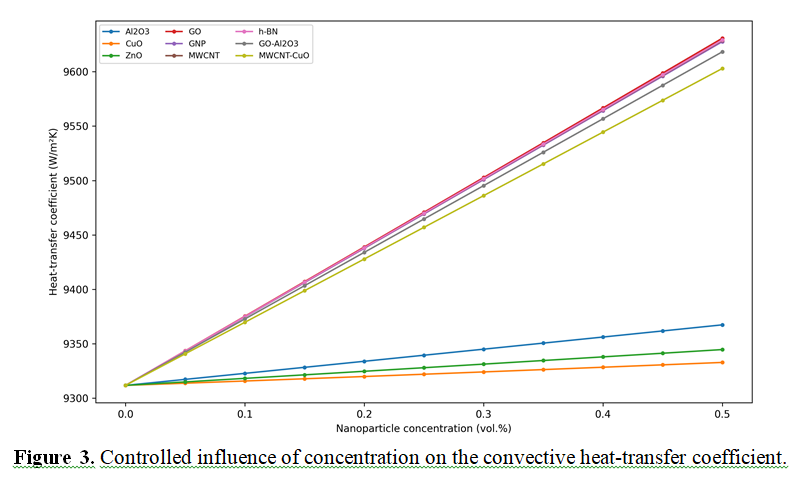
The aim of this study is to create a physics-informed numerical and multi-model, AI-based tool for predicting and optimizing thermal–hydraulic performance of a rectangular microchannel heat exchanger using various nanofluids. A total of 5,000 Latin-hypercube operating points were tested for water, eleven single nanoparticle suspensions and six hybrid nanofluids. The design space included the type of nanoparticles, the volume concentration (0–0.50%), the mixing ratio of the hybrid, the diameter of nanoparticles (20–100 nm), the width and height of the channel (0.20–0.80 mm), the length of channel (30–100 mm), the number of channels (10–50), the surface roughness, the wall material, the wall thickness, the arrangement of flow, the inlet temperature, and the mass flow rate of the hot and cold side. The effective thermophysical properties, dimensionless groups, heat transfer coefficients, effectiveness–NTU performance, pressure loss, pumping power, entropy generation, exergy destruction, and a performance evaluation criterion were determined. Ten target variables were used to compare between seven regression algorithms. For the heat-transfer coefficient, performance evaluation criterion, thermal resistance, effectiveness and heat-transfer rate, the R² values for Histogram Gradient Boosting were 0.961, 0.960, 0.957, 0.944 and 0.939, respectively. Extra Trees gave a good result for predicting the pressure drop (R² = 0.764), while an artificial neural network gave a good result in predicting the exergy destruction (R² = 0.918). The numerical database spanned heat-transfer coefficients ranging from 3.57 to 231.99 kW m−2 K−1, effectiveness of 0.106 to 0.965 and pressure drop of 23 Pa–5.96 MPa. Controlled comparisons at 0.50 vol.% showed that the carbon-based nanofluids had the maximum heat transfer coefficient, however there was a penalty in terms of viscosity and hydraulic losses for these nanofluids. To maximize the heat-transfer rate and maximizing the performance criterion and minimize the pressure drop and entropy generation, a four-objective Pareto analysis was performed and resulted in 347 non-dominated solutions. The outcomes show that the global thermal–hydraulic characteristics are mainly controlled by the exchanger geometry and flow rate, and the selection of the nanofluid offers a secondary useful refinement in the range of feasible operating conditions. The results are numerical and should be checked with experimental or high fidelity CFD models before the design is deployed.
References
[1] Aktas, F., Elibol, E. A., & Ulucak, O. (2026). Hybrid Experimental–AI Framework for Thermal Performance Optimization of ZnO–Water Nanofluids in Automotive Radiators. Arabian Journal for Science and Engineering, 51(14), 17259-17278. doi:10.1007/s13369-026-11210-4 DOI: https://doi.org/10.1007/s13369-026-11210-4
[2] Alisha, Aneja, M., & Goel, S. (2026). Recent progress in machine learning and deep learning models for heat transfer problems. Journal of Engineering and Applied Science, 73(1). doi:10.1186/s44147-026-00903-0 DOI: https://doi.org/10.1186/s44147-026-00903-0
[3] Alrasheed, M. R. A. (2023). Efficient Solutions for Electronic Chip Cooling: Multi-Objective Optimization Using Evolutionary Algorithms with Boron Nitride Nanotube-Based Nanofluid. Processes, 11(10). doi:10.3390/pr11103032 DOI: https://doi.org/10.3390/pr11103032
[4] Ayman-Mursaleen, M., Saeed, S. T., Almohammadi, S. M., Arif, K., & Imran, M. (2026). A deep neural network model for heat transfer in darcy-forchheimer hybrid nanofluid flow with activation energy. Sci Rep, 16(1). doi:10.1038/s41598-026-39536-x DOI: https://doi.org/10.1038/s41598-026-39536-x
[5] Bahrami, H. R., & Sharifi, A. E. (2024). Application of multilayered porous media for heat transfer optimization in double pipe heat exchangers using neural network and NSGA II. Sci Rep, 14(1), 31509. doi:10.1038/s41598-024-83176-y DOI: https://doi.org/10.1038/s41598-024-83176-y
[6] Ben Hamida, M. B., Basem, A., Varshney, N., & Mostafa, L. (2025). Intelligent design of high-performance fluids for thermal management: integrating response surface methodology, weighted Tchebycheff method, and strength Pareto evolutionary algorithm II. Sci Rep, 15(1), 21508. doi:10.1038/s41598-025-07132-0 DOI: https://doi.org/10.1038/s41598-025-07132-0
[7] Çolak, A. B., Açıkgöz, Ö., Mercan, H., Dalkılıç, A. S., & Wongwises, S. (2022). Prediction of heat transfer coefficient, pressure drop, and overall cost of double-pipe heat exchangers using the artificial neural network. Case Studies in Thermal Engineering, 39. doi:10.1016/j.csite.2022.102391 DOI: https://doi.org/10.1016/j.csite.2022.102391
[8] Dagdevir, T., Keklikcioglu, O., & Ozceyhan, V. (2025). Multi-objective optimization of operating parameters for dimpled twisted tape inserted heat exchanger tube flowing water/ethylene glycol mixture-based TiO2 nanofluid. Journal of Thermal Analysis and Calorimetry, 150(14), 11433-11450. doi:10.1007/s10973-025-14455-7 DOI: https://doi.org/10.1007/s10973-025-14455-7
[9] Debnath, S., Dey, K., & Kumar, R. (2026). Intelligent thermal management through nanofluids in porous media: a review of AI-driven design and optimization for high-performance systems. Journal of Thermal Engineering. doi:10.47481/jten.0011 DOI: https://doi.org/10.47481/jten.0011
[10] Faghiri, S., Poureslami, P., Partovi Aria, H., & Shafii, M. B. (2023). Multi-objective optimization of multiple droplet impacts on a molten PCM using NSGA-II optimizer and artificial neural network. Sci Rep, 13(1), 10543. doi:10.1038/s41598-023-37712-x DOI: https://doi.org/10.1038/s41598-023-37712-x
[11] Fan, Y., Wang, Z., Xiong, X., Panchal, S., Fraser, R., & Fowler, M. (2023). Multi-Objective Optimization Design and Experimental Investigation for a Prismatic Lithium-Ion Battery Integrated with a Multi-Stage Tesla Valve-Based Cold Plate. Processes, 11(6). doi:10.3390/pr11061618 DOI: https://doi.org/10.3390/pr11061618
[12] Gao, H., Ma, W., Ma, Y., & Wang, Y. (2026). Thermal Performance Analysis and Multi-Objective Optimization Design of Heat Sinks Gate Structures Based on Numerical Simulation and Genetic Algorithms. Processes, 14(4). doi:10.3390/pr14040635 DOI: https://doi.org/10.3390/pr14040635
[13] Godasiaei, S. H., Talebizadehsardari, P., & Keshmiri, A. (2025). ML-Driven optimization of two-phase microfluidic cooling using acoustofluidic bubble actuation and nanoarray-coated micropin structures. Sci Rep, 15(1), 40102. doi:10.1038/s41598-025-23871-6 DOI: https://doi.org/10.1038/s41598-025-23871-6
[14] Hai, T., Basem, A., Alizadeh, A., Sharma, K., Jasim, D. J., Rajab, H., . . . Sawaran Singh, N. S. (2024). Integrating artificial neural networks, multi-objective metaheuristic optimization, and multi-criteria decision-making for improving MXene-based ionanofluids applicable in PV/T solar systems. Sci Rep, 14(1), 29524. doi:10.1038/s41598-024-81044-3 DOI: https://doi.org/10.1038/s41598-024-81044-3
[15] Hai, T., Basem, A., Alizadeh, A., Singh, P. K., Rajab, H., Maatki, C., . . . Maleki, H. (2025). Optimizing ternary hybrid nanofluids using neural networks, gene expression programming, and multi-objective particle swarm optimization: a computational intelligence strategy. Sci Rep, 15(1), 1986. doi:10.1038/s41598-025-85236-3 DOI: https://doi.org/10.1038/s41598-025-85236-3
[16] Hasoon, F. N., Hussain, A.-S. T., Abed, T. H., Gökşenli, N., Karamallah, A. A., Bektaş, E., & Almulaisi, T. (2026). AI-Driven Thermal-Hydraulic Optimization of a Serpentine Water–Air Heat Exchanger Using Computational Fluid Dynamics Analysis. International Journal of Heat and Technology, 44(3), 1017-1033. doi:10.18280/ijht.440311 DOI: https://doi.org/10.18280/ijht.440311
[17] Huang, L., Zou, J., Liu, B., Jin, Z., & Qian, J. (2023). Machine Learning Assisted Microchannel Geometric Optimization—A Case Study of Channel Designs. Energies, 17(1). doi:10.3390/en17010044 DOI: https://doi.org/10.3390/en17010044
[18] Ishaque, S., Ullah, N., Choi, S., & Kim, M.-H. (2025). Evaluating the Thermohydraulic Performance of Microchannel Gas Coolers: A Machine Learning Approach. Energies, 18(12). doi:10.3390/en18123007 DOI: https://doi.org/10.3390/en18123007
[19] Ito, K. R., Sato, T., Osawa, C., Watanabe, J., Hamaguchi, H., Matsuzaki, T., . . . Yokoo, M. (2025). Erratum: Sake Lees: A Potential Feed Ingredient to Enhance Intestinal Barrier Function in Indigenous Meat-type Chickens. J Poult Sci, 62, 2025032. doi:10.2141/jpsa.2025032 DOI: https://doi.org/10.2141/jpsa.2025023
[20] Javadpour, S. M., Dehghani, M., Naserian, M. M., Goharimanesh, M., & Adedeji, P. (2025). Multiobjective Optimization of Photovoltaic–Thermal Collectors Using Nanofluids: Integrating Taguchi Method and Genetic Algorithm. International Journal of Energy Research, 2025(1). doi:10.1155/er/9967015 DOI: https://doi.org/10.1155/er/9967015
[21] Kadirgama, G., Ramasamy, D., Kadirgama, K., Samylingam, L., Aslfattahi, N., Chalak Qazani, M. R., . . . Schmirler, M. (2025). Characterization and machine learning analysis of hybrid alumina-copper oxide nanoparticles in therminol 55 for medium temperature heat transfer fluid. Sci Rep, 15(1), 8383. doi:10.1038/s41598-025-92461-3 DOI: https://doi.org/10.1038/s41598-025-92461-3
[22] Kanti, P. K., Wanatasanappan, V. V., Said, N. M., Saini, S., Mishra, V., Paramasivam, P., & Yusuf, M. (2025). Thermal performance, entropy generation, and machine learning insights of Al(2)O(3)-TiO(2) hybrid nanofluids in turbulent flow. Sci Rep, 15(1), 16035. doi:10.1038/s41598-025-93749-0 DOI: https://doi.org/10.1038/s41598-025-93749-0
[23] Liu, B., Qian, J., Jin, Z., Huang, L., & Zou, J. (2024). Air-Side Heat Transfer Performance Prediction for Microchannel Heat Exchangers Using Data-Driven Models with Dimensionless Numbers. Frontiers in Heat and Mass Transfer, 22(6), 1613-1643. doi:10.32604/fhmt.2024.058231 DOI: https://doi.org/10.32604/fhmt.2024.058231
[24] Liu, C., Xing, S., Wang, W., & Hu, D. (2025). Performance analysis and parameter optimization of microchannel heat sink with porous-solid composite ribs. Case Studies in Thermal Engineering, 73. doi:10.1016/j.csite.2025.106714 DOI: https://doi.org/10.1016/j.csite.2025.106714
[25] Nandakishora, Y., Khayum, N., Patra, C., Kumar, P., Sharma, A., & Ansu, A. K. (2026). AI driven approaches in battery thermal management systems for prediction and multi objective optimization: a comprehensive literature review. Discover Mechanical Engineering, 5(1). doi:10.1007/s44245-026-00231-w DOI: https://doi.org/10.1007/s44245-026-00231-w
[26] Nekahi, S., Sadegh Moghanlou, F., Vaferi, K., Ghaebi, H., Vajdi, M., & Nami, H. (2024). Optimizing finned-microchannel heat sink design for enhanced overall performance by three different approaches: Numerical simulation, artificial neural network, and multi-objective optimization. Applied Thermal Engineering, 245. doi:10.1016/j.applthermaleng.2024.122835 DOI: https://doi.org/10.1016/j.applthermaleng.2024.122835
[27] Qazani, M. R. C., Kadirgama, G., Aslfattahi, N., Ramasamy, D., Samylingam, L., Kadirgama, K., . . . Ghazali, M. F. (2025). Sustainable Viscosity Prediction of Hybrid Alumina- Copper Oxide Nanofluid for Green Heat Transfer Applications Using Adaptive Neuro-Fuzzy Inference System (ANFIS). The Nexus of Sustainability and Energy Technology Journal, 1(1), 40-55. doi:10.63100/3080-1915.1004 DOI: https://doi.org/10.63100/3080-1915.1004
[28] R, T., Ganjigatt, J. P., M B, N. A., K R, R., Kumar, L. J., M S, S., . . . Prabhu, S. R. (2026). Evolutionary-based multi-objective optimization of multi-stream plate-fin heat exchangers. Applications in Engineering Science, 27. doi:10.1016/j.apples.2026.100337 DOI: https://doi.org/10.1016/j.apples.2026.100337
[29] Rajski, K., Żukowski, M., Żabnieńska-Góra, A., & Jouhara, H. (2026). A comprehensive review of machine learning applications in liquid-based cooling solutions of PV/T systems. Thermal Science and Engineering Progress, 72. doi:10.1016/j.tsep.2026.104628 DOI: https://doi.org/10.1016/j.tsep.2026.104628
[30] Sharma, R., Mishra, D. P., Wasilewski, M., & Brar, L. S. (2023). Application of Response Surface Methodology and Artificial Neural Network to Optimize the Curved Trapezoidal Winglet Geometry for Enhancing the Performance of a Fin-and-Tube Heat Exchanger. Energies, 16(10). doi:10.3390/en16104209 DOI: https://doi.org/10.3390/en16104209
[31] Singh, N. S. S., Hassan, W. H., Kareem, J. H., Dayoub, M. S., Taner, M., Salahshour, S., & Vahedi, K. (2026). Viscosity and thermal conductivity optimization of ZnO-MWCNT/water hybrid nanofluid: A combined SVR-PSO modeling and NSGA-II approach for heat-transfer applications. Results in Engineering, 32. doi:10.1016/j.rineng.2026.111917 DOI: https://doi.org/10.1016/j.rineng.2026.111917
[32] Siricharoenpanich, A., Puangbaidee, S., Vengsungnle, P., Juntarakod, P., Panya, S., Eiamsa-ard, S., & Naphon, P. (2026). Artificial Neural Network and Non-Dominated Sorting Genetic Algorithm II for the Multi-Objective Optimization of the Graphics Processing Unit Thermal Cooling. Eng, 7(6). doi:10.3390/eng7060254 DOI: https://doi.org/10.3390/eng7060254
[33] Sun, P., Ismail, M. A., & Mustaffa, A. F. (2025). Metamodel-based design optimization for heat transfer enhancement of finned heat sinks. International Journal of Thermal Sciences, 214. doi:10.1016/j.ijthermalsci.2025.109896 DOI: https://doi.org/10.1016/j.ijthermalsci.2025.109896
[34] Vaferi, K., Vajdi, M., Nekahi, S., Heydari, A., Sadegh Moghanlou, F., Nami, H., & Jafarzadeh, H. (2023). Thermo-hydraulic performance optimization of a disk-shaped microchannel heat sink applying computational fluid dynamics, artificial neural network, and response surface methodology. Heliyon, 9(10), e21031. doi:10.1016/j.heliyon.2023.e21031 DOI: https://doi.org/10.1016/j.heliyon.2023.e21031
[35] Xue, Z., Yan, Y., He, Z., Shen, K., Zhang, C., You, J., & Ramos-Alvarado, B. (2024). Multi-objective optimization of a porous diverter plate for a liquid-cooled micro-jet heat sink via surrogate modeling. Case Studies in Thermal Engineering, 56. doi:10.1016/j.csite.2024.104264 DOI: https://doi.org/10.1016/j.csite.2024.104264
[36] Yatim, H. M., Mohd-Ghazali, N., Mohamad, M., Pamitran, A. S., & Novianto, S. (2023). Two-phase heat transfer microchannel system identification with Particle Swarm Optimization (PSO) approach. International Journal of Air-Conditioning and Refrigeration, 31(1). doi:10.1007/s44189-023-00029-5 DOI: https://doi.org/10.1007/s44189-023-00029-5
[37] Yildirim, O., & Karagöz, Ş. (2026). Thermodynamic analysis and hybrid surrogate-assisted multi-criteria optimization of heat transfer in mini-pipes. Journal of Thermal Analysis and Calorimetry. doi:10.1007/s10973-026-15820-w DOI: https://doi.org/10.1007/s10973-026-15820-w
[38] Zhang, C., Chen, L., & Tong, Z. (2022). Multi-objective optimization of heat sink with multi-cross-ribbed-fins for a motor controller. Journal of Engineering and Applied Science, 69(1). doi:10.1186/s44147-022-00085-5 DOI: https://doi.org/10.1186/s44147-022-00085-5
[39] Zhang, Y., Zhuang, Y., Cui, P., Liu, W., & Liu, Z. (2026). Structural optimization of multi-heat-source cold plates using neural network and genetic algorithm. Case Studies in Thermal Engineering, 80. doi:10.1016/j.csite.2026.107851 DOI: https://doi.org/10.1016/j.csite.2026.107851
Downloads
Published
Issue
Section
License
Copyright (c) 2026 Al-Noor Journal of Engineering Management and Computer Science

This work is licensed under a Creative Commons Attribution-NonCommercial-ShareAlike 4.0 International License.
How to Cite