Neuro-Symbolic Generative AI for Explainable Personalized Tutoring
DOI:
https://doi.org/10.71229/6vt12p50Keywords:
Neuro-Symbolic AI, Generative AI, Explainable AI, Personalized LearningAbstract
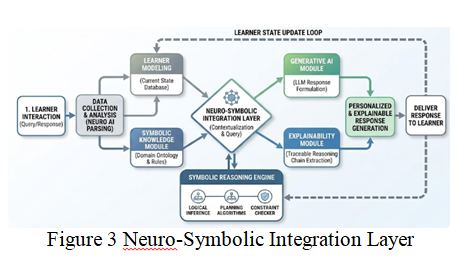
The use of Generative Artificial Intelligence (AI) is showing great promise in the field of education by providing personalized and interactive tutoring. Yet, there are some issues with current Generative AI tutors, including hallucination, lack of transparency, lack of consistency in reasoning, and lack of personalization. These constraints can diminish the trust of learners and impact the accuracy of AI-driven educational decision-making. The study suggests a neuro-symbolic Generative AI framework for explainable personalized tutoring, which integrates adaptable language generation with neural models and knowledge representation and logical reasoning with symbolic AI. The proposed framework includes a Learner Model, Domain Knowledge Base, Symbolic Reasoning Engine, Generative AI module, and Explainability component. Personalized instructional content, feedback and recommendations are generated based on learner performance, gaps in learning, learning history, and prerequisites of topics. The symbolic reasoning component provides support for tutoring decisions by checking the decisions against predefined educational rules and domain knowledge, and the explainability component provides communication about the reasons for recommendations and responses. This study will use Design Science Research methodology to create and test the proposed framework. The effectiveness will be measured in terms of accuracy, personalization, explainability, learner satisfaction, and learning performance. The research will produce a reliable, transparent, and agile personalized learning solution powered by AI
References
[1] García-Peñalvo, F. J., Llorens-Largo, F., & Vidal, J. (2024). The new reality of education in the face of advances in generative artificial intelligence. RIED-Revista Iberoamericana de Educación a Distancia, 27(1). DOI: https://doi.org/10.5944/ried.27.1.37716
[2] Lin, C. C., Huang, A. Y., & Lu, O. H. (2023). Artificial intelligence in intelligent tutoring systems toward sustainable education: a systematic review. Smart learning environments, 10(1), 41. DOI: https://doi.org/10.1186/s40561-023-00260-y
[3] Konradt, L. (2025). Limitations Support Learning: A Design Based Study of Ethically Scaffolded Generative AI Tools for Long Form Argumentation and Metacognition. University of Central Florida.
[4] Maity, S., & Deroy, A. (2024). Generative AI and its impact on personalized intelligent tutoring systems. arXiv preprint arXiv:2410.10650. DOI: https://doi.org/10.36227/techrxiv.172954174.48041095/v1
[5] Kaput, J. J. (2026). 14 Towards a Theory of Symbol Use in Mathematics. Problems of representation in the teaching and learning of mathematics. DOI: https://doi.org/10.4324/9781042000227-17
[6] Akinwumi, P. O., Qian, M., Babatope, O. A., & Asimole, I. (2026). Adaptive Neuro-Symbolic Learning Companions for Explainable Cognitive Scaffolding in Educational AI.
[7] Hasan, M. S., & Jabe, M. M. N. (2026). Neuro-Symbolic AI in Education: A Systematic Literature Review of Architectures, Pedagogical Integration, and Trustworthy Intelligent Learning Systems. DOI: https://doi.org/10.2139/ssrn.7277898
[8] Bougzime, O., Jabbar, S., Cruz, C., & Demoly, F. (2025). Neuro-Symbolic Architectures: Formalizing, Extending, Evaluating, and Empowering Generative AI. Neurosymbolic Artificial Intelligence. DOI: https://doi.org/10.1177/29498732261469485
[9] Naser, M. Z. (2026). A review of machine learning with small and limited data. Journal of Big Data, 13(1), 18. DOI: https://doi.org/10.1186/s40537-025-01346-9
[10] Shivadekar, S. (2025). Artificial Intelligence for Cognitive Systems: Deep Learning, Neuro-symbolic Integration, and Human-Centric Intelligence. Deep Science Publishing. DOI: https://doi.org/10.2139/ssrn.5344224
[11] Liang, B., Wang, Y., & Tong, C. (2025). AI reasoning in deep learning era: From symbolic AI to neural–symbolic AI. Mathematics, 13(11), 1707. DOI: https://doi.org/10.3390/math13111707
[12] Akinwumi, P. O., Qian, M., Babatope, O. A., & Asimole, I. (2026). Adaptive Neuro-Symbolic Learning Companions for Explainable Cognitive Scaffolding in Educational AI. DOI: https://doi.org/10.21203/rs.3.rs-9932715/v1
[13] Ivanova, T., & Terzieva, V. (2026). Large Language Models in Intelligent Education Systems: New Educational Perspectives—A Systematic Review. Information, 17(5), 433. DOI: https://doi.org/10.3390/info17050433
[14] Kumar, R., & Fikri, Y. (2027). Explainable Generative AI for Sustainable Human Capital Management: Enhancing Workforce Transparency, Trust, and ESG-Driven Decision Making. Managing Human Capital at the Intersection of Generative AI and Digital Sustainability, 385-418. DOI: https://doi.org/10.4018/979-8-3373-9345-2.ch014
[15] Yel, M. B. (2025). A machine learning approach to identify training needs and skill gaps in human resource development. The Journal of Academic Science, 2(4), 1126-1136.
[16] Chen, Z. (2024). Responsible AI in organizational training: Applications, implications, and recommendations for future development. Human Resource Development Review, 23(4), 498-521. DOI: https://doi.org/10.1177/15344843241273316
[17] Maleki, F., Ovens, K., Gupta, R., Reinhold, C., Spatz, A., & Forghani, R. (2022). Generalizability of machine learning models: quantitative evaluation of three methodological pitfalls. Radiology: Artificial Intelligence, 5(1), e220028. DOI: https://doi.org/10.1148/ryai.220028
Downloads
Published
Issue
Section
License
Copyright (c) 2026 Al-Noor Journal of Engineering Management and Computer Science

This work is licensed under a Creative Commons Attribution-NonCommercial-ShareAlike 4.0 International License.
How to Cite