Achieving Secure Smart Conversations: The Power of Five Protective Layers
DOI:
https://doi.org/10.71229/x07sts43Keywords:
Academic Chatbot, , Artificial Intelligence (AI), , Blockchain Technology, , Data Security, , Digital Assistant, , Educational Guidance, , Intellectual Property Protection,Abstract
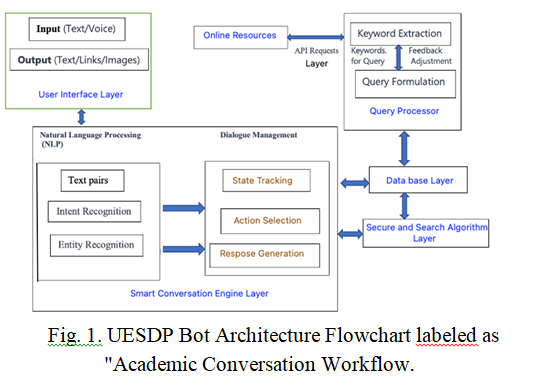
Academia is a dynamic environment characterized by the continuous pursuit of knowledge, research, and education. To meet the ever-expanding needs of researchers, students, and academics, the rapid growth of information and diverse academic demands necessitate an easily accessible and efficient route for navigating the academic landscape. In recognition of these challenges, this study proposes UESDP Bot, a novel five-layer intelligent dialogue system dedicated to supporting scholarly research. UESDP Bot leverages Natural Language Processing (NLP) to provide learning support, aiming to reduce the time students spend on administrative or information-seeking tasks, thereby freeing up more time for core academic activities. This research distinguishes itself from existing dialogue systems by integrating blockchain technology to ensure secure communication, maintain data integrity, and preserve the confidentiality of sensitive academic information.
References
1. Borgman, C.L.: Big data, little data, no data: Scholarship in the networked world. MIT Press (2017).
2. Matthews, C.: An introduction to natural language processing through Prolog. Routledge (2016). DOI: https://doi.org/10.4324/9781315845593
3. Fryer, L.K., Ainley, V., Thompson, A., Jordan, J., Joyce, W.: Developing an intelligent digital assistant for formative assessment. Computers & Education 108, 216–231 (2017).
4. Mohebi, L.: Empowering learners with ChatGPT: Insights from a systematic literature exploration. Discover Education 3(1), 36 (2024). DOI: https://doi.org/10.1007/s44217-024-00120-y
5. Zhang, Y., Chen, J.: Fusion of blockchain and AI: Applications and challenges. IEEE Access 8, 10493–10505 (2020).
6. Gunnam, G.R., Ravali, Y., Reddy, R.N., Sai, C.P., Sai, V.S.: Assessing Performance of Cloud-Based Heterogeneous Chatbot Systems and A Case Study. IEEE Access (2024). DOI: https://doi.org/10.1109/ACCESS.2024.3397053
7. Hussain, S.: Artificial Intelligence in Education. In: Global Medical Education in Normal and Challenging Times. Springer Nature Switzerland, pp. 247–258 (2024). DOI: https://doi.org/10.1007/978-3-031-51244-5_27
8. Salvador-Oliván, J.A., Serrano-Vicente, R.: Large language models in scientific information retrieval and knowledge discovery: A systematic review. Journal of Information Science 50(3), 367–387 (2024).
9. Farrokhnia, F., Paas, F., Van Merriënboer, J.J.G., de Bruin, A.B.H.: The impact of generative AI on learning, teaching, and assessment in higher education: A mid-cycle review. Educational Psychology Review (2024).
10. Hwang, G.J., Xie, H., Zeng, Q., Abelson, A.: Artificial intelligence in education 4.0: Visions and challenges. Computers and Education: Artificial Intelligence 5, 100163 (2024).
11. Bossaller, J., Wilding, V.: Chatbots in academic libraries. Library Hi Tech 35(1), 13–29 (2017). DOI: https://doi.org/10.1108/LHTN-04-2018-0026
12. Khan, M.A., Uddin, M.N., Gupta, M.K.: Artificial intelligence in libraries: A review. Library Philosophy and Practice (e-journal), 5570 (2021).
13. Turkanović, M., Stojanović, Z., Košič, F., Heričko, M.: EduCTX: A blockchain-based higher education ecosystem. IEEE Access 6, 51129–51140 (2018). DOI: https://doi.org/10.1109/ACCESS.2018.2789929
14. Sharples, M., Domingue, J.: The blockchain and learning: The future of education. European Journal of Open, Distance and E-Learning 19(3), 69–80 (2016).
15. Bird, S.: Natural language processing in education. In: Oxford Research Encyclopedia of Education (2020).
16. Bender, E.M.: The #BabelNoMore manifesto: Why data diversity matters for natural language processing. arXiv preprint arXiv:2003.03500 (2020).
Downloads
Published
Issue
Section
License
Copyright (c) 2026 Al-Noor Journal of Engineering Management and Computer Science

This work is licensed under a Creative Commons Attribution-NonCommercial-ShareAlike 4.0 International License.
How to Cite