Constrained Optimization and Multi temperature Rheological Performance of SBS-Modified Asphalt Binders Incorporating Nano-SiO₂ and Nano-CaCO3
DOI:
https://doi.org/10.71229/kaj69r66Keywords:
Asphalt binder;, Styrene-butadiene-styrene; , Nano-silica; , Nano-calciumcarbonate;, Performance grade;, RheologyAbstract
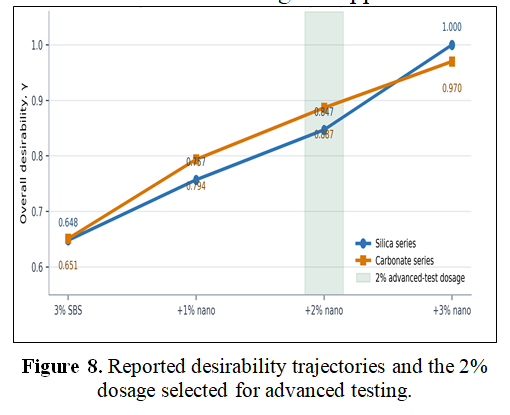
Hybrid modification provides a potential route for improving the high-temperature performance of asphalt binders while retaining acceptable processing characteristics. This study comparatively evaluated a 40/50 penetration-grade binder from the Al-Doura Refinery, Iraq, modified with styrene-butadiene-styrene (SBS) and either nano-silicon dioxide (nano-SiO₂) or nano-calcium carbonate (nano-CaCO₃). SBS contents of 3% and 4% were initially screened, after which nano-additive contents of 1-3% by binder mass were incorporated into the selected 3% SBS system. Penetration, softening point, and penetration index were used for preliminary screening, whereas rotational viscosity (RV), dynamic shear rheometry (DSR), and bending beam rheometry (BBR) were applied to the selected formulations. A constrained selection procedure identified 3% SBS + 2% nano-additive as the most practical formulation for advanced testing. Relative to the neat binder (44 mm, 53 °C, PI = -0.774), the optimized nano-SiO₂ and nano-CaCO₃ binders exhibited penetration values of 32 mm, softening points of 69 and 70 °C, and PI values of 1.588 and 1.749, respectively. Their viscosities at 135 °C were 2.35 and 2.97 Pa·s, remaining below the 3.0 Pa·s specification limit, although the carbonate system had little remaining workability margin. The ternary binders satisfied the unaged and RTFO-aged DSR criteria at 82 °C, corresponding to a high-temperature grade of PG 82, whereas the neat binder graded at PG 64. BBR results supported a low-temperature grade of -10 °C for the modified binders, compared with -16 °C for the neat binder. Accordingly, the principal benefit of the ternary systems was a substantial increase in high-temperature rutting resistance, accompanied by a narrower low-temperature grading range and increased viscosity. Mixture-scale validation and replicate-based statistical analysis are required before field implementation.
References
[1] Abed, A. H., & Oudah, A. M. (2018). Rheological properties of modified asphalt binder with nanosilica and SBS. IOP Conference Series: Materials Science and Engineering, 433, 012031. https://doi.org/10.1088/1757-899X/433/1/012031
[2] Afshin, A., & Behnood, A. (2025). Nanomaterials in asphalt pavements: A state-of-the-art review. Cleaner Waste Systems, 10, 100214. https://doi.org/10.1016/j.clws.2025.100214
[3] Airey, G. D. (2003). Rheological properties of styrene–butadiene–styrene polymer-modified road bitumens. Fuel, 82(14), 1709–1719. https://doi.org/10.1016/S0016-2361(03)00146-7
[4] Albayati, A. H., Latief, R. H., Al-Mosawe, H., & Wang, Y. (2024). Nano-additives in asphalt binder: Bridging the gap between traditional materials and modern requirements. Applied Sciences, 14(10), 3998. https://doi.org/10.3390/app14103998
[5] Al-Sabaeei, A. M., Alhussian, H., Abdulkadir, S. J., Giustozzi, F., Napiah, M., Jagadeesh, A., Sutanto, M., & Memon, A. M. (2023). Utilization of response surface methodology and machine learning for predicting and optimizing mixing and compaction temperatures of bio-modified asphalt. Case Studies in Construction Materials, 18, e02073. https://doi.org/10.1016/j.cscm.2023.e02073
[6] American Association of State Highway and Transportation Officials (AASHTO). (2023). M 320-23: Standard specification for performance-graded asphalt binder. Washington, DC: AASHTO.
[7] American Association of State Highway and Transportation Officials (AASHTO). (2022). R 28-22: Standard practice for accelerated aging of asphalt binder using a pressurized aging vessel (PAV). Washington, DC: AASHTO.
[8] American Association of State Highway and Transportation Officials (AASHTO). (2022). T 49-22: Standard method of test for penetration of bituminous materials. Washington, DC: AASHTO.
[9] American Association of State Highway and Transportation Officials (AASHTO). (2022). T 51-22: Standard method of test for ductility of asphalt materials. Washington, DC: AASHTO.
[10] American Association of State Highway and Transportation Officials (AASHTO). (2023). T 179M/T 179-23: Standard method of test for the effect of heat and air on asphalt materials using the thin-film oven test. Washington, DC: AASHTO.
[11] American Association of State Highway and Transportation Officials (AASHTO). (2023). T 240-23: Standard method of test for the effect of heat and air on a moving film of asphalt binder using the rolling thin-film oven test. Washington, DC: AASHTO.
[12] American Association of State Highway and Transportation Officials (AASHTO). (2025). T 313-25: Standard method of test for determining the flexural creep stiffness of asphalt binder using the bending beam rheometer (BBR). Washington, DC: AASHTO.
[13] American Association of State Highway and Transportation Officials (AASHTO). (2024). T 315-24: Standard method of test for determining the rheological properties of asphalt binder using a dynamic shear rheometer (DSR). Washington, DC: AASHTO.
[14] American Association of State Highway and Transportation Officials (AASHTO). (2022). T 316-22: Standard method of test for viscosity determination of asphalt binder using a rotational viscometer. Washington, DC: AASHTO.
[15] Arshad, A. K., Shaffie, E., Hashim, W., Ismail, F., & Masri, K. A. (2019). Evaluation of nanosilica-modified stone mastic asphalt. International Journal of Civil Engineering and Technology, 10(2), 1508–1516.
[16] Ashish, P. K., & Singh, D. (2021). Use of nanomaterial for asphalt binder and mixtures: A comprehensive review on development, prospect, and challenges. Road Materials and Pavement Design, 22(3), 492–538. https://doi.org/10.1080/14680629.2019.1634634
[17] ASTM International. (2020). ASTM D36/D36M-14(2020): Standard test method for softening point of bitumen using the ring-and-ball apparatus. West Conshohocken, PA: ASTM International. https://doi.org/10.1520/D0036_D0036M-14R20
[18] ASTM International. (2020). ASTM D5/D5M-20: Standard test method for penetration of bituminous materials. West Conshohocken, PA: ASTM International. https://doi.org/10.1520/D0005_D0005M-20
[19] ASTM International. (2021). ASTM D70/D70M-21: Standard test method for specific gravity and density of semi-solid asphalt binder using the pycnometer method. West Conshohocken, PA: ASTM International. https://doi.org/10.1520/D0070_D0070M-21
[20] ASTM International. (2023). ASTM D113/D113M-17(2023)e1: Standard test method for ductility of asphalt materials. West Conshohocken, PA: ASTM International. https://doi.org/10.1520/D0113_D0113M-17R23E01
[21] ASTM International. (2023). ASTM D4402/D4402M-23: Standard test method for viscosity determination of asphalt at elevated temperatures using a rotational viscometer. West Conshohocken, PA: ASTM International. https://doi.org/10.1520/D4402_D4402M-23
[22] Bala, N., Kamaruddin, I., Napiah, M., & Sutanto, M. H. (2019). Polymer nanocomposite-modified asphalt: Characterisation and optimisation using response surface methodology. Arabian Journal for Science and Engineering, 44, 4233–4243. https://doi.org/10.1007/s13369-018-3377-x
[23] Behnood, A., & Modiri Gharehveran, M. (2019). Morphology, rheology, and physical properties of polymer-modified asphalt binders. European Polymer Journal, 112, 766–791. https://doi.org/10.1016/j.eurpolymj.2018.10.049
[24] Behnood, A., & Olek, J. (2017). Rheological properties of asphalt binders modified with styrene–butadiene–styrene, ground tire rubber, or polyphosphoric acid. Construction and Building Materials, 151, 464–478. https://doi.org/10.1016/j.conbuildmat.2017.06.115
[25] Dai, Y., Liang, W., Ye, D., Xie, S., Sang, Y., & Li, D. (2023). Modification effects of nanosilica on asphalt binders: A review. Nanotechnology Reviews, 12(1), 20230138. https://doi.org/10.1515/ntrev-2023-0138
[26] Derringer, G., & Suich, R. (1980). Simultaneous optimization of several response variables. Journal of Quality Technology, 12(4), 214–219. https://doi.org/10.1080/00224065.1980.11980968
[27] He, Q., Li, Z., Huang, J., Chen, J., Zhao, L., Xing, C., Cui, T., & Zou, J. (2025). Synergistic effects of high-modulus additives on SBS-modified asphalt: Microstructural, rheological enhancement, and dosage-dependent performance optimization. Materials, 18(20), 4724. https://doi.org/10.3390/ma18204724
[28] Li, R., Xiao, F., Amirkhanian, S., You, Z., & Huang, J. (2017). Developments of nanomaterials and technologies in asphalt materials: A review. Construction and Building Materials, 143, 633–648. https://doi.org/10.1016/j.conbuildmat.2017.03.158
[29] Lin, P., Huang, W., Li, Y., & Xiao, F. (2017). Investigation of influence factors on low-temperature properties of SBS-modified asphalt. Construction and Building Materials, 154, 609–622. https://doi.org/10.1016/j.conbuildmat.2017.06.118
[30] Lu, X., & Isacsson, U. (1997). Rheological characterization of styrene–butadiene–styrene copolymer-modified bitumens. Construction and Building Materials, 11(1), 23–32. https://doi.org/10.1016/S0950-0618(96)00033-5
[31] Madhat, A. M., & Talabani, A. F. (2026). Effect of incorporating nano-sized mineral fillers on hot mix asphalt performance. Iraqi Journal of Civil Engineering, 20(1), 77–90. https://doi.org/10.37650/ijce200106
[32] Malluru, S., Islam, S. M. I., Saidi, A., Baditha, A. K., Chiu, G., & Mehta, Y. (2025). A state-of-the-practice review on the challenges of asphalt binder and a roadmap towards sustainable alternatives: A call to action. Materials, 18(10), 2312. https://doi.org/10.3390/ma18102312
[33] Manfro, A. L., de Melo, J. V. S., Del Carpio, J. A. V., & Broering, W. B. (2022). Permanent deformation performance under moisture effect of an asphalt mixture modified by calcium carbonate nanoparticles. Construction and Building Materials, 342, 128087. https://doi.org/10.1016/j.conbuildmat.2022.128087
[34] Mohammed, A. M., & Abed, A. H. (2023). Enhancing asphalt binder performance through nano-SiO₂ and nano-CaCO₃ additives: Rheological and physical insights. Case Studies in Construction Materials, 19, e02492. https://doi.org/10.1016/j.cscm.2023.e02492
[35] Mohammed, A. M., & Abed, A. H. (2024). Rutting and fatigue behavior of neat and nanomodified asphalt mixture with SiO₂ and TiO₂. Alexandria Engineering Journal, 109, 994–1009. https://doi.org/10.1016/j.aej.2024.09.083
[36] Polacco, G., Filippi, S., Merusi, F., & Stastna, G. (2015). A review of the fundamentals of polymer-modified asphalts: Asphalt/polymer interactions and principles of compatibility. Advances in Colloid and Interface Science, 224, 72–112. https://doi.org/10.1016/j.cis.2015.07.010
[37] Shafabakhsh, G., Rajabi, M., & Sahaf, A. (2019). The fatigue behavior of SBS/nanosilica composite-modified asphalt binder and mixture. Construction and Building Materials, 229, 116796. https://doi.org/10.1016/j.conbuildmat.2019.116796
[38] Shan, L., Qi, X., Duan, X., Liu, S., & Chen, J. (2020). Effect of styrene–butadiene–styrene on the rheological behavior of asphalt binders. Construction and Building Materials, 231, 117076. https://doi.org/10.1016/j.conbuildmat.2019.117076
[39] Shen, C., Li, R., Pei, J., & Li, Y. (2020). Preparation and the effect of surface-functionalized calcium carbonate nanoparticles on asphalt binder. Applied Sciences, 10(1), 91. https://doi.org/10.3390/app10010091
[40] State Corporation for Roads and Bridges (SCRB). (2003). General specifications for roads and bridges, Section R/9: Hot-mix asphalt concrete pavement (Revised ed.). Baghdad, Iraq: Ministry of Housing and Construction, Republic of Iraq.
[41] Sun, L., Zhong, W., Xiao, Z., & Qi, H. (2024). Physical, rheological and microscopic properties of AAT nanomaterial/crumb-rubber-powder composite-modified asphalt and SBS-modified asphalt. PLOS ONE, 19(1), e0284813. https://doi.org/10.1371/journal.pone.0284813
[42] Sun, P., Zhang, K., Xiao, Y., & Liang, Z. (2022). Analysis of pavement performance for nano-CaCO₃/SBS-modified asphalt mixture. Journal of Physics: Conference Series, 2329, 012031. https://doi.org/10.1088/1742-6596/2329/1/012031
[43] Sun, Y., & He, D. (2021). High- and low-temperature performance evaluation and microanalysis of SMC/SBS compound-modified asphalt. Materials, 14(4), 771. https://doi.org/10.3390/ma14040771
[44] Tavandashti, A. P., & Babaki, M. M. (2024). Rheological behaviour and rutting resistance of asphalt modified with SBS and nano-silica. Journal of Smart Science and Technology, 4(2), 1–15. https://doi.org/10.24191/jsst.v4i2.85
[45] Wang, P., Li, W., & Sun, J. (2022). Preparation and properties of nano-calcium-carbonate/styrene–butadiene–styrene block-copolymer composite-modified asphalt. China Synthetic Rubber Industry, 45(4), 320–325. https://doi.org/10.19908/j.cnki.issn1000-1255.2022.04.0320
[46] Yang, Q., Lin, J., Wang, X., Wang, D., Xie, N., & Shi, X. (2024). A review of polymer-modified asphalt binder: Modification mechanisms and mechanical properties. Cleaner Materials, 12, 100255. https://doi.org/10.1016/j.clema.2024.100255
[47] Yao, H., You, Z., Li, L., Lee, C. H., Wingard, D., Yap, Y. K., Shi, X., & Goh, S. W. (2013). Rheological properties and chemical bonding of asphalt modified with nanosilica. Journal of Materials in Civil Engineering, 25(11), 1619–1630. https://doi.org/10.1061/(ASCE)MT.1943-5533.0000690
[48] Yıldırım, Y. (2007). Polymer-modified asphalt binders. Construction and Building Materials, 21(1), 66–72. https://doi.org/10.1016/j.conbuildmat.2005.07.007
[49] Yin, P., Pan, B., Dong, T., Liu, T., & Sun, S. (2026). Rheological properties and microscopic mechanism of nano-SiO₂/SBS composite-modified asphalt. Polymers, 18(16), 1990. https://doi.org/10.3390/polym18161990
[50] Zhang, D., Chen, Z., Zhang, H., & Wei, C. (2018). Rheological and anti-aging performance of SBS-modified asphalt binders with different multidimensional nanomaterials. Construction and Building Materials, 188, 409–416. https://doi.org/10.1016/j.conbuildmat.2018.08.136
[51] Zhang, L., Gao, X., Wang, W., Wang, H., & Zheng, K. (2021). Laboratory evaluation of rheological properties of asphalt binder modified by nano-TiO₂/CaCO₃. Advances in Materials Science and Engineering, 2021, 5522025. https://doi.org/10.1155/2021/5522025
Downloads
Published
Issue
Section
License
Copyright (c) 2026 Al-Noor Journal of Engineering Management and Computer Science

This work is licensed under a Creative Commons Attribution-NonCommercial-ShareAlike 4.0 International License.
How to Cite