Two-Stage Global Maximum Power Point Tracking of Photovoltaic Systems with Peak-Region Scanning and Super-Twisting Sliding-Mode Control under Partial Shading
DOI:
https://doi.org/10.71229/v36v6j85Keywords:
Boost converter, , Chattering reduction, , Finite-time convergence, , Golden-section search, , Lyapunov stabilityAbstract
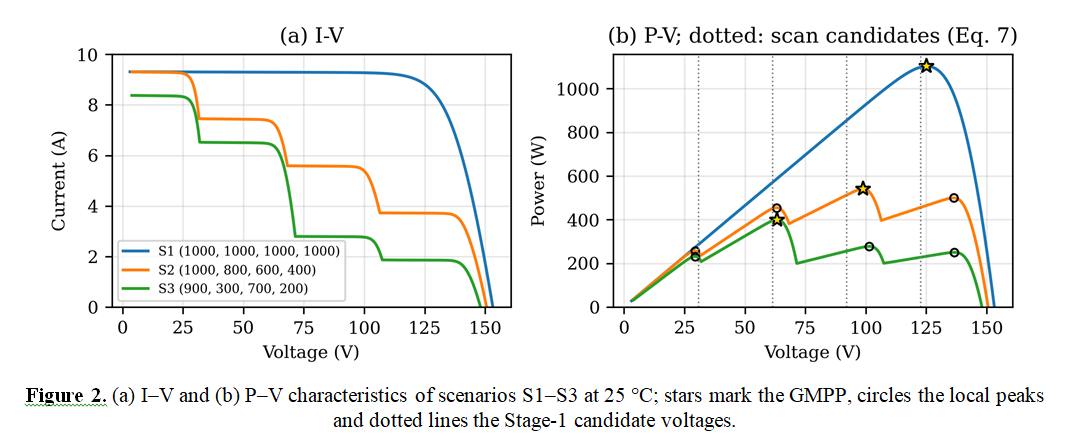
Under partial shading, a photovoltaic string exhibits several local power maxima, and a tracker must both locate the global maximum and regulate the array voltage to it despite converter nonlinearity, parameter uncertainty and measurement noise. This study proposed a two-stage tracker that separated these tasks. The first stage scanned only the candidate voltages located at integer multiples of 0.8 times the module open-circuit voltage, skipped candidates that could not exceed the best measured power, and refined the best candidate by a golden-section search, using at most twelve measurements. The second stage regulated the array voltage with a super-twisting sliding-mode controller acting on the duty cycle of a boost converter, and its finite-time convergence was certified by a quadratic Lyapunov function against a perturbation bound measured in closed loop. The array, the bypass diodes and the averaged converter dynamics were simulated numerically, and real irradiance data for Baghdad were used for a full-day test. Across 2000 random shading and temperature conditions, the first stage reached at least 99% of the global power in 95.8% of the cases. Compared with perturb-and-observe, incremental conductance, swarm optimisation with a proportional–integral loop and conventional sliding-mode tracking, the proposed tracker found the global peak in every static shading case, settled voltage steps in about 3 ms instead of 20 to 51 ms, reduced duty-cycle chattering more than 7-fold relative to first-order sliding-mode control, and kept its efficiency practically unchanged under parameter mismatch and load steps.
References
[1] Esram, T., & Chapman, P. L. (2007). Comparison of photovoltaic array maximum power point tracking techniques. IEEE Transactions on Energy Conversion, 22(2), 439–449. https://doi.org/10.1109/TEC.2006.874230
[2] Ishaque, K., & Salam, Z. (2013). A review of maximum power point tracking techniques of PV system for uniform insolation and partial shading condition. Renewable and Sustainable Energy Reviews, 19, 475–488. https://doi.org/10.1016/j.rser.2012.11.032
[3] Villalva, M. G., Gazoli, J. R., & Filho, E. R. (2009). Comprehensive approach to modeling and simulation of photovoltaic arrays. IEEE Transactions on Power Electronics, 24(5), 1198–1208. https://doi.org/10.1109/TPEL.2009.2013862
[4] Patel, H., & Agarwal, V. (2008). MATLAB-based modeling to study the effects of partial shading on PV array characteristics. IEEE Transactions on Energy Conversion, 23(1), 302–310. https://doi.org/10.1109/TEC.2007.914308
[5] Femia, N., Petrone, G., Spagnuolo, G., & Vitelli, M. (2005). Optimization of perturb and observe maximum power point tracking method. IEEE Transactions on Power Electronics, 20(4), 963–973. https://doi.org/10.1109/TPEL.2005.850975
[6] Ishaque, K., Salam, Z., & Lauss, G. (2014). The performance of perturb and observe and incremental conductance maximum power point tracking method under dynamic weather conditions. Applied Energy, 119, 228–236. https://doi.org/10.1016/j.apenergy.2013.12.054
[7] Chu, C.-C., & Chen, C.-L. (2009). Robust maximum power point tracking method for photovoltaic cells: A sliding mode control approach. Solar Energy, 83(8), 1370–1378. https://doi.org/10.1016/j.solener.2009.03.005
[8] Patel, H., & Agarwal, V. (2008). Maximum power point tracking scheme for PV systems operating under partially shaded conditions. IEEE Transactions on Industrial Electronics, 55(4), 1689–1698. https://doi.org/10.1109/TIE.2008.917118
[9] Kobayashi, K., Takano, I., & Sawada, Y. (2005). A study of a two-stage maximum power point tracking control of a photovoltaic system under partially shaded insolation conditions. Electrical Engineering in Japan, 153(4), 39–49. https://doi.org/10.1002/eej.20188
[10] Ahmed, J., & Salam, Z. (2015). An improved method to predict the position of maximum power point during partial shading for PV arrays. IEEE Transactions on Industrial Informatics, 11(6), 1378–1387. https://doi.org/10.1109/TII.2015.2489579
[11] Ahmed, S., Mekhilef, S., Mubin, M., Tey, K. S., & Kermadi, M. (2023). An adaptive perturb and observe algorithm with enhanced skipping feature for fast global maximum power point tracking under partial shading conditions. IEEE Transactions on Power Electronics, 38(9), 11601–11613. https://doi.org/10.1109/TPEL.2023.3285243
[12] Koh, J. S., Tan, R. H. G., Lim, W. H., & Tan, N. M. L. (2024). A real-time deterministic peak hopping maximum power point tracking algorithm for complex partial shading condition. IEEE Access, 12, 43632–43644. https://doi.org/10.1109/ACCESS.2024.3380844
[13] Yilmaz, M. (2024). Comparative analysis of hybrid maximum power point tracking algorithms using voltage scanning and perturb and observe methods for photovoltaic systems under partial shading conditions. Sustainability, 16(10), 4199. https://doi.org/10.3390/su16104199
[14] Yang, J., Peng, Q., Liu, T., Liu, Y., Gu, T., & Meng, J. (2025). Fast global flexible power point tracking of photovoltaic systems under partial shading condition with tracking-affiliated environmental parameter estimation. Energy, 318, 134844. https://doi.org/10.1016/j.energy.2025.134844
[15] Kennedy, J., & Eberhart, R. (1995). Particle swarm optimization. In Proceedings of ICNN'95 - International Conference on Neural Networks (pp. 1942–1948). IEEE. https://doi.org/10.1109/ICNN.1995.488968
[16] Ishaque, K., Salam, Z., Amjad, M., & Mekhilef, S. (2012). An improved particle swarm optimization (PSO)-based MPPT for PV with reduced steady-state oscillation. IEEE Transactions on Power Electronics, 27(8), 3627–3638. https://doi.org/10.1109/TPEL.2012.2185713
[17] Kermadi, M., & Berkouk, E. M. (2017). Artificial intelligence-based maximum power point tracking controllers for photovoltaic systems: Comparative study. Renewable and Sustainable Energy Reviews, 69, 369–386. https://doi.org/10.1016/j.rser.2016.11.125
[18] Utkin, V., Guldner, J., & Shi, J. (2009). Sliding mode control in electro-mechanical systems (2nd ed.). CRC Press. https://doi.org/10.1201/9781420065619
[19] Shtessel, Y., Edwards, C., Fridman, L., & Levant, A. (2014). Sliding mode control and observation. Birkhäuser. https://doi.org/10.1007/978-0-8176-4893-0
[20] Gohar Ali, H., & Arbos, R. V. (2020). Chattering free adaptive sliding mode controller for photovoltaic panels with maximum power point tracking. Energies, 13(21), 5678. https://doi.org/10.3390/en13215678
[21] Gohar Ali, H., Vilanova Arbos, R., Herrera, J., Tobón, A., & Peláez-Restrepo, J. (2020). Non-linear sliding mode controller for photovoltaic panels with maximum power point tracking. Processes, 8(1), 108. https://doi.org/10.3390/pr8010108
[22] Aminnejhad, H., Kazeminia, S., & Aliasghary, M. (2021). Robust sliding-mode control for maximum power point tracking of photovoltaic power systems with quantized input signal. Optik, 247, 167983. https://doi.org/10.1016/j.ijleo.2021.167983
[23] Duranay, Z. B., & Güldemir, H. (2025). Mitigating partial shading effects in photovoltaic systems using particle swarm optimization-tuned sliding mode control. Processes, 13(5), 1463. https://doi.org/10.3390/pr13051463
[24] Raouf, A. H., Yazdiniya, F. S., & Ansarifar, G. R. (2024). Super-twisting ADRC for maximum power point tracking control of photovoltaic power generation system based on non-linear extended state observer. Heliyon, 10(16), e36428. https://doi.org/10.1016/j.heliyon.2024.e36428
[25] Levant, A. (1993). Sliding order and sliding accuracy in sliding mode control. International Journal of Control, 58(6), 1247–1263. https://doi.org/10.1080/00207179308923053
[26] Levant, A. (2003). Higher-order sliding modes, differentiation and output-feedback control. International Journal of Control, 76(9–10), 924–941. https://doi.org/10.1080/0020717031000099029
[27] Moreno, J. A., & Osorio, M. (2008). A Lyapunov approach to second-order sliding mode controllers and observers. In 47th IEEE Conference on Decision and Control (pp. 2856–2861). IEEE. https://doi.org/10.1109/CDC.2008.4739356
[28] Moreno, J. A., & Osorio, M. (2012). Strict Lyapunov functions for the super-twisting algorithm. IEEE Transactions on Automatic Control, 57(4), 1035–1040. https://doi.org/10.1109/TAC.2012.2186179
[29] Kiefer, J. (1953). Sequential minimax search for a maximum. Proceedings of the American Mathematical Society, 4(3), 502–506. https://doi.org/10.1090/S0002-9939-1953-0055639-3
[30] Boyd, S., El Ghaoui, L., Feron, E., & Balakrishnan, V. (1994). Linear matrix inequalities in system and control theory. SIAM. https://doi.org/10.1137/1.9781611970777
[31] CENELEC. (2010). Overall efficiency of grid connected photovoltaic inverters (EN 50530:2010). CENELEC.
[32] Li, X., Wen, H., Hu, Y., Du, Y., & Yang, Y. (2021). A comparative study on photovoltaic MPPT algorithms under EN50530 dynamic test procedure. IEEE Transactions on Power Electronics, 36(4), 4153–4168. https://doi.org/10.1109/TPEL.2020.3024211
[33] De Soto, W., Klein, S. A., & Beckman, W. A. (2006). Improvement and validation of a model for photovoltaic array performance. Solar Energy, 80(1), 78–88. https://doi.org/10.1016/j.solener.2005.06.010
[34] Holmgren, W. F., Hansen, C. W., & Mikofski, M. A. (2018). pvlib python: A python package for modeling solar energy systems. Journal of Open Source Software, 3(29), 884. https://doi.org/10.21105/joss.00884
[35] Erickson, R. W., & Maksimović, D. (2001). Fundamentals of power electronics (2nd ed.). Springer. https://doi.org/10.1007/b100747
[36] Huld, T., Müller, R., & Gambardella, A. (2012). A new solar radiation database for estimating PV performance in Europe and Africa. Solar Energy, 86(6), 1803–1815. https://doi.org/10.1016/j.solener.2012.03.006
Downloads
Published
Issue
Section
License
Copyright (c) 2026 Al-Noor Journal of Engineering Management and Computer Science

This work is licensed under a Creative Commons Attribution-NonCommercial-ShareAlike 4.0 International License.
How to Cite