Machine-Learning Prediction of Shear Capacity of RC Corbels Under Combined Vertical and Horizontal Loading
DOI:
https://doi.org/10.71229/mpws1x11Keywords:
RC Corbels, Machine learning, Shear capacity, Taylor diagram, Combined loadingAbstract
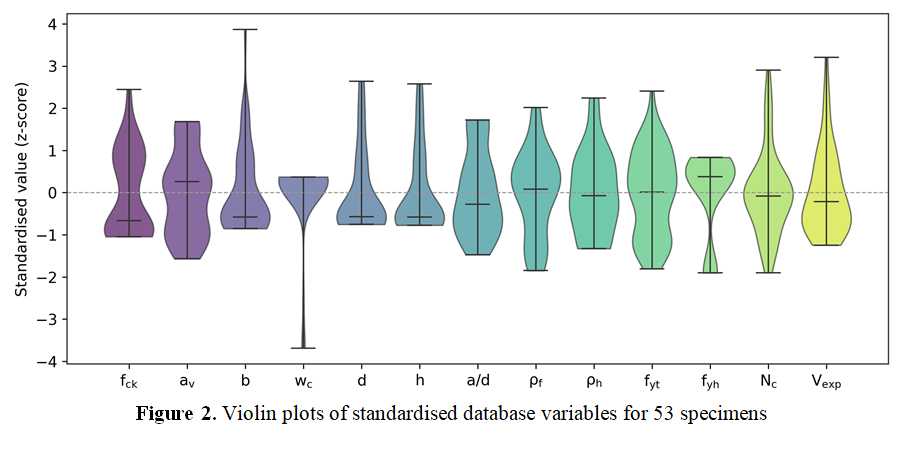
The shear capacity of reinforced concrete corbel (RCC) remains difficult to predict because these members are disturbed (D-) regions governed by strut-and-tie action rather than by conventional theory, and because their strength is further modified when a horizontal tension force acts together with the vertical load. This study develops and compares data-driven models for the shear strength of RCCs using a compiled database of 53 experimental specimens under combined vertical shear and horizontal force, described by twelve geometric, material, and reinforcement parameters. Five algorithms: multiple linear regression (MLR), random forest (RF), gradient-boosted regression trees (GBRT), support vector regression (SVR), and artificial neural network (ANN) were trained and evaluated under a cross-validation protocol to obtain out of sample predictions. Support vector regression achieved the highest accuracy (R2 = 0.926, RMSE = 59.5 kN, mean absolute percentage error = 15.7%), then followed by gradient boosting (R2 = 0.913) and the neural network (R2 = 0.904), whereas the linear model and the random forest were less accurate. Taylor and radar diagrams confirmed the same ranking across multiple criteria. Feature-importance analysis identified the corbel width, the concrete strength, the shear-span-to-depth ratio, and the applied horizontal force as the dominant predictors, in agreement with established corbel mechanics. The results indicate that the shear strength capacity of RCCs can be predicted with lower scatter than a semi-empirical formulation adopted by standard codes, and therefore provide an interpretable basis for design capacity estimation.
References
[1] L. B. Kriz and C. H. Raths, “Connections in Precast Concrete Structures—Strength of Corbels,” PCI J., vol. 10, no. 1, pp. 16–61, Feb. 1965, doi: 10.15554/pcij.02011965.16.61. DOI: https://doi.org/10.15554/pcij.02011965.16.61
[2] A. H. Mattock, K. C. Chen, and K. Soongswang, “Behavior of Reinforced Concrete Corbels.,” J Prestress. Concr Inst, vol. 21, no. 2, pp. 52–77, Mar. 1976, doi: 10.15554/pcij.03011976.52.77. DOI: https://doi.org/10.15554/pcij.03011976.52.77
[3] ACI Committee 318, Building code for structural concrete--code requirements and commentary (ACI Code-318-25). 2025.
[4] BS EN 1992-1-1, “Eurocode 2: Design of concrete structures - Part 1-1 : General rules and rules for buildings,” Br. Stand. Inst., vol. 1, no. 2004, p. 230, 2004.
[5] A. Y. Ali and W. Hamzah, “Experimental Investigation for Behavior of Reinforced Hybrid Concrete Corbel-Column System Subjected to Un-Symmetrical Vertical Loading,” J. Babylon Univ. Sci., vol. 25, no. 2, pp. 2017–376, 2017, doi: 10.13140/RG.2.2.22029.36327.
[6] S.-J. Hwang and H.-J. Lee, “Strength Prediction for Discontinuity Regions by Softened Strut-and-Tie Model,” J. Struct. Eng., vol. 128, no. 12, pp. 1519–1526, 2002, doi: 10.1061/(asce)0733-9445(2002)128:12(1519). DOI: https://doi.org/10.1061/(ASCE)0733-9445(2002)128:12(1519)
[7] M. S. Sandeep, K. Tiprak, S. Kaewunruen, P. Pheinsusom, and W. Pansuk, “Shear strength prediction of reinforced concrete beams using machine learning,” Structures, vol. 47, pp. 1196–1211, Jan. 2023, doi: 10.1016/j.istruc.2022.11.140. DOI: https://doi.org/10.1016/j.istruc.2022.11.140
[8] J. Zhang, Y. Sun, G. Li, Y. Wang, J. Sun, and J. Li, “Machine-learning-assisted shear strength prediction of reinforced concrete beams with and without stirrups,” Eng. Comput., vol. 38, no. 2, pp. 1293–1307, Apr. 2022, doi: 10.1007/s00366-020-01076-x. DOI: https://doi.org/10.1007/s00366-020-01076-x
[9] T. G. Wakjira, U. Ebead, and M. S. Alam, “Machine learning-based shear capacity prediction and reliability analysis of shear-critical RC beams strengthened with inorganic composites,” Case Stud. Constr. Mater., vol. 16, p. e01008, Jun. 2022, doi: 10.1016/j.cscm.2022.e01008. DOI: https://doi.org/10.1016/j.cscm.2022.e01008
[10]K. Megahed, “STM-based symbolic regression for strength prediction of RC deep beams and corbels,” Sci. Rep., vol. 14, no. 1, p. 25066, 2024, doi: 10.1038/s41598-024-74803-9. DOI: https://doi.org/10.1038/s41598-024-74803-9
[11]M. R. Kaloop et al., “Shear Strength Estimation of Reinforced Concrete Deep Beams Using a Novel Hybrid Metaheuristic Optimized SVR Models,” Sustainability, vol. 14, no. 9, p. 5238, Apr. 2022, doi: 10.3390/su14095238. DOI: https://doi.org/10.3390/su14095238
[12]M. K. Abbas and A. Y. Ali, “Experimental data-driven neural network model for predicting RC corbel shear strength via a web-based interface,” Multiscale Multidiscip. Model. Exp. Des., vol. 8, no. 8, p. 352, Aug. 2025, doi: 10.1007/s41939-025-00942-9. DOI: https://doi.org/10.1007/s41939-025-00942-9
[13]“EN 1992-1-1: 2004, Eurocode 2- Design of concrete structures- Part 1-1: General rules and rules for buildings,” Des. Struct. Elem., vol. 3, p. 230, 2004.
[14]M. K. Abbas and A. Yasir Ali, “Structural Response of Reinforced Concrete Corbels Under Repeated and Combined Loading: Scoping Review,” IOP Conf. Ser. Earth Environ. Sci., vol. 1545, no. 1, 2025, doi: 10.1088/1755-1315/1545/1/012068. DOI: https://doi.org/10.1088/1755-1315/1545/1/012068
Downloads
Published
Issue
Section
License
Copyright (c) 2026 Al-Noor Journal of Engineering Management and Computer Science

This work is licensed under a Creative Commons Attribution-NonCommercial-ShareAlike 4.0 International License.
How to Cite