Design and Development of a Multidimensional Software System for Arabic Text Rendering Quality Assessment in Computer Vision Applications with Efficiency Optimization under Green AI Principles
DOI:
https://doi.org/10.71229/9xdzh468Keywords:
Multidimensional Quality Assessment, , Arabic Text Rendering, , Green AI, , Computer Vision, , Computational Efficiency, , Computer Vision (CV).Abstract
Optical Character Recognition (OCR) face challenges when trying to identify Arabic text due to the intricacies presented in the ligatures, cursive styles, and complexity of the text (due to a combination of the diacritics and ligatures). In this paper, we propose an Arabic text rendering evaluation that maintains the structure of Arabic text rendering and applies the Multidimensional Quality Assessment (MQA) model of “Green Arabic” Quality Assurance (GreenArabicSQA) within the Computer Vision Pipeline (CVP).
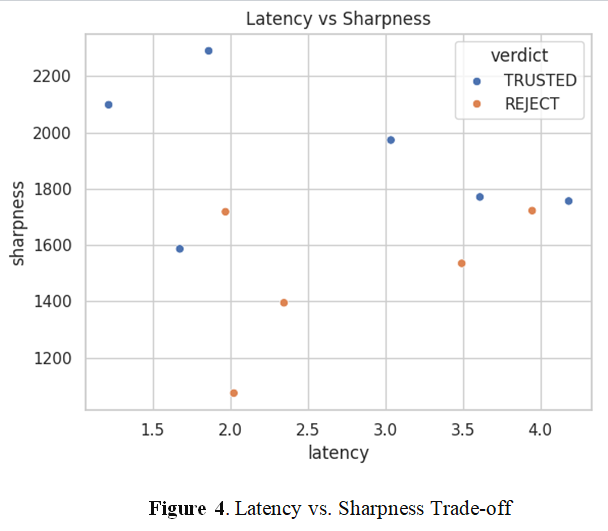
The model is presented along with the numerous operational and structural attributes (dimensions) of the rendering’s design and structure. This is inclusive of sharpness, contrast, sense, and entropy, while also including computational latency as a penalty dimension. A dominant design pertaining to the rendering quality was constructed in order to identify the design’s trade-off between the rendering dimensional quality and rendering design efficiency.
The results of the dynamic “Trusted/Reject” decision are presented. This showed reduced dimensions of rendering quality and deep machine learning model. This filtering mechanism also brought improvement to other dimensions within the Arabic Quality Assurance systems.
The proposed solutions are in harmony with the Green AI principles of Arabic Quality Assurance (QA) systems as they are more sustainable and scalable solutions.
References
[1] Nisar, H., Tapp, A., & Linguraru, M. G. (2026). Green AI: Systematic Review and Guidelines for Sustainability in Artificial Intelligence. DOI: https://doi.org/10.20944/preprints202602.0411.v1
[2] An, Y., Hou, N., & Lv, Z. (2026). A Systematic Review of Transfer Learning Research From the Perspective of Knowledge Graph: Visual Analysis Based on the Bibliometric Method. Wiley Interdisciplinary Reviews: Data Mining and Knowledge Discovery, 16(2), e70084. DOI: https://doi.org/10.1002/widm.70084
[3] Ramachandran, B., & Atef, R. (2026). An Efficient Artificial Intelligence-and Deep Learning-Based Smart Sustainability in Net Zero. In The Role of Technology and Innovation in Achieving Sustainability: Assessing Benefits and Limitations (pp. 103-135). DOI: https://doi.org/10.1142/9789819820528_0005
[4] Ahmed, S. M., Wahid, A., & Hamid, Y. (2026). Exploring Urdu OCR Systems Across Handwritten, Printed, Online, Offline, Multilingual, Natural Scene, and Video Scenarios: A Comprehensive Review. SN Computer Science, 7(4), 303. DOI: https://doi.org/10.1007/s42979-026-04890-0
[5] Charatsaris, P., Diamanti, M., Tsiropoulou, E. E., & Papavassiliou, S. (2026). Balancing Accuracy-Latency Tradeoff in Hybrid Approximate-Delayed Computing Systems. IEEE Transactions on Consumer Electronics. DOI: https://doi.org/10.1109/TCE.2026.3681135
[6] Liu, Y., Xiao, Y., Long, X., & Wu, J. (2026). Is more always better? Measuring the quality of ranking data through information entropy. Journal of Data and Information Science, 11(1), 105-131. DOI: https://doi.org/10.2478/jdis-2025-0055
[7] Schwartz, R., et al. (2020). Green AI. Communications of the ACM, 63(12), 54-63. DOI: https://doi.org/10.1145/3381831
[8] Verdecchia, R., et al. (2023). A systematic review of Green AI. Wiley Interdisciplinary Reviews: Data Mining and Knowledge Discovery, 13(4). DOI: https://doi.org/10.1002/widm.1507
[9] Jasim, M. (2020). Evolution of Arabic OCR: From Rule-based to Deep Learning. Journal of Digital Information, 18(1).
[10] Al-Sheikh, A., et al. (2020). Complex Script Recognition: Challenges in Arabic Typography. AI Research Reports, 22(3).
[11] Ahmed, S., & Khan, N. (2025). Robustness of Arabic OCR under High Compression Scenarios. Int. Journal of CV Research, 15(1).
[12] Wasfy, A., Nacar, O., Elkhateb, A., Reda, M., Elshehy, O., Ammar, A., & Boulila, W. (2025). Qari-ocr: High-fidelity arabic text recognition through multimodal large language model adaptation. arXiv preprint arXiv:2506.02295.
[13] Han, J. (2025). Conveying Imagistic Thinking in Traditional Chinese Medicine Translation: A Prompt Engineering and LLM-Based Evaluation Framework. arXiv preprint arXiv:2511.23059.
[14] Tabbakh, A., Al Amin, L., Islam, M., Mahmud, G. I., Chowdhury, I. K., & Mukta, M. S. H. (2024). Towards sustainable AI: a comprehe
sive framework for Green AI. Discover Sustainability, 5(1), 408.
[15] Verdecchia, R., Sallou, J., & Cruz, L. (2023). A systematic review of Green AI. Wiley Interdisciplinary Reviews: Data Mining and Knowledge Discovery, 13(4), e1507. DOI: https://doi.org/10.1002/widm.1507
[16] Jacobson, R. E. (1995). An evaluation of image quality metrics. The journal of photographic science, 43(1), 7-16. DOI: https://doi.org/10.1080/00223638.1995.11738604
[17] Magdy, S. M., Alwajih, F., Mekki, A. E., El-Sayed, W., & Abdul-Mageed, M. (2026). LQM: Linguistically Motivated Multidimensional Quality Metrics for Machine Translation. arXiv preprint arXiv:2604.18490. DOI: https://doi.org/10.18653/v1/2026.findings-acl.2012
[18] Alzoubi, H., & Mishra, A. (2026). Green Artificial Intelligence: A Comprehensive Review of Metrics and Tools. Archives of Computational Methods in Engineering
Downloads
Published
Issue
Section
License
Copyright (c) 2026 Al-Noor Journal of Engineering Management and Computer Science

This work is licensed under a Creative Commons Attribution-NonCommercial-ShareAlike 4.0 International License.
How to Cite