Material-Efficient Ring Foundations on Sandy Soil: Experimental Evaluation of Bearing Capacity Factors
DOI:
https://doi.org/10.71229/1bmx9n17Keywords:
Ring footing,, radii ratio,, Sandy soil,, Centrifuge modeling,, Bearing capacity factorsAbstract
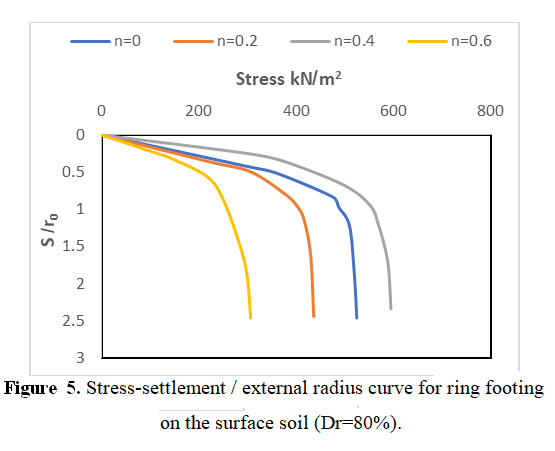
Ring footings have become an increasingly recognized option for a more resource-efficient means of building construction than traditional circular footings. Generally, the ground is the principal load-bearing element in building construction. However, there exists only a limited amount of testing to determine how variations in foundation configuration and embedment depth affect the bearing capacity factors Nγ and Nq associated with ring footings in cohesionless soils. Therefore, this research evaluates the bearing capacity factors (Nγ, Nq) for ring footings of varying radii ratios and embedment depths. To investigate this behavior, experimental study are conducted using a centrifuge device system of ring foundations models with varying ring radii ratios n = 0, 0.2, 0.4, and 0.6. The substantial steel foundations, each with an area of 2200 mm² and a thickness of 50 mm, are situated on and under sandy soil with different relative densities. This study used loose, medium, and dense sand with soil unit weight are 15.2 kN/m³, 16 kN/m³ and 17 kN/m³ respectively. Based on the results obtained, the soil density and ring configuration were found to have a significant influence on the ultimate bearing capacity of ring footings, with the optimal radii ratio producing the best performance being approximately n = 0.4. Ring foundations embedded in the soil exhibit a greater load capacity than foundations placed on the surface. It has been shown that optimally designed ring foundations are capable of producing greater structural performance at a lower material consumptive level. This supports an environmentally sustainable and efficient approach to designing foundations.
References
[1]. Adebowale, O. J., & Agumba, J. N. (2026). Sustainable building materials utilization in the construction sector and the implications on labour productivity. Journal of Engineering, Design and Technology, 24(2), 448-471. DOI: https://doi.org/10.1108/JEDT-04-2023-0164
[2]. Da Silva, S. R., Borges, P. M., Tošić, N., & Andrade, J. J. D. O. (2026). Advances in circular valorization of construction and demolition waste (CDW) toward low-carbon and resilient construction: A Comprehensive review. Sustainability, 18(6), 2759. DOI: https://doi.org/10.3390/su18062759
[3]. Mwat, A. N., Jahil, B. H., Noori, B. A., Mahdi, A. A. K. F., & Sarteep, S. J. (2026). Applied Materials Science for Civil and Construction Engineering. RK Publication.
[4]. Venu Jaya, S., Acquaye, A., Khalfan, M., Swarnakar, V., & El Fadel, M. (2026). Towards net-zero modular construction: machine learning and time series analysis for waste generation and emissions prediction modelling. Construction Innovation, 1-23. DOI: https://doi.org/10.1108/CI-06-2025-0248
[5]. Haigh, R., & Li, L. (2026). Decade review of modular construction systems in the building and construction industry: research trends toward the development and utilisation of timber materials within the context of a circular economy. Wood Material Science & Engineering, 1-20. DOI: https://doi.org/10.1080/17480272.2025.2611132
[6]. Harle, S. M., Ranit, A. B., Ambadkar, S., & Bejalwar, S. (2026). Reducing Carbon Footprint in the Construction Industry: Strategies from Design to Operation. In Reduction of Industrial Carbon Footprint (pp. 43-91). Cham: Springer Nature Switzerland. DOI: https://doi.org/10.1007/978-3-032-10913-2_4
[7]. Balu, A. S. (2025). Theory of Structures. KHANNA PUBLISHING HOUSE.
[8]. Vu-Hoang, T., Nguyen, T., Shiau, J., Ly-Khuong, D., & Pham-Tran, H. T. (2025). Prediction of bearing capacity of ring footings on cohesive frictional soils using Terzaghi stability factors and Kolmogorov Arnold networks. Scientific Reports. DOI: https://doi.org/10.1038/s41598-025-32268-4
[9]. Prasad, S. D., & Chakraborty, M. (2025). Bearing capacity of ring footing resting on rock mass under different loading positions. Sādhanā, 50(2), 111. DOI: https://doi.org/10.1007/s12046-025-02757-3
[10]. Shah, J., Alam, M., Javed, F., Umar, M., & Ahmad, F. (2025). Comparative performance evaluation of machine learning models for predicting the ultimate bearing capacity of shallow foundations on granular soils. Scientific Reports, 15(1), 36525. DOI: https://doi.org/10.1038/s41598-025-13926-z
[11]. El Gendy, M. (2025). A comparative machine and deep learning approach for predicting ultimate bearing capacity of shallow foundations in cohesionless soil. Scientific Reports, 15(1), 40402. DOI: https://doi.org/10.1038/s41598-025-22812-7
[12]. Jiao, C., Zhang, Y., Ren, C., Xiang, N., Liu, W., & Jia, J. (2026, February). Ultimate load-bearing capacity assessment of ancient stone arch bridges based on cohesive models. In Structures (Vol. 84, p. 110949). Elsevier. DOI: https://doi.org/10.1016/j.istruc.2025.110949
[13]. Bishnoi, D., & Dasaka, S. M. (2026). Quantification of Arching in Cohesionless Soils due to Diaphragm-Type Pressure Cells: A Numerical Investigation. International Journal of Geomechanics, 26(4), 04026051. DOI: https://doi.org/10.1061/IJGNAI.GMENG-12682
[14]. Liu, H., & Jia, Q. (2026). Load-Bearing Analysis of Arched Caisson Underground Garage. Results in Engineering, 109969. DOI: https://doi.org/10.1016/j.rineng.2026.109969
[15]. Lu, J., Wang, J. Q., Yang, X. Y., & Wang, H. T. (2026). Analysis of Dynamic Load Tests on Reinforced Foundations Under the Influence of Karst Soil Cavity Collapse. Buildings, 16(4), 828. DOI: https://doi.org/10.3390/buildings16040828
[16]. Yünkül, K., Gürbüz, A., & Demirdöğen, S. (2026). The Effect of Aspect Ratio on the Shape Factors of Rectangular Footings on Sandy Soil. Turkish Journal of Civil Engineering, (Advanced Online Publication). DOI: https://doi.org/10.18400/tjce.1637258
[17]. Mani, G., Subramanian, S., & Jagadesh, P. (2026). Bearing capacity and settlement behavior of square footing on coir geocell–reinforced sand under concentric and eccentric loading. Scientific Reports. DOI: https://doi.org/10.1038/s41598-026-48511-5
[18]. Li, Y., Du, J., & Ma, Z. (2026). Study of the Size Effects and the Macro-and Microscopic Bearing Characteristics of Anchor Plate Foundations Based on the Discrete-Element Method. International Journal of Geomechanics, 26(1), 04025311. DOI: https://doi.org/10.1061/IJGNAI.GMENG-11104
[19]. Hataf, N., & Fatolahzadeh, A. (2019). An experimental and numerical study on the bearing capacity of circular and ring footings on rehabilitated sand slopes with geogrid. Journal of Rehabilitation in Civil Engineering, 7(1), 174-185.
[20]. Rupani, H., & Bhoi, M. (2019). Experimental study of load settlement behaviour of ring footings for different internal diameter keeping the contact surface area same. In Proceedings of the 4th World Congress on Civil, Structural, and Environmental Engineering (CSEE’19), Rome, Italy, ICGRE (pp. 167-7). DOI: https://doi.org/10.11159/icgre19.167
[21]. Al-Sumaiday, H., Khalaf, W. D., & Muhauwiss, F. M. (2024). Experimental Investigation of Bearing Capacity of Circular and Ring Footings on Geogrid-Reinforced Cohesionless Soils. Civil and Environmental Engineering, 20(1), 349-363. DOI: https://doi.org/10.2478/cee-2024-0027
[22]. Hataf N, Razavi MR (2003) Behavior of ring footing on sand. Iran J Sci Technol Trans B Eng 27:47–56.
[23]. JYM, A., & AAH, A. S. (2026). Optimal Design of Ring Footing on Reinforced Sandy Soil under Eccentric-Inclined Loads. F1000Research, 15, 563. DOI: https://doi.org/10.12688/f1000research.176061.1
[24]. Yadav, J. S., Sharma, V., Dutta, R. K., & Kumar, V. S. (2026). Pressure settlement behaviour of ring footing resting on geotextile encased stone column. International Journal of Mining and Geo-Engineering, 60(1), 75-82.
[25]. El Naggar, A., Youssef, M. A., & El Naggar, H. (2026). Structural Response of Reinforced Concrete Frame Structures Subjected to Tunnelling Induced Differential Foundation Settlements. Geotechnical and Geological Engineering, 44(3), 162. DOI: https://doi.org/10.1007/s10706-026-03680-y
[26]. Elmorsy, M., Adamopoulou, D., Zhang, Y., Shea, K., Jones, L., Anastasopoulos, I., & Vassiliou, M. F. (2026). Shear behavior and centrifuge seismic modeling of a sustainable corbel dwelling with interlocking blocks. Construction and Building Materials, 515, 145553. DOI: https://doi.org/10.1016/j.conbuildmat.2026.145553
[27]. Lbibb, S., & Manzari, M. T. (2026). The Critical Role of Initial Stresses in the Seismic Response of Sheet-Pile Walls in Liquefiable Soils. In Geo-Congress 2026 (pp. 467-476). DOI: https://doi.org/10.1061/9780784486702.046
[28]. Hung, W. Y., Tran, M. C., & Ha, T. Q. (2026). Centrifuge modelling lateral loading test of battered-piled-raft system in sand. Journal of the Chinese Institute of Engineers, 49(3), 784-800. DOI: https://doi.org/10.1080/02533839.2025.2587695
[29]. Rizwan, M., Naseem, S., & Tarar, M. A. (2026). Advancements in predicting bearing capacity of foundations near slopes: a comparative review of LEM/LAM/FEM to AI-driven models. Bulletin of Engineering Geology and the Environment, 85(4), 230. DOI: https://doi.org/10.1007/s10064-026-04841-2
[30]. Louw, H., & Kearsley, E. (2026). Structural health monitoring of an onshore wind turbine piled-raft foundation. Structural Health Monitoring, 14759217251405396. DOI: https://doi.org/10.1177/14759217251405396
[31]. Bahuguna, A., Sundararajan, J., & Ravichandran, N. (2026). Nonlinear Seismic Risk Assessment of Reinforced Concrete Pile Groups in Charleston, South Carolina, Considering Three-Dimensional Soil–Structure Interaction. International Journal of Geomechanics, 26(5), 04026080. DOI: https://doi.org/10.1061/IJGNAI.GMENG-12898
[32]. Viswanadham, B. V. S., Turlapati, V. V., & Bhattarai, S. K. (2026). Centrifuge model tests on Geostrip Reinforced Soil Walls with low-permeable backfills subjected to seepage. Geotextiles and Geomembranes, 54(2), 386-402. DOI: https://doi.org/10.1016/j.geotexmem.2026.01.003
[33]. Luong, M. P. (2026). Prestressed soils using high capacity anchor systems: Vorgespannte Böden durch die Verwendung von Ankern mit großer Tragkraft. In Anchors in Theory and Practice/Anker in Theorie Und Praxis (pp. 197-204). CRC Press. DOI: https://doi.org/10.1201/9781003761396-26
[34]. Kabeta, W. F. F. (2025). Centrifuge Modelling of Tapered Pile Installation Effects in Sand.
[35]. Jaafar A. J. centrifuge modeling and numerical analysis of helical pile embedded in sandy soil. A Thesis. Civil Engineering Department of the University of Technology (2020).
[36]. Huda A. G. Behavior of Ring Footing Adjacent to a Slope: Centrifuge Modeling and Numerical Analysis. A Thesis. Civil Engineering Department of the University of Technology (2025).
[37]. Abebe, T. N., Lee, T. H., & Kim, H. G. (2026). Development and Field Validation of a GNSS-Integrated Smart Compaction Management System. Results in Engineering, 109778. DOI: https://doi.org/10.1016/j.rineng.2026.109778
[38]. Wibowo, D. E., Purwana, Y. M., Setiawan, B., & Chrismaningwang, G. (2026, March). Ultimate uplift capacity of jacks-like ground anchor in granular soil with relative density variation. In IOP Conference Series: Earth and Environmental Science (Vol. 1589, No. 1, p. 012040). IOP Publishing. DOI: https://doi.org/10.1088/1755-1315/1589/1/012040
[39]. Saliba, E. C., & Sayão, A. D. S. F. J. (2026). Use of mining tailings in compacted earth fill. Soils and Rocks, 49(3), e2026012023. DOI: https://doi.org/10.28927/SR.2026.012023
[40]. Chavda, Jitesh T. The ultimate bearing capacity of ring footing with inclined base. In: Indian Geotechnical Conference. Singapore: Springer Nature Singapore, 2021. p. 23-31. DOI: https://doi.org/10.1007/978-981-19-6359-9_3
[41]. Hosamo, Haidar; SLITEEN, Iyad; DING, Songxiong. Numerical analysis of bearing capacity of a ring footing on geogrid reinforced sand. Buildings, 2021, 11.2: 68. DOI: https://doi.org/10.3390/buildings11020068
Downloads
Published
Issue
Section
License
Copyright (c) 2026 Al-Noor Journal of Engineering Management and Computer Science

This work is licensed under a Creative Commons Attribution-NonCommercial-ShareAlike 4.0 International License.
How to Cite