The operational performance of photovoltaic systems on the roofs of fuel supply stations and their impact on the environment is assessed in the Governorate of Babylon, as an example
DOI:
https://doi.org/10.71229/6batrg23Keywords:
Photovoltaic energy, , power stations, , pollution, , Babylon Governorate.Abstract
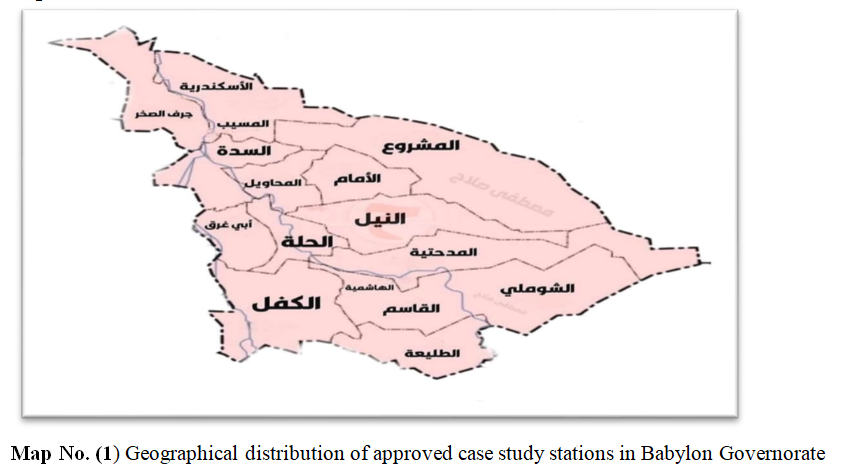
The aim of this applied study is to investigate the operational efficiency of PV power generation systems on the roof of fuel stations and the impact that they have on the environment in a case study in Babylon Governorate. Solar panels installed on the roofs and canopies of urban fuel stations in Iraq to provide power to these facilities without the need for diesel generators (Off-grid PV) are considered a sustainable solution to replace the conventional diesel generator for power supply. The fuel stations in Babylon Governorate were chosen as a case study because the region is densely populated and at the center of population and the climatic conditions are considered to be vulnerable in the Middle Euphrates region. The efficiency of the solar cells is directly affected by the dust deposition rates. Estimated outputs indicate the system's ability to fully meet operational needs throughout the day at a self-sufficient rate. This means clear economic gains, due to reduced operating and periodic maintenance costs for generators, and substantial conservation of diesel fuel. Moreover, the study presents an important environmental and social aspect, whereby there was a significant reduction in pollutants and toxic gases (including carbon monoxide) and the total removal of noise pollution in the urban environment. This has a direct and positive effect on public health and enhances the quality of life of the community and its surrounding communities.
References
[1] Iraqi Ministry of Planning, (2024). “Annual Statistical Report and Urban and Population Indicators for Babylon Governorate”, Babylon Statistics Directorate.
[2] International Renewable Energy Agency (IRENA), (2024). “Carbon Emission Reduction Indicators and Environmental Impact Assessment of Autonomous Urban Systems”, Sustainable Development Report.
[3] Iraqi Ministry of Environment, (2023). “Air Quality Determinants and the Heat Island Phenomenon Caused by Private Generators in Iraqi Urban Centers”, Department of Environmental Protection and Improvement in the Middle Euphrates Region.
[4] World Health Organization (WHO) - Regional Office for the Eastern Mediterranean, (2023). "Urban and environmental standards for safe noise levels and their impact on public health within cities."
[5] Babil Provincial Council - Energy and Environment Committee, (2025). “The Protected Strategic Plan for Adopting Sustainable Energy Technologies in Service and Urban Facilities in the Governorate.”
Foreign references
[6] Jamil, M., & Hussain, S. (2021). “Global Trajectory of Solar Photovoltaic Energy: A Review of Sustainable Development Goals”, Renewable and Sustainable Energy Reviews, vol. 143, pp. 110-125.
[7] Al-Khafaji, A. H. (2022). “Challenges of Electrical Energy Generation and the Impact of Diesel Generators in Iraqi Cities”, Iraqi Journal of Mechanical and Material Engineering, vol. 22, no. 1, pp. 45-58.
[8 Roberts, J., & Hasan, M. (2020). “Utilization of Urban Rooftops for Solar PV Generation: Technical Feasibility and Built Environment”, Energy and Buildings, vol. 215, pp. 109-122.
[9 [Kazem, H. A., & Chaichan, M. T. (2019). “The Economic and Environmental Feasibility of Solar Energy Systems in Iraq”, International Journal of Renewable Energy Development, vol. 8, no. 2, pp. 151-160.
[10] Solangi, K. H., & Islam, M. R. (2020). “Design and Performance Analysis of Off-Grid Photovoltaic Systems for Urban Applications”, Solar Energy, vol. 199, pp. 312-327.
[11] Chaichan, M. T., & Kazem, H. A. (2021). “The Impact of High Ambient Temperatures on the Performance of Monocrystalline PV Modules in Middle Euphrates Region, Iraq”, Journal of Solar Energy Research, vol. 6, no. 3, pp. 789-801.
[12] Al-Hamdani, N., & Al-Shammari, K. (2023). “Dust Accumulation and its Mitigation Techniques on Solar PV Panels: A Case Study of Babylon Province”, Journal of Engineering and Sustainable Development, vol. 27, no. 4, pp. 112-126.
[13] Ibrahim, A., & Tariq, M. (2022). “Battery Energy Storage Systems for Off-Grid Solar PV Applications: Capacity Sizing and Reliability”, Journal of Energy Storage, vol. 50, pp. 104-119.
[14] Fu, R., Feldmann, D., & Margolis, R. (2018). "US Solar Photovoltaic System Cost Benchmark: Q1 2018", National Renewable Energy Laboratory (NREL), Technical Report. DOI: https://doi.org/10.2172/1484344
[15] Sarhan, A., & Al-Amiri, M. (2019). “Optimization of PV System Components and Tilting Angles for Urban Fuel Stations”, Proceedings of the 8th Annual World Conference of the Society for Industrial and Systems Engineering, Baltimore, MD, USA.
Downloads
Published
Issue
Section
License
Copyright (c) 2026 Al-Noor Journal of Engineering Management and Computer Science

This work is licensed under a Creative Commons Attribution-NonCommercial-ShareAlike 4.0 International License.
How to Cite