Measurement of the radioactivity of 238U, 232TH and 40K in beans and lentils available in Iraqi markets using a detector NaI(Tl)
DOI:
https://doi.org/10.71229/h72kye02Keywords:
Radioactivity,, NaI(Tl) detector, , Radiation exposure limits, , beans and lentils, , gamma spectrometryAbstract
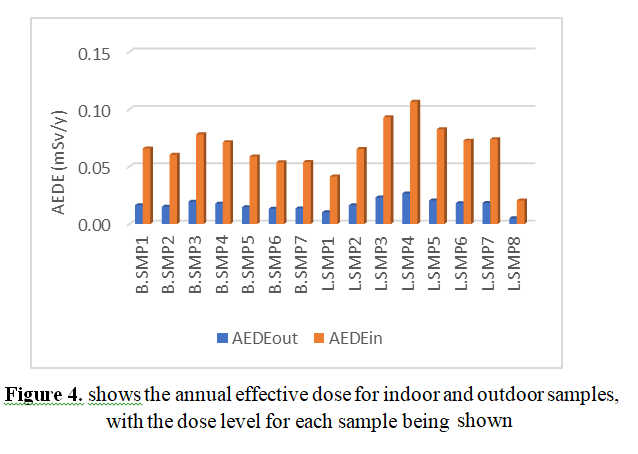
The Thallium-doped sodium iodide NaI(Tl) detector 3×3 crystal-size was used to detect the radioactivity of 232TH, 238U, and 40K isotopes in 15 samples of beans and lentils. The energy used for their detection was 911.2 kev for (228Ac) for thorium concentration, 1460.82 kev for potassium, and 1764.52 kev for (214Bi) for uranium The highest thorium concentration in lentils was found to be (7.985 Bq/kg) and in beans (10.631 Bq/kg) with an average value of (3.674 Bq/kg) and (7.985 Bq/kg) for the lentil samples, while the potassium concentration was (256.077 Bq/kg) in lentils with an average value of (163.58 Bq/kg) and (262.501 Bq/kg) in beans with an average value of (227.148 Bq/kg). The radioactivity concentration of uranium was (19.096 Bq/kg) in lentils and the average values were (6.076 Bq/kg) and (7.366 Bq/kg) in beans with an average value of (2.859 Bq/kg). The radium equivalent was also measured and found to be (46.782 Bq/kg) in lentils and the average was (29.27 Bq/kg) and (32.405 Bq/kg) in beans and the average values were (25.253 Bq/kg). Other hazard indicators, such, absorbed dose rate of air, annual effective dose equivalent, gamma ray ideal levels index, internal and external risk indices, and excess life time cancer risk, and all results were within permissible limits and do not pose a risk to human health.
References
[1] J. Iqbal, F. M. Howari, A.-M. O. Mohamed, and E. K. Paleologos, “Assessment of radiation pollution from nuclear power plants,” in Pollution Assessment for Sustainable Practices in Applied Sciences and Engineering, Elsevier, 2021, pp. 1027–1053. doi: 10.1016/B978-0-12-809582-9.00020-7. DOI: https://doi.org/10.1016/B978-0-12-809582-9.00020-7
[2] Nazar abdulamer hussen, Bases in nuclear and radiation chemistry. 2017.
[3] “U.S. Environmental Protection Agency. (2024, January 22). Radiation Basics. epa.gov”.
[4] J. MOLINARI and W. J. SNODGRASS, The chemistry and radiochemistry of radium and the other elements of the uranium and thorium natural decay series. 1990.
[5] H. J. Hassan, “Radiation hazards and effective dose evaluation: A study of various imported walnut consumed in Kurdistan-Iraq,” Radiation Physics and Chemistry, vol. 235, p. 112899, Oct. 2025, doi: 10.1016/j.radphyschem.2025.112899. DOI: https://doi.org/10.1016/j.radphyschem.2025.112899
[6] F. Zou, C. Tan, B. Zhang, W. Wu, and N. Shang, “The Valorization of Banana By-Products: Nutritional Composition, Bioactivities, Applications, and Future Development,” Foods, vol. 11, no. 20, p. 3170, Oct. 2022, doi: 10.3390/foods11203170. DOI: https://doi.org/10.3390/foods11203170
[7] Saif M. Alghazaly, “Danger Indicators of Natural Radionuclides in Consumed Products in the City of Hilla Markets,” Iraqi Journal of Science, pp. 1914–1924, May 2025, doi: 10.24996/ijs.2025.66.5.11. DOI: https://doi.org/10.24996/ijs.2025.66.5.11
[8] J. J. Choi et al., “Improving the light collection using a new NaI(Tl) crystal encapsulation,” Nucl. Instrum. Methods Phys. Res. A, vol. 981, p. 164556, Nov. 2020, doi: 10.1016/j.nima.2020.164556. DOI: https://doi.org/10.1016/j.nima.2020.164556
[9] H. R. Algayyim, A. A. Lafta, and A. J. Al-Fartusi, “Measurement of Uranium and Radium Concentrations in Sediments of the Arabian Gulf Coast in the Raas Al-Besha Area, Basra- Iraq,” Mesopotamian Journal of Marine Sciences, vol. 41, no. 1, pp. 91–102, Jun. 2026, doi: 10.58629/mjms.v41i1.439. DOI: https://doi.org/10.58629/mjms.v41i1.439
[10] V. V. Golovko, “Simplified efficiency calibration methods for scintillation detectors used in nuclear remediation,” J. Clean. Prod., vol. 478, p. 143910, Nov. 2024, doi: 10.1016/j.jclepro.2024.143910. DOI: https://doi.org/10.1016/j.jclepro.2024.143910
[11] R. Hawrami, E. Ariesanti, A. Farsoni, D. Szydel, and H. Sabet, “Growth and Evaluation of Improved CsI:Tl and NaI:Tl Scintillators,” Crystals (Basel)., vol. 12, no. 11, p. 1517, Oct. 2022, doi: 10.3390/cryst12111517. DOI: https://doi.org/10.3390/cryst12111517
[12] J. J. Choi et al., “Waveform simulation for scintillation characteristics of NaI(Tl) crystal,” Nucl. Instrum. Methods Phys. Res. A, vol. 1065, p. 169489, Aug. 2024, doi: 10.1016/j.nima.2024.169489. DOI: https://doi.org/10.1016/j.nima.2024.169489
[13] Arpit Patel and Himanshu Mazumdar, “A review on Radiation Detectors for Various Radiation Detection Applications,” Journal of Radiation and Nuclear Applications, vol. 8, no. 2, pp. 93–111, May 2023, doi: 10.18576/jrna/080201. DOI: https://doi.org/10.18576/jrna/080201
[14] H. Zhou, F. Liu, X. Yuan, J. Wu, and G. Li, “Effect of Photomultiplier Tube Voltage on the Performance of Sealed NaI (Tl) Scintillator Detectors,” Science and Technology of Nuclear Installations, vol. 2024, no. 1, Jan. 2024, doi: 10.1155/2024/5206668. DOI: https://doi.org/10.1155/2024/5206668
[15] Z. Ullah et al., “Benchmarking of the efficiency of the NaI(Tl) detector using FLUKA, MCNP, and experimental measurements at multiple source distances,” Nuclear Analysis, vol. 4, no. 4, p. 100185, Dec. 2025, doi: 10.1016/j.nucana.2025.100185. DOI: https://doi.org/10.1016/j.nucana.2025.100185
[16] N. N. Nazaruddin, M. S. M. Sanusi, and S. Hashim, “Geology-Driven Variability of Urban Terrestrial Gamma Radiation and Soil Contamination Index UCSI: Evidence from Carborne Surveys in Peninsular Malaysia,” Asian Journal of Environment & Ecology, vol. 24, no. 12, pp. 185–203, Dec. 2025, doi: 10.9734/ajee/2025/v24i12840. DOI: https://doi.org/10.9734/ajee/2025/v24i12840
[17] I. , A. M. L. , H. M. A. , A. M. I. , P. D. , and I. S. M. A. Jahan, “Distribution of natural and probable artificial radioactivity in the sediment and water samples collected from low-lying areas of Savar industrial zone,” Bangladesh. Journal of Nuclear and Particle Physics , pp. 25–34, 2016.
[18] S. M. Alghazaly, “Calculate the Rate of Natural Radioactivity in the Soil of Some Schools Using the NaI(Tl) Detector in the City of Hilla-Iraq,” BASRA JOURNAL OF SCIENCE, vol. 42, no. 1, pp. 52–68, Jun. 2024, doi: 10.29072/basjs.20240104. DOI: https://doi.org/10.29072/basjs.20240104
[19] M. Fatih Kuluöztürk, “Optimization of 3×3 inch NaI(Tl) detector related to energy, distance and bias voltage,” J. Radiat. Res. Appl. Sci., vol. 16, no. 3, p. 100613, Sep. 2023, doi: 10.1016/j.jrras.2023.100613. DOI: https://doi.org/10.1016/j.jrras.2023.100613
[20] R. A. Ramadhan and K. M.-S. Abdullah, “Background reduction by Cu/Pb shielding and efficiency study of NaI(TI) detector,” Nuclear Engineering and Technology, vol. 50, no. 3, pp. 462–469, Apr. 2018, doi: 10.1016/j.net.2017.12.016. DOI: https://doi.org/10.1016/j.net.2017.12.016
[21] ABOJASSIM and Ali Abid, “Measurement of natural radioactivity in bread product samples available in Iraqi markets,” International Journal of Energy and Environment, pp. 135–141, 2019.
[22] H. A. Mazoon and M. H. Oleiwi, “Assessment of Natural Radio Activity Level in Some Imported Food Products in the Iraq Markets,” NeuroQuantology, vol. 20, no. 3, pp. 75–80, Mar. 2022, doi: 10.14704/nq.2022.20.3.NQ22044. DOI: https://doi.org/10.14704/nq.2022.20.3.NQ22044
[23] L. A. Najam et al., “Radiological hazard assessment of 226 Ra, 232 Th, and 40 K in soil samples collected from northwestern Iraq,” Int. J. Environ. Anal. Chem., pp. 1–18, Sep. 2025, doi: 10.1080/03067319.2025.2553749. DOI: https://doi.org/10.1080/03067319.2025.2553749
[24] S. Suresh, D. R. Rangaswamy, J. Sannappa, S. Dongre, E. Srinivasa, and S. Rajesh, “Estimation of natural radioactivity and assessment of radiation hazard indices in soil samples of Uttara Kannada district, Karnataka, India,” J. Radioanal. Nucl. Chem., vol. 331, no. 4, pp. 1869–1879, Apr. 2022, doi: 10.1007/s10967-021-08145-5. DOI: https://doi.org/10.1007/s10967-021-08145-5
[25] A. F. IBUKUNOLUWA and Aremu Feyisayo, “Investigation of Radioactivity Levels in Some Selected Imported Canned Foods Consumed in Abuja, Nigeria,” Journal of Radiation and Nuclear Applications, vol. 10, no. 1, pp. 13–19, Jan. 2025, doi: 10.18576/jrna/100103. DOI: https://doi.org/10.18576/jrna/100103
[26] Z. A. Hussein, N. F. Salih, and S. Z. Sedeeq, “Assessment the Natural Radioactivity of Radionuclides ( 226Ra, 232Th, 40K, and 137Cs) in Wheat Grain,” ARO-THE SCIENTIFIC JOURNAL OF KOYA UNIVERSITY, vol. 9, no. 1, pp. 95–102, Jun. 2021, doi: 10.14500/aro.10736. DOI: https://doi.org/10.14500/aro.10736
[27] R. Elsaman, E.-M. M. Seleem, S. A. Salman, E. M. A. El Ella, and A. El-Taher, “Evaluation of Natural Radioactivity Levels and Associated Radiological Risk in Soil from Siwa Oasis, Egypt,” Radiochemistry, vol. 64, no. 3, pp. 409–415, Jun. 2022, doi: 10.1134/S1066362222030195. DOI: https://doi.org/10.1134/S1066362222030195
[28] H. H. Azeez, S. T. Ahmad, and H. H. Mansour, “Assessment of radioactivity levels and radiological-hazard indices in plant fertilizers used in Iraqi Kurdistan Region,” J. Radioanal. Nucl. Chem., vol. 317, no. 3, pp. 1273–1283, Sep. 2018, doi: 10.1007/s10967-018-6001-3. DOI: https://doi.org/10.1007/s10967-018-6001-3
[29] R. S. Mugalgaon, A. R. Mugalgaon, and B. R. Kerur, “Measurement of natural radioactivity levels in soil samples of Bidar district, Karnataka, India,” Radiat. Prot. Dosimetry, vol. 200, no. 11–12, pp. 1059–1063, Jul. 2024, doi: 10.1093/rpd/ncae025. DOI: https://doi.org/10.1093/rpd/ncae025
[30] N. Salih, Z. Hussein, and S. Sedeeq, “Environmental radioactivity levels in agricultural soil and wheat grains collected from wheat-farming lands of Koya district, Kurdistan region-Iraq,” Radiation Protection and Environment, vol. 42, no. 4, p. 128, 2019, doi: 10.4103/rpe.RPE_37_19. DOI: https://doi.org/10.4103/rpe.RPE_37_19
[31] T. Krishnamoorthi, Satyanarayan Bramha, S. Chandrasekaran, R. Ravichandaran, S. Sivakumar, and R. Ravisankar, “Measurement of natural radioactivity and assessment of radiological hazard indices in soil from Tirunelveli District, Tamil Nadu, India with statistical approach,” Nuclear Analysis, vol. 4, no. 1, p. 100156, Mar. 2025, doi: 10.1016/j.nucana.2025.100156. DOI: https://doi.org/10.1016/j.nucana.2025.100156
[32] S. Pervin et al., “Assessment of natural radioactivity in urban soil samples from Dhaka city and its associated health hazard,” PLoS One, vol. 21, no. 3, p. e0345030, Mar. 2026, doi: 10.1371/journal.pone.0345030. DOI: https://doi.org/10.1371/journal.pone.0345030
[33] ALI YAHYA SALMAN, ANWAR QASIM AHMED, SHAYMAA AWAD KADHIM, and ALI ABID ABOJASSIM, “Measurement of Radiation Contamination by 226Ra, 232Th and 40K in Different Types of Rice Implanted in Iraq,” Annals of Agri-Bio Research, vol. 24, pp. 289–293, 2019.
[34] S. Lewicka, B. Piotrowska, A. Łukaszek-Chmielewska, and T. Drzymała, “Assessment of Natural Radioactivity in Cements Used as Building Materials in Poland,” Int. J. Environ. Res. Public Health, vol. 19, no. 18, p. 11695, Sep. 2022, doi: 10.3390/ijerph191811695. DOI: https://doi.org/10.3390/ijerph191811695
[35] A. A. Abojassim, D. M. Dahir, A. S. Alaboodi, and A. H. Abonasria, “Annual Effective Dose of Gamma Emitters in Adults and Children for Some Types of Rice Consumed in Iraq,” J. Food Prot., vol. 79, no. 12, pp. 2174–2178, Dec. 2016, doi: 10.4315/0362-028X.JFP-16-242. DOI: https://doi.org/10.4315/0362-028X.JFP-16-242
[36] Sheeba, N. Alnassar, N. Ahmad, M. Bakhsh, S. Shahin, and R. Ajaj, “Radiological assessment and health hazards of rice samples consumed in Quetta, Balochistan,” J. Radiat. Res. Appl. Sci., vol. 19, no. 2, p. 102496, Jun. 2026, doi: 10.1016/j.jrras.2026.102496. DOI: https://doi.org/10.1016/j.jrras.2026.102496
[37] D. Majid Hameed, “Evaluation of natural environmental radioactivity in the soil of some schools in Baghdad Governorate, Iraq,” E3S Web of Conferences, vol. 537, p. 04005, Jun. 2024, doi: 10.1051/e3sconf/202453704005. DOI: https://doi.org/10.1051/e3sconf/202453704005
[38] R. A. ABED and J. H. JEBUR, “ NATURAL RADIOACTIVITY MEASUREMENTS IN SOIL AND DATES SAMPLES FROM GROVES OF THE SHATT AL-ARAB IN BASRAH GOVERNORATE,” Journal of Basrah Researches, vol. 46, pp. 216–222, 2020.
[39] G. MALIK, “ Monitoring of Absorbed Dose Rate in Air due to Gamma Radiation,” Indian Journal of Pure & Applied Physics (IJPAP), pp. 354–359, 2025.
[40] F. Lolila and M. S. Mazunga, “Measurements of natural radioactivity and evaluation of radiation hazard indices in soils around the Manyoni uranium deposit in Tanzania,” J. Radiat. Res. Appl. Sci., vol. 16, no. 1, p. 100524, Mar. 2023, doi: 10.1016/j.jrras.2023.100524. DOI: https://doi.org/10.1016/j.jrras.2023.100524
[41] Hamad Hasan, Adel Abdulalah, Marwa Khalifa, and Himeedah Abduinab, “Assessment of Natural Radioactive Elements and Health Risk Values in Imported Cocoa Samples at Some Libyan Markets,” Libyan Medical Journal, pp. 383–392, Dec. 2025, doi: 10.69667/lmj.2517404. DOI: https://doi.org/10.69667/lmj.2517404
[42] A. Abbas Oudh, M. J. H. Kadhim, A. K. Abdul-hussein, and Z. Al-khafaji, “Natural and Anthropogenic Radionuclides Concentration and Risk Assessment in Legumes and Grains, which Provides in a Basket Foodstuffs in Iraq Country,” Nat. Eng. Sci., vol. 10, no. 1, pp. 1–13, Apr. 2025, doi: 10.28978/nesciences.1482014. DOI: https://doi.org/10.28978/nesciences.1482014
[43] N. F. Salih, “Measurement the natural radioactivity concentration levels of radionuclides in selected vegetables collected from Kirkuk, Iraq using HPGe detector,” Int. J. Environ. Anal. Chem., vol. 103, no. 6, pp. 1323–1342, May 2023, doi: 10.1080/03067319.2021.1873313. DOI: https://doi.org/10.1080/03067319.2021.1873313
[44] J. M. Smail, S. T. Ahmad, and H. H. Mansour, “Estimation of the natural radioactivity levels in the soil along the Little Zab River, Kurdistan Region in Iraq,” J. Radioanal. Nucl. Chem., vol. 331, no. 1, pp. 119–128, Jan. 2022, doi: 10.1007/s10967-021-08064-5. DOI: https://doi.org/10.1007/s10967-021-08064-5
[45] B. C. Eke, I. R. Akomolafe, U. M. Ukewuihe, and C. P. Onyenegecha, “Assessment of Radiation Hazard Indices Due to Natural Radionuclides in Soil Samples from Imo State University, Owerri, Nigeria,” Environ. Health Insights, vol. 18, Jan. 2024, doi: 10.1177/11786302231224581. DOI: https://doi.org/10.1177/11786302231224581
[46] H. A. Saudi et al., “An In-Depth Examination of the Natural Radiation and Radioactive Dangers Associated with Regularly Used Medicinal Herbs,” Int. J. Environ. Res. Public Health, vol. 19, no. 13, p. 8124, Jul. 2022, doi: 10.3390/ijerph19138124. DOI: https://doi.org/10.3390/ijerph19138124
[47] A. Saeed jassim, A. Hassoon Oraibi, A. Abid Abojassim, S. A. Algazali, A. Abdulhussein Hameed, and H. Hamza Hussian, “Determination of long-lived gamma emitters in some vegetarian products in Al-Najaf governorate using NaI(Tl),” IOP Conf. Ser. Earth Environ. Sci., vol. 1325, no. 1, p. 012008, Apr. 2024, doi: 10.1088/1755-1315/1325/1/012008. DOI: https://doi.org/10.1088/1755-1315/1325/1/012008
[48] Muhammad Briem Muhammad and Hiwa H. Azeez, “Assessment of Natural Radioactivity Level in Rice Available in Erbil City, Iraq, and Its Radiological Indices,” Zanco J. Pure Appl. Sci., vol. 38, no. 1, pp. 83–90, Feb. 2026, doi: 10.21271/ZJPAS.38.1.7. DOI: https://doi.org/10.21271/ZJPAS.38.1.7
Downloads
Published
Issue
Section
License
Copyright (c) 2026 Al-Noor Journal of Engineering Management and Computer Science

This work is licensed under a Creative Commons Attribution-NonCommercial-ShareAlike 4.0 International License.
How to Cite