Embodied Carbon and Compressive Strength Assessment of Limestone Calcined Clay Concrete Incorporating Thermally Activated Iraqi Kaolin
DOI:
https://doi.org/10.71229/67p22h47Keywords:
LC3 concrete, Embodied carbon, Compressive strength, Calcined kaolin, Limestone powderAbstract
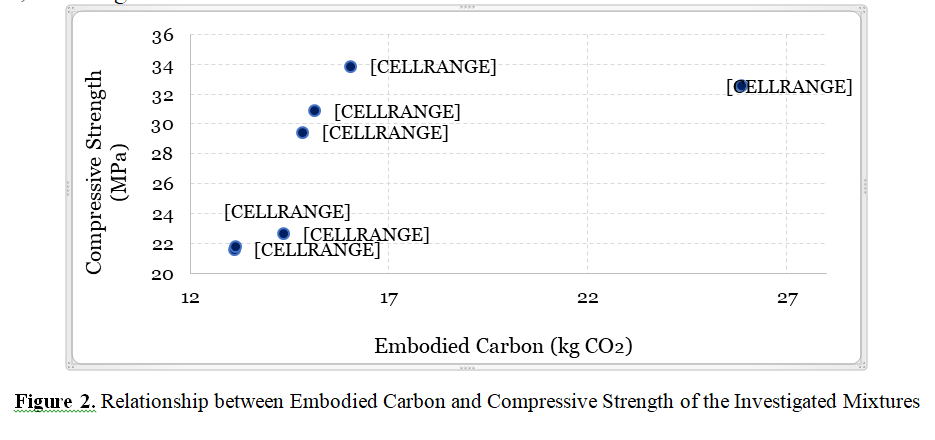
The production of Portland cement is a major source of global carbon dioxide (CO₂) emissions, mainly because of the high energy demand and calcination processes involved in clinker production. This study evaluates the embodied carbon emissions of Limestone calcined clay cement (LC3) concrete produced using locally available Iraqi limestone and thermally activated kaolin. Seven concrete mixtures were considered, including one ordinary Portland cement (OPC) reference mixture and six LC3 mixtures incorporating 15–20% limestone powder and 30-35% thermally activated kaolin. Two kaolin activation levels were investigated: low reactive kaolin and highly reactive kaolin. The embodied carbon of each mixture was calculated in a simplified way by employing factors obtained from published literature and recognized databases. The calculated results indicated that all LC3 mixtures achieved significant reductions in embodied carbon emissions compared with the reference mixture, ranging from 38.0% to 49.3%. the LC3 mixture with 20% limestone powder and 30% highly reactive kaolin had the lowest embodied carbon emissions of 13.11 kg CO₂ per experimental mixture and a compressive strength of 32.55 MPa, providing the best balance between environmental performance and mechanical strength among the investigated LC3 mixtures. increasing cement content from 50% to 55% increased the embodied carbon, while the use of highly reactive kaolin generally resulted in higher emissions. The results demonstrate that locally available Iraqi limestone and kaolin can be effectively used to produce low-carbon LC3 systems and provide practical guidance for optimizing binder composition and clay activation to reduce the embodied carbon of cementitious materials.
References
1. Nejad, B. M., Enferadi, S., & Andrew, R. (2025). A comprehensive analysis of process-related CO2 emissions from Iran’s cement industry. Cleaner Environmental Systems, 16, 100251. https://doi.org/https://doi.org/10.1016/j.cesys.2024.100251 DOI: https://doi.org/10.1016/j.cesys.2024.100251
2. Andrew, R. M. (2018). Global chemCO_2 emissions from cement production. Earth System Science Data, 10(1), 195–217. https://doi.org/https://doi.org/10.5194/essd-10-195-2018 DOI: https://doi.org/10.5194/essd-10-195-2018
3. Citaristi, I. (2022). International Energy Agency—IEA. In The Europa Directory of International Organizations 2022 (24th ed., p. 2). Routledge. DOI: https://doi.org/10.4324/9781003292548-126
4. IPCC Change. (2006). IPCC guidelines for national greenhouse gas inventories. 4. https://www.ipcc-tfi.iges.or.jp/meeting/pdfiles/Washington_Report.pdf
5. Scrivener, K. L., John, V. M., & Gartner, E. M. (2018). Eco-efficient cements: Potential economically viable solutions for a low-CO2 cement-based materials industry. Cement and Concrete Research, 114, 2–26. https://doi.org/https://doi.org/10.1016/j.cemconres.2018.03.015 DOI: https://doi.org/10.1016/j.cemconres.2018.03.015
6. Scrivener, K., Martirena, F., Bishnoi, S., & Maity, S. (2018). Calcined clay limestone cements (LC3). Cement and Concrete Research, 114, 49–56. https://doi.org/https://doi.org/10.1016/j.cemconres.2017.08.017 DOI: https://doi.org/10.1016/j.cemconres.2017.08.017
7. Olivo, A., Libera, A. D., Moratti, F., Dhers, S., Weldert, K., Schwesig, P., Bizzozero, J., & Magarotto, R. (2025). Insights on Admixtures Adsorption on Limestone Calcined Clay Cements. In K. Scrivener, M. Sharma, & F. Zunino (Eds.), Calcined Clays for Sustainable Concrete (Vol. 57, pp. 55–65). Springer Nature Switzerland. https://doi.org/https://doi.org/10.1007/978-3-031-83889-7_6 DOI: https://doi.org/10.1007/978-3-031-83889-7_6
8. Dhandapani, Y., & Santhanam, M. (2020). Influence of Calcined Clay-Limestone Ratio on Properties of Concrete with Limestone Calcined Clay Cement (LC3). In S. Bishnoi (Ed.), Calcined Clays for Sustainable Concrete (Vol. 57, pp. 731–738). Springer Singapore. https://doi.org/https://doi.org/10.1007/978-981-15-2806-4_81 DOI: https://doi.org/10.1007/978-981-15-2806-4_81
9. Díaz, Y. C., Berriel, S. S., Heierli, U., Favier, A. R., Sánchez Machado, I. R., Scrivener, K. L., Martirena Hernández, J. F., & Habert, G. (2017). Limestone calcined clay cement as a low-carbon solution to meet expanding cement demand in emerging economies. Development Engineering, 2, 82–91. https://doi.org/https://doi.org/10.1016/j.deveng.2017.06.001 DOI: https://doi.org/10.1016/j.deveng.2017.06.001
10. Habert, G., Miller, S. A., John, V. M., Provis, J. L., Favier, A., Horvath, A., & Scrivener, K. L. (2020). Environmental impacts and decarbonization strategies in the cement and concrete industries. Nature Reviews Earth & Environment, 1(11), 559–573. https://doi.org/https://doi.org/10.1038/s43017-020-0093-3 DOI: https://doi.org/10.1038/s43017-020-0093-3
11. Overmann, S., Vollpracht, A., & Matschei, T. (2024). Reactivity of Calcined Clays as SCM—A Review. Materials, 17(2), 312. https://doi.org/https://doi.org/10.3390/ma17020312 DOI: https://doi.org/10.3390/ma17020312
12. Dhandapani, Y., Joseph, S., Bishnoi, S., Kunther, W., Kanavaris, F., Kim, T., Irassar, E., Castel, A., Zunino, F., Machner, A., Talakokula, V., Thienel, K.-C., Wilson, W., Elsen, J., Martirena, F., & Santhanam, M. (2022). Durability performance of binary and ternary blended cementitious systems with calcined clay: A RILEM TC 282-CCL, review. Materials and Structures, 55(5), 145. https://doi.org/https://doi.org/10.1617/s11527-022-01974-0 DOI: https://doi.org/10.1617/s11527-022-01974-0
13. Nguyen, Q. D., Afroz, S., & Castel, A. (2022). Chloride Diffusion Resistance of Limestone Calcined Clay Cement (L3) Concrete Based on Calcined Clay Reactivity. 6th FIB International Congress, 233–239.
14. Sharma, M., Bishnoi, S., Martirena, F., & Scrivener, K. (2021). Limestone calcined clay cement and concrete: A state-of-the-art review. Cement and Concrete Research, 149, 106564. https://doi.org/https://doi.org/10.1016/j.cemconres.2021.106564 DOI: https://doi.org/10.1016/j.cemconres.2021.106564
15. BS EN197-1. (2011). Part 1: Composition, specifications and conformity criteria for common cements.
16. Ghazy, M. F., Maaty, E. S. A., Elaty, M. A., & Alrwashdeh, A. A. (2025). A comprehensive review of limestone calcined clay cement (LC3): Environmental and properties benefits, challenges, opportunities, and future directions. Results in Engineering, 28, 108319. https://doi.org/https://doi.org/10.1016/j.rineng.2025.108319 DOI: https://doi.org/10.1016/j.rineng.2025.108319
17. Fotsop, C. G., Lieb, A., & Scheffler, F. (2025). Elucidation of the thermo-kinetics of the thermal decomposition of cameroonian kaolin: Mechanism, thermodynamic study and identification of its by-products. RSC Advances, 15(39), 32172–32187. https://doi.org/https://doi.org/10.1039/d5ra05149e DOI: https://doi.org/10.1039/D5RA05149E
18. Wernet, G., Bauer, C., Steubing, B., Reinhard, J., Moreno-Ruiz, E., & Weidema, B. (2016). The ecoinvent database version 3 (part I): Overview and methodology. The International Journal of Life Cycle Assessment, 21(9), 1218–1230. https://doi.org/https://doi.org/10.1007/s11367-016-1087-8 DOI: https://doi.org/10.1007/s11367-016-1087-8
19. Kogel, J. E. (2014). Mining and Processing Kaolin. Elements, 10(3), 189–193. https://doi.org/https://doi.org/10.2113/gselements.10.3.189 DOI: https://doi.org/10.2113/gselements.10.3.189
20. Jena, M. S., Sahu, P., Dash, P., & Mohanty, J. K. (2013). Beneficiation of limestone plant rejects for value addition. Journal of Hazardous Materials, 262, 218–227. https://doi.org/https://doi.org/10.1016/j.jhazmat.2013.08.048 DOI: https://doi.org/10.1016/j.jhazmat.2013.08.048
21. Inaba, A., Chevassus, S., Cumberlege, T., Hong, E., Kataoka, A., Lohsomboon, P., Mercadie, C., Mungcharoen, T., & Radunsky, K. (2016). Carbon Footprint of Products. In M. Finkbeiner (Ed.), Special Types of Life Cycle Assessment (pp. 11–71). Springer Netherlands. https://doi.org/https://doi.org/10.1007/978-94-017-7610-3_2 DOI: https://doi.org/10.1007/978-94-017-7610-3_2
22. Rosado, L. P., Vitale, P., Penteado, C. S. G., & Arena, U. (2017). Life cycle assessment of natural and mixed recycled aggregate production in Brazil. Journal of Cleaner Production, 151, 634–642. https://doi.org/https://doi.org/10.1016/j.jclepro.2017.03.068 DOI: https://doi.org/10.1016/j.jclepro.2017.03.068
23. Zunino, F., & Scrivener, K. (2025). Hydration and strength development of low-clinker (<50 %) factor limestone calcined clay cements (LC3): A comparative study with natural pozzolans. Construction and Building Materials, 499, 144075. https://doi.org/https://doi.org/10.1016/j.conbuildmat.2025.144075 DOI: https://doi.org/10.1016/j.conbuildmat.2025.144075
24. Hernández, J. F. M., & Santhanam, M. (2025). Closing Letter of RILEM TC 282-CCL: Calcined Clays as Supplementary Cementitious Materials. RILEM Technical Letters, 10, 51–57. https://doi.org/https://doi.org/10.21809/rilemtechlett.2025.215 DOI: https://doi.org/10.21809/rilemtechlett.2025.215
25. Almada, B. S., Santos, W. J., & Silva, G. J. B. (2025). Study of the potential use of LC3 as a binder in civil construction: A review. IOP Conference Series: Earth and Environmental Science, 1536(1), 012033. https://doi.org/https://doi.org/10.1088/1755-1315/1536/1/012033 DOI: https://doi.org/10.1088/1755-1315/1536/1/012033
Downloads
Published
Issue
Section
License
Copyright (c) 2026 Al-Noor Journal of Engineering Management and Computer Science

This work is licensed under a Creative Commons Attribution-NonCommercial-ShareAlike 4.0 International License.
How to Cite