Real-time driver drowsiness detection Using YOLO algorithm-based Hybrid Features
DOI:
https://doi.org/10.71229/f5sj0d45Keywords:
Driver Drowsiness Detection (DDD) , Road Safety – , YOLO10 – , Head movements -, eye aspect ratio (EAR)Abstract
One of the leading causes of mortality worldwide is traffic accidents brought on by sleepy drivers, as the driver gradually loses focus without direct awareness. And although there are traditional techniques for monitoring the driver, most of them suffer from limited accuracy or slow response. We created a method to identify driver inattention using real-time video processing to quickly and accurately categorize driver information in response to the growing need for driver monitoring technology while driving.
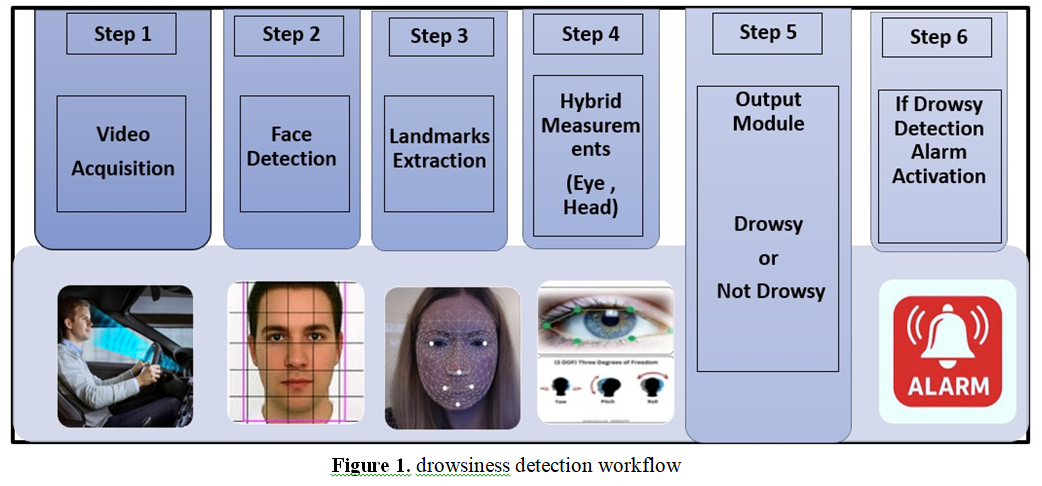
The detection system relies on head tilt and eye movement indicators as key determinants of drowsiness thru real-time face detection using the YOLO algorithm. The high performance and ease of use of the YOLO algorithm helped identify signs of drowsiness with low response time and high precision. In this paper, we adopted the tenth version of the YOLO algorithm. YOLOv10 detects the driver's face. then facial landmarks and vital areas are extracted by MediaPipe FaceMesh. After that, the head rotation angles (Yaw, Pitch, Roll) and the eye closure ratio are calculated separately using computer vision algorithms to determine the driver's drowsiness. The results showed that the rapid face detection of the YOLO algorithm reduces errors and increases the system's reliability. Additionally, combining head movement indicators with eye indicators enhances the accuracy and speed of drowsiness detection compared to relying on a single indicator. The model was tested on the (DDD-NTHU) database from OpenCV. The system achieved an accuracy of 96% in identifying two states of the driver: alert or drowsy.
References
[1] I. Journal and O. F. Circuits, “Contributions to driver fatigue detection based on,” vol. 15, pp. 1–7, 2021, doi: 10.46300/9106.2021.15.1. DOI: https://doi.org/10.46300/9106.2021.15.1
[2] Y. Kim, “Deep Learning-Based Drowsiness Detection System for Driver ’ s Deep Learning-Based Drowsiness Detection System for Driver ’ s Safety,” pp. 154080–154102, 2025. DOI: https://doi.org/10.1109/ACCESS.2025.3604728
[3] T. National and H. Traffic, “Drowsy Driving in Fatal Crashes , United Assessment of Driver Drowsiness in Crashes,” pp. 2017–2021, 2024.
[4] G. Li, B. Lee, and W. Chung, “Smartwatch-Based Wearable EEG System for Driver Drowsiness Detection,” IEEE Sens. J., vol. 15, no. 12, pp. 7169–7180, 2015, doi: 10.1109/JSEN.2015.2473679. DOI: https://doi.org/10.1109/JSEN.2015.2473679
[5] I. A. Fouad, “A robust and efficient EEG-based drowsiness detection system using different machine learning algorithms Pre-Processing,” Ain Shams Eng. J., vol. 14, no. 3, p. 101895, 2023, doi: 10.1016/j.asej.2022.101895. DOI: https://doi.org/10.1016/j.asej.2022.101895
[6] A. Darzi, S. M. Gaweesh, M. M. Ahmed, and D. Novak, “Identifying the Causes of Drivers ’ Hazardous States Using Driver Characteristics , Vehicle Kinematics , and Physiological Measurements,” vol. 12, no. August, pp. 1–13, 2018, doi: 10.3389/fnins.2018.00568. DOI: https://doi.org/10.3389/fnins.2018.00568
[7] K. D. V. H. Shfwhg et al., “&rpsdudwlyh 6wxg wr ’hwhfw ’ulyhu ’urzvlqhvv,” vol. 7, pp. 678–683.
[8] E. Shaik, “Transportation Research Interdisciplinary Perspectives A systematic review on detection and prediction of driver drowsiness,” Transp. Res. Interdiscip. Perspect., vol. 21, no. June, p. 100864, 2023, doi: 10.1016/j.trip.2023.100864. DOI: https://doi.org/10.1016/j.trip.2023.100864
[9] J. Singh, R. Kanojia, R. Singh, R. Bansal, and S. Bansal, “Driver Drowsiness Detection System – An Approach By Machine Learning Application,” vol. 13, no. 10, pp. 3002–3012, 2022, doi: 10.47750/pnr.2022.13.S10.361.
[10] A. A. Rather et al., “A Survey on Fatigue and Drowsiness Detection Techniques in Driving,” pp. 239–244, 2021. DOI: https://doi.org/10.1109/ICCCIS51004.2021.9397224
[11] S. Biradar, S. Pathak, N. Shirude, P. Tiwari, and P. U. Patil, “Driver Drowsiness Detection Using Eye Movement Behavior,” vol. 7, no. 3, pp. 1–11, 2025. DOI: https://doi.org/10.36948/ijfmr.2025.v07i03.44117
[12] K. Rahul, R. S. G, S. Rajesh, and G. Udhayakumar, “Driver ’ s Drowsiness Detection by Analyzing Yaw ning and Eye Closure,” no. May, pp. 3101–3104, 2022.
[13] T. Fonseca, “Drowsiness Detection in Drivers : A Systematic Review of Deep Learning-Based Models,” pp. 1–43, 2025. DOI: https://doi.org/10.3390/app15169018
[14] L. Approach and B. Akrout, “How to Prevent Drivers before Their Sleepiness Using Deep,” pp. 1–19, 2023.
[15] E. Arkin, N. Yadikar, X. Xu, A. Aysa, and K. Ubul, “A survey : object detection methods from CNN to transformer,” pp. 21353–21383, 2023. DOI: https://doi.org/10.1007/s11042-022-13801-3
[16] A. O. B, I. Keshta, and M. Al-fayoumi, “Visual Object Tracking Using Machine Learning,” vol. 1, pp. 63–79, 2023. DOI: https://doi.org/10.1007/978-3-031-40398-9_4
[17] Z. Tian, C. Shen, H. Chen, and T. He, “FCOS : A Simple and Strong Anchor-free Object Detector,” pp. 1–13. DOI: https://doi.org/10.1109/TPAMI.2020.3032166
[18] O. Access, “CRIMINAL IDENTIFICATIONS SYSTEM FOR LAW ENFORCEMENT DEPARTMENT USING DEEP LEARNING,” no. 03, pp. 4763–4770, 2024.
[19] Z. Yu, H. Huang, W. Chen, Y. Su, Y. Liu, and C. V Aug, “YOLO-FaceV2 : A Scale and Occlusion Aware Face Detector,” pp. 1–18.
[20] U. S. S. Phani, P. Parvathaneni, N. Srinivasu, P. Barsocchi, and P. Barsocchi, “Statistical Analysis of Design Aspects of Various YOLO-Based Deep Learning Models for Object Detection,” Int. J. Comput. Intell. Syst., vol. 0123456789, pp. 1–29, 2023, doi: 10.1007/s44196-023-00302-w. DOI: https://doi.org/10.1007/s44196-023-00302-w
[21] Z. Zheng, P. Wang, W. Liu, J. Li, R. Ye, and D. Ren, “Distance-IoU Loss: Faster and Better Learning for Bounding Box Regression,” no. 2, 2019.
[22] J. Redmon, S. Divvala, R. Girshick, and A. Farhadi, “You Only Look Once : Unified , Real-Time Object Detection”.
[23] S. Shinde, A. Kothari, and V. Gupta, “ScienceDirect YOLO based Human Action Recognition and Localization,” Procedia Comput. Sci., vol. 133, no. 2018, pp. 831–838, 2019, doi: 10.1016/j.procs.2018.07.112. DOI: https://doi.org/10.1016/j.procs.2018.07.112
[24] H. Zhao, “Anormal Target Detection for Power Transmission Cable Drone Images Employing Improved YOLO10 and ESRGAN,” no. 1, pp. 768–777, 2025, doi: 10.5755/j01.itc.54.3.41460. DOI: https://doi.org/10.5755/j01.itc.54.3.41460
[25] J. Lee, “YOLO with adaptive frame control for real ‑ time object detection applications,” Multimed. Tools Appl., pp. 36375–36396, 2022, doi: 10.1007/s11042-021-11480-0. DOI: https://doi.org/10.1007/s11042-021-11480-0
[26] A. Wang et al., “YOLOv10 : Real-Time End-to-End Object Detection,” no. NeurIPS, pp. 1–21, 2024. DOI: https://doi.org/10.52202/079017-3429
[27] Q. Wu, “Improved YOLOv10 : A Real-Time Object Detection Approach in Complex Environments,” pp. 1–17, 2025. DOI: https://doi.org/10.3390/s25226893
[28] J. Lyu and D. Chen, “Long-term Multi-granularity Deep Framework for Driver Drowsiness Detection,” no. 1.
Downloads
Published
Issue
Section
License
Copyright (c) 2026 Al-Noor Journal of Engineering Management and Computer Science

This work is licensed under a Creative Commons Attribution-NonCommercial-ShareAlike 4.0 International License.
How to Cite