Analysis of Video Stream for Known Plaintext Attack and Perceptual Encryption Feature
DOI:
https://doi.org/10.71229/0qfjw516Keywords:
Perceptual Encryption, Known Plaintext Attack (KPA), MPEG-2, Cipher, Chaotic-Neural NetworkAbstract
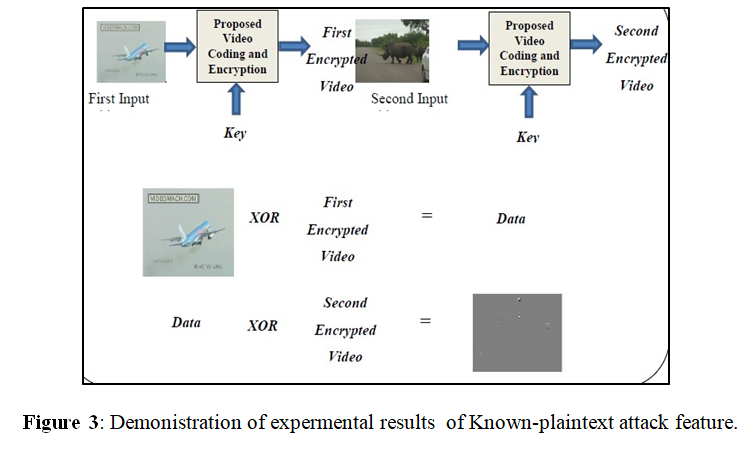
Secure transmission of digital video must Coordinate two competing goals: protecting the content against cryptographic attacks while preserving format compliance and low complexity for real-time multimedia delivery. This paper presents an integrated joint video coding-and-encryption framework in which a convolutional neural network (CNN) cipher is embedded into a modified MPEG-2 codec. The cipher operates as a keyed value transformation whose weights and biases are generated from a chaotic logistic map, with the control parameter μ and the initial value x₀ acting as the secret key encryption is applied in the coded domain to the quantized transform coefficients and motion vectors before entropy coding. Two operating modes are supported: a full-protection mode that encrypts coefficients and motion vectors, and a perceptual mode that encrypts only the motion-vector stream together with a reduced quality factor, yielding a controllable low-quality preview suitable for try-before-buy services. Building on a focused review of prior work on known-plaintext attacks (KPA) and perceptual encryption, the scheme is assessed against the KPA threat through an XOR-based analysis, which shows that the effective mask recovered from one plaintext–ciphertext pair cannot decrypt a different encrypted scene and instead produces a noise-like result. Experimental results demonstrate that the proposed framework resists the known-plaintext attack while providing controllable perceptual protection, confirming its suitability for secure and efficient video transmission.
References
[1] S. Li, G. Chen, A. Cheung, B. Bhargava, and K.-T. Lo, "On the design of perceptual MPEG-video encryption algorithms," IEEE Transactions on Circuits and Systems for Video Technology, vol. 17, no. 2, pp. 214–223, 2007. DOI: https://doi.org/10.1109/TCSVT.2006.888840
[2] P. Ping, J. Fu, Y. Mao, F. Xu, and J. Gao, "Meaningful encryption: Generating visually meaningful encrypted images by compressive sensing and reversible color transformation," IEEE Access, vol. 7, pp. 170168–170184, 2019. DOI: https://doi.org/10.1109/ACCESS.2019.2955570
[3] F. Dufaux and T. Ebrahimi, "Scrambling for privacy protection in video surveillance systems," IEEE Transactions on Circuits and Systems for Video Technology, vol. 18, no. 8, pp. 1168–1174, 2008, https://doi:10.1109/TCSVT.2008.928225. DOI: https://doi.org/10.1109/TCSVT.2008.928225
[4] G. Alvarez and S. Li, "Some basic cryptographic requirements for chaos-based cryptosystems," International Journal of Bifurcation and Chaos, vol. 16, no. 8, pp. 2129–2151, 2006, https://doi:10.1142/S0218127406015970. DOI: https://doi.org/10.1142/S0218127406015970
[5] F. Peng, X. Zhang, Z. Lin, and M. Long, "A tunable selective encryption scheme for H.265/HEVC based on chroma IPM and coefficient scrambling," IEEE Transactions on Circuits and Systems for Video Technology, vol. 30, no. 8, pp. 2765–2780, 2020, https://doi:10.1109/TCSVT.2019.2924910. DOI: https://doi.org/10.1109/TCSVT.2019.2924910
[6] J.-C. Yen and J.-I. Guo, "A chaotic neural network for signal encryption/decryption and its VLSI architecture," in Proc. 10th VLSI Design/CAD Symposium, 1999, pp. 319–322.
[7] N. V. Prasad, S. Tumu, and A. R. Bevi, "Memristor based chaotic neural network with application in nonlinear cryptosystem," in Proc. Springer Int. Conf., Lecture Notes in Computer Science, 2017, https://doi:10.1007/978-3-319-65172-9_5. DOI: https://doi.org/10.1007/978-3-319-65172-9_5
[8] T. A. Fadil, N. Y. Shahrul, A. Badlishah, and Y. Abid, "A chaotic neural network based encryption algorithm for MPEG-2 encoded video signal," in Proc. Int. Conf. on Man-Machine Systems (ICoMMS 2012), 2012; extended in International Journal of Artificial Intelligence and Soft Computing, 2013, https://doi:10.1504/IJAISC.2013.056841 DOI: https://doi.org/10.1504/IJAISC.2013.056841
[9] He, J., Gu, K., Huang, Y., Li, Y., & Chen, X. (2025). "An Improved Chosen Plaintext Attack on JPEG Encryption." Journal of Sensor and Actuator Networks, 14(4), 72. https://doi.org/10.3390/jsan14040072. DOI: https://doi.org/10.3390/jsan14040072
[10] Chen, C., Qu, L., Amirpour, H., Wang, X., Timmerer, C., & Tian, Z. (2024). "On the Security of Selectively Encrypted HEVC Video Bitstreams." ACM Transactions on Multimedia Computing, Communications, and
Applications, 20(9), 1–27. https://doi.org/10.1145/3672568. DOI: https://doi.org/10.1145/3672568
[11] Liu, G., Xu, G., Wang, C., & Xu, G. (2025). "Hyper-Chaos and CNN-Based Image Encryption Scheme for Wireless Communication Transmission." Computers, Materials & Continua, 84(3), 4851–4868. https://doi.org/10.32604/cmc.2025.066331. DOI: https://doi.org/10.32604/cmc.2025.066331
[12] Kashyap, U., Padhi, S. K., & Ali, S. S. (2024). "Attack GAN (AGAN): A New Security Evaluation Tool for Perceptual Encryption." arXiv:2407.06570. https://arxiv.org/abs/2407.06570.
[13] Nair, B. V., Vismaya, V. S., Muni, S. S., & Durdu, A. (2024). "Deep Learning and Chaos: A Combined Approach to Image Encryption and Decryption." arXiv:2406.16792. https://arxiv.org/abs/2406.16792.
Downloads
Published
Issue
Section
License
Copyright (c) 2026 Al-Noor Journal of Engineering Management and Computer Science

This work is licensed under a Creative Commons Attribution-NonCommercial-ShareAlike 4.0 International License.
How to Cite