Spatiotemporal Key Synchronization and Recursive Integrity Auditing for One-Way Industrial Channels
DOI:
https://doi.org/10.71229/n7fwnx89Keywords:
Unidirectional Security Gateways, , Data Diodes, , Spatiotemporal Entropy, , Merkle Trees, , Non-Interactive Key Exchange, , Critical Infrastructure Security, , Asynchronous AttestationAbstract
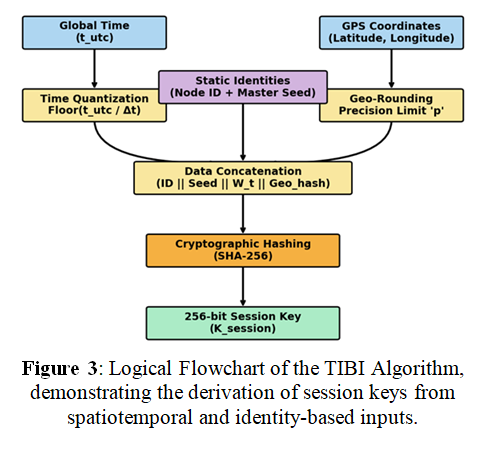
In Critical Energy Infrastructures (CEI), the standard cryptographic synchronization model failed once return paths were physically severed by one-way data diodes. Conventional interactive workflows, including Diffie-Hellman key exchanges and TCP-style handshakes, could not function in these zero-feedback environments. Consequently, industrial deployments often relied on static pre-shared keys or unprotected telemetry, exposing critical systems to considerable risk. This study proposed a multi-layer security framework for non-interactive key coordination and asynchronous integrity verification over strictly unbuffered industrial channels. The framework combined Geo-Spatial Temporal Identity-Based Initialization (TIBI), which derived session entropy from localized spatiotemporal anchors, with Interleaved Merkle-Hash Chains (IM-Forest), which enabled recursive forensic auditing. The proposed approach was evaluated using a high-fidelity discrete-event simulation engine under simulated Man-in-the-Middle and replay-attack conditions. Results showed that the TIBI-IM approach achieved 100% detection accuracy for bit-level forgeries and replay attacks. When benchmarked against conventional RSA-2048 configurations, the proposed framework reduced computational latency by approximately 34.6% and bandwidth overhead by approximately 87.5%, while peak memory consumption remained below 150 MB. These findings indicated that the framework established a mathematically self-contained isolation boundary that supported resilience among geographically separated organizations. The approach enabled asynchronous attestation without requiring two-way signaling or interactive trust establishment, addressing a persistent limitation of conventional cryptographic protocols in unidirectional industrial environments.
Downloads
Published
Issue
Section
License
Copyright (c) 2026 Al-Noor Journal of Engineering Management and Computer Science

This work is licensed under a Creative Commons Attribution-NonCommercial-ShareAlike 4.0 International License.
How to Cite