Executed Reduced-Order Screening and a Proposed High-Fidelity Verification Protocol for Flexible Vortex Generators in a Heated Turbulent Rectangular Channel
DOI:
https://doi.org/10.71229/76056198Keywords:
Convective heat transfer, Flexible vortex generator, Fluid–structure interaction, Multifidelity modeling, Turbulent channel flowAbstract
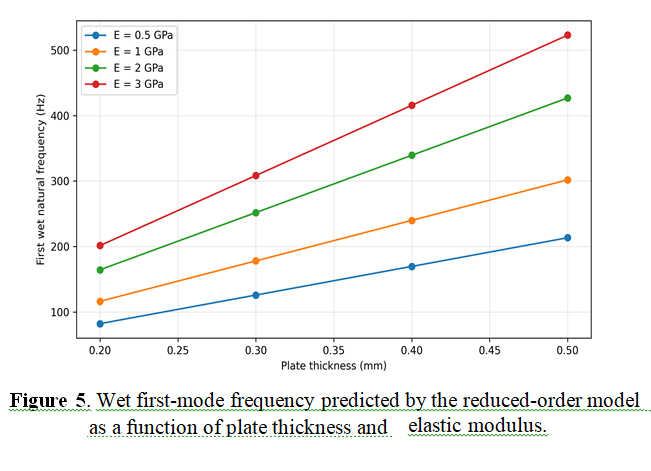
While flexible vortex generators might enhance convective transport through the passive, unsteady near-wall mixing they impart, the structural shape of such features must be optimized for deformation, avoided failures, and minimized pressure-loss concurrently. This manuscript documents a multifidelity pre-screening and verification protocol for the heated turbulent rectangular channel of a wall-mounted flexible plate. The sample evidence includes direct space-time lower-fidelity analytical reference calculations, a reduced-order fluid–structure screening study of 720 cases, and a robustness analysis of 81 scenarios. Wet natural frequency, forcing proximity, static deflection, bounded dynamic amplitude, root stress and qualitative mixing and pressure indices swept over Reynolds number (Re), elastic modulus (E), thickness (t), inclination angle(θ) and length ratio as part of a screening model on the device. No, these indices are only used to rank candidate configurations; they are not predictions of Nusselt number, pressure drop or performance evaluation criterion. The following step is the specification of a seventeen-case three-dimensional ANSYS Fluent–Transient Structural–System Coupling matrix consisting of smooth-channel and rigid-generator controls, mesh/time/coupling studies and validation needs. This higher-ranked reduced-order candidate is thus recommended as a verification priority, rather than an optimal thermal-hydraulic configuration. In this manuscript, we present a route from generalizable, reproducible pre-screening to evidence-based CFD–FSI assessment with no unsupported device-performance claims.
References
[1] M. Awais and A. A. Bhuiyan, “Heat transfer enhancement using different types of vortex generators: A review on experimental and numerical activities,” Thermal Science and Engineering Progress, vol. 5, pp. 524–545, 2018, doi: 10.1016/j.tsep.2018.02.007. DOI: https://doi.org/10.1016/j.tsep.2018.02.007
[2] A. M. Jacobi and R. K. Shah, “Heat transfer surface enhancement through the use of longitudinal vortices: A review of recent progress,” Experimental Thermal and Fluid Science, vol. 11, pp. 295–309, 1995, doi: 10.1016/0894-1777(95)00066-U. DOI: https://doi.org/10.1016/0894-1777(95)00066-U
[3] S. Ali, C. Habchi, S. Menanteau, T. Lemenand, and J.-L. Harion, “Heat transfer and mixing enhancement by free elastic flaps oscillation,” International Journal of Heat and Mass Transfer, vol. 85, pp. 250–264, 2015, doi: 10.1016/j.ijheatmasstransfer.2015.01.122. DOI: https://doi.org/10.1016/j.ijheatmasstransfer.2015.01.122
[4] S. Ali, S. Menanteau, C. Habchi, T. Lemenand, and J.-L. Harion, “Heat transfer and mixing enhancement by using multiple freely oscillating flexible vortex generators,” Applied Thermal Engineering, vol. 105, pp. 276–289, 2016, doi: 10.1016/j.applthermaleng.2016.04.130. DOI: https://doi.org/10.1016/j.applthermaleng.2016.04.130
[5] S. Ali, C. Habchi, S. Menanteau, T. Lemenand, and J.-L. Harion, “Three-dimensional numerical study of heat transfer and mixing enhancement in a circular pipe using self-sustained oscillating flexible vorticity generators,” Chemical Engineering Science, vol. 162, pp. 152–168, 2017, doi: 10.1016/j.ces.2016.12.039. DOI: https://doi.org/10.1016/j.ces.2016.12.039
[6] A. Dadvand, S. Hosseini, S. Aghebatandish, and B. C. Khoo, “Enhancement of heat and mass transfer in a microchannel via passive oscillation of a flexible vortex generator,” Chemical Engineering Science, vol. 207, pp. 556–580, 2019, doi: 10.1016/j.ces.2019.06.045. DOI: https://doi.org/10.1016/j.ces.2019.06.045
[7] S. G. Park, “Heat transfer enhancement by a wall-mounted flexible vortex generator with an inclination angle,” International Journal of Heat and Mass Transfer, vol. 148, Art. no. 119053, 2020, doi: 10.1016/j.ijheatmasstransfer.2019.119053. DOI: https://doi.org/10.1016/j.ijheatmasstransfer.2019.119053
[8] S. Hosseini, S. Aghebatandish, A. Dadvand, and B. C. Khoo, “An immersed boundary-lattice Boltzmann method with multi relaxation time for solving flow-induced vibrations of an elastic vortex generator and its effect on heat transfer and mixing,” Chemical Engineering Journal, vol. 405, Art. no. 126652, 2021, doi: 10.1016/j.cej.2020.126652. DOI: https://doi.org/10.1016/j.cej.2020.126652
[9] M. S. Kang, S. G. Park, and C. T. Dinh, “Heat transfer enhancement by a pair of asymmetric flexible vortex generators and thermal performance prediction using machine learning algorithms,” International Journal of Heat and Mass Transfer, vol. 200, Art. no. 123518, 2023, doi: 10.1016/j.ijheatmasstransfer.2022.123518. DOI: https://doi.org/10.1016/j.ijheatmasstransfer.2022.123518
[10] J. Kim, S. G. Park, and C. T. Dinh, “Enhancement of heat transfer performance with asymmetrically inclined flexible vortex generators: A numerical analysis,” Heat and Mass Transfer, vol. 60, pp. 101–116, 2024, doi: 10.1007/s00231-023-03422-3. DOI: https://doi.org/10.1007/s00231-023-03422-3
[11] M. Sheikhizad Saravani, H. Mohaddes Deylami, and M. Naghashzadegan, “Investigating the effect of physical parameters of a flexible vortex generator on the flow field and heat transfer inside a microchannel,” Thermal Science and Engineering Progress, vol. 54, Art. no. 102824, 2024, doi: 10.1016/j.tsep.2024.102824. DOI: https://doi.org/10.1016/j.tsep.2024.102824
[12] S. Caliskan, A. D. Koseoglu, A. Dogan, and U. R. Sahin, “Experimental investigation of the effect of flexible/rigid flag on heat transfer,” International Journal of Thermal Sciences, vol. 188, Art. no. 108147, 2023, doi: 10.1016/j.ijthermalsci.2023.108147. DOI: https://doi.org/10.1016/j.ijthermalsci.2023.108147
[13] M. Dogan and A. A. Igci, “An experimental comparison of delta winglet and novel type vortex generators for heat transfer enhancement in a rectangular channel and flow visualization with stereoscopic PIV,” International Journal of Heat and Mass Transfer, vol. 164, Art. no. 120592, 2021, doi: 10.1016/j.ijheatmasstransfer.2020.120592. DOI: https://doi.org/10.1016/j.ijheatmasstransfer.2020.120592
[14] C. Habchi, M. Oneissi, S. Russeil, D. Bougeard, and T. Lemenand, “Comparison of eddy viscosity turbulence models and stereoscopic PIV measurements for a flow past rectangular-winglet pair vortex generator,” Chemical Engineering and Processing—Process Intensification, vol. 169, Art. no. 108637, 2021, doi: 10.1016/j.cep.2021.108637. DOI: https://doi.org/10.1016/j.cep.2021.108637
[15] H. Karkaba, T. Dbouk, C. Habchi, S. Russeil, T. Lemenand, and D. Bougeard, “Multi-objective optimization of vortex generators for heat transfer enhancement using large design-space exploration,” Chemical Engineering and Processing—Process Intensification, vol. 154, Art. no. 107982, 2020, doi: 10.1016/j.cep.2020.107982. DOI: https://doi.org/10.1016/j.cep.2020.107982
[16] H. Karkaba, T. Dbouk, C. Habchi, S. Russeil, T. Lemenand, and D. Bougeard, “Multiobjective optimization of vortex generators for heat transfer enhancement in turbulent flows,” International Journal of Thermofluids, vol. 22, Art. no. 100633, 2024, doi: 10.1016/j.ijft.2024.100633. DOI: https://doi.org/10.1016/j.ijft.2024.100633
[17] S. Ali, C. Habchi, H. Zaytoun, M. Khaled, and T. Dbouk, “Surrogate-based optimization of the attack and inclination angles of a delta winglet pair vortex generator in turbulent channel flow,” International Journal of Thermofluids, vol. 20, Art. no. 100473, 2023, doi: 10.1016/j.ijft.2023.100473. DOI: https://doi.org/10.1016/j.ijft.2023.100473
[18] P. Saini, A. Dhar, and S. Powar, “Performance enhancement of fin and tube heat exchanger employing curved delta winglet vortex generator with circular punched holes,” International Journal of Thermofluids, vol. 20, Art. no. 100452, 2023, doi: 10.1016/j.ijft.2023.100452. DOI: https://doi.org/10.1016/j.ijft.2023.100452
[19] M. Fahad, N. Ifraj, S. Tahsin, and M. J. Hasan, “Numerical investigation of the hydrothermal performance of novel vortex generators in a rectangular channel by employing inclination and rotational angles,” International Journal of Thermofluids, vol. 20, Art. no. 100500, 2023, doi: 10.1016/j.ijft.2023.100500. DOI: https://doi.org/10.1016/j.ijft.2023.100500
[20] H. Fu, H. Sun, L. Yang, L. Yan, Y. Luan, and F. Magagnato, “Effects of the configuration of delta winglet longitudinal vortex generators and channel height on flow and heat transfer in minichannels,” Applied Thermal Engineering, vol. 227, Art. no. 120401, 2023, doi: 10.1016/j.applthermaleng.2023.120401. DOI: https://doi.org/10.1016/j.applthermaleng.2023.120401
[21] A. U. Tepe and H. Yilmaz, “Thermal–hydraulic performance of the circular-slice-shaped-winglet for tube bank heat exchanger,” International Journal of Thermal Sciences, vol. 179, Art. no. 107711, 2022, doi: 10.1016/j.ijthermalsci.2022.107711. DOI: https://doi.org/10.1016/j.ijthermalsci.2022.107711
[22] H. Z. Demirag, M. Dogan, and A. A. Igci, “The experimental and numerical investigation of novel type conic vortex generator on heat transfer enhancement,” International Journal of Thermal Sciences, vol. 191, Art. no. 108383, 2023, doi: 10.1016/j.ijthermalsci.2023.108383. DOI: https://doi.org/10.1016/j.ijthermalsci.2023.108383
[23] J. K. Shao, Y. P. Hao, and Z. Y. Li, “Multi-objective optimization of a microchannel heat sink combining cavities and longitudinal vortex generators based on CFD and NSGA-II genetic algorithm,” International Journal of Heat and Mass Transfer, vol. 220, Art. no. 125019, 2024, doi: 10.1016/j.ijheatmasstransfer.2023.125019. DOI: https://doi.org/10.1016/j.ijheatmasstransfer.2023.125019
[24] Z. Yang, J. Gu, X. Luo, et al., “An RSM approach to optimize the thermal performance of novel type vortex generators,” Progress in Nuclear Energy, vol. 167, Art. no. 104978, 2024, doi: 10.1016/j.pnucene.2023.104978. DOI: https://doi.org/10.1016/j.pnucene.2023.104978
[25] F. R. Menter, “Two-equation eddy-viscosity turbulence models for engineering applications,” AIAA Journal, vol. 32, no. 8, pp. 1598–1605, 1994, doi: 10.2514/3.12149. DOI: https://doi.org/10.2514/3.12149
[26] S. B. Pope, Turbulent Flows. Cambridge, U.K.: Cambridge University Press, 2000. DOI: https://doi.org/10.1017/CBO9780511840531
[27] R. D. Blevins, Flow-Induced Vibration, 2nd ed. New York, NY, USA: Van Nostrand Reinhold, 1990.
[28] M. P. Païdoussis, Fluid-Structure Interactions: Slender Structures and Axial Flow, 2nd ed., vol. 1. Oxford, U.K.: Academic Press, 2014.
[29] I. B. Celik, U. Ghia, P. J. Roache, C. J. Freitas, H. Coleman, and P. E. Raad, “Procedure for estimation and reporting of uncertainty due to discretization in CFD applications,” Journal of Fluids Engineering, vol. 130, Art. no. 078001, 2008, doi: 10.1115/1.2960953. DOI: https://doi.org/10.1115/1.2960953
[30] V. Gnielinski, “New equations for heat and mass transfer in turbulent pipe and channel flow,” International Chemical Engineering, vol. 16, pp. 359–368, 1976.
[31] T. L. Bergman, A. S. Lavine, F. P. Incropera, and D. P. DeWitt, Fundamentals of Heat and Mass Transfer, 8th ed. Hoboken, NJ, USA: Wiley, 2017.
[32] ASME, Standard for Verification and Validation in Computational Fluid Dynamics and Heat Transfer, ASME V&V 20-2009, New York, NY, USA, 2009.
[33] P. J. Roache, Verification and Validation in Computational Science and Engineering. Albuquerque, NM, USA: Hermosa Publishers, 1998.
[34] ANSYS, Inc., ANSYS Fluent Theory Guide, Release 2024 R2, 2024.
Downloads
Published
Issue
Section
License
Copyright (c) 2026 Al-Noor Journal of Engineering Management and Computer Science

This work is licensed under a Creative Commons Attribution-NonCommercial-ShareAlike 4.0 International License.
How to Cite