Experimental Investigation of the Relationship Between RMS Delay Spread and Path Loss in Outdoor Mobile Ultra-Wideband Channels
DOI:
https://doi.org/10.71229/d7be9w47Keywords:
UWB, path loss, CIR, measurement, delay spread, RegressionAbstract
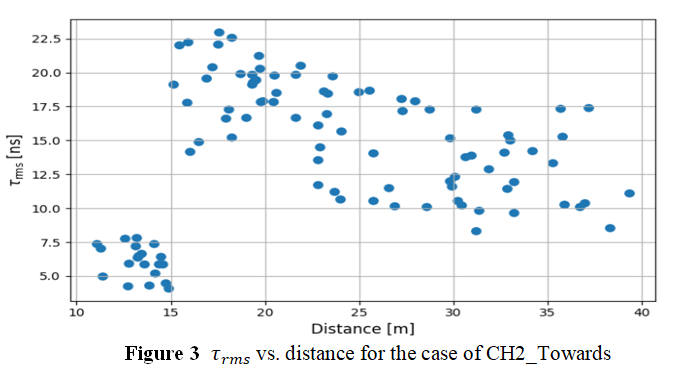
Ultra-wideband (UWB) is an important technology for getting high data rate communications, where it is used in several applications, such as indoor positioning, radar sensing and medical devices. Similar to other communication technologies, understanding UWB wireless channel behaviour and modeling its parameters is crucial for overall wireless system performance. Some of the crucial channel parameters are root mean square (RMS) delay spread \tau_rms and path loss. Several research works studied these parameters and modelled them in a single view on each of them. However, there is a lack of knowledge in understanding and modeling the relationship between \tau_rms and path loss for the case of mobile outdoor UWB channels. In this paper, statistical characterization and modeling of the relationship between \tau_rms and path loss is performed. The two parameters were extracted based on conducted mobile outdoor UWB channel measurements. Results indicate the positive correlation between them with a crucial effect of the scattering environment. The relationship is modeled with a third-order polynomial regression model which provides suitable statistical indications.
References
[1] B. Hua et al., “Ultra-Wideband Nonstationary Channel Modeling for UAV-to-Ground Communications,” IEEE Trans. Wirel. Commun., vol. 24, no. 5, pp. 4190–4204, May 2025, doi: 10.1109/TWC.2025.3537766.
[2] H. Ni et al., “Path Loss and Shadowing for UAV-to-Ground UWB Channels Incorporating the Effects of Built-Up Areas and Airframe,” IEEE Trans. Intell. Transp. Syst., vol. 25, no. 11, pp. 17066–17077, Nov. 2024, doi: 10.1109/TITS.2024.3418952.
[3] D. Boshoff, M. M. Zhou, R. E. Nkrow, B. Silva, and G. P. Hancke, “UWB Physical Layer Key Sharing Using the Frequency Domain CIR Magnitude,” IEEE Trans. Ind. Inform., vol. 21, no. 2, pp. 2000–2009, Feb. 2025, doi: 10.1109/TII.2025.3526320.
[4] Z. Li, Y. Huan, X. Zhang, Z. Li, and X. Chen, “A UWB Positioning Method Based on Clustering for NLOS Identification and Mitigation,” IEEE Trans. Ind. Electron., pp. 1–12, 2026, doi: 10.1109/TIE.2025.3649770.
[5] D. Coppens, A. Shahid, S. Lemey, B. Van Herbruggen, C. Marshall, and E. De Poorter, “An Overview of UWB Standards and Organizations (IEEE 802.15.4, FiRa, Apple): Interoperability Aspects and Future Research Directions,” IEEE Access, vol. 10, pp. 70219–70241, 2022, doi: 10.1109/ACCESS.2022.3187410.
[6] M. Cheraghinia et al., “A Comprehensive Overview on UWB Radar: Applications, Standards, Signal Processing Techniques, Datasets, Radio Chips, Trends and Future Research Directions,” IEEE Commun. Surv. Tutor., vol. 27, no. 4, pp. 2283–2324, Aug. 2025, doi: 10.1109/COMST.2024.3488173.
[7] X. He, X. Meng, L. Mo, F. Yang, Y. Zhang, and Y. Wu, “Enhance UWB Performance Using Dynamic AI-Enabled Approach,” IEEE Internet Things J., vol. 12, no. 24, pp. 52474–52487, Dec. 2025, doi: 10.1109/JIOT.2025.3614999.
[8] O. Kanhere, H. Poddar, and T. S. Rappaport, “Calibration of NYURay for Ray Tracing Using 28, 73, and 142 GHz Channel Measurements Conducted in Indoor, Outdoor, and Factory Scenarios,” IEEE Trans. Antennas Propag., vol. 73, no. 1, pp. 405–420, Jan. 2025, doi: 10.1109/TAP.2024.3472214.
[9] T. Li, X. Wang, D. Li, and Y. Jian, “Sparse Channel Estimation With Distorted Signals for UWB OFDM Systems,” IEEE Wirel. Commun. Lett., vol. 12, no. 4, pp. 620–624, Apr. 2023, doi: 10.1109/LWC.2023.3236668.
[10] X. Li, J. Hu, H. Wang, Z. Chen, and J. Luo, “Enabling Ultra-Wideband Wi-Fi Sensing via Sparse Channel Sampling,” IEEE J. Sel. Areas Commun., vol. 43, no. 11, pp. 3782–3795, Nov. 2025, doi: 10.1109/JSAC.2025.3584510.
[11] R. Zavorka et al., “Measurement and Characterization of Dual-Band Vehicle-to-Vehicle Millimeter-Wave Propagation Channels at 60 GHz and 80 GHz,” IEEE Antennas Wirel. Propag. Lett., vol. 25, no. 9, pp. 3821–3825, Sep. 2026, doi: 10.1109/LAWP.2026.3720404.
[12] A. Prokes et al., “Comparison of 60 GHz and 80 GHz Vehicle-to-Vehicle Channels Using Delay and Doppler Characteristics,” in 2025 IEEE Future Networks World Forum (FNWF), Bangalore, India: IEEE, Nov. 2025, pp. 1–7. doi: 10.1109/FNWF66845.2025.11317288.
[13] J. Chen, M. Sun, L. Bai, X. Cheng, and X. Cai, “Simulation‐Based Channel Modeling at 28 GHz for Different Vehicular Traffic Densities in Vehicle‐to‐Vehicle Scenarios,” Radio Sci., vol. 60, no. 5, p. e2024RS008155, May 2025, doi: 10.1029/2024RS008155.
[14] M. E. Leinonen, V. Hovinen, R. Vuohtoniemi, and A. Pärssinen, “Radio channel characterization measurements in an underground mine for 5G at sub-6 GHz and millimeter wave frequencies,” Int. J. Microw. Wirel. Technol., vol. 17, no. 5, pp. 850–861, Jun. 2025, doi: 10.1017/S1759078725101827.
[15] J. Blumenstein et al., “Stochastic 3-D Foliage Modeling at 80 GHz: Experimental Validation and Ray-Tracing Simulations,” IEEE Antennas Wirel. Propag. Lett., vol. 24, no. 10, pp. 3669–3673, Oct. 2025, doi: 10.1109/LAWP.2025.3600373.
[16] X. Xiong et al., “3D Urban Channel Characterization for V2X Communications: Measurement-Driven Modeling of V2V and U2V Propagations,” IEEE Trans. Veh. Technol., vol. 75, no. 7, pp. 13419–13432, Jul. 2026, doi: 10.1109/TVT.2026.3658063.
[17] Z. Peng, F. Dan, C. Chen, C. Haoran, H. Yanyan, and A. Bo, “Wideband channel measurement and characterization based on 5G passive sounding in railway scenarios,” China Commun., vol. 22, no. 4, pp. 13–26, Apr. 2025, doi: 10.23919/JCC.fa.2024-0415.202504.
[18] P. Pagani and F. Munoz, “Measurement and Modeling of the Radio Channel for Warehouse Localization : UWB Technology,” in 2026 20th European Conference on Antennas and Propagation (EuCAP), Dublin, Ireland: IEEE, Apr. 2026, pp. 1–5. doi: 10.23919/EuCAP68105.2026.11612132.
[19] B. Lee, J. Choi, S. Jeong, J. Choi, and K.-Y. Oh, “Comprehensive outdoor UWB dataset: Static and dynamic measurements in LOS/NLOS environments,” Sci. Data, vol. 12, no. 1, p. 1532, Sep. 2025, doi: 10.1038/s41597-025-05887-9.
[20] V.-D. Trinh, M.-D. Hoang, V.-A. Dang, M.-T. Le, and D.-D. Nguyen, “UWB-Based Positioning System for Outdoor and Indoor Environments,” IEEE Access, vol. 13, pp. 202988–203003, 2025, doi: 10.1109/ACCESS.2025.3636807.
[21] D. Sun, G. He, Z. Wang, and H. Wang, “A 3-D Indoor Positioning Method Fusing Relative Barometric Pressure and UWB Measurements,” IEEE Trans. Instrum. Meas., vol. 74, pp. 1–8, 2025, doi: 10.1109/TIM.2025.3550953.
[22] L. Sun, C. Deng, J.-S. Hsu, and S. Sangodoyin, “Guided Random Search Algorithm for Offline High Resolution Terahertz Radar Sensing,” IEEE Trans. Terahertz Sci. Technol., vol. 16, no. 9, pp. 997–1008, Sep. 2026, doi: 10.1109/TTHZ.2026.3705618.
[23] X. Zhang et al., “Parametric scatterer extraction method for space‐target inverse synthetic aperture radar image CLEAN,” IET Radar Sonar Navig., vol. 17, no. 5, pp. 899–915, May 2023, doi: 10.1049/rsn2.12386.
[24] C. Sanguanpuak, S. Promwong, and C. Bunlaksananusorn, “Measurement and Investigation of HB-UWB Transmission Link for BAN System,” J. Mob. Multimed., Oct. 2023, doi: 10.13052/jmm1550-4646.1965.
Downloads
Published
Issue
Section
License
Copyright (c) 2026 Al-Noor Journal of Engineering Management and Computer Science

This work is licensed under a Creative Commons Attribution-NonCommercial-ShareAlike 4.0 International License.
How to Cite