Blind Image Deblurring in Dynamic Scenes Using Physics-Informed Neural Networks
DOI:
https://doi.org/10.71229/0cgyxf41Keywords:
blind image deblurring,, physics-informed neural network,, motion blur, , dynamic scenes, , image restoration, , cross-dataset generalization,, NAFNetAbstract
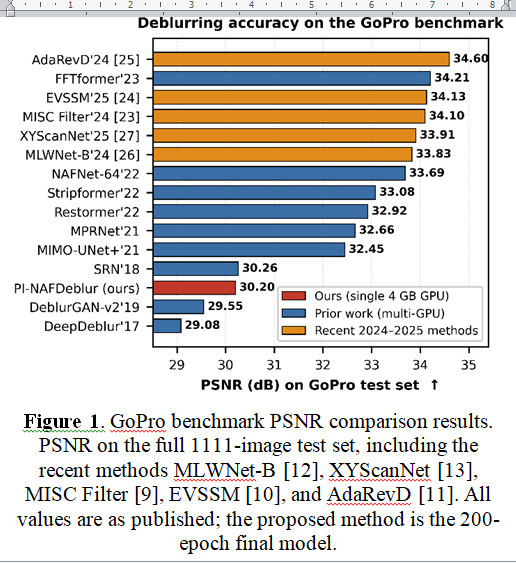
Blind motion deblurring of dynamic scenes is difficult due to the spatially-varying nature of the blur kernels, and the inverse nature of the problem. In this work, we present PI-NAFDeblur, a physics-informed neural network that utilizes a coupling of a lightweight NAFNet restoration backbone and a differentiable reblur operator that enforces forward-model consistency during training. The predicted per-pixel displacement field and blur resynthesis in the reblur branch provide a self-supervised regularization signal and yield an inferred latent blur parameterization as a by-product of restoration; because the reblur operator is sign-symmetric, this field is not validated against ground-truth motion and is therefore not claimed to be a physical motion estimate. PI-NAFDeblur, trained on a single 4 GB GPU, reaches 30.20 dB PSNR and 0.9041 SSIM on the full 1111-image GoPro test set with only 29.4 M parameters, which is 3.6–4.4 dB below recent 2024–2025 methods such as MISC Filter, EVSSM, MLWNet, XYScanNet, and AdaRevD; the contribution of this work is accordingly the feasibility of physics-informed deblurring under a 4 GB training budget together with a controlled analysis of the reblur prior, and not benchmark-leading accuracy. A controlled 50-epoch matched-seed ablation reveals that the physics-informed loss is neutral in-distribution (+0.004 dB) and yields small improvements on two of three out-of-distribution benchmarks (HIDE +0.092 dB, t = 20.14, p < 0.001; RealBlur-R +0.098 dB, t = 6.88, p < 0.001) that remain significant under a Bonferroni-corrected threshold of α = 0.0167, whereas the RealBlur-J difference (+0.022 dB, t = 2.36, p = 0.018) does not and is reported as non-significant. All statistics come from a single matched-seed pair, so they characterise consistency across test images rather than robustness across independent training runs. All settings are reported in a fully transparent fashion, and we demonstrate that physics-informed regularization can help improve cross-dataset robustness under resource-constrained training; a full reproducibility package (code, configurations, seeds, checkpoints, and per-image metrics) accompanies the paper.
References
[1] J. Rim, H. Lee, J. Won, and S. Cho, "Real-World Blur Dataset for Learning and Benchmarking Deblurring Algorithms," presented at the Computer Vision – ECCV 2020, Cham, 2020. [Online]. Available: https://doi.org/10.1007/978-3-030-58595-2_12.
[2] D. Ren, K. Zhang, Q. Wang, Q. Hu, and W. Zuo, "Neural Blind Deconvolution Using Deep Priors," presented at the 2020 IEEE/CVF Conference on Computer Vision and Pattern Recognition (CVPR), Seattle, WA, USA, 13-19 June 2020, 2020. [Online]. Available: https://doi.org/10.1109/CVPR42600.2020.00340.
[3] S. W. Zamir, A. Arora, S. Khan, M. Hayat, F. S. Khan, M. H. Yang, and L. Shao, "Multi-Stage Progressive Image Restoration," presented at the 2021 IEEE/CVF Conference on Computer Vision and Pattern Recognition (CVPR), Nashville, TN, USA, 2021. [Online]. Available: https://doi.org/10.1109/CVPR46437.2021.01458.
[4] S. J. Cho, S. W. Ji, J. P. Hong, S. W. Jung, and S. J. Ko, "Rethinking Coarse-to-Fine Approach in Single Image Deblurring," presented at the 2021 IEEE/CVF International Conference on Computer Vision (ICCV), Montreal, QC, Canada, 10-17 Oct. 2021, 2021. [Online]. Available: https://doi.org/10.1109/ICCV48922.2021.00460.
[5] G. E. Karniadakis, I. G. Kevrekidis, L. Lu, P. Perdikaris, S. Wang, and L. Yang, "Physics-informed machine learning," Nature Reviews Physics, vol. 3, no. 6, pp. 422-440, 2021, doi: https://doi.org/10.1038/s42254-021-00314-5.
[6] S. W. Zamir, A. Arora, S. Khan, M. Hayat, F. S. Khan, and M. Yang, "Restormer: Efficient Transformer for High-Resolution Image Restoration," presented at the 2022 IEEE/CVF Conference on Computer Vision and Pattern Recognition (CVPR), New Orleans, LA, USA, 2022. [Online]. Available: https://doi.org/10.1109/CVPR52688.2022.00564.
[7] L. Chen, X. Chu, X. Zhang, and J. Sun, "Simple Baselines for Image Restoration," presented at the Computer Vision – ECCV 2022, Cham, 2022. [Online]. Available: https://doi.org/10.1007/978-3-031-20071-7_2.
[8] F.-J. Tsai, Y.-T. Peng, Y.-Y. Lin, C.-C. Tsai, and C.-W. Lin, "Stripformer: Strip Transformer for Fast Image Deblurring," presented at the Computer Vision – ECCV 2022, Cham, 2022. [Online]. Available: https://doi.org/10.1007/978-3-031-19800-7_9.
[9] C. Liu, X. Wang, X. Xu, R. Tian, S. Li, X. Qian, and M.-H. Yang, "Motion-adaptive Separable Collaborative Filters for Blind Motion Deblurring," arXiv preprint, vol. arXiv.2404.13153, 2024, doi: https://doi.org/10.48550/arXiv.2404.13153.
[10] L. Kong, J. Dong, J. Tang, M.-H. Yang, and J. Pan, "Efficient Visual State Space Model for Image Deblurring," arXiv preprint, vol. arXiv.2405.14343, 2025, doi: https://doi.org/10.48550/arXiv.2405.14343.
[11] X. Mao, Q. Li, and Y. Wang, "AdaRevD: Adaptive Patch Exiting Reversible Decoder Pushes the Limit of Image Deblurring," arXiv preprint, vol. arXiv.2406.09135, 2024, doi: https://doi.org/10.48550/arXiv.2406.09135.
[12] X. Gao, T. Qiu, X. Zhang, H. Bai, K. Liu, X. Huang, H. Wei, G. Zhang, and H. Liu, "Efficient Multi-scale Network with Learnable Discrete Wavelet Transform for Blind Motion Deblurring," arXiv preprint, vol. arXiv.2401.00027, 2024, doi: https://doi.org/10.48550/arXiv.2401.00027.
[13] H. Liu, C. Liu, J. Xu, P. Jiang, and M. Lu, "XYScanNet: A State Space Model for Single Image Deblurring," arXiv preprint, vol. arXiv.2412.10338, 2025, doi: https://doi.org/10.48550/arXiv.2412.10338.
[14] G. Dong, L. Bu, Z. Zhang, and G. Liu, "Interpretable image deblurring with ISTA_inspired deep network (ISTA_Deblurnet)," Geocarto International, vol. 41, no. 1, p. 2631861, 2026, doi: https://doi.org/10.1080/10106049.2026.2631861.
[15] X. Liu, Z. Li, L. Cheng, and X. Jiang, "Robust Blind Image Deblurring Algorithm for Saturated Images," Circuits, Systems, and Signal Processing, vol. 45, no. 6, pp. 4739-4760, 2026, doi: https://doi.org/10.1007/s00034-025-03423-z.
[16] A. Mohammad-Djafari, N. Chu, and L. Wang, "Bayesian physics-informed neural networks for inverse problems (BPINN-IP): Application in infrared image processing," Journal of the Franklin Institute, vol. 363, no. 7, p. 108607, 2026, doi: https://doi.org/10.1016/j.jfranklin.2026.108607.
[17] E. Antony, R. K. S. Kumar, V. L. Lajish, P. Sethumadhavan, V. Sanal, K. M. Muraleedharan, and M. C. Jobi, "Improving Astronomical Image Quality Using Physics-Informed Neural Networks and Blur-Specific Loss Functions," presented at the Proceedings of the Fifth International Conference on Intelligent Systems and Networks, Singapore, 2026. [Online]. Available: https://doi.org/10.1007/978-981-95-1746-6_40.
[18] K. Zhang, W. Ren, W. Luo, W.-S. Lai, B. Stenger, M.-H. Yang, and H. Li, "Deep Image Deblurring: A Survey," International Journal of Computer Vision, vol. 130, no. 9, pp. 2103-2130, 2022, doi: https://doi.org/10.1007/s11263-022-01633-5.
[19] X. Chu, L. Chen, C. Chen, and X. Lu, "Improving Image Restoration by Revisiting Global Information Aggregation," presented at the Computer Vision – ECCV 2022, Cham, 2022. [Online]. Available: https://doi.org/10.1007/978-3-031-20071-7_4.
[20] L. Kong, J. Dong, J. Ge, M. Li, and J. Pan, "Efficient Frequency Domain-based Transformers for High-Quality Image Deblurring," presented at the 2023 IEEE/CVF Conference on Computer Vision and Pattern Recognition (CVPR), Vancouver, BC, Canada, 17-24 June 2023, 2023. [Online]. Available: https://doi.org/10.1109/CVPR52729.2023.00570.
[21] Y. Cui, Y. Tao, W. Ren, and A. Knoll, "Dual-Domain Attention for Image Deblurring," Proceedings of the AAAI Conference on Artificial Intelligence, vol. 37, no. 1, pp. 479-487, 2023, doi: https://doi.org/10.1609/aaai.v37i1.25122.
[22] N. Namaki, M. R. Eslahchi, and R. Salehi, "The use of physics-informed neural network approach to image restoration via nonlinear PDE tools," Computers & Mathematics with Applications, vol. 152, pp. 355-363, 2023, doi: https://doi.org/10.1016/j.camwa.2023.10.002.
[23] D. Park, D. U. Kang, J. Kim, and S. Y. Chun, "Multi-Temporal Recurrent Neural Networks for Progressive Non-uniform Single Image Deblurring with Incremental Temporal Training," presented at the Computer Vision – ECCV 2020, Cham, 2020. [Online]. Available: https://doi.org/10.1007/978-3-030-58539-6_20.
[24] Z. Fang, F. Wu, W. Dong, X. Li, J. Wu, and G. Shi, "Self-supervised Non-uniform Kernel Estimation with Flow-based Motion Prior for Blind Image Deblurring," presented at the 2023 IEEE/CVF Conference on Computer Vision and Pattern Recognition (CVPR), Vancouver, BC, Canada, 17-24 June 2023, 2023. [Online]. Available: https://doi.org/10.1109/CVPR52729.2023.01736.
[25] T. Cevik, N. Cevik, M. S. Ag, O. Guler, and S. Saglam, "A unified deep learning framework for image denoising and sharpening: from sequential to end-to-end models," Neural Computing and Applications, vol. 38, no. 8, p. 269, 2026, doi: https://doi.org/10.1007/s00521-026-12015-0.
[26] X. Liu, Z. Li, L. Cheng, and X. Jiang, "Enhancing blind image deblurring robustness against impulse noise via adaptive noise detection and graph regularization," Signal, Image and Video Processing, vol. 19, no. 9, p. 733, 2025, doi: https://doi.org/10.1007/s11760-025-04333-y.
[27] Z. Shen, W. Wang, X. Lu, J. Shen, H. Ling, T. Xu, and L. Shao, "Human-Aware Motion Deblurring," presented at the 2019 IEEE/CVF International Conference on Computer Vision (ICCV), Seoul, Korea (South), 27 Oct.-2 Nov. 2019, 2019. [Online]. Available: https://doi.org/10.1109/ICCV.2019.00567.
[28] S. Nah, T. H. Kim, and K. M. Lee, "Deep Multi-scale Convolutional Neural Network for Dynamic Scene Deblurring," arXiv preprint, vol. arXiv.1612.02177, 2018, doi: https://doi.org/10.48550/arXiv.1612.02177.
[29] B.-D. Pham, P. Tran, A. Tran, C. Pham, R. Nguyen, and M. Hoai, "Blur2Blur: Blur Conversion for Unsupervised Image Deblurring on Unknown Domains," arXiv preprint, vol. arXiv.2403.16205, 2024, doi: https://doi.org/10.48550/arXiv.2403.16205.
Downloads
Published
Issue
Section
License
Copyright (c) 2026 Al-Noor Journal of Engineering Management and Computer Science

This work is licensed under a Creative Commons Attribution-NonCommercial-ShareAlike 4.0 International License.
How to Cite