Feature Representation Based on Fractal Average Pooling(FAP) for Dorsal Hand Vein Biometric Recognition with ResNet18
DOI:
https://doi.org/10.71229/9m40c796Keywords:
Dorsal hand vein recognition, ResNet-18, Fractal average pooling, Multiscale feature representation, Global average pooling (GAP)Abstract
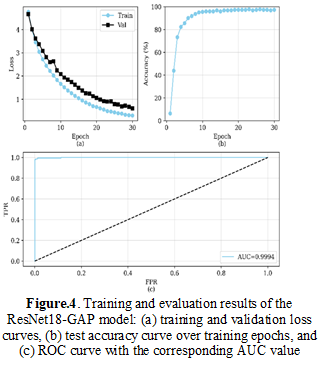
Dorsal hand vein recognition is a strong biometric modality because of its uniqueness and ability to resist forgery. Nonetheless, it is difficult to derive discriminative vein pattern features. The present paper presents a deep learning model that includes a ResNet18 backbone with a fractal pooling mechanism to optimize the representation of features. ResNet18 is designed to perform hierarchical feature extraction, and the proposed fractal average pooling enhances feature aggregation by extracting both local and global features of feature maps to maintain local and global structural information. This method is more effective than traditional global average pooling (GAP), which tends to blur spatial features. Experimental findings show better performance in classification; The proposed Fractal Average Pooling gave higher identification accuracy of 99.54%, F1 score of 0.9906, precision of 0.9947, recall of 0.9910, and ROC–AUC of 1.0000 compared to the baseline method of Global Average Pooling. The effectiveness of the method in producing discriminative feature representations to perform biometric identification has been confirmed through comparative analyses against a GAP baseline and by modern studies.
References
[1] G. Singh, G. Bhardwaj, S. V. Singh, and V. Garg, “Biometric identification system: security and privacy concern,” in Artificial intelligence for a sustainable industry 4.0, Springer, 2021, pp. 245–264.
[2] W. Jia et al., “A survey on dorsal hand vein biometrics,” Pattern Recognit., vol. 120, p. 108122, 2021.
[3] 3. Methodology et al., “Deep residual learning for image recognition,” in Proceedings of the IEEE conference on computer vision and pattern recognition, 2016, pp. 770–778.
[4] J. Li, Y. Han, M. Zhang, G. Li, and B. Zhang, “Multi-scale residual network model combined with Global Average Pooling for action recognition,” Multimed. Tools Appl., vol. 81, no. 1, pp. 1375–1393, 2022.
[5] J. B. Florindo, “Fractal pooling: A new strategy for texture recognition using convolutional neural networks,” Expert Syst. Appl., vol. 243, p. 122978, 2024.
[6] Y. Xu, F. Li, Z. Chen, J. Liang, and Y. Quan, “Encoding Spatial Distribution of Convolutional Features for Texture Representation,” no. NeurIPS, pp. 1–13, 2021.
[7] M. A. Rajab and K. M. Hashim, “Dorsal hand veins features extraction and recognition by correlation coefficient,” Telkomnika, vol. 20, no. 4, pp. 867–874, 2022.
[8] N. A. Al-johania and L. A. Elrefaei, “Dorsal Hand Vein Recognition by Convolutional Neural Networks: Feature Learning and Transfer Learning Approaches.,” Int. J. Intell. Eng. Syst., vol. 12, no. 3, 2019.
[9] A. Benaouda, A. H. Mustapha, and S. Benziane, “A CNN Approach for the Identification of Dorsal Veins of the Hand,” in International Conference on Artificial Intelligence and its Applications, Springer, 2021, pp. 574–587.
[10] G. Gu et al., “Dorsal hand vein recognition based on transfer learning with fusion of LBP feature,” in Chinese Conference on Biometric Recognition, Springer, 2021, pp. 221–230.
[11] G. Liu, Y. Zheng, and Z. Luo, “Feature-Fused Deep Convolutional Neural Network for Dorsal Hand Vein Recognition,” in Chinese Conference on Biometric Recognition, Springer, 2023, pp. 65–72.
[12] F. Liu, S. Jiang, B. Kang, and T. Hou, “A recognition system for partially occluded dorsal hand vein using improved biometric graph matching,” IEEE Access, vol. 8, pp. 74525–74534, 2020.
[13] J. Li, K. Li, G. Zhang, J. Wang, K. Li, and Y. Yang, “Recognition of dorsal hand vein in small-scale sample database based on fusion of ResNet and HOG feature,” Electronics, vol. 11, no. 17, p. 2698, 2022.
[14] Y. Wang, J. Gui, X. Shi, L. Gui, Y. Y. Tang, and J. T.-Y. Kwok, “ColorVein: Colorful Cancelable Vein Biometrics,” IEEE Trans. Inf. Forensics Secur., 2025.
[15] F. Wilches-Bernal, B. Núñez-Álvares, and P. Vizcaya, “A database of dorsal hand vein images,” arXiv Prepr. arXiv2012.05383, 2020.
[16] R. Nour, H. E.-D. Moustafa, E. H. Abdelhay, and M. M. Ata, “Improved unsupervised deep Boltzmann learning approach for accurate hand vein recognition,” IEEE Access, vol. 12, pp. 18488–18507, 2024.
[17] A. Herbadji, N. Guermat, L. Ziet, Z. Akhtar, M. Cheniti, and D. Herbadji, “Contactless Multi-biometric System Using Fingerprint and Palmprint Selfies.,” Trait. du Signal, vol. 37, no. 6, 2020.
[18] H. S. Ali, A. I. Ismail, F. A. Farag, and F. E. A. El-Samie, “Speeded up robust features for efficient iris recognition,” Signal, Image Video Process., vol. 10, no. 8, pp. 1385–1391, 2016.
[19] M. M. Sufian et al., “COVID-19 classification through deep learning models with three-channel grayscale CT images,” Big Data Cogn. Comput., vol. 7, no. 1, p. 36, 2023.
[20] H. Mehraj and A. H. Mir, “Robust multimodal biometric system based on feature level fusion of optimiseddeepnet features,” Wirel. Pers. Commun., vol. 127, no. 3, pp. 2461–2482, 2022.
[21] H. Zhang, J. Xue, and K. Dana, “Deep ten: Texture encoding network,” in Proceedings of the IEEE conference on computer vision and pattern recognition, 2017, pp. 708–717.
Downloads
Published
Issue
Section
License
Copyright (c) 2026 Al-Noor Journal of Engineering Management and Computer Science

This work is licensed under a Creative Commons Attribution-NonCommercial-ShareAlike 4.0 International License.
How to Cite