Design of Experiments as a Strategic Tool in Engineering Research: A Review of Applications and Best Practices
DOI:
https://doi.org/10.71229/hxfrr504Keywords:
design of experiments, factorial design, robust optimization, reproducibility., response surface methodology;Abstract
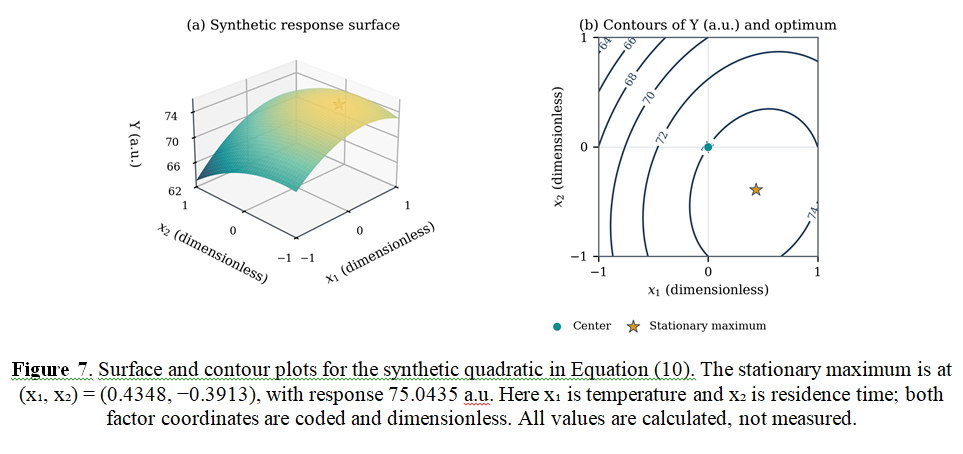
Design of experiments (DOE) is an organized way to learn how engineering systems react to an engineered change. The strategic value is far greater than a reduction in experimental runs: an appropriate design allows effects to be identified, interaction effects to be seen, uncertainty to be quantified and the link between laboratory evidence and practical decisions to be established. This is a fundamental overview of some principles, important design families, representative engineering applications and techniques to enhance the validity of experimental results. The discussion combines factorial screening, response surface methodology, mixture experiments, restricted randomization, and sequential computer experiments. Examples of applications such as additive manufacturing, construction materials, adsorption, production of biodiesel, and the charging of batteries demonstrate how the design can be influenced by the experimental objectives and the physical constraints. An explicit synthetic numerical example illustrates the use of the CCD for the estimation of curvature, and the identification of a stationary point without attempting to validate any experiments. The main difference in the literature reviewed is the search for an attractive fitted model and the production of evidence that helps guide a repeatable engineering decision. Best practices include identifying the experimental unit, safeguarding against misleading error estimates with the help of replication, verifying the alias structure, matching models to randomization, reserving resources for confirmation, and providing publically available information to aid in re-use. DOE is best viewed as an iterative research procedure, where the process involves using statistical reasoning, physical knowledge, and clear reporting, rather than a recipe for finding the optimum condition using a software application.
References
[1] NIST/SEMATECH, “Process improvement,” in e-Handbook of Statistical Methods. Accessed: Sep. 4, 2026. [Online]. Available: https://www.itl.nist.gov/div898/handbook/pri/pri.htm
[2] G. E. P. Box and K. B. Wilson, “On the experimental attainment of optimum conditions,” Journal of the Royal Statistical Society: Series B (Methodological), vol. 13, no. 1, pp. 1–38, 1951. doi: 10.1111/j.2517-6161.1951.tb00067.x
[3] D. C. Montgomery, Design and Analysis of Experiments, 10th ed. Hoboken, NJ, USA: Wiley, 2019. ISBN: 978-1-119-49244-3. https://www.wiley.com/en-us/Design+and+Analysis+of+Experiments,+10th+Edition-p-9781119492443
[4] NIST/SEMATECH, “Full factorial designs,” in e-Handbook of Statistical Methods, sec. 5.3.3.3. Accessed: Sep. 4, 2026. [Online]. Available: https://www.itl.nist.gov/div898/handbook/pri/section3/pri333.htm
[5] B. Jones and C. J. Nachtsheim, “Split-plot designs: What, why, and how,” Journal of Quality Technology, vol. 41, no. 4, pp. 340–361, 2009. doi: 10.1080/00224065.2009.11917790
[6] R. L. Plackett and J. P. Burman, “The design of optimum multifactorial experiments,” Biometrika, vol. 33, no. 4, pp. 305–325, 1946. doi: 10.1093/biomet/33.4.305
[7] B. Jones and C. J. Nachtsheim, “A class of three-level designs for definitive screening in the presence of second-order effects,” Journal of Quality Technology, vol. 43, no. 1, pp. 1–15, 2011. doi: 10.1080/00224065.2011.11917841
[8] NIST/SEMATECH, “Central composite designs (CCD),” in e-Handbook of Statistical Methods, sec. 5.3.3.6.1. Accessed: Sep. 4, 2026. [Online]. Available: https://www.itl.nist.gov/div898/handbook/pri/section3/pri3361.htm
[9] G. E. P. Box and D. W. Behnken, “Some new three level designs for the study of quantitative variables,” Technometrics, vol. 2, no. 4, pp. 455–475, 1960. doi: 10.1080/00401706.1960.10489912
[10] H. Scheffé, “Experiments with mixtures,” Journal of the Royal Statistical Society: Series B (Methodological), vol. 20, no. 2, pp. 344–360, 1958. doi: 10.1111/j.2517-6161.1958.tb00299.x
[11] NIST/SEMATECH, “D-optimal designs,” in e-Handbook of Statistical Methods, sec. 5.5.2.1. Accessed: Sep. 4, 2026. [Online]. Available: https://www.itl.nist.gov/div898/handbook/pri/section5/pri521.htm
[12] G. G. Vining and R. H. Myers, “Combining Taguchi and response surface philosophies: A dual response approach,” Journal of Quality Technology, vol. 22, no. 1, pp. 38–45, 1990. doi: 10.1080/00224065.1990.11979204
[13] G. Derringer and R. Suich, “Simultaneous optimization of several response variables,” Journal of Quality Technology, vol. 12, no. 4, pp. 214–219, 1980. doi: 10.1080/00224065.1980.11980968
[14] J. Sacks, W. J. Welch, T. J. Mitchell, and H. P. Wynn, “Design and analysis of computer experiments,” Statistical Science, vol. 4, no. 4, pp. 409–423, 1989. doi: 10.1214/ss/1177012413
[15] M. D. McKay, R. J. Beckman, and W. J. Conover, “A comparison of three methods for selecting values of input variables in the analysis of output from a computer code,” Technometrics, vol. 21, no. 2, pp. 239–245, 1979. doi: 10.1080/00401706.1979.10489755
[16] D. R. Jones, M. Schonlau, and W. J. Welch, “Efficient global optimization of expensive black-box functions,” Journal of Global Optimization, vol. 13, pp. 455–492, 1998. doi: 10.1023/A:1008306431147
[17] J. Snoek, H. Larochelle, and R. P. Adams, “Practical Bayesian optimization of machine learning algorithms,” in Advances in Neural Information Processing Systems 25, 2012, pp. 2951–2959. [Online]. Available: https://papers.nips.cc/paper/4522-practical-bayesian-optimization-of-machine-learning-algorithms
[18] C. Kamath, “Data mining and statistical inference in selective laser melting,” The International Journal of Advanced Manufacturing Technology, vol. 86, pp. 1659–1677, 2016. doi: 10.1007/s00170-015-8289-2
[19] A. Pfaff, M. Jäcklein, M. Schlager, W. Harwick, K. Hoschke, and F. Balle, “An empirical approach for the development of process parameters for laser powder bed fusion,” Materials, vol. 13, no. 23, Art. no. 5400, 2020. doi: 10.3390/ma13235400
[20] T. F. Awolusi, O. L. Oke, O. O. Akinkurolere, and A. O. Sojobi, “Application of response surface methodology: Predicting and optimizing the properties of concrete containing steel fibre extracted from waste tires with limestone powder as filler,” Case Studies in Construction Materials, vol. 10, Art. no. e00212, 2019. doi: 10.1016/j.cscm.2018.e00212
[21] H. A. Atta, K. K. Hummadi, and M. J. M-Ridha, “The application of response surface methodology and Design-Expert® for analysis of ciprofloxacin removal from aqueous solution using raw rice husk: Kinetic and isotherm studies,” Desalination and Water Treatment, vol. 248, pp. 203–216, 2022. doi: 10.5004/dwt.2022.28074
[22] A. F. Panichikkal, P. Prakasan, U. K. Nair, and M. K. Valappil, “Optimization of parameters for the production of biodiesel from rubber seed oil using onsite lipase by response surface methodology,” 3 Biotech, vol. 8, no. 11, Art. no. 459, 2018. doi: 10.1007/s13205-018-1477-7
[23] P. M. Attia et al., “Closed-loop optimization of fast-charging protocols for batteries with machine learning,” Nature, vol. 578, pp. 397–402, 2020. doi: 10.1038/s41586-020-1994-5
[24] R. L. Wasserstein and N. A. Lazar, “The ASA’s statement on p-values: Context, process, and purpose,” The American Statistician, vol. 70, no. 2, pp. 129–133, 2016. doi: 10.1080/00031305.2016.1154108
[25] NIST/SEMATECH, “How to confirm DOE results (confirmatory runs),” in e-Handbook of Statistical Methods, sec. 5.4.6. Accessed: Sep. 4, 2026. [Online]. Available: https://www.itl.nist.gov/div898/handbook/pri/section4/pri46.htm
[26] M. D. Wilkinson et al., “The FAIR Guiding Principles for scientific data management and stewardship,” Scientific Data, vol. 3, Art. no. 160018, 2016. doi: 10.1038/sdata.2016.18
[27] A. G. Kusne et al., “On-the-fly closed-loop materials discovery via Bayesian active learning,” Nature Communications, vol. 11, Art. no. 5966, 2020. doi: 10.1038/s41467-020-19597-w
Downloads
Published
Issue
Section
License
Copyright (c) 2026 Al-Noor Journal of Engineering Management and Computer Science

This work is licensed under a Creative Commons Attribution-NonCommercial-ShareAlike 4.0 International License.
How to Cite