Rice Husk Ash for Sustainable Ground Improvement: A Comprehensive Geotechnical Review
DOI:
https://doi.org/10.71229/55vfhv69Keywords:
Soil stabilization, , Rice husk ash, , Pozzolanic reaction, , Soft soil, , Ground improvementAbstract
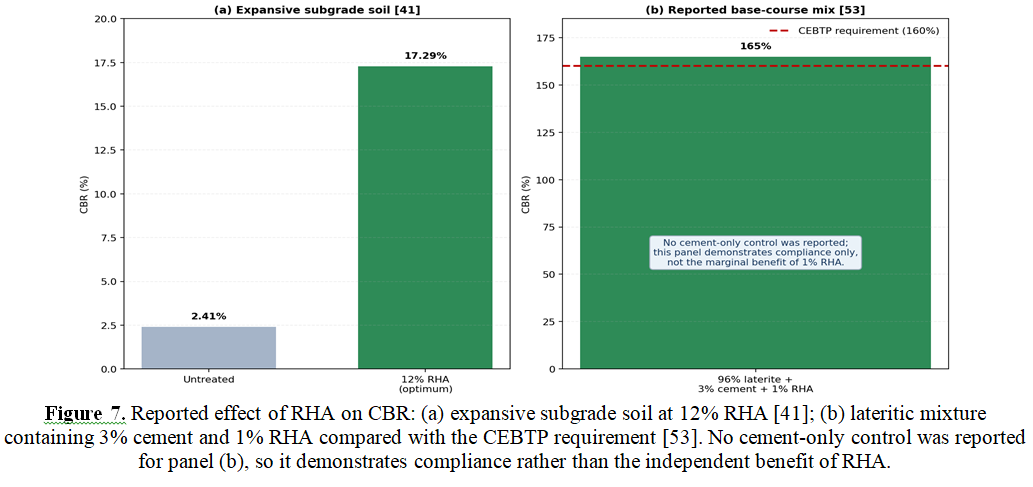
Rice husk ash (RHA), an abundant agricultural by-product containing about 85–95% predominantly amorphous silica when produced by controlled combustion at approximately 500–700 °C, has been extensively investigated as a low-carbon additive for ground improvement. This paper systematically reviews the experimental evidence published between 1987 and 2026 on the production and characterization of the ash, the mechanisms of soil–RHA interaction, and the quantitative effects on index, compaction, swelling, strength, permeability, and durability properties, for RHA used alone, combined with calcium-bearing activators (lime, cement, calcium carbide residue), and in alkali-activated geopolymer systems. The collected results form a consistent quantitative picture. Plasticity and swelling decrease systematically with RHA content: the differential free swell of a black cotton soil dropped from 73% to 14% with 10% calcium carbide residue and 15% RHA. Maximum dry density decreases while optimum moisture content increases, a compaction trade-off attributable to the low specific gravity and porous morphology of the ash. With an appropriate activator and adequate curing, unconfined compressive strength increases severalfold (from 142 to 817 kPa at 12% RHA in an expansive subgrade, and by 74–192% at 28 days), soaked CBR rises from 2.41% to 17.29%, and lean field mixes such as 3% cement + 1% RHA achieve a base-course CBR of 165%. In soft and organic soils treated by deep or mass in-situ mixing, RHA acts instead as a partial cement replacement: up to 15–35% of the binder can advantageously be RHA, the strength of cement-admixed soft clay increased by more than 100% at 28 days, and stabilized peat reached a fivefold strength gain over the untreated state. Reported optimum dosages cluster at about 4–12% RHA by dry weight of soil, reflecting the stoichiometric balance between reactive silica and available calcium or alkali; beyond the optimum, a dilution effect causes strength to stall or decline. Geopolymer RHA systems exhibit superior durability, surviving 12 wetting–drying cycles with mass losses of only 10.5–24.4%, whereas silica-deficient mixtures disintegrate. The discussion interprets these results mechanistically, derives their design implications, quantifies their significance for reducing binder-related CO₂ emissions, and identifies the standardization, field-validation, and life-cycle research still required.
References
[1] S. K. R. Gidigasu and S. K. Y. Gawu, “The mode of formation, nature and geotechnical characteristics of black cotton soils – a review,” Standard Scientific Research and Essays, vol. 1, no. 15, 2013.
[2] J. James and P. K. Pandian, “Industrial wastes as auxiliary additives to cement/lime stabilization of soils,” Advances in Civil Engineering, vol. 2016, Article ID 1267391, 2016.
[3] Food and Agriculture Organization of the United Nations, “Agricultural production statistics 2010–2024,” FAOSTAT, Rome, 2026. Available: https://www.fao.org/statistics/highlights-archive/highlights-detail/agricultural-production-statistics-2010-2024/en (accessed 31 August 2026).
[4] “Sustainable soil–cement composites with rice husk ash and silica fume: a review of performance and environmental benefits,” 2025. Available: https://pmc.ncbi.nlm.nih.gov/articles/PMC12195367/
[5] L. Behak, “Soil stabilization with rice husk ash,” in Rice – Technology and Production, IntechOpen, Rijeka, 2017.
[6] R. Pode, “Potential applications of rice husk ash waste from rice husk biomass power plant,” Renewable and Sustainable Energy Reviews, vol. 53, pp. 1468–1485, 2016.
[7] G. C. Cordeiro, R. D. Toledo Filho, and E. M. R. Fairbairn, “Use of ultrafine rice husk ash with high-carbon content as pozzolan in high performance concrete,” Materials and Structures, vol. 42, pp. 983–992, 2009, doi: 10.1617/s11527-008-9437-z.
[8] “Sustainable rice husk ash aggregates: optimized production and performance for eco-efficient concrete,” Journal of Building Engineering, 2025. Available: https://www.sciencedirect.com/science/article/abs/pii/S2352710225022363
[9] “Innovative approaches to sustainable construction: a detailed study of rice husk ash as an eco-friendly substitute in cement production,” Discover Applied Sciences, vol. 6, 2024, doi: 10.1007/s42452-024-06314-1.
[10] “A state-of-the-art review on suitability of rice husk ash as a sustainable additive for geotechnical applications,” Indian Geotechnical Journal, vol. 54, p. 910, 2024, doi: 10.1007/s40098-024-00905-w.
[11] “An overview of rice husk ash as a waste by-product material for sustainable soil stabilization,” Elsevier (ScienceDirect), 2025. Available: https://www.sciencedirect.com/science/article/pii/S2772912525002441
[12] D. G. Nair, A. Fraaij, A. A. K. Klaassen, and A. P. M. Kentgens, “A structural investigation relating to the pozzolanic activity of rice husk ashes,” Cement and Concrete Research, vol. 38, no. 6, pp. 861–869, 2008.
[13] Y. Shinohara and N. Kohyama, “Quantitative analysis of tridymite and cristobalite crystallized in rice husk ash by heating,” Industrial Health, vol. 42, no. 2, pp. 277–285, 2004.
[14] V. P. Della, I. Kühn, and D. Hotza, “Rice husk ash as an alternate source for active silica production,” Materials Letters, vol. 57, no. 4, pp. 818–821, 2002.
[15] R. V. Krishnarao, J. Subrahmanyam, and T. J. Kumar, “Studies on the formation of black particles in rice husk silica ash,” Journal of the European Ceramic Society, vol. 21, no. 1, pp. 99–104, 2001.
[16] S. Chandrasekhar, K. G. Satyanarayana, P. N. Pramada, P. Raghavan, and T. N. Gupta, “Review of processing, properties and applications of reactive silica from rice husk – an overview,” Journal of Materials Science, vol. 38, pp. 3159–3168, 2003.
[17] S. Chandrasekhar, P. N. Pramada, and J. Majeed, “Effect of calcination temperature and heating rate on the optical properties and reactivity of rice husk ash,” Journal of Materials Science, vol. 41, no. 23, pp. 7926–7933, 2006.
[18] “Synergistic effects of rice husk ash and extracted microsilica on the performance of high-strength concrete,” Scientific Reports, vol. 15, 2025, doi: 10.1038/s41598-025-25218-7.
[19] “Effect of temperature and time on purity, morphology and phase transformations of silica from rice husk,” Elsevier (ScienceDirect), 2025. Available: https://www.sciencedirect.com/science/article/pii/S2949746925000060
[20] M. F. M. Zain, M. N. Islam, F. Mahmud, and M. Jamil, “Production of rice husk ash for use in concrete as a supplementary cementitious material,” Construction and Building Materials, vol. 25, no. 2, pp. 798–805, 2011.
[21] G. A. Habeeb and H. B. Mahmud, “Study on properties of rice husk ash and its use as cement replacement material,” Materials Research, vol. 13, no. 2, pp. 185–190, 2010.
[22] A. N. Givi, S. A. Rashid, F. N. A. Aziz, and M. A. M. Salleh, “Contribution of rice husk ash to the properties of mortar and concrete: a review,” Journal of American Science, vol. 6, no. 3, pp. 157–165, 2010.
[23] “Rice husk ash in concrete,” Sustainability, vol. 15, no. 1, 137, 2023, doi: 10.3390/su15010137.
[24] G. R. de Sensale, “Strength development of concrete with rice-husk ash,” Cement and Concrete Composites, vol. 28, no. 2, pp. 158–160, 2006.
[25] M. R. F. Gonçalves and C. P. Bergmann, “Thermal insulators made with rice husk ashes: production and correlation between properties and microstructure,” Construction and Building Materials, vol. 21, no. 12, pp. 2059–2065, 2007.
[26] R. S. Sharma, B. R. Phanikumar, and B. V. Rao, “Engineering behavior of a remolded expansive clay blended with lime, calcium chloride, and rice-husk ash,” Journal of Materials in Civil Engineering, vol. 20, no. 8, pp. 509–515, 2008.
[27] A. Seco, F. Ramírez, L. Miqueleiz, and B. García, “Stabilization of expansive soils for use in construction,” Applied Clay Science, vol. 51, no. 3, pp. 348–352, 2011.
[28] J. N. Jha and K. S. Gill, “Effect of rice husk ash on lime stabilization of soil,” Journal of the Institution of Engineers (India): Civil Engineering Division, vol. 87, pp. 33–39, 2006.
[29] A. J. Choobbasti, H. Ghodrat, M. J. Vahdatirad, S. Firouzian, A. Barari, M. Torabi, and A. Bagherian, “Influence of using rice husk ash in soil stabilization method with lime,” Frontiers of Earth Science in China, vol. 4, no. 4, pp. 471–480, 2010, doi: 10.1007/s11707-010-0138-x.
[30] M. A. Rahman, “Effects of cement-rice husk ash mixtures on geotechnical properties of lateritic soils,” Soils and Foundations, vol. 27, no. 2, pp. 61–65, 1987.
[31] F. H. Ali, A. Adnan, and C. K. Choy, “Geotechnical properties of a chemically stabilized soil from Malaysia with rice husk ash as an additive,” Geotechnical and Geological Engineering, vol. 10, no. 2, pp. 117–134, 1992.
[32] A. S. Muntohar and G. Hantoro, “Influence of rice husk ash and lime on engineering properties of a clayey subgrade,” Electronic Journal of Geotechnical Engineering, vol. 5, 2000.
[33] A. S. Muntohar, “Utilization of uncontrolled burnt rice husk ash in soil improvement,” Dimensi Teknik Sipil, vol. 4, no. 2, pp. 100–105, 2002.
[34] E. A. Basha, R. Hashim, H. B. Mahmud, and A. S. Muntohar, “Stabilization of residual soil with rice husk ash and cement,” Construction and Building Materials, vol. 19, no. 6, pp. 448–453, 2005, doi: 10.1016/j.conbuildmat.2004.08.001.
[35] M. Y. Fattah, F. H. Rahil, and K. Y. H. Al-Soudany, “Improvement of clayey soil characteristics using rice husk ash,” Journal of Civil Engineering and Urbanism, vol. 3, no. 1, pp. 12–18, 2013.
[36] M. Alhassan, “Potentials of rice husk ash for soil stabilization,” AU Journal of Technology, vol. 11, no. 4, pp. 246–250, 2008.
[37] M. Alhassan and A. M. Mustapha, “Effect of rice husk ash on cement stabilized laterite,” Leonardo Electronic Journal of Practices and Technologies, no. 11, pp. 47–58, 2007.
[38] “Sustainable subgrade improvement with calcium carbide residue and rice husk ash,” Scientific Reports, vol. 15, 2025, doi: 10.1038/s41598-025-98833-z.
[39] Y. Liu, C. W. Chang, A. Namdar, Y. She, C. H. Lin, X. Yuan, et al., “Stabilization of expansive soil using cementing material from rice husk ash and calcium carbide residue,” Construction and Building Materials, vol. 221, pp. 1–11, 2019, doi: 10.1016/j.conbuildmat.2019.05.157.
[40] “Stabilization of black cotton soil using rice husk ash and lime,” International Research Journal of Engineering and Technology (IRJET), vol. 6, 2019.
[41] A. Manimaran and P. T. Ravichandran, “A study on the strength characteristics of expansive soil blended with rice husk ash,” in Recent Advances in Civil Engineering, Lecture Notes in Civil Engineering, pp. 27–35, 2024, doi: 10.1007/978-981-99-6229-7_3.
[42] R. A. Blayi et al., “Impact of rice husk ash on swelling and durability of expansive soils,” 2026. Available: https://www.sciencedirect.com/science/article/pii/S2949822825009621.
[43] K. M. A. Hossain, “Stabilized soils incorporating combinations of rice husk ash and cement kiln dust,” Journal of Materials in Civil Engineering, vol. 23, no. 9, pp. 1320–1327, 2011, doi: 10.1061/(ASCE)MT.1943-5533.0000310.
[44] R. M. Brooks, “Soil stabilization with fly ash and rice husk ash,” International Journal of Research and Reviews in Applied Sciences, vol. 1, no. 3, pp. 209–217, 2009.
[45] A. A. Ashango and N. R. Patra, “Behavior of expansive soil treated with steel slag, rice husk ash, and lime,” Journal of Materials in Civil Engineering, vol. 28, no. 7, 2016.
[46] A. Kumar and D. Gupta, “Behavior of cement-stabilized fiber-reinforced pond ash, rice husk ash–soil mixtures,” Geotextiles and Geomembranes, vol. 44, no. 3, pp. 466–474, 2016.
[47] M. A. Rahgozar, M. Saberian, and J. Li, “Soil stabilization with non-conventional eco-friendly agricultural waste materials: an experimental study,” Transportation Geotechnics, vol. 14, pp. 52–60, 2018.
[48] Z. Eliaslankaran, N. N. N. Daud, Z. M. Yusoff, and V. Rostami, “Evaluation of the effects of cement and lime with rice husk ash as an additive on strength behavior of coastal soil,” Materials, vol. 14, no. 5, 1140, 2021.
[49] Y. O. Muñoz, R. L. dos Santos Izzo, J. L. de Almeida, J. A. Baldovino, and J. L. Rose, “The role of rice husk ash, cement and polypropylene fibers on the mechanical behavior of a soil from Guabirotuba formation,” Transportation Geotechnics, vol. 31, 100673, 2021.
[50] D. E. Wibowo, D. A. Ramadhan, and H. Prayuda, “Soil stabilization using rice husk ash and cement for pavement subgrade materials,” Revista de la Construcción, vol. 22, no. 1, pp. 192–202, 2023.
[51] “Assessing the impact of rice husk ash on soil strength in subgrade layers: a novel approach to sustainable ground engineering,” Sustainability, vol. 17, no. 12, 5457, 2025, doi: 10.3390/su17125457.
[52] “Sustainable soil reinforcement by maximizing geotechnical performance with rice husk ash in subgrade layers,” Materials, vol. 18, no. 4, 873, 2025, doi: 10.3390/ma18040873.
[53] “Performance of rice husk ash- and cement-stabilized lateritic soils for pavement base courses: a case study from Benin,” International Journal of Engineering Trends and Technology, vol. 73, no. 9, 2025.
[54] A. B. Alabi, A. O. Olutaiwo, and A. O. Adeboje, “Evaluation of rice husk ash stabilized lateritic soil as sub-base in road construction,” Current Journal of Applied Science and Technology, vol. 9, no. 4, pp. 374–382, 2015.
[55] F. O. Okafor and U. N. Okonkwo, “Effects of rice husk ash on some geotechnical properties of lateritic soil,” Leonardo Electronic Journal of Practices and Technologies, no. 15, pp. 67–74, 2009.
[56] R. Chen, S. S. C. Congress, G. Cai, W. Duan, and S. Liu, “Sustainable utilization of biomass waste-rice husk ash as a new solidified material of soil in geotechnical engineering: a review,” Construction and Building Materials, vol. 292, 123219, 2021.
[57] N. T. Duong, “Effect of rice husk ash on unconfined compressive strength of soil-cement admixture,” Suranaree Journal of Science and Technology, vol. 29, no. 1, 2022.
[58] N. Wahab et al., “Performance of rice husk ash (RHA) as partial cement replacement in peat stabilization using the mass stabilization method,” 2026. Available: https://www.sciencedirect.com/science/article/pii/S2949822825010433.
[59] N. T. Duong, B. T. Son, and N. T. Nu, “Possibility of replacing cement with rice husk ash in soft soil improvement using soil-cement column,” in Proceedings of the National Conference on Earth Sciences and Natural Resources for Sustainable Development (ERSD 2022), pp. 133–139, 2022.
[60] “Comparison between cement-rice husk ash and cement-rice husk ash one-part geopolymer for stabilized soft clay as deep mixing material,” Transportation Infrastructure Geotechnology, 2023, doi: 10.1007/s40515-023-00345-8.
[61] “Analysis of strength development and soil–water characteristics of rice husk ash–lime stabilized soft soil,” Advances in Civil Engineering, 2019. Available: https://www.ncbi.nlm.nih.gov/pmc/articles/PMC6926948/
[62] “Effect of rice husk ash incorporation on the strength development and microstructural properties of stabilized clayey soil,” Arabian Journal for Science and Engineering, 2025, doi: 10.1007/s13369-025-10051-x.
[63] “Soil stabilization using rice husk ash and natural lime as an alternative to cutting and filling in road construction,” 2016. Available: https://www.researchgate.net/publication/310744637
[64] “Engineering properties of expansive soil stabilized with barley husk ash and lime: case study of Jimma town subgrade soils,” Scientific Reports, vol. 15, 2025, doi: 10.1038/s41598-025-25182-2.
[65] “Utilisation of fly ash and rice husk in soil stabilization,” Longdom (open access), 2022. Available: https://www.longdom.org/open-access/utilisation-of-fly-ash-and-rice-husk-in-soil-stabilization-92899.html
[66] “An experimental study of black cotton soil, stabilized with rice husk ash, fly ash and lime,” International Journal of Engineering Research and Technology (IJERT), vol. 3, no. 11, 2014.
[67] “Mechanical, durability, and microstructural study of dispersive soil stabilized by alkali-activated rice husk ash and natural fiber,” Results in Engineering, 2025. Available: https://www.sciencedirect.com/science/article/pii/S2590123025047231
[68] “Mechanical properties of soil reinforced by fiber and alkaline-activated rice husk ash, and rainfall erosion model tests,” Science of the Total Environment, 2024. Available: https://www.sciencedirect.com/science/article/abs/pii/S0048969724082573
[69] “Durability performance of geopolymer stabilised expansive soil incorporating novel rice husk ash-based waste derived alkaline activator,” International Journal of Pavement Engineering, 2026, doi: 10.1080/10298436.2026.2642959.
[70] M. Alhassan, “Permeability of lateritic soil treated with lime and rice husk ash,” AU Journal of Technology, vol. 12, no. 2, pp. 115–120, 2008.
[71] “Durability performance of Onna expansive subgrade soil stabilized with rice husk ash geopolymer for road pavement construction,” International Journal of Transportation Engineering and Technology, vol. 11, no. 2, 2025, doi: 10.11648/j.ijtet.20251102.12.
[72] “Impact of rice husk ash based-geopolymer on some geotechnical properties of selected residual tropical soils,” Nigerian Journal of Technological Development, 2024.
[73] “Characteristic evaluation of geopolymer based lateritic soil stabilization enriched with eggshell ash and rice husk ash for road construction: an experimental investigation,” Construction and Building Materials, 2023. Available: https://www.sciencedirect.com/science/article/abs/pii/S0950061823013727
[74] A. O. Eberemu, “Consolidation properties of compacted lateritic soil treated with rice husk ash,” Geomaterials, vol. 1, no. 3, pp. 70–78, 2011.
[75] “Optimization of rice husk ash concrete design towards economic and environmental assessment,” Environmental Impact Assessment Review, 2023. Available: https://www.sciencedirect.com/science/article/abs/pii/S0195925523001956
[76] “Sustainable use of rice husk ash in cement-based materials: environmental evaluation and performance improvement,” Journal of Cleaner Production, 2020. Available: https://www.sciencedirect.com/science/article/abs/pii/S0959652620317911
[77] Ş. Sargın, M. Saltan, N. Morova, S. Serin, and S. Terzi, “Evaluation of rice husk ash as filler in hot mix asphalt concrete,” Construction and Building Materials, vol. 48, pp. 390–397, 2013.
[78] G. Habert, J. B. d'Espinose de Lacaillerie, and N. Roussel, “An environmental evaluation of geopolymer-based concrete production,” Journal of Cleaner Production, vol. 19, no. 11, pp. 1229–1238, 2011, doi: 10.1016/j.jclepro.2011.03.012.
[79] J. Hong et al., “Life cycle assessment of caustic soda production,” Journal of Cleaner Production, vol. 66, pp. 113–120, 2014, doi: 10.1016/j.jclepro.2013.10.009.
[80] A. Passuello et al., “Environmental footprint of geopolymers using waste-derived activators,” Journal of Cleaner Production, vol. 166, pp. 680–689, 2017, doi: 10.1016/j.jclepro.2017.08.007.
Downloads
Published
Issue
Section
License
Copyright (c) 2026 Al-Noor Journal of Engineering Management and Computer Science

This work is licensed under a Creative Commons Attribution-NonCommercial-ShareAlike 4.0 International License.
How to Cite