Integrated Electrical, Spatial, and Thermal Characterization of Atmospheric-Pressure Ar–O₂ Plasma Jets with Ag and Cu External Ring Electrodes
DOI:
https://doi.org/10.71229/ddxtrv52Keywords:
Atmospheric-pressure plasma jet, APPJ Ar–O₂ plasma,Abstract
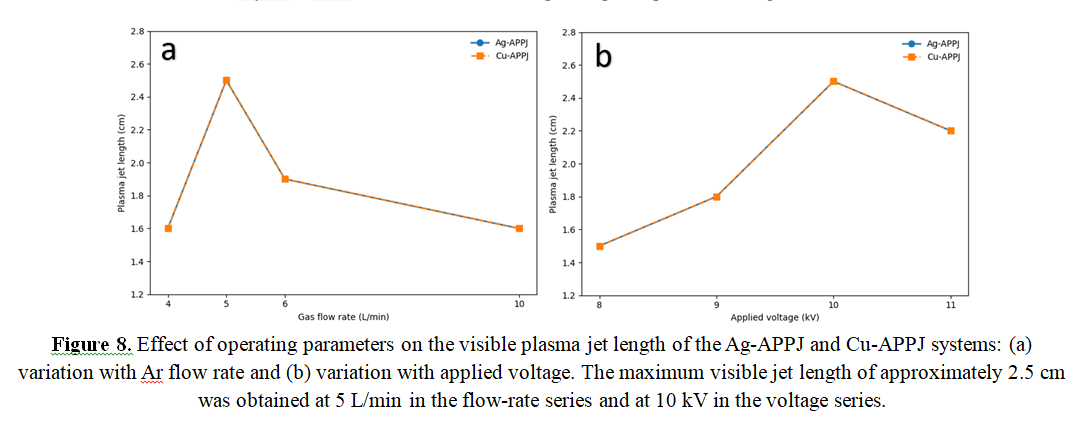
Atmospheric-pressure plasma jets (APPJs) require coordinated control of electrical excitation, gas flow, plume propagation, and thermal output to operate at controlled low temperatures. This study presents an integrated electrical and physical characterization of two geometrically identical Ar–O₂ APPJ systems employing external silver (Ag) and copper (Cu) ring electrodes. The electrical response was evaluated at 5 kHz over a voltage-setting range of 8–11 kV, while plasma-jet length was examined as a function of Ar flow rate and applied voltage. Plasma-effluent temperature was additionally measured as a function of downstream distance and excitation voltage. The measured voltage exhibited an excellent linear relationship with the power-supply setting (R² = 0.9988), with a nearly constant mean voltage-transfer factor of 1.417. Increasing the measured voltage from 11.31 to 15.70 kV increased the current from 7.63 to 9.83 mA and the displayed electrical power from 86.2 to 153.6 W. In contrast, plasma-jet extension showed a non-monotonic dependence on the operating parameters. The maximum visible jet length of approximately 2.5 cm was obtained at an Ar flow rate of 5 L/min and an applied voltage of 10 kV, demonstrating that maximum plume extension did not coincide with the highest electrical input or gas flow. The effluent temperature decreased from approximately 42.0–42.5 °C at the tube outlet to 35.0 °C at 3 cm, while a temperature of approximately 38.5 °C was measured at 2 cm under the 10 kV operating condition. Ag-APPJ and Cu-APPJ exhibited essentially identical plume-length behavior and closely overlapping thermal profiles, with temperature differences not exceeding approximately 0.5 °C. These results demonstrate that, for the investigated external-electrode configuration, the macroscopic APPJ behavior was governed predominantly by the operating conditions rather than by the Ag or Cu electrode material. The combined electrical, spatial, and thermal analysis identifies 10 kV and 5 L/min as a particularly favorable operating regime, providing maximum measured plume extension together with moderate downstream thermal output.
References
1. Corbella C, Portal S, Keidar M (2023) Flexible Cold Atmospheric Plasma Jet Sources. Plasma 6:72–88. https://doi.org/10.3390/plasma6010007
2. Kazemi A, Nicol MJ, Bilén SG, et al (2024) Cold Atmospheric Plasma Medicine: Applications, Challenges, and Opportunities for Predictive Control. Plasma 7:233–257. https://doi.org/10.3390/plasma7010014
3. Lu X, Liu D, Xian Y, et al (2021) Cold atmospheric-pressure air plasma jet: Physics and opportunities. Phys Plasmas 28:. https://doi.org/10.1063/5.0067478
4. Silva N, Marques J, da Cruz MB, et al (2023) The applications of cold atmospheric plasma in dentistry. Plasma Processes and Polymers 20:. https://doi.org/10.1002/ppap.202300067
5. Dai X, Wu J, Lu L, Chen Y (2023) Current Status and Future Trends of Cold Atmospheric Plasma as an Oncotherapy. Biomol Ther (Seoul) 31:496–514. https://doi.org/10.4062/biomolther.2023.027
6. Schweigert I V., Zakrevsky DmE, Milakhina E V., et al (2023) Characteristics of Cold Atmospheric Plasma Jet when Excited by Sinusoidal and Positive Pulse Voltages for Medical Applications. Plasma Physics Reports 49:595–601. https://doi.org/10.1134/S1063780X2360010X
7. Wang T, Wang S, Wang J, et al (2022) Effect of electrode configurations on the characteristics of the ring–ring typed atmospheric pressure plasma jet and its modification on polymer film. Plasma Processes and Polymers 19:. https://doi.org/10.1002/ppap.202100139
8. Wang T, Wang J, Wang S, et al (2022) Influence of ring electrodes covered with dielectric layer on the characteristics of atmospheric pressure plasma jet and its interaction with polymer surface. Appl Surf Sci 585:152681. https://doi.org/10.1016/j.apsusc.2022.152681
9. T. P. R, Kar S (2023) Effect of an additional floating electrode on radio frequency cross-field atmospheric pressure plasma jet. Sci Rep 13:10665. https://doi.org/10.1038/s41598-023-37805-7
10. Chen X, Wang X-Q, Zhang B-X, et al (2023) Compared discharge characteristics and film modifications of atmospheric pressure plasma jets with two different electrode geometries. Chinese Physics B 32:115201. https://doi.org/10.1088/1674-1056/ace768
11. Liu Y, Vass M, Hübner G, et al (2023) Local enhancement of electron heating and neutral species generation in radio-frequency micro-atmospheric pressure plasma jets: the effects of structured electrode topologies. Plasma Sources Sci Technol 32:025012. https://doi.org/10.1088/1361-6595/acb9b8
12. Barkhordari A, Karimian S, Shahsavari S, et al (2024) Influence of the argon admixture on the reactive oxide species formation inside an atmospheric pressure oxygen plasma jet. Sci Rep 14:3425. https://doi.org/10.1038/s41598-024-54111-y
13. JPengying JIA, Guoxin HAN, Xiupin DONG, et al (2024) Influence of bias voltage and oxygen addition on the discharge aspects of a diffuse argon plume in an atmospheric pressure plasma jet. Plasma Science and Technology 26:125402. https://doi.org/10.1088/2058-6272/ad73ab
14. Jõgi I, Talviste R, Raud S, et al (2020) Comparison of two cold atmospheric pressure plasma jet configurations in argon. Contributions to Plasma Physics 60:. https://doi.org/10.1002/ctpp.201900127
15. Balkhi SAA, Allabakshi SM, Srikar PSNSR, et al (2024) Unwinding the correlation between atmospheric pressure plasma jet operating parameters and variation in antibiotic wastewater characteristics. Journal of Water Process Engineering 60:105186. https://doi.org/10.1016/j.jwpe.2024.105186
16. Sun W, Yu Q, Li Y, et al (2024) Generation of Large-Scale Plasma Jet with Excitation of Bipolar Nanosecond Pulse Voltage in Single-Spiral Electrode Configuration. Applied Sciences 14:8013. https://doi.org/10.3390/app14178013
17. T P R, Kar S (2025) Gas flow rate influence on gas temperature regulation in a reinforced radio-frequency cross-field atmospheric pressure plasma jet. Asian Journal of Physics 34:167–178. https://doi.org/10.54955/AJP.34.3-4.2025.167-178
18. Schulenberg DA, Vass M, Klich M, et al (2024) Mode Transition Induced by Gas Heating Along the Discharge Channel in Capacitively Coupled Atmospheric Pressure Micro Plasma Jets. Plasma Chemistry and Plasma Processing 44:1217–1235. https://doi.org/10.1007/s11090-023-10444-6
19. Gillies RM, Tompkins J, McKay K (2025) Breakdown conditions of a multi-electrode low temperature atmospheric pressure plasma source. Phys Scr 100:025603. https://doi.org/10.1088/1402-4896/ada594
20. Javanmard S, Pouryoussefi SG (2023) Comparison of characteristics of atmospheric pressure plasma jets using argon and helium working gases. Current Applied Physics 46:61–69. https://doi.org/10.1016/j.cap.2022.12.002
21. Li Q, Li J-T, Zhu W-C, et al (2009) Effects of gas flow rate on the length of atmospheric pressure nonequilibrium plasma jets. Appl Phys Lett 95:. https://doi.org/10.1063/1.3243460
22. Wu J, Li X, Ran J, et al (2023) Discharge aspects of a snake‐like plasma plume generated by an atmospheric pressure plasma jet with variable argon flow rate. Plasma Processes and Polymers 20:. https://doi.org/10.1002/ppap.202200188
23. Chen Y, Yang B, Liu Y, et al (2023) Application of an atmospheric pressure plasma jet in a rat model of ischaemic stroke: Design, optimisation, and characteristics. High Voltage 8:315–325. https://doi.org/10.1049/hve2.12267
24. Ahmed MH, Humud HR (2025) The Influence of Gas Type and Flow Rate on Plasma Jet Length and Gas Temperature. Iraqi Journal of Physics 23:128–136. https://doi.org/10.30723/ijp.v23i3.1305
25. Johnson MJ, Boris DR, Petrova TB, Walton SG (2024) Electrical Characterization of the Cycle-to-Cycle Repeatability of an Atmospheric Pressure Plasma Jet. IEEE Transactions on Plasma Science 52:5597–5607. https://doi.org/10.1109/TPS.2024.3516487
26. Shen S, Tampieri F, Garcia MC, Canal C (2024) Design and characterization of a nano‐pulsed atmospheric pressure plasma jet for biomedical applications. Plasma Processes and Polymers 21:. https://doi.org/10.1002/ppap.202400086
27. Kadhim SA, Humud HR (2023) Development of Low-Temperature Atmospheric Plasma Jet Sources for Biological Applications. Iraqi Journal of Science 4262–4272. https://doi.org/10.24996/ijs.2023.64.7.18
28. Asghar AH, Galaly AR (2021) The Effect of Oxygen Admixture with Argon Discharges on the Impact Parameters of Atmospheric Pressure Plasma Jet Characteristics. Applied Sciences 11:6870. https://doi.org/10.3390/app11156870
29. JOVANOVIĆ O, PUAČ N, ŠKORO N (2022) A comparison of power measurement techniques and electrical characterization of an atmospheric pressure plasma jet. Plasma Science and Technology 24:105404. https://doi.org/10.1088/2058-6272/ac742b
30. Wu J, Li X, Ran J, et al (2023) Discharge aspects of a snake‐like plasma plume generated by an atmospheric pressure plasma jet with variable argon flow rate. Plasma Processes and Polymers 20:. https://doi.org/10.1002/ppap.202200188
31. Nastuta AV, Gerling T (2022) Cold Atmospheric Pressure Plasma Jet Operated in Ar and He: From Basic Plasma Properties to Vacuum Ultraviolet, Electric Field and Safety Thresholds Measurements in Plasma Medicine. Applied Sciences 12:644. https://doi.org/10.3390/app12020644
32. Huang P, Weng H, Hsueh C, et al (2025) Comparing the Effects of Different Dielectric Materials on an Atmospheric Pressure Plasma Jet by Experiments and Simulations. Plasma Processes and Polymers 22:. https://doi.org/10.1002/ppap.202400121
33. Shen S, Tampieri F, Garcia MC, Canal C (2024) Design and characterization of a nano‐pulsed atmospheric pressure plasma jet for biomedical applications. Plasma Processes and Polymers 21:. https://doi.org/10.1002/ppap.202400086
34. Wang X-K, Vass M, Korolov I, et al (2026) Upscaling of atmospheric pressure plasma jets for large area surface treatment via customized electrode designs. J Phys D Appl Phys 59:205201. https://doi.org/10.1088/1361-6463/ae6926
Downloads
Published
Issue
Section
License
Copyright (c) 2026 Al-Noor Journal of Engineering Management and Computer Science

This work is licensed under a Creative Commons Attribution-NonCommercial-ShareAlike 4.0 International License.
How to Cite