Seed-Level Reliability of NSGA-III-Refined Cloud Task Scheduling Under Large-Scale Workloads: A Ten-Trial Analysis on 100,000 Tasks
DOI:
https://doi.org/10.71229/g91aa222Keywords:
Cloud task scheduling, NSGA-III, Multi-objective optimization, Reinforcement learningAbstract
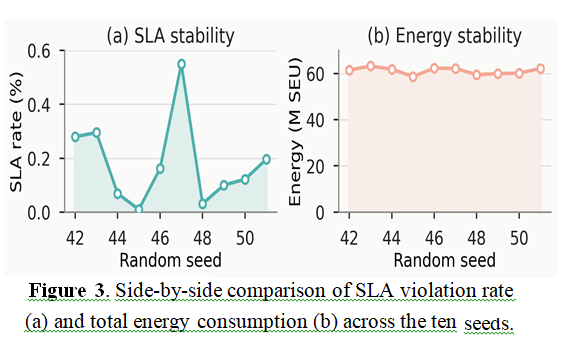
This study investigated the consistency of a Transformer-plus-Deep-Q-Network cloud scheduler optimised by NSGA-III, running the same configuration over ten independent random seeds with a heavy workload of 100,000 tasks. The scheduler, using a real workload trace from Bitbrains and a simulated cluster of five machines, achieved an average service-level-agreement (SLA) violation rate of 0.182 percent, with individual seeds ranging from 0.010 to 0.550 percent, while total energy consumption remained in a tight band of about 58.7 to 63.2 million simulated watts across all ten trials. Energy use was found to be far more consistent across seeds than SLA compliance: its coefficient of variation (CV) was around 2.3%, compared to about 84% for SLA compliance. In one seed, the violation rate was nearly three times the reported mean. This seed had a z-score that was significant but not extreme, and was just below the usual cutoff for an outlier in a formal statistical test. The results indicated that reporting only a mean value, without seed level detail, in stochastic cloud scheduling systems risked overstating the dependability of the reported performance. The study recommended that future evaluations of evolutionary refinement schedulers should report both aggregate statistics and the full spread of individual seed outcomes before such systems are considered ready for production deployment.
References
[1] International Energy Agency, "Energy and AI – World Energy Outlook Special Report," IEA, Paris, 2025. [Online]. Available: https://www.iea.org/reports/energy-and-ai
[2] H. Mao, M. Alizadeh, I. Menache, and S. Kandula, "Resource management with deep reinforcement learning," in Proc. 15th ACM Workshop Hot Topics Netw. (HotNets), 2016, pp. 50–56, doi: 10.1145/3005745.3005750.
[3] M. K. Jha and M. Kumar, "An efficient computation offloading and resource allocation technique using deep reinforcement learning in edge-cloud collaborated environment," J. Supercomput., vol. 81, art. 923, 2025, doi: 10.1007/s11227-025-07366-9.
[4] N. Yamsani and C. R. P, "SLA-aware deep reinforcement learning for adaptive edge-cloud task scheduling," Sci. Rep., vol. 16, art. 10037, 2026, doi: 10.1038/s41598-026-40237-8.
[5] V. Mnih et al., "Human-level control through deep reinforcement learning," Nature, vol. 518, no. 7540, pp. 529–533, 2015, doi: 10.1038/nature14236.
[6] X. Wang, S. Wang, X. Liang, D. Zhao, J. Huang, X. Xu, B. Dai, and Q. Miao, "Deep reinforcement learning: A survey," IEEE Trans. Neural Netw. Learn. Syst., vol. 35, no. 4, pp. 5064–5078, 2024, doi: 10.1109/TNNLS.2022.3207346.
[7] G. Zhou, W. Tian, R. Buyya, R. Xue, and L. Song, "Deep reinforcement learning-based methods for resource scheduling in cloud computing: A review and future directions," Artif. Intell. Rev., vol. 57, art. 124, 2024, doi: 10.1007/s10462-024-10756-9.
[8] A. Beloglazov and R. Buyya, "Optimal online deterministic algorithms and adaptive heuristics for energy and performance efficient dynamic consolidation of virtual machines in cloud data centers," Concurr. Comput. Pract. Exper., vol. 24, no. 13, pp. 1397–1420, 2012, doi: 10.1002/cpe.1867.
[9] N. Rana, F. Jeribi, Z. Khan, W. Alrawagfeh, I. Ben Dhaou, M. Haseebuddin, and M. Uddin, "A systematic literature review on contemporary and future trends in virtual machine scheduling techniques in cloud and multi-access computing," Front. Comput. Sci., vol. 6, art. 1288552, 2024, doi: 10.3389/fcomp.2024.1288552.
[10] N. Shazeer et al., "Outrageously large neural networks: The sparsely-gated mixture-of-experts layer," in Proc. Int. Conf. Learn. Represent. (ICLR), 2017, doi: 10.48550/arXiv.1701.06538.
[11] W. Cai, J. Jiang, F. Wang, J. Tang, S. Kim, and J. Huang, "A survey on mixture of experts in large language models," IEEE Trans. Knowl. Data Eng., vol. 37, no. 7, pp. 3896–3915, 2025, doi: 10.1109/TKDE.2025.3554028.
[12] I. Das and J. E. Dennis, "Normal-boundary intersection: A new method for generating the Pareto surface in nonlinear multicriteria optimization problems," SIAM J. Optim., vol. 8, no. 3, pp. 631–657, 1998, doi: 10.1137/S1052623496307510.
[13] K. Deb and H. Jain, "An evolutionary many-objective optimization algorithm using reference-point-based nondominated sorting approach, part I: Solving problems with box constraints," IEEE Trans. Evol. Comput., vol. 18, no. 4, pp. 577–601, 2014, doi: 10.1109/TEVC.2013.2281535.
[14] B. Lakshminarayanan, A. Pritzel, and C. Blundell, "Simple and scalable predictive uncertainty estimation using deep ensembles," in Adv. Neural Inf. Process. Syst. (NeurIPS), vol. 30, 2017, pp. 6402–6413, doi: 10.48550/arXiv.1612.01474.
[15] N. Veček, M. Črepinšek, and M. Mernik, "On the influence of the number of algorithms, problems, and independent runs in the comparison of evolutionary algorithms," Appl. Soft Comput., vol. 54, pp. 23–45, 2017, doi: 10.1016/j.asoc.2017.01.011.
[16] Y. Shen, G. Chen, H. Ma, and M. Zhang, "DEFT: Deadline-perceptive mixture-of-experts for dynamic cloud workflow scheduling," arXiv:2606.01162, 2026, doi: 10.48550/arXiv.2606.01162.
[17] Z. Yao, L. Ding, H. Zhang, H. Li, L. Chen, and Z. Li, "Deep reinforcement learning for job scheduling on load-aware heterogeneous cluster," J. Big Data, vol. 12, no. 1, pp. 1–19, 2025, doi: 10.1186/s40537-025-01325-0.
[18] X. Yu et al., "Dynamic multi-objective task scheduling in cloud computing using reinforcement learning for energy and cost optimization," Sci. Rep., vol. 15, art. 45387, 2025, doi: 10.1038/s41598-025-29280-z.
[19] P. Altmann, F. Ritz, L. Feuchtinger, J. Nüßlein, C. Linnhoff-Popien, and T. Phan, "CROP: Towards distributional-shift robust reinforcement learning using compact reshaped observation processing," in Proc. 32nd Int. Joint Conf. Artif. Intell. (IJCAI), 2023, pp. 3414–3422, doi: 10.24963/ijcai.2023/380.
[20] J. Wang, C. Lan, C. Liu, Y. Ouyang, T. Qin, W. Lu, Y. Chen, W. Zeng, and P. S. Yu, "Generalizing to unseen domains: A survey on domain generalization," IEEE Trans. Knowl. Data Eng., vol. 35, no. 8, pp. 8052–8072, 2023, doi: 10.1109/TKDE.2022.3178128.
[21] J. Yang, K. Zhou, Y. Li, and Z. Liu, "Generalized out-of-distribution detection: A survey," Int. J. Comput. Vis., vol. 132, pp. 5635–5662, 2024, doi: 10.1007/s11263-024-02117-4.
[22] J. Derrac, S. García, D. Molina, and F. Herrera, "A practical tutorial on the use of nonparametric statistical tests as a methodology for comparing evolutionary and swarm intelligence algorithms," Swarm Evol. Comput., vol. 1, no. 1, pp. 3–18, 2011, doi: 10.1016/j.swevo.2011.02.002.
[23] A. Al-Said Ahmad and P. Andras, "Scalability analysis comparisons of cloud-based software services," J. Cloud Comput., vol. 8, art. 10, 2019, doi: 10.1186/s13677-019-0134-y.
[24] A. Verma, L. Pedrosa, M. Korupolu, D. Oppenheimer, E. Tune, and J. Wilkes, "Large-scale cluster management at Google with Borg," in Proc. 10th Eur. Conf. Comput. Syst. (EuroSys), 2015, pp. 1–17, doi: 10.1145/2741948.2741964.
[25] Z. Wang, E. Yang, L. Shen, and H. Huang, "A comprehensive survey of forgetting in deep learning beyond continual learning," IEEE Trans. Pattern Anal. Mach. Intell., vol. 47, no. 3, pp. 1464–1483, 2025, doi: 10.1109/TPAMI.2024.3498346.
Downloads
Published
Issue
Section
License
Copyright (c) 2026 Al-Noor Journal of Engineering Management and Computer Science

This work is licensed under a Creative Commons Attribution-NonCommercial-ShareAlike 4.0 International License.
How to Cite