Distributed Systems in the Age of AI: A Systematic Review of Sustainability Practices, Metrics, and Frameworks
DOI:
https://doi.org/10.71229/pt97m783Keywords:
Distributed Systems,, Sustainable Computing,, Green Software, , Artificial Intelligence, , Cloud ComputingAbstract
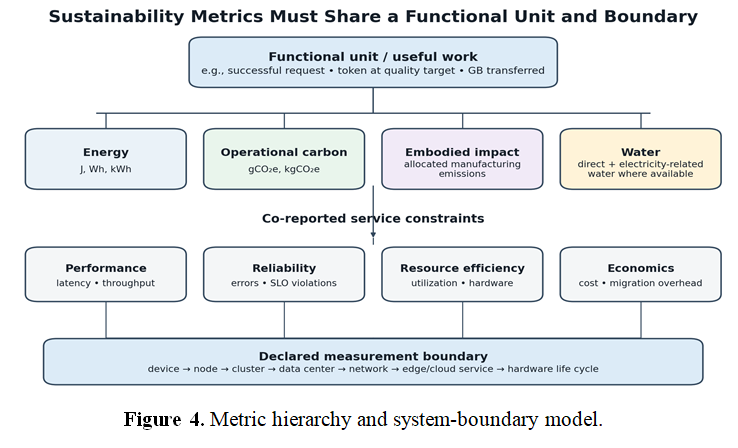
Today, cloud computing, edge intelligence, microservices, serverless computing, and federated artificial intelligence rely on distributed systems for computing resources. The growing need for sustainability studies is complicated by the intervening variables surrounding sustainability, which span such areas as software architecture, orchestration, network components, heterogeneous hardware, cooling, electricity generation, and hardware production. Moreover, AI presents a further complication to the sustainability discourse because it represents both a rapidly growing workload as well as a means of optimizing resource allocation, forecasting, scheduling, and controlling resources. This systematic integrative review covers findings until September 2026 related to sustainability in distributed systems. Reporting was guided by PRISMA 2020 and PRISMA-S principles for scope definition, concepts searched, and eligibility, extraction, interpretation, and synthesis processes, although a full PRISMA flow diagram could not be reconstructed because database export-level logs were unavailable. The final corpus included 96 sources, including over 80 peer-reviewed studies from published articles, standards, and measurement reports. This synthesis identifies five groups of best practices for the application/model layer, namely demand reduction; resource proportionality and consolidation; edge-cloud placement and workload shifting; carbon- and thermal-aware infrastructure management; and measurement/governance based on the principle of functional units and life-cycle boundaries. Apart from that, it has been discovered that energy is still the primary measure while operational carbon, embodied emissions, water, network effects, and hardware life cycle are still measured in less consistent manner. The frameworks currently available, including sustainability models, Sustainability Awareness Framework, Green Software Measurement Model, Software Carbon Intensity, and new green federated-learning frameworks address various parts of the problem but seldom provide a complete cross-layer measurement-and-control cycle at all. To fill in this gap, the review proposes SAIDS (Sustainability Aware AI for Distributed Systems) framework, which involves Measure-Attribute-Predict-Optimize-Verify-Report stages and relies on service, reliability, privacy, cost, and life-cycle dimensions.
References
[1] L. A. Barroso and U. Hölzle, “The case for energy-proportional computing,” Computer, vol. 40, no. 12, pp. 33–37, 2007, doi: https://doi.org/10.1109/MC.2007.443.
[2] X. Fan, W.-D. Weber, and L. A. Barroso, “Power provisioning for a warehouse-sized computer,” in Proc. 34th Int. Symp. Computer Architecture (ISCA), 2007, pp. 13–23, doi: https://doi.org/10.1145/1250662.1250665.
[3] V. D. Reddy, B. Setz, G. S. V. R. K. Rao, G. R. Gangadharan, and M. Aiello, “Metrics for sustainable data centers,” IEEE Transactions on Sustainable Computing, vol. 2, no. 3, pp. 290–303, 2017, doi: https://doi.org/10.1109/TSUSC.2017.2701883.
[4] E. Masanet, A. Shehabi, N. Lei, S. Smith, and J. Koomey, “Recalibrating global data center energy-use estimates,” Science, vol. 367, no. 6481, pp. 984–986, 2020, doi: https://doi.org/10.1126/science.aba3758.
[5] The Green Grid, “PUE: A comprehensive examination of the metric,” White Paper no. 49, 2012. [Online]. Available: https://archive.thegreengrid.org/en/resources/library-and-tools/237-WP
[6] The Green Grid, “Carbon Usage Effectiveness (CUE): A Green Grid data center sustainability metric,” White Paper no. 32, 2010. [Online]. Available: https://archive.thegreengrid.org/en/resources/library-and-tools/241-WP
[7] The Green Grid, “Water Usage Effectiveness (WUE): A Green Grid data center sustainability metric,” White Paper no. 35, 2011. [Online]. Available: https://archive.thegreengrid.org/en/resources/library-and-tools/238-WP
[8] M. Dayarathna, Y. Wen, and R. Fan, “Data center energy consumption modeling: A survey,” IEEE Communications Surveys & Tutorials, vol. 18, no. 1, pp. 732–794, 2016, doi: https://doi.org/10.1109/COMST.2015.2481183.
[9] A. Berl et al., “Energy-efficient cloud computing,” The Computer Journal, vol. 53, no. 7, pp. 1045–1051, 2010, doi: https://doi.org/10.1093/comjnl/bxp080.
[10] D. Kliazovich, P. Bouvry, and S. U. Khan, “GreenCloud: A packet-level simulator of energy-aware cloud computing data centers,” The Journal of Supercomputing, vol. 62, pp. 1263–1283, 2012, doi: https://doi.org/10.1007/s11227-010-0504-1.
[11] R. N. Calheiros, R. Ranjan, A. Beloglazov, C. A. F. De Rose, and R. Buyya, “CloudSim: A toolkit for modeling and simulation of cloud computing environments and evaluation of resource provisioning algorithms,” Software: Practice and Experience, vol. 41, no. 1, pp. 23–50, 2011, doi: https://doi.org/10.1002/spe.995.
[12] A. Beloglazov, J. Abawajy, and R. Buyya, “Energy-aware resource allocation heuristics for efficient management of data centers for cloud computing,” Future Generation Computer Systems, vol. 28, no. 5, pp. 755–768, 2012, doi: https://doi.org/10.1016/j.future.2011.04.017.
[13] S. S. Gill and R. Buyya, “A taxonomy and future directions for sustainable cloud computing: 360 degree view,” ACM Computing Surveys, vol. 51, no. 5, art. no. 104, 2018, doi: https://doi.org/10.1145/3241038.
[14] S. Bharany et al., “A systematic survey on energy-efficient techniques in sustainable cloud computing,” Sustainability, vol. 14, no. 10, art. no. 6256, 2022, doi: https://doi.org/10.3390/su14106256.
[15] R. Buyya, S. Ilager, and P. Arroba, “Energy-efficiency and sustainability in new generation cloud computing: A vision and directions for integrated management of data centre resources and workloads,” Software: Practice and Experience, vol. 54, no. 1, pp. 24–38, 2024, doi: https://doi.org/10.1002/spe.3248.
[16] M. Zakarya et al., “Sustainable computing across datacenters: A review of enabling models and techniques,” Computer Science Review, vol. 52, art. no. 100620, 2024, doi: https://doi.org/10.1016/j.cosrev.2024.100620.
[17] D. Biswas, S. Jahan, S. Saha, and M. Samsuddhoha, “A succinct state-of-the-art survey on green cloud computing: Challenges, strategies, and future directions,” Sustainable Computing: Informatics and Systems, vol. 44, art. no. 101036, 2024, doi: https://doi.org/10.1016/j.suscom.2024.101036.
[18] W. Lin, J. Lin, Z. Peng, H. Huang, W. Lin, and K. Li, “A systematic review of green-aware management techniques for sustainable data center,” Sustainable Computing: Informatics and Systems, vol. 42, art. no. 100989, 2024, doi: https://doi.org/10.1016/j.suscom.2024.100989.
[19] E. Strubell, A. Ganesh, and A. McCallum, “Energy and policy considerations for deep learning in NLP,” in Proc. 57th Annual Meeting of the Association for Computational Linguistics, 2019, pp. 3645–3650, doi: https://doi.org/10.18653/v1/P19-1355.
[20] R. Schwartz, J. Dodge, N. A. Smith, and O. Etzioni, “Green AI,” Communications of the ACM, vol. 63, no. 12, pp. 54–63, 2020, doi: https://doi.org/10.1145/3381831.
[21] P. Henderson, J. Hu, J. Romoff, E. Brunskill, D. Jurafsky, and J. Pineau, “Towards the systematic reporting of the energy and carbon footprints of machine learning,” Journal of Machine Learning Research, vol. 21, no. 248, pp. 1–43, 2020. [Online]. Available: https://www.jmlr.org/papers/v21/20-312.html
[22] L. F. W. Anthony, B. Kanding, and R. Selvan, “Carbontracker: Tracking and predicting the carbon footprint of training deep learning models,” arXiv:2007.03051, 2020, doi: https://doi.org/10.48550/arXiv.2007.03051.
[23] L. Lannelongue, J. Grealey, and M. Inouye, “Green Algorithms: Quantifying the carbon footprint of computation,” Advanced Science, vol. 8, no. 12, art. no. 2100707, 2021, doi: https://doi.org/10.1002/advs.202100707.
[24] A. Lacoste, A. Luccioni, V. Schmidt, and T. Dandres, “Quantifying the carbon emissions of machine learning,” arXiv:1910.09700, 2019, doi: https://doi.org/10.48550/arXiv.1910.09700.
[25] D. Patterson et al., “Carbon emissions and large neural network training,” arXiv:2104.10350, 2021, doi: https://doi.org/10.48550/arXiv.2104.10350.
[26] A. S. Luccioni, S. Viguier, and A.-L. Ligozat, “Estimating the carbon footprint of BLOOM, a 176B parameter language model,” Journal of Machine Learning Research, vol. 24, no. 253, pp. 1–15, 2023. [Online]. Available: https://www.jmlr.org/papers/v24/23-0069.html
[27] A. S. Luccioni, Y. Jernite, and E. Strubell, “Power hungry processing: Watts driving the cost of AI deployment?” in Proc. ACM Conf. Fairness, Accountability, and Transparency (FAccT), 2024, pp. 85–99, doi: https://doi.org/10.1145/3630106.3658542.
[28] A. de Vries, “The growing energy footprint of artificial intelligence,” Joule, vol. 7, no. 10, pp. 2191–2194, 2023, doi: https://doi.org/10.1016/j.joule.2023.09.004.
[29] A. Tschand et al., “MLPerf Power: Benchmarking the energy efficiency of machine learning systems from μWatts to MWatts for sustainable AI,” in Proc. 2025 IEEE Int. Symp. High Performance Computer Architecture (HPCA), 2025, pp. 1201–1216, doi: https://doi.org/10.1109/HPCA61900.2025.00092.
[30] L. H. Kaack et al., “Aligning artificial intelligence with climate change mitigation,” Nature Climate Change, vol. 12, pp. 518–527, 2022, doi: https://doi.org/10.1038/s41558-022-01377-7.
[31] D. Rolnick et al., “Tackling climate change with machine learning,” ACM Computing Surveys, vol. 55, no. 2, art. no. 42, 2022, doi: https://doi.org/10.1145/3485128.
[32] S. Santos, A. L. C. Ottoni, R. Borgo, D. Ferreira, et al., “A systematic review of Green Machine Learning: Practices and challenges for sustainability,” Artificial Intelligence Review, vol. 59, art. no. 132, 2026, doi: https://doi.org/10.1007/s10462-026-11515-8.
[33] A. Radovanović et al., “Carbon-aware computing for datacenters,” IEEE Transactions on Power Systems, vol. 38, no. 2, pp. 1270–1280, 2023, doi: https://doi.org/10.1109/TPWRS.2022.3173250.
[34] J. Dodge et al., “Measuring the carbon intensity of AI in cloud instances,” in Proc. ACM Conf. Fairness, Accountability, and Transparency (FAccT), 2022, pp. 1877–1894, doi: https://doi.org/10.1145/3531146.3533234.
[35] N. Asadov, V. C. Coroamă, M. Franzil, S. Galantino, and M. Finkbeiner, “Carbon-aware spatio-temporal workload shifting in edge-cloud environments: A review and novel algorithm,” Sustainability, vol. 17, no. 14, art. no. 6433, 2025, doi: https://doi.org/10.3390/su17146433.
[36] T. Bahreini, A. N. Tantawi, and A. Youssef, “A carbon-aware workload dispatcher in cloud computing systems,” in Proc. IEEE 16th Int. Conf. Cloud Computing (CLOUD), 2023, pp. 212–218, doi: https://doi.org/10.1109/CLOUD60044.2023.00032.
[37] K. W. Liow, H. Subramaniam, R. Wang, R. Zheng, H. Akter, and B. Huang, “CARA: Adaptive scheduling for carbon-efficient workload orchestration in distributed cloud systems,” Sustainable Computing: Informatics and Systems, vol. 51, art. no. 101407, 2026, doi: https://doi.org/10.1016/j.suscom.2026.101407.
[38] J. Goldverg, E. Rodrigues, and T. Kosar, “Carbon-aware spatiotemporal scheduling of data transfers,” in Proc. 16th ACM Int. Green and Sustainable Computing Conf. (IGSC), 2026, pp. 36–41, doi: https://doi.org/10.1145/3797248.3815406.
[39] P. Ramicetty, H. Moore, S. Qi, A. Islam, M. Ghose, D. Milojicic, C. Bash, and S. Pasricha, “Sustainable graph analytics workload scheduling with evolutionary reinforcement learning in edge-cloud systems,” in Proc. 16th ACM Int. Green and Sustainable Computing Conf. (IGSC), 2026, pp. 169–176, doi: https://doi.org/10.1145/3797248.3816187.
[40] T. Bahreini, A. N. Tantawi, and A. Youssef, “An approximation algorithm for minimizing the cloud carbon footprint through workload scheduling,” in Proc. IEEE 15th Int. Conf. Cloud Computing (CLOUD), 2022, pp. 522–531, doi: https://doi.org/10.1109/CLOUD55607.2022.00075.
[41] C. Calero, M. A. Moraga, and M. F. Bertoa, “Towards a software product sustainability model,” arXiv:1309.1640, 2013, doi: https://doi.org/10.48550/arXiv.1309.1640.
[42] C. C. Venters et al., “Software sustainability: The modern Tower of Babel,” CEUR Workshop Proceedings, vol. 1216, pp. 7–12, 2014. [Online]. Available: https://ceur-ws.org/Vol-1216/paper2.pdf
[43] B. Penzenstadler et al., “Systematic mapping study on software engineering for sustainability (SE4S),” in Proc. 18th Int. Conf. Evaluation and Assessment in Software Engineering (EASE), 2014, doi: https://doi.org/10.1145/2601248.2601256.
[44] C. Becker et al., “Sustainability design and software: The Karlskrona Manifesto,” in Proc. 37th IEEE/ACM Int. Conf. Software Engineering, 2015, pp. 467–476, doi: https://doi.org/10.1109/ICSE.2015.179.
[45] P. Lago, S. Koçak, I. Crnkovic, and B. Penzenstadler, “Framing sustainability as a property of software quality,” Communications of the ACM, vol. 58, no. 10, pp. 70–78, 2015, doi: https://doi.org/10.1145/2714560.
[46] B. Penzenstadler, C. Becker, R. Chitchyan, L. Duboc, and M. Mahaux, “Software engineering for sustainability: Findings and research directions,” Journal of Systems and Software, vol. 162, art. no. 110517, 2020, doi: https://doi.org/10.1016/j.jss.2019.110517.
[47] C. C. Venters, R. Capilla, E. Y. Nakagawa, S. Betz, B. Penzenstadler, T. Crick, and I. Brooks, “Sustainable software engineering: Reflections on advances in research and practice,” Information and Software Technology, vol. 164, art. no. 107316, 2023, doi: https://doi.org/10.1016/j.infsof.2023.107316.
[48] J. Lee, C. Fernando, S. Lee, and K. A. Schneider, “A survey of energy concerns for software engineering,” Journal of Systems and Software, vol. 210, art. no. 111944, 2024, doi: https://doi.org/10.1016/j.jss.2023.111944.
[49] S. Schuler and G. Kotsis, “A systematic review on techniques and approaches to estimate mobile software energy consumption,” Sustainable Computing: Informatics and Systems, vol. 41, art. no. 100919, 2024, doi: https://doi.org/10.1016/j.suscom.2023.100919.
[50] S. Betz et al., “Lessons learned from developing a Sustainability Awareness Framework for software engineering using design science,” ACM Transactions on Software Engineering and Methodology, vol. 33, no. 5, art. no. 136, 2024, doi: https://doi.org/10.1145/3649597.
[51] A. Guldner et al., “Development and evaluation of a reference measurement model for assessing the resource and energy efficiency of software products and components: Green Software Measurement Model (GSMM),” Future Generation Computer Systems, vol. 155, pp. 402–418, 2024, doi: https://doi.org/10.1016/j.future.2024.01.033.
[52] H. Noman, N. A. Mahoto, S. Bhatti, and A. Rajab, “Towards sustainable software systems: A software sustainability analysis framework,” Information and Software Technology, vol. 169, art. no. 107411, 2024, doi: https://doi.org/10.1016/j.infsof.2024.107411.
[53] A. García-Mireles, M. Á. Moraga, F. García, and C. Calero, “Sustainability in the field of software engineering: A tertiary study,” ACM Transactions on Software Engineering and Methodology, vol. 35, no. 5, art. no. 141, 2026, doi: https://doi.org/10.1145/3747178.
[54] ISO/IEC 21031:2024, Information technology — Software Carbon Intensity (SCI) specification, 1st ed. Geneva, Switzerland: ISO/IEC, 2024. [Online]. Available: https://www.iso.org/standard/86612.html
[55] W. Shi et al., “Edge computing: Vision and challenges,” IEEE Internet of Things Journal, vol. 3, no. 5, pp. 637–646, 2016, doi: https://doi.org/10.1109/JIOT.2016.2579198.
[56] M. Satyanarayanan, “The emergence of edge computing,” Computer, vol. 50, no. 1, pp. 30–39, 2017, doi: https://doi.org/10.1109/MC.2017.9.
[57] Y. Mao, C. You, J. Zhang, K. Huang, and K. B. Letaief, “A survey on mobile edge computing: The communication perspective,” IEEE Communications Surveys & Tutorials, vol. 19, no. 4, pp. 2322–2358, 2017, doi: https://doi.org/10.1109/COMST.2017.2745201.
[58] R. Deng, R. Lu, C. Lai, and T. H. Luan, “Towards power consumption-delay tradeoff by workload allocation in cloud-fog computing,” in Proc. IEEE Int. Conf. Communications (ICC), 2015, pp. 3909–3914, doi: https://doi.org/10.1109/ICC.2015.7248934.
[59] R. Deng, R. Lu, C. Lai, T. H. Luan, and H. Liang, “Optimal workload allocation in fog-cloud computing toward balanced delay and power consumption,” IEEE Internet of Things Journal, vol. 3, no. 6, pp. 1171–1181, 2016, doi: https://doi.org/10.1109/JIOT.2016.2565516.
[60] Z. Jiang et al., “Energy aware edge computing: A survey,” Computer Communications, vol. 151, pp. 556–580, 2020, doi: https://doi.org/10.1016/j.comcom.2020.01.004.
[61] M. Alizadeh, J. Shayan, S. Jamshidi, and M. M. Javidi, “Task scheduling approaches in fog computing: A systematic review,” International Journal of Communication Systems, vol. 33, art. no. e4583, 2020, doi: https://doi.org/10.1002/dac.4583.
[62] S. Matrouk and K. Alatoun, “Scheduling algorithms in fog computing: A survey,” International Journal of Networked and Distributed Computing, vol. 9, pp. 59–74, 2021, doi: https://doi.org/10.2991/ijndc.k.210111.001.
[63] M. Kaur et al., “A systematic review on task scheduling in fog computing: Taxonomy, tools, challenges, and future directions,” Concurrency and Computation: Practice and Experience, 2021, doi: https://doi.org/10.1002/cpe.6432.
[64] A. Bansal et al., “A systematic review of task scheduling approaches in fog computing,” Transactions on Emerging Telecommunications Technologies, 2022, doi: https://doi.org/10.1002/ett.4523.
[65] Y. Yu, X. Bu, K. Yang, Z. Wu, and Z. Han, “Green large-scale fog computing resource allocation using joint Benders decomposition, Dinkelbach algorithm, ADMM, and branch-and-bound,” IEEE Internet of Things Journal, vol. 6, no. 3, pp. 4106–4117, 2019, doi: https://doi.org/10.1109/JIOT.2018.2875587.
[66] M. H. Alsharif et al., “Survey of energy-efficient fog computing: Techniques and recent advances,” Energy Reports, vol. 13, pp. 1739–1763, 2025, doi: https://doi.org/10.1016/j.egyr.2025.01.039.
[67] H. Gupta, A. V. Dastjerdi, S. K. Ghosh, and R. Buyya, “iFogSim: A toolkit for modeling and simulation of resource management techniques in the Internet of Things, edge and fog computing environments,” Software: Practice and Experience, vol. 47, no. 9, pp. 1275–1296, 2017, doi: https://doi.org/10.1002/spe.2509.
[68] S. Tuli, R. Mahmud, S. Tuli, and R. Buyya, “FogBus: A blockchain-based lightweight framework for edge and fog computing,” Journal of Systems and Software, vol. 154, pp. 22–36, 2019, doi: https://doi.org/10.1016/j.jss.2019.04.050.
[69] H. Shafiei, A. Khonsari, and P. Mousavi, “Serverless computing: A survey of opportunities, challenges, and applications,” ACM Computing Surveys, vol. 54, no. 11s, art. no. 239, 2022, doi: https://doi.org/10.1145/3510611.
[70] C. Denninnart et al., “Efficiency in the serverless cloud paradigm: A survey on the reusing and approximation aspects,” Software: Practice and Experience, 2023, doi: https://doi.org/10.1002/spe.3233.
[71] R. Raith, T. Rausch, A. Furutanpey, and S. Dustdar, “faas-sim: A trace-driven simulation framework for serverless edge computing platforms,” Software: Practice and Experience, 2023, doi: https://doi.org/10.1002/spe.3277.
[72] J. Araujo et al., “Energy consumption in microservices architectures: A systematic literature review,” IEEE Access, vol. 12, pp. 186710–186729, 2024, doi: https://doi.org/10.1109/ACCESS.2024.3389064.
[73] M. Centofanti, L. Santos, V. Gudepu, and K. Kondepu, “Impact of power consumption in containerized clouds: A comprehensive analysis of open-source power measurement tools,” Computer Networks, vol. 245, art. no. 110371, 2024, doi: https://doi.org/10.1016/j.comnet.2024.110371.
[74] M. Amaral, H. Chen, T. Chiba, R. Nakazawa, S. Choochotkaew, E. K. Lee, and T. Eilam, “Process-based efficient power level exporter,” in Proc. IEEE 17th Int. Conf. Cloud Computing (CLOUD), 2024, pp. 456–467, doi: https://doi.org/10.1109/CLOUD62652.2024.00058.
[75] C. Serrano-Gutierrez, C. Ayala, and L. Fuentes, “Integrating energy consumption in the development of serverless applications,” Information and Software Technology, vol. 186, art. no. 107819, 2025, doi: https://doi.org/10.1016/j.infsof.2025.107819.
[76] X. Zhu, J. Hurley, and H. Tabatabaee Malazi, “Does energy-efficiency mean carbon-awareness? A critical evaluation of sustainable serverless edge scheduling,” in Proc. ACM/IEEE Int. Conf. Utility and Cloud Computing (UCC), 2025, doi: https://doi.org/10.1145/3773274.3774929.
[77] S. Mirani, S. Azizi, and M. Ghobaei-Arani, “A systematic literature review on energy efficiency in serverless environments: Taxonomy, techniques, and future directions,” Computers & Electrical Engineering, vol. 136, art. no. 111212, 2026, doi: https://doi.org/10.1016/j.compeleceng.2026.111212.
[78] E. O’Dea, R. Capuano, P. Avgeriou, and H. Muccini, “Energy efficiency in microservice architectures: A systematic literature review,” arXiv:2608.04070, 2026, doi: https://doi.org/10.48550/arXiv.2608.04070.
[79] M. Shahrad et al., “Serverless in the wild: Characterizing and optimizing the serverless workload at a large cloud provider,” in Proc. 2020 USENIX Annual Technical Conf. (USENIX ATC 20), 2020, pp. 205–218. [Online]. Available: https://www.usenix.org/conference/atc20/presentation/shahrad Preprint available with DataCite DOI: https://doi.org/10.48550/arXiv.2003.03423
[80] S. Triendl and S. Ristov, “Peeking behind the serverless implementations and deployments of the Montage workflow,” in Companion Proc. 15th ACM/SPEC Int. Conf. Performance Engineering, 2024, pp. 196–203, doi: https://doi.org/10.1145/3629527.3651420.
[81] H. B. McMahan, E. Moore, D. Ramage, S. Hampson, and B. Agüera y Arcas, “Communication-efficient learning of deep networks from decentralized data,” in Proc. 20th Int. Conf. Artificial Intelligence and Statistics (AISTATS), PMLR, vol. 54, 2017, pp. 1273–1282. [Online]. Available: https://proceedings.mlr.press/v54/mcmahan17a.html Preprint available with DataCite DOI: https://doi.org/10.48550/arXiv.1602.05629
[82] P. Kairouz et al., “Advances and open problems in federated learning,” Foundations and Trends in Machine Learning, vol. 14, no. 1–2, pp. 1–210, 2021, doi: https://doi.org/10.1561/2200000083.
[83] P. Grataloup, E. Jonas, and C. Meyer, “A review of federated learning in renewable energy applications: Potential, challenges, and future directions,” Energy and AI, vol. 17, art. no. 100375, 2024, doi: https://doi.org/10.1016/j.egyai.2024.100375.
[84] D. Thakur, A. Guzzo, G. Fortino, and F. Piccialli, “Green Federated Learning: A new era of green aware AI,” ACM Computing Surveys, vol. 57, no. 8, art. no. 194, 2025, doi: https://doi.org/10.1145/3718363.
[85] M. Alahmari and T. Alghamdi, “A comprehensive survey on energy-efficient and privacy-preserving federated learning for edge intelligence and IoT,” Results in Engineering, vol. 28, art. no. 107849, 2025, doi: https://doi.org/10.1016/j.rineng.2025.107849.
[86] C. Feng, A. Huertas Celdrán, X. Cheng, G. Bovet, and B. Stiller, “GreenDFL: A framework for assessing the sustainability of decentralized federated learning systems,” Information and Software Technology, vol. 190, art. no. 107937, 2026, doi: https://doi.org/10.1016/j.infsof.2025.107937.
[87] M. Lameesa et al., “Federated learning for sustainable IoT: Decentralized intelligence and energy-efficient applications,” Energy Reports, vol. 15, art. no. 109145, 2026, doi: https://doi.org/10.1016/j.egyr.2026.109145.
[88] W. Y. B. Lim et al., “Federated learning in mobile edge networks: A comprehensive survey,” IEEE Communications Surveys & Tutorials, vol. 22, no. 3, pp. 2031–2063, 2020, doi: https://doi.org/10.1109/COMST.2020.2986024.
[89] S. Niknam, H. S. Dhillon, and J. H. Reed, “Federated learning for wireless communications: Motivation, opportunities, and challenges,” IEEE Communications Magazine, vol. 58, no. 6, pp. 46–51, 2020, doi: https://doi.org/10.1109/MCOM.001.1900461.
[90] Q. Yang, Y. Liu, T. Chen, and Y. Tong, “Federated machine learning: Concept and applications,” ACM Transactions on Intelligent Systems and Technology, vol. 10, no. 2, art. no. 12, 2019, doi: https://doi.org/10.1145/3298981.
[91] T. Li, A. K. Sahu, A. Talwalkar, and V. Smith, “Federated learning: Challenges, methods, and future directions,” IEEE Signal Processing Magazine, vol. 37, no. 3, pp. 50–60, 2020, doi: https://doi.org/10.1109/MSP.2020.2975749.
[92] P. Wiesner, I. Behnke, D. Scheinert, K. Gontarska, and L. Thamsen, “Let’s wait awhile: How temporal workload shifting can reduce carbon emissions in the cloud,” in Proc. 22nd Int. Middleware Conf., 2021, doi: https://doi.org/10.1145/3464298.3493399.
[93] M. J. Page et al., “The PRISMA 2020 statement: An updated guideline for reporting systematic reviews,” BMJ, vol. 372, art. no. n71, 2021, doi: https://doi.org/10.1136/bmj.n71.
[94] M. L. Rethlefsen et al., “PRISMA-S: An extension to the PRISMA Statement for Reporting Literature Searches in Systematic Reviews,” Systematic Reviews, vol. 10, art. no. 39, 2021, doi: https://doi.org/10.1186/s13643-020-01542-z.
[95] B. Kitchenham et al., “Systematic literature reviews in software engineering – A systematic literature review,” Information and Software Technology, vol. 51, no. 1, pp. 7–15, 2009, doi: https://doi.org/10.1016/j.infsof.2008.09.009.
[96] K. Petersen, S. Vakkalanka, and L. Kuzniarz, “Guidelines for conducting systematic mapping studies in software engineering: An update,” Information and Software Technology, vol. 64, pp. 1–18, 2015, doi: https://doi.org/10.1016/j.infsof.2015.03.007.
[97] Jasim, O.H., Al-Hitawi, M.A.S., Fattah, M.Y. et al. Physics-informed neural networks for predicting collapse potential in chemically stabilized unsaturated gypseous soils: interpretable machine learning framework. Model. Earth Syst. Environ. 12, 219 (2026). https://doi.org/10.1007/s40808-026-02853-1.
Downloads
Published
Issue
Section
License
Copyright (c) 2026 Al-Noor Journal of Engineering Management and Computer Science

This work is licensed under a Creative Commons Attribution-NonCommercial-ShareAlike 4.0 International License.
How to Cite