An Integrated ViT–DQN Framework for Jamming Detection and Adaptive Mitigation in Wireless Communications
DOI:
https://doi.org/10.71229/zfe87257Keywords:
Wireless interference detection, , Interference classification, , Wireless interferenceVision Transformer, , spectrogram,, IQ signals, , Wireless securityAbstract
Radio interference is a problem that impacts the quality of communications and reliability of wireless communications. In the light of the above, the aim of this research is to develop an automatic radio interference detection and classification system based on deep learning and a "Vision Transformer" (ViT) model. This was done by converting the received “IQ” signals into color coded spectral windows that were 224×224 pixels in size. These windows are then passed to the model “ViT-B/16” where each one is classified as either a valid signal or one of three types of interference: harmonic interference, broadband interference, and intermittent interference. A balanced window set of 20,000 windows was constructed, with 14,000 windows used for training, 3,000 windows used for validation and 3,000 windows used for testing. The system was trained in two steps: first, the base model was trained using the same weights in the classification head, and then the last four layers of the Transformer encoder and the classification head were fine-tuned.
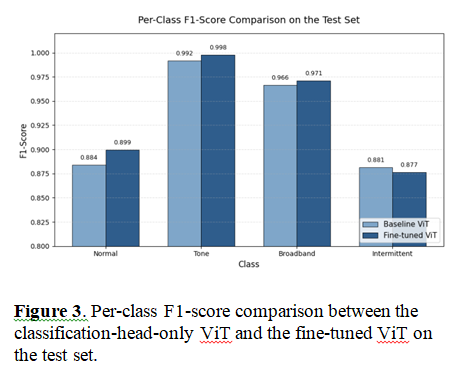
The model was fine-tuned based on the results of an independent test set, which found that the accuracy was 93.70% and the Macro-F1 score was 0.9362. The model performed well in recognizing both tonal interference and broadband interference. The confusion matrix demonstrated that the main challenge for the system is intermittent interference as most of the errors were due to the difficulty in distinguishing between normal and intermittent interference. These results confirm the effectiveness of using the Vision Transformer (ViT) model to analyze the spectral representation of IQ signals for the purpose of detecting and classifying radio interference.
References
[1] Kufakunesu, R., Myburgh, H., & De Freitas, A. (2025). The internet of battle things: a survey on communication challenges and recent solutions. Discover Internet of Things, 5(1), 3. DOI: https://doi.org/10.1007/s43926-025-00093-w
[2] Saeed, R., & El Faki, A. (2016). Proceedings, 2016 International Conference on Computing, in Arabic. Lulu. com.
[3] Alam, A. M., Kurum, M., & Gurbuz, A. C. (2026). Rfi-net: Enhancing passive sensing through deep learning-based time-frequency domain radio frequency interference detection and mitigation. IEEE Transactions on Geoscience and Remote Sensing. DOI: https://doi.org/10.36227/techrxiv.175416119.92208774/v1
[4] Xu, D., Lei, T., Zhao, G., Zhao, J., & Sun, D. (2026). CLTBA: learnable trigger backdoor attack via frequency domain injection. Journal on Information Security. DOI: https://doi.org/10.1186/s13635-026-00246-6
[5] An, T., Yan, X., Zhang, N., Hao, X., Zhang, J., & Dai, J. (2026). Weak Signal Detection Method for Millimeter-Wave Sensor Signals Based on Heterodyne Duffing Oscillator. Mathematics, 14(3), 545. DOI: https://doi.org/10.3390/math14030545
[6] Ahmed, T., Ahmed, A., Imran, A. S., Ullah, M., Manaf, A., & Soylu, A. (2026). Exploring the impact of self-supervised learning and Swin-B transformer on saliency maps and performance in multi-label chest X-ray classification. IEEE Access. DOI: https://doi.org/10.1109/ACCESS.2026.3655022
[7] Diarra, D., Absaloms, H. O., & Langat, P. K. (2026). Multi-Agent Deep Reinforcement Learning-Based Power Control for Energy-Efficient user-centric Cell-Free Massive MIMO. Physical Communication, 103275. DOI: https://doi.org/10.1016/j.phycom.2026.103275
[8] Shaghluf, N., & Gulliver, T. A. (2026). Multi-agent deep reinforcement learning-based resource allocation for cognitive D2D communications underlaying cellular networks. Wireless Networks, 1-19. DOI: https://doi.org/10.1007/s11276-026-04176-6
[9] Arakkal, P., Suresh, S. S., Sreehari, D., Anand, N. K., Vinod, N. K., Poorna, S. S., & Anuraj, K. (2026). Deep Learning–based RF Fingerprinting for Secure Physical-Layer Device Authentication. IEEE Access. DOI: https://doi.org/10.1109/ACCESS.2026.3692297
[10] Xu, C., Ren, J., Yu, W., Jin, Y., Cao, Z., Wu, X., & Jiang, W. (2022). Time-frequency analysis-based deep interference classification for frequency hopping system. EURASIP Journal on Advances in Signal Processing, 2022(1), 90. DOI: https://doi.org/10.1186/s13634-022-00913-z
[11] Dosovitskiy, A. (2020). An image is worth 16x16 words: Transformers for image recognition at scale. arXiv preprint arXiv:2010.11929.
Downloads
Published
Issue
Section
License
Copyright (c) 2026 Al-Noor Journal of Engineering Management and Computer Science

This work is licensed under a Creative Commons Attribution-NonCommercial-ShareAlike 4.0 International License.
How to Cite