Heat-Source-Constrained Optimization of an Organic Rankine Cycle Driven by a Finite Sensible Solar-HTF Source: Working-Fluid and Power-Efficiency Trade-offs
DOI:
https://doi.org/10.71229/e3n55n06Keywords:
Organic Rankine cycle; , solar thermal energy;, heat-source matching; , working-fluid selection; , reduced evaporation pressure; , pinch-point constraint; , thermodynamic optimization; , low-GWP refrigerantsAbstract
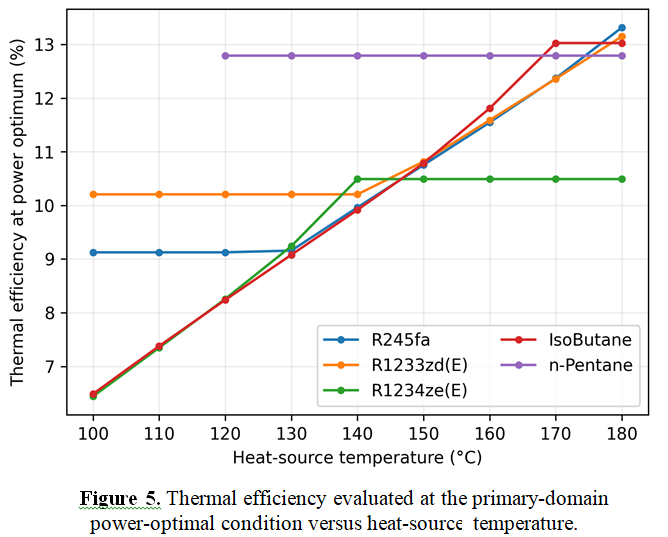
A steady-state subcritical organic Rankine cycle (ORC) coupled to a finite sensible solar heat-transfer-fluid (HTF) source was evaluated to distinguish useful net-power optima from thermal-efficiency limits. Five fluids were screened at nine heat-source temperatures (100–180°C) and 25 reduced evaporation pressures (Pr=0.20–0.80), with a common source heat-capacity rate of 1 kW K−1. Re-execution of the candidate-level Python model yielded 755 feasible and 370 rejected states among 1,125 candidates; all rejected primary-grid states failed the 10 K hot-end evaporator approach (32.9% rejection). At 150°C, R1234ze(E) delivered the highest primary-domain net power, 10.325 kW at Pr=0.80. A separately examined Pr=0.10–0.90 extension increased its power to 10.683 kW at the Pr=0.90 upper bound, which is not an unconstrained optimum. Its Pr=0.10 state was infeasible because evaporation pressure was below condensation pressure. The extended n-pentane power maximum occurred at an interior Pr=0.1304 and 8.200 kW. At 180°C, isobutane reached 17.149 kW at the extended upper bound Pr=0.90. For several fluids, maximizing efficiency alone approached zero-throughput pinch limits; the resulting limiting efficiency ratios are not realizable finite-output operating states. Reproducible code, the 1,125-state dataset, an analytical pinch unit test and mesh-refinement checks are provided. Property-path verification and limited R245fa cycle comparisons do not independently validate the thermophysical formulation or actual source-side heat transfer. All power figures are thermodynamic comparisons for the normalized source under the stated steady-state assumptions, not predictions of a specified solar plant.
References
[1] Dickes, R.; Casati, E.; Desideri, A.; Lemort, V.; Quoilin, S. Solar-powered organic Rankine cycles: A technical and historical review. Renewable and Sustainable Energy Reviews 2025, 212, 115319. https://doi.org/10.1016/j.rser.2024.115319 DOI: https://doi.org/10.1016/j.rser.2024.115319
[2] Quoilin, S.; van den Broek, M.; Declaye, S.; Dewallef, P.; Lemort, V. Techno-economic survey of Organic Rankine Cycle (ORC) systems. Renewable and Sustainable Energy Reviews 2013, 22, 168-186. https://doi.org/10.1016/j.rser.2013.01.028 DOI: https://doi.org/10.1016/j.rser.2013.01.028
[3] Tchanche, B.F.; Lambrinos, G.; Frangoudakis, A.; Papadakis, G. Low-grade heat conversion into power using organic Rankine cycles - A review of various applications. Renewable and Sustainable Energy Reviews 2011, 15(8), 3963-3979. https://doi.org/10.1016/j.rser.2011.07.024 DOI: https://doi.org/10.1016/j.rser.2011.07.024
[4] Velez, F.; Segovia, J.J.; Martin, M.C.; Antolin, G.; Chejne, F.; Quijano, A. A technical, economical and market review of organic Rankine cycles for the conversion of low-grade heat for power generation. Renewable and Sustainable Energy Reviews 2012, 16(6), 4175-4189. https://doi.org/10.1016/j.rser.2012.03.022 DOI: https://doi.org/10.1016/j.rser.2012.03.022
[5] Colonna, P.; Casati, E.; Trapp, C.; Mathijssen, T.; Larjola, J.; Turunen-Saaresti, T.; Uusitalo, A. Organic Rankine Cycle Power Systems: From the Concept to Current Technology, Applications, and an Outlook to the Future. Journal of Engineering for Gas Turbines and Power 2015, 137(10), 100801-1-100801-19. https://doi.org/10.1115/1.4029884 DOI: https://doi.org/10.1115/1.4029884
[6] Chen, H.; Goswami, D.Y.; Stefanakos, E.K. A review of thermodynamic cycles and working fluids for the conversion of low-grade heat. Renewable and Sustainable Energy Reviews 2010, 14(9), 3059-3067. https://doi.org/10.1016/j.rser.2010.07.006 DOI: https://doi.org/10.1016/j.rser.2010.07.006
[7] Bao, J.; Zhao, L. A review of working fluid and expander selections for organic Rankine cycle. Renewable and Sustainable Energy Reviews 2013, 24, 325-342. https://doi.org/10.1016/j.rser.2013.03.040 DOI: https://doi.org/10.1016/j.rser.2013.03.040
[8] Lecompte, S.; Huisseune, H.; van den Broek, M.; Vanslambrouck, B.; De Paepe, M. Review of organic Rankine cycle (ORC) architectures for waste heat recovery. Renewable and Sustainable Energy Reviews 2015, 47, 448-461. https://doi.org/10.1016/j.rser.2015.03.089 DOI: https://doi.org/10.1016/j.rser.2015.03.089
[9] Badr, O.; Probert, S.D.; O'Callaghan, P.W. Selecting a working fluid for a Rankine-cycle engine. Applied Energy 1985, 21(1), 1-42. https://doi.org/10.1016/0306-2619(85)90072-8 DOI: https://doi.org/10.1016/0306-2619(85)90072-8
[10] Saleh, B.; Koglbauer, G.; Wendland, M.; Fischer, J. Working fluids for low-temperature organic Rankine cycles. Energy 2007, 32(7), 1210-1221. https://doi.org/10.1016/j.energy.2006.07.001 DOI: https://doi.org/10.1016/j.energy.2006.07.001
[11] Drescher, U.; Brueggemann, D. Fluid selection for the Organic Rankine Cycle (ORC) in biomass power and heat plants. Applied Thermal Engineering 2007, 27(1), 223-228. https://doi.org/10.1016/j.applthermaleng.2006.04.024 DOI: https://doi.org/10.1016/j.applthermaleng.2006.04.024
[12] Lakew, A.A.; Bolland, O. Working fluids for low-temperature heat source. Applied Thermal Engineering 2010, 30(10), 1262-1268. https://doi.org/10.1016/j.applthermaleng.2010.02.009 DOI: https://doi.org/10.1016/j.applthermaleng.2010.02.009
[13] Tchanche, B.F.; Papadakis, G.; Lambrinos, G.; Frangoudakis, A. Fluid selection for a low-temperature solar organic Rankine cycle. Applied Thermal Engineering 2009, 29(11-12), 2468-2476. https://doi.org/10.1016/j.applthermaleng.2008.12.025 DOI: https://doi.org/10.1016/j.applthermaleng.2008.12.025
[14] Rayegan, R.; Tao, Y.X. A procedure to select working fluids for Solar Organic Rankine Cycles (ORCs). Renewable Energy 2011, 36(2), 659-670. https://doi.org/10.1016/j.renene.2010.07.010 DOI: https://doi.org/10.1016/j.renene.2010.07.010
[15] Quoilin, S.; Orosz, M.; Hemond, H.; Lemort, V. Performance and design optimization of a low-cost solar organic Rankine cycle for remote power generation. Solar Energy 2011, 85(5), 955-966. https://doi.org/10.1016/j.solener.2011.02.010 DOI: https://doi.org/10.1016/j.solener.2011.02.010
[16] Facao, J.; Palmero-Marrero, A.; Oliveira, A.C. Analysis of a solar assisted micro-cogeneration ORC system. International Journal of Low-Carbon Technologies 2008, 3(4), 254-264. https://doi.org/10.1093/ijlct/3.4.254 DOI: https://doi.org/10.1093/ijlct/3.4.254
[17] Letelier, E.; Romera, S.; Coronas, A.; Bruno, J.C. Modelling and optimisation of solar organic Rankine cycle engines for reverse osmosis desalination. Applied Thermal Engineering 2008, 28(17-18), 2212-2226. https://doi.org/10.1016/j.applthermaleng.2007.12.022 DOI: https://doi.org/10.1016/j.applthermaleng.2007.12.022
[18] Freeman, J.; Hellgardt, K.; Markides, C.N. An assessment of solar-powered organic Rankine cycle systems for combined heating and power in UK domestic applications. Applied Energy 2015, 138, 605-620. https://doi.org/10.1016/j.apenergy.2014.10.035 DOI: https://doi.org/10.1016/j.apenergy.2014.10.035
[19] Freeman, J.; Hellgardt, K.; Markides, C.N. Working fluid selection and electrical performance optimisation of a domestic solar-ORC combined heat and power system for year-round operation in the UK. Applied Energy 2017, 186(Part 3), 291-303. https://doi.org/10.1016/j.apenergy.2016.04.041 DOI: https://doi.org/10.1016/j.apenergy.2016.04.041
[20] Desai, N.B.; Bandyopadhyay, S. Thermo-economic analysis and selection of working fluid for solar organic Rankine cycle. Applied Thermal Engineering 2016, 95, 471-481. https://doi.org/10.1016/j.applthermaleng.2015.11.018 DOI: https://doi.org/10.1016/j.applthermaleng.2015.11.018
[21] Patil, V.R.; Biradar, V.I.; Shreyas, R.; Garg, P.; Orosz, M.S.; Thirumalai, N.C. Techno-economic comparison of solar organic Rankine cycle (ORC) and photovoltaic (PV) systems with energy storage. Renewable Energy 2017, 113, 1250-1260. https://doi.org/10.1016/j.renene.2017.06.107 DOI: https://doi.org/10.1016/j.renene.2017.06.107
[22] Wang, Y.; Song, J.; Chatzopoulou, M.A.; Nixon, S.; Simpson, M.C.; Wang, J.; Markides, C.N. A holistic thermoeconomic assessment of small-scale, distributed solar organic Rankine cycle (ORC) systems: Comprehensive comparison of configurations, component and working fluid selection. Energy Conversion and Management 2021, 248, 114618. https://doi.org/10.1016/j.enconman.2021.114618 DOI: https://doi.org/10.1016/j.enconman.2021.114618
[23] Valencia Ochoa, G.; Villicana Ortiz, E.; Duarte Forero, J. Thermo-economic and environmental optimization using PSO of solar organic Rankine cycle with flat plate solar collector. Heliyon 2023, 9(3), e13697. https://doi.org/10.1016/j.heliyon.2023.e13697 DOI: https://doi.org/10.1016/j.heliyon.2023.e13697
[24] Zhang, S.; Liu, X.; Liu, L.; Pan, X.; Li, Q.; Wang, S.; Jiao, Y.; He, C.; Li, G. Thermo-economic assessment and multi-objective optimization of organic Rankine cycle driven by solar energy and waste heat. Energy 2024, 290, 130223. https://doi.org/10.1016/j.energy.2023.130223 DOI: https://doi.org/10.1016/j.energy.2023.130223
[25] Arjunan, P.; Gnana Muthu, J.H.; Somanasari Radha, S.L.; Suryan, A. Selection of working fluids for solar organic Rankine cycle - A review. International Journal of Energy Research 2022, 46(14), 20573-20599. https://doi.org/10.1002/er.7723 DOI: https://doi.org/10.1002/er.7723
[26] Li, J.; Liu, Q.; Ge, Z.; Duan, Y.-Y.; Yang, Z. Thermodynamic performance analyses and optimization of subcritical and transcritical organic Rankine cycles using R1234ze(E) for 100-200 C heat sources. Energy Conversion and Management 2017, 149, 140-154. https://doi.org/10.1016/j.enconman.2017.06.060 DOI: https://doi.org/10.1016/j.enconman.2017.06.060
[27] Liu, W.; Meinel, D.; Wieland, C.; Spliethoff, H. Investigation of hydrofluoroolefins as potential working fluids in organic Rankine cycle for geothermal power generation. Energy 2014, 67, 106-116. https://doi.org/10.1016/j.energy.2013.11.081 DOI: https://doi.org/10.1016/j.energy.2013.11.081
[28] Liu, W.; Meinel, D.; Gleinser, M.; Wieland, C.; Spliethoff, H. Optimal Heat Source Temperature for thermodynamic optimization of sub-critical Organic Rankine Cycles. Energy 2015, 88, 897-906. https://doi.org/10.1016/j.energy.2015.07.040 DOI: https://doi.org/10.1016/j.energy.2015.07.040
[29] Chen, G.; An, Q.; Wang, Y.; Zhao, J.; Chang, N.; Alvi, J. Performance prediction and working fluids selection for organic Rankine cycle under reduced temperature. Applied Thermal Engineering 2019, 153, 95-103. https://doi.org/10.1016/j.applthermaleng.2019.02.011 DOI: https://doi.org/10.1016/j.applthermaleng.2019.02.011
[30] Long, R.; Bao, Y.J.; Huang, X.M.; Liu, W. Exergy analysis and working fluid selection of organic Rankine cycle for low grade waste heat recovery. Energy 2014, 73, 475-483. https://doi.org/10.1016/j.energy.2014.06.040 DOI: https://doi.org/10.1016/j.energy.2014.06.040
[31] Frutiger, J.; Andreasen, J.; Liu, W.; Spliethoff, H.; Haglind, F.; Abildskov, J.; Sin, G. Working fluid selection for organic Rankine cycles - Impact of uncertainty of fluid properties. Energy 2016, 109, 987-997. https://doi.org/10.1016/j.energy.2016.05.010 DOI: https://doi.org/10.1016/j.energy.2016.05.010
[32] Sarkar, J. Generalized pinch point design method of subcritical-supercritical organic Rankine cycle for maximum heat recovery. Energy 2018, 143, 141-150. https://doi.org/10.1016/j.energy.2017.10.057 DOI: https://doi.org/10.1016/j.energy.2017.10.057
[33] Madhawa Hettiarachchi, H.D.; Golubovic, M.; Worek, W.M.; Ikegami, Y. Optimum design criteria for an Organic Rankine cycle using low-temperature geothermal heat sources. Energy 2007, 32(9), 1698-1706. https://doi.org/10.1016/j.energy.2007.01.005 DOI: https://doi.org/10.1016/j.energy.2007.01.005
[34] Heberle, F.; Preissinger, M.; Brueggemann, D. Zeotropic mixtures as working fluids in Organic Rankine Cycles for low-enthalpy geothermal resources. Renewable Energy 2012, 37(1), 364-370. https://doi.org/10.1016/j.renene.2011.06.044 DOI: https://doi.org/10.1016/j.renene.2011.06.044
[35] Chys, M.; van den Broek, M.; Vanslambrouck, B.; De Paepe, M. Potential of zeotropic mixtures as working fluids in organic Rankine cycles. Energy 2012, 44(1), 623-632. https://doi.org/10.1016/j.energy.2012.05.030 DOI: https://doi.org/10.1016/j.energy.2012.05.030
[36] Dai, Y.; Wang, J.; Gao, L. Parametric optimization and comparative study of organic Rankine cycle (ORC) for low grade waste heat recovery. Energy Conversion and Management 2009, 50(3), 576-582. https://doi.org/10.1016/j.enconman.2008.10.018 DOI: https://doi.org/10.1016/j.enconman.2008.10.018
[37] Quoilin, S.; Declaye, S.; Tchanche, B.F.; Lemort, V. Thermo-economic optimization of waste heat recovery Organic Rankine Cycles. Applied Thermal Engineering 2011, 31(14-15), 2885-2893. https://doi.org/10.1016/j.applthermaleng.2011.05.014 DOI: https://doi.org/10.1016/j.applthermaleng.2011.05.014
[38] Eyerer, S.; Wieland, C.; Vandersickel, A.; Spliethoff, H. Experimental study of an ORC and analysis of R1233zd-E as a drop-in replacement for R245fa for low temperature heat utilization. Energy 2016, 103, 660-671. https://doi.org/10.1016/j.energy.2016.03.034 DOI: https://doi.org/10.1016/j.energy.2016.03.034
[39] Yang, J.; Sun, Z.; Yu, B.; Chen, J. Experimental comparison and optimization guidance of R1233zd(E) as a drop-in replacement to R245fa for Organic Rankine Cycle application. Applied Thermal Engineering 2018, 141, 10-19. https://doi.org/10.1016/j.applthermaleng.2018.05.105 DOI: https://doi.org/10.1016/j.applthermaleng.2018.05.105
[40] Eyerer, S.; Dawo, F.; Kaindl, J.; Wieland, C.; Spliethoff, H. Experimental investigation of modern ORC working fluids R1224yd(Z) and R1233zd(E) as replacements for R245fa. Applied Energy 2019, 240, 946-963. https://doi.org/10.1016/j.apenergy.2019.02.086 DOI: https://doi.org/10.1016/j.apenergy.2019.02.086
[41] Dawo, F.; Fleischmann, J.; Kaufmann, F.; Schifflechner, C.; Eyerer, S.; Wieland, C.; Spliethoff, H. R1224yd(Z), R1233zd(E) and R1336mzz(Z) as replacements for R245fa: Experimental performance, interaction with lubricants and environmental impact. Applied Energy 2021, 288, 116661. https://doi.org/10.1016/j.apenergy.2021.116661 DOI: https://doi.org/10.1016/j.apenergy.2021.116661
[42] Yang, M.-H.; Liu, M.-C.; Yeh, R.-H. Investigation of low-GWP working fluids as substitutes for R245fa in organic Rankine cycle application. Heliyon 2024, 10(14), e34219. https://doi.org/10.1016/j.heliyon.2024.e34219 DOI: https://doi.org/10.1016/j.heliyon.2024.e34219
[43] Kang, S.H. Design and experimental study of ORC (organic Rankine cycle) and radial turbine using R245fa working fluid. Energy 2012, 41(1), 514-524. https://doi.org/10.1016/j.energy.2012.02.035 DOI: https://doi.org/10.1016/j.energy.2012.02.035
[44] Declaye, S.; Quoilin, S.; Guillaume, L.; Lemort, V. Experimental study on an open-drive scroll expander integrated into an ORC system with R245fa as working fluid. Energy 2013, 55, 173-183. https://doi.org/10.1016/j.energy.2013.04.003 DOI: https://doi.org/10.1016/j.energy.2013.04.003
[45] Kong, R.; Deethayat, T.; Asanakham, A.; Vorayos, N.; Kiatsiriroat, T. Thermodynamic performance analysis of a R245fa organic Rankine cycle (ORC) with different kinds of heat sources at evaporator. Case Studies in Thermal Engineering 2019, 13, 100385. https://doi.org/10.1016/j.csite.2018.100385 DOI: https://doi.org/10.1016/j.csite.2018.100385
[46] Talluri, L.; Dumont, O.; Manfrida, G.; Lemort, V.; Fiaschi, D. Experimental investigation of an Organic Rankine Cycle Tesla turbine working with R1233zd(E). Applied Thermal Engineering 2020, 174, 115293. https://doi.org/10.1016/j.applthermaleng.2020.115293 DOI: https://doi.org/10.1016/j.applthermaleng.2020.115293
[47] Rijpkema, J.; Andersson, S.B.; Munch, K. Experimental study of an organic Rankine cycle with R1233zd(E) for waste heat recovery from the coolant of a heavy-duty truck engine. Energy Conversion and Management 2021, 244, 114500. https://doi.org/10.1016/j.enconman.2021.114500 DOI: https://doi.org/10.1016/j.enconman.2021.114500
[48] Bell, I.H.; Wronski, J.; Quoilin, S.; Lemort, V. Pure and Pseudo-pure Fluid Thermophysical Property Evaluation and the Open-Source Thermophysical Property Library CoolProp. Industrial & Engineering Chemistry Research 2014, 53(6), 2498-2508. https://doi.org/10.1021/ie4033999 DOI: https://doi.org/10.1021/ie4033999
[49] Akasaka, R.; Lemmon, E.W. An International Standard Formulation for trans-1-Chloro-3,3,3-trifluoroprop-1-ene [R1233zd(E)] Covering Temperatures from the Triple-Point Temperature to 450 K and Pressures up to 100 MPa. Journal of Physical and Chemical Reference Data 2022, 51(2), 023101. https://doi.org/10.1063/5.0083026 DOI: https://doi.org/10.1063/5.0083026
[50] Benoit, H.; Spreafico, L.; Gauthier, D.; Flamant, G. Review of heat transfer fluids in tube-receivers used in concentrating solar thermal systems: Properties and heat transfer coefficients. Renewable and Sustainable Energy Reviews 2016, 55, 298-315. https://doi.org/10.1016/j.rser.2015.10.059 DOI: https://doi.org/10.1016/j.rser.2015.10.059
[51] IPCC Climate Change 2021: The Physical Science Basis. Contribution of Working Group I to the Sixth Assessment Report of the Intergovernmental Panel on Climate Change. Cambridge University Press 2021. https://doi.org/10.1017/9781009157896 DOI: https://doi.org/10.1017/9781009157896
[52] ASHRAE ANSI/ASHRAE Standard 34-2022: Designation and Safety Classification of Refrigerants. American Society of Heating, Refrigerating and Air-Conditioning Engineers 2022.
[53] Chen, Q.; Xu, J.; Chen, H. A new design method for Organic Rankine Cycles with constraint of inlet and outlet heat carrier fluid temperatures coupling with the heat source. Applied Energy 2012, 98, 562–573. https://doi.org/10.1016/j.apenergy.2012.04.035 DOI: https://doi.org/10.1016/j.apenergy.2012.04.035
20
Downloads
Published
Issue
Section
License
Copyright (c) 2026 Al-Noor Journal of Engineering Management and Computer Science

This work is licensed under a Creative Commons Attribution-NonCommercial-ShareAlike 4.0 International License.
How to Cite