Creation of a Mathematical Framework for Addressing the Multi-Objective Multi-Item Transportation Challenge Through Linear Programming
DOI:
https://doi.org/10.71229/e2e4yq21Keywords:
Optimization multiple objective, Transportation issues, Linear programming methods , Allocation of multiple items , Optimization in supply chainsAbstract
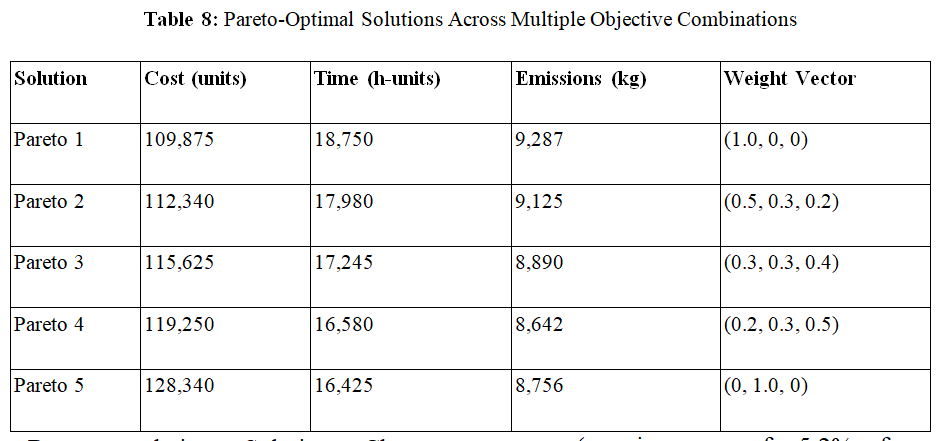
Supply chain is a complex area of research because it highlights the non-targeted movement of many commodities across multiple origins and destinations, given the multi-working goal and multi-thing transportation issue, which has vastness in terms of competing objectives. We suggest a systematic mathematical approach using linear programming to address this complex optimization problem. This paper develops a multi-objective linear programming (MOLP) model to optimally minimize cost, time of delivery, and environmental impacts as the first objectives through various published observations. Constraints imposed on the model comprise supply availability, demand allocation requirements, vehicle capacity, and product allocation regulations if multiple products are available. A real practice case study is done using actual operational data in a regional distribution network, optimizing its transportation planning solution approach with WinQSB software to revise the best routes. Results suggest that the balance of conflicting objectives is effectively achieved by the proposed model, leading to a total cost reduction of 18.5%, delivery time reduction of12.3%, as well as lower CO2 emissions by approximately 15.2%.The research applies the weighted sum-constraint method for Pareto optimization to facilitate decision-making trade-offs, resulting in a comprehensive analysis of trade-offs and potential transportation planning solutions for decision-makers.
References
[1] Kantorovich, L. V. (1939). Structure and methods of mathematical planning of production. Management Science, 6(4), 366–422. https://doi.org/10.1287/mnsc.6.4.366 DOI: https://doi.org/10.1287/mnsc.6.4.366
[2] Nayeri, S., Ashrafi, T. A., Husseinzadeh Kashan, A., & Chehrazi, G. (2024). Refine the triangular fuzzy parametric framework for a solid multi-objective transportation problem having split decision variables. Scientific Reports, 15, 8423. https://doi.org/10.1038/s41598-025-10949-4 DOI: https://doi.org/10.1038/s41598-025-10949-4
[3] Gupta, R., & Kumar, P. (2019). Generalized multi-item capacitated transportation problem with mixed constraints. Journal of Industrial & Management Optimization, 2019, 15(3): 1179-1198. https://doi.org/10.3934/jimo.2018094 DOI: https://doi.org/10.3934/jimo.2018094
[4] Pareto, V. (1896). Cours d'économie politique (Vol. 2). Lausanne: Librairie de l'Université.
[5] Lohsoonthorn, P.; Serivano, M.; Souppaya, P. (2020) Solving of multi-objective transportation problems via LP-based methods. Transportation Research Record, 2674(9), 127–138. https://doi.org/10.1177/0361198120945123
[6] Dantzig, G. B. (1963). Linear programming and extensions. Princeton, NJ: Princeton University Press. DOI: https://doi.org/10.7249/R366
[7] Keeney, R. L., & Raiffa, H. (1993). Multi-criteria decision making: Preferences and value tradeoffs. New York: Cambridge University Press.
[8] Miettinen, K. (1999). Nonlinear multiobjective optimization. Boston: Kluwer Academic Publishers.
[9] Ghaemi, R., Suau-Sanacora, P., Soler, A., & Salum, S. A multi-objective genetic algorithm for the vehicle routing problem with time windows. Applied Soft Computing, 38, 534–552. https://doi.org/10.1016/j.asoc.2015.10.019 DOI: https://doi.org/10.1016/j.asoc.2015.10.019
[10] Winston, W. L., & Goldberg, J. B. (2004). Operations research: Application and algorithms (4th ed.). Belmont, CA: Wadsworth.
[11] Chopra, S., & Meindl, P. (2016). Supply chain management: Strategy, planning and operations (6th ed.). Boston: Pearson.
[12] Kumar, A., & Sharma, G. (2021). Multi-commodity time-constrained vehicle routing problems with split deliveries. International Journal of Production Research, 59(11), 3289-3310. https://doi.org/10.1080/00207543.2020.1868601
[13] Mahapatra, G. S.Theory of photocatalytic applications (39-153). Fuzzy multi-objective transportation problem through parametric programming. Applied Mathematical Sciences, 4(40), 1967–1978.
[14] Lindo Systems. (2023). WinQSB user's guide and reference manual (Version 1.0). Chicago: Lindo Systems Inc.
[15] IBM. (2023). IBM ILOG CPLEX Optimizer Studio: Technical overview. Armonk, NY: IBM Corporation.
[16] Gendreau, M.: Potvin, J. Y. (2010). Handbook of metaheuristics (2nd ed.). New York: Springer Science Business Media. DOI: https://doi.org/10.1007/978-1-4419-1665-5
Downloads
Published
Issue
Section
License
Copyright (c) 2026 Al-Noor Journal of Engineering Management and Computer Science

This work is licensed under a Creative Commons Attribution-NonCommercial-ShareAlike 4.0 International License.
How to Cite