Experimental Investigation of Electrically-Assisted Stretch Forming of 304Stainless Steel and carbon Steel Using Continuous and Pulsed Currents
DOI:
https://doi.org/10.71229/pptq0b98Keywords:
Electrically Assisted Stretch Forming, Electroplastic effect, Formability, electron wind, Pulsed DC Current, Stretch FormingAbstract
Stretch forming is a common procedure in sheet metal manufacturing, and it is often applies force to create parts with complex geometrical shapes. It becomes very important to obtain an understanding and optimization of parameters for improving the manufacturing process of the present time.
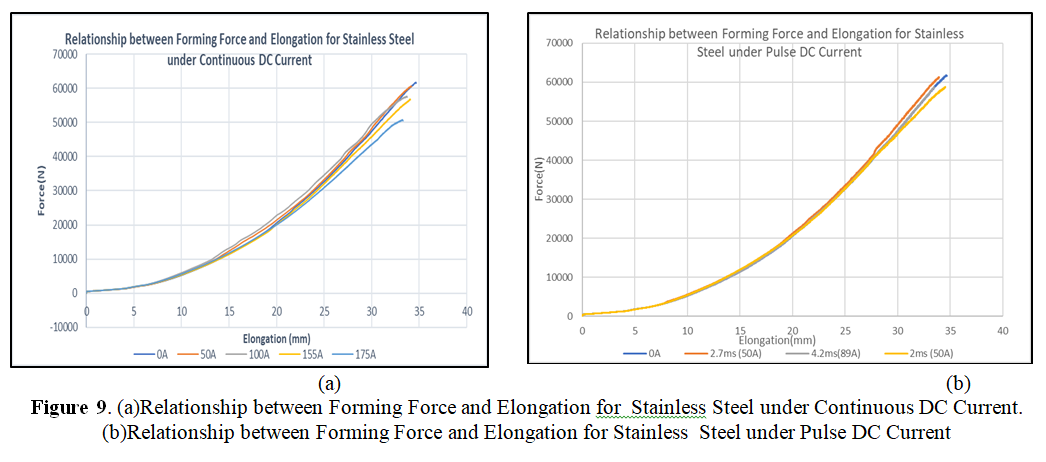
However, one of the main disadvantages of using the traditional stretch forming technology is the requirement for high forces that could lead to defects in manufacturing, tool wear, and low stretchability of the materials. To overcome the limitations, the application of the electroplastic effect to reduce processing resistance is studied in the present work using two power-generation methods: continuous and pulsed DC.
experimental studies on carbon steel and 304 grade stainless steel plates, it can be seen that using both DC continuous currents and pulsed currents causes a decrease in the forming force. It is found that force decreases by 6.95%–8.40% for carbon steel and 14.37%–17.87% for stainless steel 304, depending on the type of current used. Besides, pulsed current becomes more effective for decreasing the forming force when the value of current becomes smaller. In addition to this, good correlations are found between experimental and theoretical calculations, especially when the current is in the form of DC current.
References
[1] W. A. Salandro, J. J. Jones, C. Bunget, L. Mears, and J. T. Roth, Electrically Assisted Forming: Modeling and Control. in Springer Series in Advanced Manufacturing. Cham: Springer International Publishing, 2015. doi: 10.1007/978-3-319-08879-2. DOI: https://doi.org/10.1007/978-3-319-08879-2
[2] B. J. Ruszkiewicz, T. Grimm, I. Ragai, L. Mears, and J. T. Roth, ‘A Review of Electrically-Assisted Manufacturing With Emphasis on Modeling and Understanding of the Electroplastic Effect’, J. Manuf. Sci. Eng., vol. 139, no. 11, p. 110801, Nov. 2017, doi: 10.1115/1.4036716. DOI: https://doi.org/10.1115/1.4036716
[3] S. M. Kamal, L. Zani, A. A. Kadir, K. P. Baxevanakis, and A. Roy, ‘Advancement and emerging challenges in electric-field assisted manufacturing: a review’, Int. J. Adv. Manuf. Technol., vol. 141, no. 5–6, pp. 2447–2470, Nov. 2025, doi: 10.1007/s00170-025-16499-3. DOI: https://doi.org/10.1007/s00170-025-16499-3
[4] M.-J. Kim et al., ‘Electric current–assisted deformation behavior of Al-Mg-Si alloy under uniaxial tension’, Int. J. Plast., vol. 94, pp. 148–170, Jul. 2017, doi: 10.1016/j.ijplas.2016.09.010. DOI: https://doi.org/10.1016/j.ijplas.2016.09.010
[5] A. Khal, B. J. Ruszkiewicz, and L. Mears, ‘Springback Evaluation of 304 Stainless Steel in an Electrically Assisted Air Bending Operation’, in Volume 1: Processing, Blacksburg, Virginia, USA: American Society of Mechanical Engineers, Jun. 2016, p. V001T02A020. doi: 10.1115/MSEC2016-8736. DOI: https://doi.org/10.1115/MSEC2016-8736
[6] K. Okazaki, M. Kagawa, and H. Conrad, ‘A study of the electroplastic effect in metals’, Scr. Metall., vol. 12, no. 11, pp. 1063–1068, Nov. 1978, doi: 10.1016/0036-9748(78)90026-1. DOI: https://doi.org/10.1016/0036-9748(78)90026-1
[7] J. J. Jones and L. Mears, ‘Constant Current Density Compression Behavior of 304 Stainless Steel and Ti-6Al-4V During Electrically-Assisted Forming’, in ASME 2011 International Manufacturing Science and Engineering Conference, Volume 1, Corvallis, Oregon, USA: ASMEDC, Jan. 2011, pp. 629–637. doi: 10.1115/MSEC2011-50287. DOI: https://doi.org/10.1115/MSEC2011-50287
[8] J. H. Song et al., ‘Effect of Pulsed Electric Current on the Tensile Properties of DP Type Ultra-High Strength Steel Sheets’, Appl. Mech. Mater., vol. 389, pp. 284–288, Aug. 2013, doi: 10.4028/www.scientific.net/AMM.389.284. DOI: https://doi.org/10.4028/www.scientific.net/AMM.389.284
[9] J. J. Jones, L. Mears, and J. T. Roth, ‘Electrically-Assisted Forming of Magnesium AZ31: Effect of Current Magnitude and Deformation Rate on Forgeability’, J. Manuf. Sci. Eng., vol. 134, no. 3, p. 034504, Jun. 2012, doi: 10.1115/1.4006547. DOI: https://doi.org/10.1115/1.4006547
[10] Y. Song et al., ‘Electroplasticity constitutive modeling of aluminum alloys based on dislocation density evolution’, J. Mater. Res. Technol., vol. 33, pp. 3501–3517, Nov. 2024, doi: 10.1016/j.jmrt.2024.09.238. DOI: https://doi.org/10.1016/j.jmrt.2024.09.238
[11] F. Cao, Y. Zeng, and B. Liu, ‘Electrically Assisted Stretch Bending of Aluminum Extruded Profile’, MATEC Web Conf., vol. 175, p. 03056, 2018, doi: 10.1051/matecconf/201817503056. DOI: https://doi.org/10.1051/matecconf/201817503056
[12] D. Dobras, ‘Electrically-assisted forming of 5754 aluminium alloy under different strain conditions’, presented at the Material Forming, May 2024, pp. 1408–1415. doi: 10.21741/9781644903131-156. DOI: https://doi.org/10.21741/9781644903131-156
[13] A. F. Sprecher, S. L. Mannan, and H. Conrad, ‘Overview no. 49: On the mechanisms for the electroplastic effect in metals’, Acta Metall., vol. 34, no. 7, pp. 1145–1162, Jul. 1986, doi: 10.1016/0001-6160(86)90001-5. DOI: https://doi.org/10.1016/0001-6160(86)90001-5
[14] Z. Xu, T. Jiang, J. Huang, L. Peng, X. Lai, and M. W. Fu, ‘Electroplasticity in electrically-assisted forming: Process phenomena, performances and modelling’, Int. J. Mach. Tools Manuf., vol. 175, p. 103871, Apr. 2022, doi: 10.1016/j.ijmachtools.2022.103871. DOI: https://doi.org/10.1016/j.ijmachtools.2022.103871
[15] Y. Chen, J. Xu, B. Guo, and D. Shan, ‘Effect of Pulsed Current-Assisted Tension on the Mechanical Behavior and Local Strain of Nickel-Based Superalloy Sheet’, Materials, vol. 16, no. 4, p. 1589, Feb. 2023, doi: 10.3390/ma16041589. DOI: https://doi.org/10.3390/ma16041589
[16] V. Stolyarov and A. Misochenko, ‘A Pulsed Current Application to the Deformation Processing of Materials’, Materials, vol. 16, no. 18, p. 6270, Sep. 2023, doi: 10.3390/ma16186270. DOI: https://doi.org/10.3390/ma16186270
Downloads
Published
Issue
Section
License
Copyright (c) 2026 Al-Noor Journal of Engineering Management and Computer Science

This work is licensed under a Creative Commons Attribution-NonCommercial-ShareAlike 4.0 International License.
How to Cite