Comparative Groundwater Quality Assessment Using the Nemerow Pollution Index and the Canadian CCME Water Quality Index in Tikrit, Iraq
DOI:
https://doi.org/10.71229/nn479392Keywords:
Groundwater quality, , Nemerow Pollution Index,, CCME-WQI,, salinity hazard, , hydrochemistry, i, irrigation suitability,Abstract
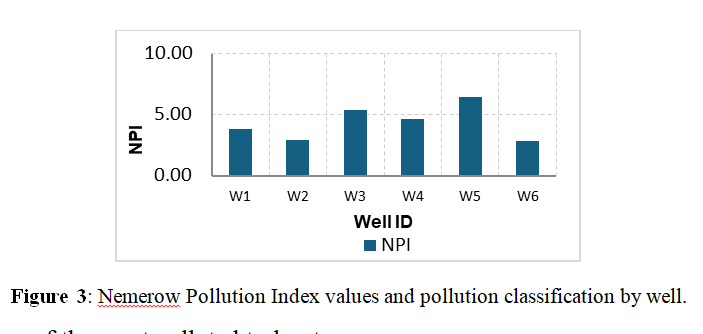
Groundwater in arid and semi-arid settings is often controlled by the combined influence of lithological dissolution, evaporation, return flow from irrigation and groundwater abstraction. This paper provides a comparative assessment of groundwater quality in the Tikrit area, Salah al-Din Governorate, Iraq, using two complementary index models, i.e., the Nemerow Pollution Index (NPI) and the Canadian Council of Ministers of the Environment Water Quality Index (CCME-WQI). Physicochemical parameters like pH, turbidity, EC, TDS, total hardness, major cations, major anions, nitrate, and phosphate were measured in six groundwater wells (W1–W6). To measure the severity of pollution, the NPI model, which combines average single-factor pollution index and maximum pollution factor, was used. The CCME-WQI model was used to summarize the scope, frequency, and amplitude of guideline exceedances. The NPI values ranged from 2.83 to 6.41, and W2 and W6 were classified as moderately polluted, and W1, W3, W4, and W5 were classified as seriously polluted. The CCME-WQI values ranged from 28.59 to 53.13, indicating poor suitability for drinking water for W1, W3, W4 and W5, and marginal suitability for W2 and W6. The overall poor status of the study area was revealed by the regional CCME-WQI of 34.58. Both models identified W5, W3 and W4 as priority wells, but focused on different aspects of deterioration: NPI emphasized the dominance of a single parameter, especially Na+ at W5 and SO4 2- at W3 and W4, whereas CCME-WQI captured the broader multi-parameter failure structure. The irrigation indices showed that all wells are under very high salinity class (C4) with W5 showing combined salinity-sodicity constraint (C4-S3). Thus, the combined NPI-CCME approach provides a more defensible interpretation of groundwater degradation than either model alone, and supports targeted management decisions for drinking-water treatment, irrigation restriction and long-term monitoring.
References
[1] S. H. Ahmed, A. K. Ibrahim, and M. F. Abed, "Assessing the Quality of the Groundwater and the Nitrate Exposure, North Salah Al-Din Governorate, Iraq," Tikrit J. Eng. Sci., vol. 30, no. 1, pp. 25-36, 2023. DOI: https://doi.org/10.25130/tjes.30.1.3
[2] H. A. Khudhair, R. R. Ahmed, R. H. Hussein, H. D. Ibrahim, and O. S. Hassain, "Studying of the Physio-chemical Properties of the Groundwater in Al-A'lam City," Tikrit J. Eng. Sci., vol. 27, no. 4, pp. 31-38, 2020. DOI: https://doi.org/10.25130/tjes.27.4.04
[3] Q. F. Khalaf, D. R. Azeez, and S. F. Mohammed, "Evaluation of the water quality of some groundwater wells in Salah al-Din Governorate," Kirkuk Univ. J. Agric. Sci., vol. 16, no. 3, 2025. DOI: https://doi.org/10.58928/ku25.16317
[4] L. M. N. Laheeb and M. M. Noaman, "Using the Irrigation Water Quality Index to Assess the Suitability of the Tigris River Water for Irrigation Purposes Between Al-Shirqat and Tikrit Sections in Salah al-Din Governorate," Int. J. Environ. Sci., vol. 11, no. 14S, pp. 271-282, 2025. DOI: https://doi.org/10.64252/hnwa0s27
[5] A. S. Qureshi and A. A. Al-Falahi, Extent, Characterization and Causes of Soil Salinity in Central and Southern Iraq. Dubai, UAE: International Center for Biosaline Agriculture, 2015.
[6] A. S. Qureshi, W. Ahmad, and A. A. Al-Falahi, "Optimum Groundwater Table Depth and Irrigation Schedules for Controlling Soil Salinity in Central Iraq," Irrig. Drain., vol. 62, no. 5, pp. 600-609, 2013. DOI: https://doi.org/10.1002/ird.1746
[7] A. K. Ibraheem and O. S. Majeed, "Hydrochemical Assessment of Tigris River for Irrigation Purposes within Baghdad Province, Iraq," South East. Eur. J. Public Health, 2024. DOI: https://doi.org/10.70135/seejph.vi.1274
[8] I. Al-Mallah, Q. Al-Suhail, and A. Albadran, "Mineralogical and Geochemical Analysis of Sediments in Central Iraq," Iraqi J. Sci., vol. 57, no. 3B, pp. 2025-2042, 2016.
[9] Food and Agriculture Organization of the United Nations, The Global Status of Salt-Affected Soils. Rome, Italy: FAO, 2024.
[10] W. M. Al-Shafie, "Soil Salinity Situation in Iraq," Ministry of Agriculture, Iraq, presented at FAO Global Symposium on Salt-Affected Soils, 2021.
[11] Environmental Impact Assessment and Capacity Building Programme, Climate Change Impacts on Livelihoods, Food Security and Water Resources in Salah Al-Din Governorate, Iraq. Case Study Report, 2024.
[12] Japan International Cooperation Agency, Data Collection Survey on Water Resource Management in Iraq. Tokyo, Japan: JICA, 2024.
[13] R. Abood, A. Mustafa, and J. Al-Somaydaii, "Assessment of Groundwater Quality at Selected Wells and Al-Warrar Canal, Ramadi City, Iraq," Iraqi J. Civ. Eng., vol. 15, no. 1, 2021. DOI: https://doi.org/10.37650/ijce.2021.170714
[14] "Assessment of water quality of Tigris River by using WQ index in Salah Al-Din Province," GSC Biol. Pharm. Sci., vol. 24, no. 2, pp. 80-86, 2023. DOI: https://doi.org/10.30574/gscbps.2023.24.2.0290
[15] "Water Quality Assessment for Tigris River Through Salah al-Din," Iraqi J. Phys., vol. 18, no. 47, pp. 95-106, 2020.
[16] "Environmental Evaluation of Surface Water, Groundwater and Wastewater using Pollution Indices at a Landfill Site, Southern Baiji, Salah Al-Din," Iraqi Geol. J., vol. 55, no. 1B, 2022.
[17] International Center for Agricultural Research in the Dry Areas, "Technical and environmental efficiency of wheat farms in saline irrigated areas of Central Iraq," Agric. Water Manage., 2023.
[18] A. A. Al-Falahi and A. S. Qureshi, Iraq Salinity Project: Relationship between Groundwater Table Depth, Groundwater Quality, Soil Salinity and Crop Production. ICARDA/IWMI, 2021.
[19] American Public Health Association, Standard Methods for the Examination of Water and Wastewater, 23rd ed. Washington, DC: APHA, 2017.
[20] U.S. Environmental Protection Agency, "Groundwater Sampling Guidelines," EPA/540/S-95/504, Washington, DC, USA, 1995.
[21] International Organization for Standardization, "Water quality - Sampling - Part 2: Guidance on sampling techniques," ISO 5667-2:2023, Geneva, Switzerland, 2023.
[22] ASTM International, "Standard Test Methods for Determination of Metals and Trace Elements in Water by Atomic Absorption Spectroscopy," ASTM D1976, West Conshohocken, PA, USA, 2020.
[23] International Organization for Standardization, "Water quality - Determination of dissolved anions by ion chromatography," ISO 10304, Geneva, Switzerland, 2023.
[24] World Health Organization, Guidelines for Drinking-Water Quality, 4th ed., Incorporating the First and Second Addenda. Geneva, Switzerland: WHO, 2022.
[25] Central Organization for Standardization and Quality Control, "Iraqi Standard for Drinking Water," IQS 417:2009, Baghdad, Iraq, 2009.
[26] A. Lumb, T. C. Sharma, and J. F. Bibeault, "A review of genesis and evolution of water quality index and some future directions," Water Qual. Expo. Health, vol. 3, pp. 11-24, 2011. DOI: https://doi.org/10.1007/s12403-011-0040-0
[27] S. K. Singha, S. Pasupuleti, S. Singha, R. Kumar, and S. Mondal, "Effectiveness of groundwater heavy metal pollution indices studies by deep learning," J. Contam. Hydrol., vol. 235, 2020. DOI: https://doi.org/10.1016/j.jconhyd.2020.103718
[28] M. K. Sahu and P. K. Sahu, "A comprehensive review of saline water conveyance, treatment, and disposal," Environ. Geochem. Health, vol. 43, pp. 517-536, 2021.
[29] T. Abbasnia et al., "Evaluation of groundwater quality using water quality index and its suitability for assessing water for drinking and irrigation purposes," Groundw. Sustain. Dev., vol. 6, pp. 36-42, 2018.
[30] M. Li, J. Wu, and H. Qian, "Groundwater quality assessment based on entropy weighted water quality index and spatial analysis," Environ. Earth Sci., vol. 78, 2019.
[31] A. Bodrud-Doza et al., "Groundwater quality and human health risk assessment for safe and sustainable water supply," Environ. Monit. Assess., vol. 188, 2016.
[32] M. Adimalla, "Groundwater quality for drinking and irrigation purposes and potential health risks assessment," Expo. Health, vol. 12, pp. 109-123, 2020. DOI: https://doi.org/10.1007/s12403-018-0288-8
[33] N. Nemerow, Scientific Stream Pollution Analysis. New York, NY, USA: McGraw-Hill, 1974.
[34] K. Su, Y. Wang, J. Hu, and L. Zhang, "Water quality assessment based on Nemerow pollution index method," PLOS ONE, vol. 17, no. 8, 2022. DOI: https://doi.org/10.1371/journal.pone.0273305
[35] Y. Li, H. Zhang, and X. Chen, "Application of Nemerow pollution index in groundwater quality evaluation," Environ. Sci. Pollut. Res., vol. 29, pp. 51220-51233, 2022.
[36] J. Wu, P. Li, and H. Qian, "Groundwater quality assessment based on Nemerow index and human health risk assessment," Environ. Earth Sci., vol. 78, 2019.
[37] Canadian Council of Ministers of the Environment, Canadian Water Quality Guidelines for the Protection of Aquatic Life: CCME Water Quality Index 1.0, Technical Report. Winnipeg, MB, Canada: CCME, 2001.
[38] Canadian Council of Ministers of the Environment, CCME Water Quality Index 1.0 User's Manual. Winnipeg, MB, Canada: CCME, 2001.
[39] A. Khan, T. Paterson, and H. Khan, "Modification and application of the Canadian Council of Ministers of the Environment Water Quality Index," Water Qual. Res. J. Canada, vol. 39, no. 2, pp. 128-137, 2004. DOI: https://doi.org/10.2166/wqrj.2004.039
[40] A. Lumb, D. Halliwell, and T. Sharma, "Application of CCME Water Quality Index to monitor water quality," Environ. Monit. Assess., vol. 157, pp. 1-13, 2009.
[41] Food and Agriculture Organization of the United Nations, Water Quality for Agriculture, Irrigation and Drainage Paper No. 29, Rev. 1. Rome, Italy: FAO, 1985.
[42] L. A. Richards, Ed., Diagnosis and Improvement of Saline and Alkali Soils, Agriculture Handbook No. 60. Washington, DC, USA: USDA, 1954. DOI: https://doi.org/10.1097/00010694-195408000-00012
[43] L. V. Wilcox, Classification and Use of Irrigation Waters, USDA Circular 969. Washington, DC, USA: USDA, 1955.
[44] W. P. Kelley, "Use of saline irrigation water," Soil Sci., vol. 95, no. 4, pp. 385-391, 1963. DOI: https://doi.org/10.1097/00010694-196306000-00003
[45] W. D. Doneen, Notes on Water Quality in Agriculture. Davis, CA, USA: University of California, 1964.
[46] S. K. Raghunath, Groundwater, 3rd ed. New Delhi, India: New Age International Publishers, 2007.
[47] D. K. Todd and L. W. Mays, Groundwater Hydrology, 3rd ed. Hoboken, NJ, USA: Wiley, 2005.
[48] C. A. J. Appelo and D. Postma, Geochemistry, Groundwater and Pollution, 2nd ed. Leiden, Netherlands: A.A. Balkema, 2005. DOI: https://doi.org/10.1201/9781439833544
[49] R. A. Freeze and J. A. Cherry, Groundwater. Englewood Cliffs, NJ, USA: Prentice-Hall, 1979.
[50] P. S. Datta and S. K. Tyagi, "Major ion chemistry of groundwater in Delhi area," Chem. Geol., vol. 179, pp. 69-89, 2001.
[51] A. M. Al-Azawi and K. H. Al-Jiburi, "Hydrochemistry and water quality of shallow groundwater in the Tikrit area of Salah Al-Din Province, Iraq," Appl. Water Sci., vol. 13, 2023. DOI: https://doi.org/10.1007/s13201-023-02008-y
[52] A. A. Adham et al., "Groundwater hydrogeochemical and quality appraisal for agriculture irrigation in a greenbelt area, Iraq," Environments, vol. 9, no. 4, 2022. DOI: https://doi.org/10.3390/environments9040043
Downloads
Published
Issue
Section
License
Copyright (c) 2026 Al-Noor Journal of Engineering Management and Computer Science

This work is licensed under a Creative Commons Attribution-NonCommercial-ShareAlike 4.0 International License.
How to Cite