An Adaptive Control Framework for Sustainable Edge Inference of Cross-Modal Foundation Models
DOI:
https://doi.org/10.71229/zfs6t418Keywords:
Green Information Systems, Edge Intelligence, Foundation Models, Dynamic Token Pruning, Sustainable AIAbstract
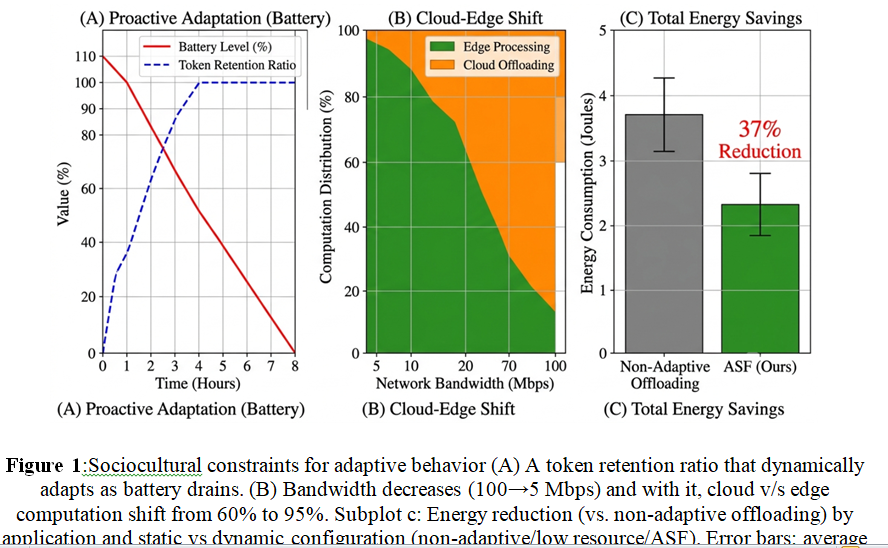
Running cross-modal Foundation Models (FMs) near to the edge unlocks innovative IoT use-cases but comes with unmanageable energy and carbon emissions costs. Static optimization techniques completely break under dynamic edge constraints, and throw away all of these precious compute resources while generating inference pipelines that are not truly sustainable. We propose a closed-loop telemetry- driven control architecture, called the Adaptive Sustainable Framework (ASF), to adaptively vary token pruning intensity as function of real-time battery/thermal/network conditions. Tested through Design Science Research over a variety of edge devices (NVIDIA Jetson, Raspberry Pi) and cross-modal datasets, ASF mitigates up to 56% in energy use - and thus proportional carbon emissions - whilst maintaining the task accuracy to within 3% of the unoptimized baseline number. Our framework achieves 15–32% better energy efficiency compared to static pruning, quantization-only, or adaptive offloading baselines across non-stationary workloads. This work contributes to Green Information Systems (Green IS) theory by exhibiting how sustainability can be operationalized as a runtime control target, enriches Design Science methodology with carbon-aware design criteria and provides IT practitioners with actionable deployment guidelines that align the metrics of net-talk time & bandwidth usage in regard to regulatory compliance obligations for the ESG-space. We show that it is system-level adaptivity and not algorithmic novelty, which enables sustainable edge intelligence.
References
[1] E. Strubell, A. Ganesh, and A. McCallum. 2019. Energy and Policy Considerations for Deep Learning in NLP. In Proceedings of the 57th Annual Meeting of the Association for Computational Linguistics, pages 3645–3650, Florence, Italy. Association for Computational Linguistics. https://doi.org/10.48550/arXiv.1906.02243 DOI: https://doi.org/10.18653/v1/P19-1355
[2] Watson, R. T., Boudreau, M., & Chen, A. J. (2010).Information Systems and Environmentally Sustainable Development: Energy Informatics and New Directions for the IS Community1. MIS Quarterly 1 March 2010; 34 (1): 23–38. https://doi.org/10.2307/20721413 DOI: https://doi.org/10.2307/20721413
[3] Dedrick, Jason. (2010). Green IS: Concepts and Issues for Information Systems Research. Communications of the Association for Information Systems. 27. DOI: 10.17705/1CAIS.02711 DOI: https://doi.org/10.17705/1CAIS.02711
[4] Han, S., Mao, H., & Dally, W.J. (2015). Deep Compression: Compressing Deep Neural Network with Pruning, Trained Quantization and Huffman Coding. arXiv: Computer Vision and Pattern Recognition. https://doi.org/10.48550/arXiv.1510.00149
[5] Radford, A., Kim, J.W., Hallacy, C., Ramesh, A., Goh, G., Agarwal, S., Sastry, G., Askell, A., Mishkin, P., Clark, J., Krueger, G., & Sutskever, I. (2021). Learning Transferable Visual Models From Natural Language Supervision. ArXiv, abs/2103.00020. https://doi.org/10.48550/arXiv.2103.00020
[6] Roy Schwartz, Jesse Dodge, Noah A. Smith, and Oren Etzioni. 2020. Green AI. Commun. ACM 63, 12 (December 2020), 54–63. https://doi.org/10.1145/3381831 DOI: https://doi.org/10.1145/3381831
[7] Marmouzi, O., Oumaira, I., & Ajana El Khaddar, M. (2026). A Systematic Review of Green and Sustainable AI: Taxonomy, Metrics, Challenges, and Open Research Directions. Sustainability, 18(8), 4115. https://doi.org/10.3390/su18084115 DOI: https://doi.org/10.3390/su18084115
[8] Devadas, R.M., T, S. Towards carbon-aware AI: a systematic prisma review and taxonomy of green architectures, hardware life-cycle, and energy-efficient algorithms. Energy Inform 9, 38 (2026). https://doi.org/10.1186/s42162-026-00651-8 DOI: https://doi.org/10.1186/s42162-026-00651-8
[9] W. Shi, J. Cao, Q. Zhang, Y. Li and L. Xu, "Edge Computing: Vision and Challenges," in IEEE Internet of Things Journal, vol. 3, no. 5, pp. 637-646, Oct. 2016, https://doi.org/10.1109/JIOT.2016.2579198 DOI: https://doi.org/10.1109/JIOT.2016.2579198
[10] Triwahyuni, N., Wardihani, E., Rizal, A., Beta, S., Sambora, R., & Oktaviani, R. (2025). AIoT-Driven Human Activity Recognition for Versatile Framework on Multipurpose Applications. Techné : Jurnal Ilmiah Elektroteknika, 24(1), 55–72. https://doi.org/10.31358/techne.v24i1.514 DOI: https://doi.org/10.31358/techne.v24i1.514
[11] Li, E., Zeng, L., Zhou, Z., & Chen, X. (2019). Edge AI: On-Demand Accelerating Deep Neural Network Inference via Edge Computing. IEEE Transactions on Wireless Communications, 19, 447-457. https://doi.org/10.48550/arXiv.1910.05316 DOI: https://doi.org/10.1109/TWC.2019.2946140
[12] João Simioni, Eduardo Kugler Viegas, Altair Santin, and Pedro Horchulhack. 2025. An Early Exit Deep Neural Network for Fast Inference Intrusion Detection. In Proceedings of the 40th ACM/SIGAPP Symposium on Applied Computing (SAC '25). Association for Computing Machinery, New York, NY, USA, 730–737. https://doi.org/10.1145/3672608.3707974 DOI: https://doi.org/10.1145/3672608.3707974
[13] Hinton, G.E., Vinyals, O., & Dean, J. (2015). Distilling the Knowledge in a Neural Network. ArXiv, abs/1503.02531. https://doi.org/10.48550/arXiv.1503.02531
[14] Zhang, W., Zhu, Z., Li, N., Liu, K., & Liu, Y. (2025). AdaptInfer: Adaptive Token Pruning for Vision-Language Model Inference with Dynamical Text Guidance. ArXiv, abs/2508.06084. https://doi.org/10.48550/arXiv.2508.06084 DOI: https://doi.org/10.3390/rs17142508
[15] Peffers, Ken & Tuunanen, Tuure & Rothenberger, Marcus & Chatterjee, S.. (2007). A design science research methodology for information systems research. Journal of Management Information Systems. 24. 45-77. https://www.researchgate.net/publication/284503626_A_design_science_research_methodology_for_information_systems_research DOI: https://doi.org/10.2753/MIS0742-1222240302
[16] Gregor, S. & Hevner, A. R. (2013).Positioning and Presenting Design Science Research for Maximum Impact1. MIS Quarterly 1 June 2013; 37 (2): 337–355. https://doi.org/10.25300/MISQ/2013/37.2.01 DOI: https://doi.org/10.25300/MISQ/2013/37.2.01
[17] Oikonomou, E., & Rouskas, A. (2026). Workload-Aware Edge Node Orchestration and Dynamic Resource Scaling in MEC. Future Internet, 18(4), 184. https://doi.org/10.3390/fi18040184 DOI: https://doi.org/10.3390/fi18040184
Downloads
Published
Issue
Section
License
Copyright (c) 2026 Al-Noor Journal of Engineering Management and Computer Science

This work is licensed under a Creative Commons Attribution-NonCommercial-ShareAlike 4.0 International License.
How to Cite