A Lock-Free Approach for Fixing File Management System Concurrency Problems in Operating Systems
DOI:
https://doi.org/10.71229/2d68by86Keywords:
Lock-free file systems, MVCC, CAS, concurrency control, distributed storageAbstract
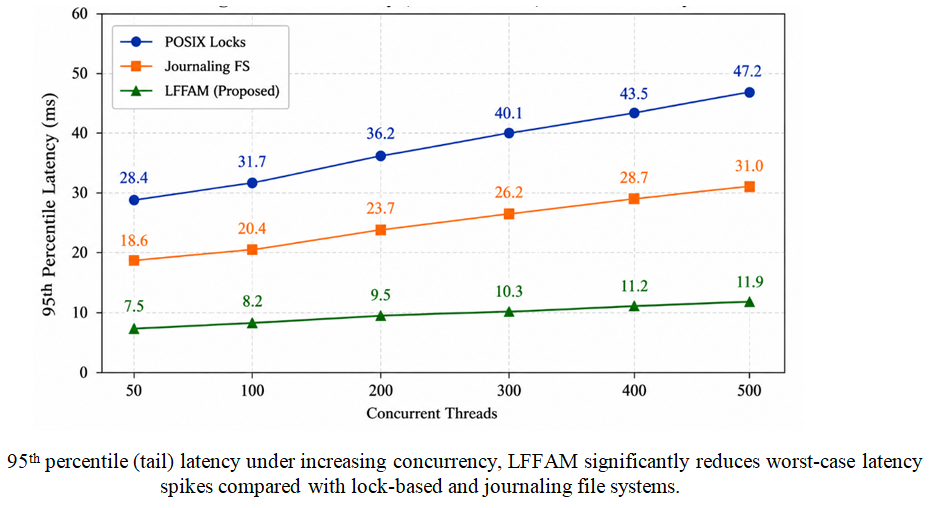
Modern operating systems have trouble with too many attempts by the process of opening a file. The traditional approach to such a challenge is by using locks, which will not allow more than one process at a time to work with the file. But there are issues with that technique, including slowness and the possibility of deadlocks (and even just sluggishness) when the system is heavily loaded. This paper proposes a novel manner of accessing files called Lock-Free File Access Mechanism, LFFAM. Instead of locks, LFFAM uses atomic updates to file Metadata, stores multiple versions of data and enforces transaction-like semantics for updating the filesystem. This let read and write proceed without having to wait for a lock, which in turn allows individual threads to operate independently and at higher speed. LFFAM is evaluated for different activity levels by comparing state-of-threat conventional methods such as POSIX locks and journaling file systems. We conclude that LFFAM performs efficiently on park tasks in a very short schedule time, keeping fixed and low delays through the number of processes considered, and preventing deadlocks if more than one process is running. All these results indicate that lock free is more scalable than locks in high-concurrency systems, such as cloud computing. In addition, LFFAM provides the foundation for future improvements such as intelligent file versions management and system-level metadata support.
References
[1] N. Tressa and C. Priya. (2026). "An Analysis of Adaptive Consensus and Ordering Techniques for Hyperledger Fabric-Based Scalable and Low-Latency UPI Transactions," Musik In Bayern, vol. 91, pp. 10-28.
[2] H. Ashraf, A. R. Shah, and F. Asghar. (2026). "Role of Cloud Computing, Data Storage Scalability, and Distributed Computing Frameworks in Improving Big Data Processing Efficiency," ComputeX-Journal of Emerging Technology & Applied Science, vol. 2, pp. 01-14. DOI: https://doi.org/10.71317/computex.2.1.2026.163
[3] C. Bilbao Muñoz. (2026). "Novel system software for addressing resource contention, maximizing CPU usage, and harnessing performance asymmetry on multicore systems.
[4] J. Ji, Y. Gu, Y. Fu, and Q. Lin. (2024). "Beyond the Bottleneck: Enhancing High-Concurrency Systems with Lock Tuning," in International Symposium on Formal Methods, pp. 325-337. DOI: https://doi.org/10.1007/978-3-031-71177-0_20
[5] H. Zhang, K. Cheng, R. Chen, and H. Chen. (2024). "Fast and scalable in-network lock management using lock fission," in 18th USENIX Symposium on Operating Systems Design and Implementation (OSDI 24), pp. 251-268.
[6] Q. Li, L. Chen, X. Wang, S. Huang, Q. Xiang, Y. Dong, et al. (2023). "Fisc: a large-scale cloud-native-oriented file system," in 21st USENIX Conference on File and Storage Technologies (FAST 23), pp. 231-246.
[7] S. Gong, C.-E. Lin, K. Wu, E. Lu, and P. Fonseca. (2026). "A Comprehensive Study of Concurrency Bugs in the Linux Kernel,". DOI: https://doi.org/10.1145/3744916.3787790
[8] M. Hasan, S. Yasmin, and A. Salam. (2024). "Concurrency control in distributed database system: Solution of the anomalies & challenges," in Proceedings of the 3rd International Conference on Computing Advancements, pp. 629-636. DOI: https://doi.org/10.1145/3723178.3723261
[9] E. W. Dijkstra. (2011). "Solution of a problem in concurrent programming control," in Software Pioneers: Contributions to Software Engineering, ed: Springer, pp. 347-350. DOI: https://doi.org/10.1007/978-3-642-59412-0_20
[10] L. Lamport. (2019). "A new solution of Dijkstra's concurrent programming problem," in Concurrency: the works of leslie lamport, ed, pp. 171-178. DOI: https://doi.org/10.1145/3335772.3335782
[11] H.-T. Kung and J. T. Robinson. (1981). "On optimistic methods for concurrency control," ACM Transactions on Database Systems (TODS), vol. 6, pp. 213-226. DOI: https://doi.org/10.1145/319566.319567
[12] P. A. Bernstein, V. Hadzilacos, and N. Goodman. (1987). Concurrency control and recovery in database systems vol. 370: Addison-wesley Reading.
[13] M. J. Carey and W. A. Muhanna. (1986). "The performance of multiversion concurrency control algorithms," ACM Transactions on Computer Systems (TOCS), vol. 4, pp. 338-378. DOI: https://doi.org/10.1145/6513.6517
[14] M. Herlihy. (1991). "Wait-free synchronization," ACM Transactions on Programming Languages and Systems (TOPLAS), vol. 13, pp. 124-149. DOI: https://doi.org/10.1145/114005.102808
[15] P. E. McKenney, M. Wong, M. M. Michael, A. Hunter, D. Hollman, J. Bastien, et al. (2005). "Read-copy update (RCU),".
[16] K. Shvachko, H. Kuang, S. Radia, and R. Chansler. (2010). "The hadoop distributed file system," in 2010 IEEE 26th symposium on mass storage systems and technologies (MSST), pp. 1-10. DOI: https://doi.org/10.1109/MSST.2010.5496972
[17] R. Cheng, Y. Zhou, J. Xiao, S. Zhang, H. Dong, H. Jin, et al. (2026). "Furion: Efficient and Atomic Cross-Blockchain Transactions Through Multi-Future Exploration," IEEE Transactions on Knowledge and Data Engineering. DOI: https://doi.org/10.1109/TKDE.2026.3684675
[18] C. Hu, K. Qian, E. Xu, Y. Shen, H. Zhang, X. Li, et al. (2026). "Come Hell or Still Water: Alleviating Tail Latency in Cloud Block Store," in 23rd USENIX Symposium on Networked Systems Design and Implementation (NSDI 26), pp. 1259-1274.
[19] O. Syrotiuk. (2024). "Development of lock-free approach for shared memory organisation in real-time multi-threading applications," Technology audit and production reserves, vol. 4, pp. 6-11. DOI: https://doi.org/10.15587/2706-5448.2024.309344
[20] P. Antonopoulos, M. Chauhan, S. Dabas, R. Jain, D. Kattera, W. Kim, et al. (2025). "Md-mvcc: Multi-version concurrency control for schema changes in azure sql database," Proceedings of the VLDB Endowment, vol. 18, pp. 4791-4803. DOI: https://doi.org/10.14778/3750601.3750605
[21] K. Liu, K. Liu, X. Zhang, H. Yuan, X. Zheng, N. Liu, et al. (2026). "RaidenSwap: A Multi-Swap Remote System for Multi-core Applications," in Proceedings of the 21st European Conference on Computer Systems, pp. 208-224. DOI: https://doi.org/10.1145/3767295.3803575
[22] R. Agrawal, M. J. Carey, and M. Livny. (1987). "Concurrency control performance modeling: Alternatives and implications," ACM Transactions on Database Systems (TODS), vol. 12, pp. 609-654. DOI: https://doi.org/10.1145/32204.32220
[23] J. B. a. M. Moore. (2007). "ZFS: The last word in file systems," Sun Microsystems Technical Report.
[24] C. Min, S. Kashyap, S. Maass, and T. Kim. (2016). "Understanding manycore scalability of file systems," in 2016 USENIX Annual Technical Conference (USENIX ATC 16), pp. 71-85.
[25] H. Attiya, P. Fatourou, E. Kosmas, and Y. Wei. (2025). "Recoverable Lock-Free Locks," arXiv preprint arXiv:2512.09710.
[26] M. Sung, R. Nikolaev, and B. Ravindran. (2025). "Scalable and Fault-Tolerant Storage and File System Services with Non-Blocking Synchronization for Private Clouds," in Proceedings of the 2025 ACM Symposium on Cloud Computing, pp. 307-319. DOI: https://doi.org/10.1145/3772052.3772235
[27] H. Kas-Sharir, G. Sela, and E. Petrank. (2025). "A Study of Synchronization Methods for Concurrent Size," in Proceedings of the 37th ACM Symposium on Parallelism in Algorithms and Architectures, pp. 382-396. DOI: https://doi.org/10.1145/3694906.3743316
[28] T. Neumann, T. Mühlbauer, and A. Kemper. (2015). "Fast serializable multi-version concurrency control for main-memory database systems," in Proceedings of the 2015 ACM SIGMOD International Conference on Management of Data, pp. 677-689. DOI: https://doi.org/10.1145/2723372.2749436
[29] F. Habibi, J. Fang, T. Lorido-Botran, and F. Nawab. (2025). "Brook-2PL: Tolerating High Contention Workloads with A Deadlock-Free Two-Phase Locking Protocol," Proceedings of the ACM on Management of Data, vol. 3, pp. 1-27. DOI: https://doi.org/10.1145/3769767
[30] S. Chen, C. Shen, and C. Wu. (2025). "Intelligent Transaction Scheduling to Enhance Concurrency in High-Contention Workloads," Applied Sciences, vol. 15, p. 6341. DOI: https://doi.org/10.3390/app15116341
[31] F. T. a. G. Thomas. (2026). CSC4508 – Operating Systems. Paris: Institut polytechnique de paris.
[32] O. Kode and T. Oyemade. (2024). "Analysis of Synchronization Mechanisms in Operating Systems," arXiv preprint arXiv:2409.11271. DOI: https://doi.org/10.2139/ssrn.4959064
Downloads
Published
Issue
Section
License
Copyright (c) 2023 Al-Noor Journal of Engineering Management and Computer Science

This work is licensed under a Creative Commons Attribution-NonCommercial-ShareAlike 4.0 International License.
How to Cite