An Integrated MobileNet and XGBoost architecture to Categories Quail based on colors Using a Novel Dataset Images
DOI:
https://doi.org/10.71229/p38xhf53Keywords:
Quail, Deep Learning, Machine Learning, Feather colorAbstract
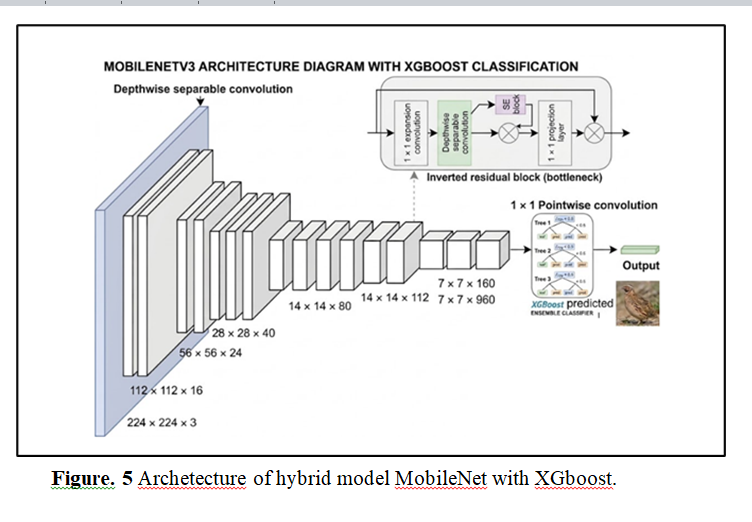
Precise separation of quail phenotypes based on feather color (black, brown, gold, and white) is essential in selection and genetic improvement programs because of its link with productive qualities. Quail are a significant economic pillar in the poultry industry. By creating a novel hybrid architecture that combines the MobileNet network and the XGBoost algorithm, this research offers a digital alternative to overcome the drawbacks of conventional, laborious, and visually biased human review. The approach makes use of MobileNet's deep visual feature extraction capabilities, and the XGBoost algorithm's better statistical abilities in handling nonlinear relationships are used to handle the final classification jobs.. The researcher's own independent database, which included 1219 photos depicting the four color patterns, was used to train and test the model.,he model's total statistical stability and lack of bias were mathematically demonstrated by the system's 96% overall accuracy and perfectly balanced standard indices of 0.96 for precision, recall, and F1 score. The geometric superiority of the suggested architecture was shown by experimental findings on a different test set (243 photos). The Confusion Matrix of the suggested hybrid approach (MobileNet + XGBoost), which precisely documents the statistical distribution of accurate predictions and validates the model's superior ability to critically distinguish between phenotypic patterns without overlap, is revealed by a thorough analysis of the results by category
References
[1] Mustafa Al-Sofee, K. H., Al-Hamed, A. M., Abdul-Majeed, A. F., & Osman, M. A. (2025). Overview on Quail Management, Production and Its Physiological Performance (Article Review). Journal of Agricultural, Environmental & Veterinary Sciences, 9(3). p22 doi. 10.26389/AJSRP.N120725 DOI: https://doi.org/10.26389/AJSRP.N120725
[2] Al-Hilali, A. H. K., & Najm, Z. M. (2018). The Effect of Aqueous Extractof Anise Seeds. Pimpinella Anisum L. Effect on Body Weight, Weight Gain, Feed Consumption and Feed Conversion Ratio of Japanese Quail. Al-Qadisiyah Journal For Agriculture Sciences, 7(2). DOI: https://doi.org/10.33794/qjas.Vol7.Iss2.40
[3] Cahyadi, M., Fauzy, R., & Dewanti, R.. (2019). Egg Production Traits and Egg Quality Characteristics in Black and Brown Plumage Color Lines of Japanese Quail. POULTRY SCIENCE JOURNAL, 7(2), 179-184. https://sid.ir/paper/749154/en
[4] Islam, M. S., Faruque, S., Khatun, H., & Islam, M. N. (2014). Comparative production performances of different types of quail (Coturnix coturnix japonica). The Agriculturists, 12(2), 151-155. doi.org/10.3329/agric.v12i2.21744 DOI: https://doi.org/10.3329/agric.v12i2.21744
[5] Ribeiro, A. G., Silva, R. D. S., Silva, D. A. D., Nascimento, J. C. D. S., Souza, L. F. A. D., Silva, E. G. D., ... & Guerra, R. R. (2024). Heat stress in Japanese quails (Coturnix japonica): benefits of phytase supplementation. Animals, 14(24), 3599. doi.org/10.3390/ani14243599 DOI: https://doi.org/10.3390/ani14243599
[6] Rachman, S., Ganieva, O., & Sadullaev, F. (2025). Traces of Steinbeck in Uzbek Literature: Odil Yoqubov’s “Goodness”: Toward an Uzbek-American Literary Dialogue. Steinbeck Review, 22(2), 135-151. doi.org/10.5325/steinbeckreview.22.2.0135 DOI: https://doi.org/10.5325/steinbeckreview.22.2.0135
[7] Lukanov, H. (2019). Domestic quail (Coturnix japonica domestica), is there such farm animal?. World's poultry science journal, 75(4), 547-558. doi.org/10.1017/S0043933919000631 DOI: https://doi.org/10.1017/S0043933919000631
[8] Taghipour-Shahbandi, M., Zhandi, M., Ansari-Pirsaraei, Z., & Yousefi, A. R. (2024). Exploration of age-related changes in reproductive parameters of female Japanese quail (Coturnix japonica). Poultry Science, 103(12), 104499. doi.org/10.1016/j.psj.2024.104499 DOI: https://doi.org/10.1016/j.psj.2024.104499
[9] Hasdar, M. (2024). Contributing factors to quail farming failures in Brebes and potential mitigation strategies. Bantara Journal of Animal Science, 6(2), 1-11. doi.org/10.32585/bjas.v6i2.5672 DOI: https://doi.org/10.32585/bjas.v6i2.5672
[10] Ibrahim, F. K., & Al-Neemy, M. A. S. (2023, November). The Relationship Between Plumage Color, Genetic Group and Their Interaction on Quail’s Performance. In IOP Conference Series: Earth and Environmental Science (Vol. 1259, No. 1, p. 012066). DOI: https://doi.org/10.1088/1755-1315/1259/1/012066
[11] Lukanov, H., Pavlova, I., Genchev, A., Penkov, D., Peltekov, A., & Mihaylova, G. (2023). Quality and composition of meat in different productive types of domestic quail. Journal of Central European Agriculture, 24(2), 322-339. https://hrcak.srce.hr/305065 DOI: https://doi.org/10.5513/JCEA01/24.2.3871
[12] Białek, M., Wojtak, W., Czauderna, M., Zaworski, K., & Białek, A. (2026). Lipidomic Insight into Eggs and Meat of Quail (Coturnix japonica) as Potential ‘Superfoods’. Molecules, 31(3), 407. doi.org/10.3390/molecules31030407 DOI: https://doi.org/10.3390/molecules31030407
[13] Mota-Rojas, D., Marcet-Rius, M., Domínguez-Oliva, A., Buenhombre, J., Daza-Cardona, E. A., Lezama-García, K., ... & Bienboire-Frosini, C. (2023). Parental behavior and newborn attachment in birds: life history traits and endocrine responses. Frontiers in Psychology, 14, 1183554. doi.org/10.3389/fpsyg.2023.1183554 DOI: https://doi.org/10.3389/fpsyg.2023.1183554
[14] Niu, J., Li, T., Qi, K., Liu, Y., Deng, H., Hu, Y., ... & Zhao, X. (2025). Research note: Application of convolutional neural networks for feather classification in chickens. Poultry Science, 105254. doi.org/10.1016/j.psj.2025.105254 DOI: https://doi.org/10.1016/j.psj.2025.105254
[15] Dahal, S., Paneru, B., Dhungana, A., & Chai, L. (2026). Deep Learning and Thermal Imaging Approaches for the Assessment of Feather Coverage in Cage-Free Laying Hens. AgriEngineering, 8(2), 68. doi.org/10.3390/agriengineering8020068 DOI: https://doi.org/10.3390/agriengineering8020068
[16] Lamping, C., Derks, M., Koerkamp, P. G., & Kootstra, G. (2022). ChickenNet-an end-to-end approach for plumage condition assessment of laying hens in commercial farms using computer vision. Computers and Electronics in Agriculture, 194, 106695. doiorg/10.1016/j.compag.2022.106695 DOI: https://doi.org/10.1016/j.compag.2022.106695
[17] A.Marini, F.Jacques and K.Alessandro L. "Bird species classification based on color features." 2013 IEEE international conference on systems, man, and cybernetics. IEEE, 2013. doi.org/10.1109/SMC.2013.740. DOI: https://doi.org/10.1109/SMC.2013.740
[18] Qian, S., Ning, C., & Hu, Y. (2021, March). MobileNetV3 for image classification. In 2021 IEEE 2nd International Conference on Big Data, Artificial Intelligence and Internet of Things Engineering (ICBAIE) (pp. 490-497). DOI: https://doi.org/10.1109/ICBAIE52039.2021.9389905
[19] Wang, W., Li, Y., Zou, T., Wang, X., You, J., & Luo, Y. (2020). A novel image classification approach via dense-MobileNet models. Mobile Information Systems, 2020(1), 7602384. doi.org/10.1155/2020/7602384 DOI: https://doi.org/10.1155/2020/7602384
[20] Wu, J., Kong, L., Yi, M., Chen, Q., Cheng, Z., Zuo, H., & Yang, Y. (2022). Prediction and screening model for products based on fusion regression and xgboost classification. Computational Intelligence and Neuroscience, 2022(1), 4987639. doi.org/10.1155/2022/4987639 DOI: https://doi.org/10.1155/2022/4987639
[21] Ren, X., Guo, H., Li, S., Wang, S., & Li, J. (2017, July). A novel image classification method with CNN-XGBoost model. In International workshop on digital watermarking (pp. 378-390). Cham: Springer doi.org/10.1007/978-3-319-64185-0_28 DOI: https://doi.org/10.1007/978-3-319-64185-0_28
[22] Rainio, O., Teuho, J., & Klén, R. (2024). Evaluation metrics and statistical tests for machine learning. Scientific reports, 14(1), 6086. doi.org/10.1038/s41598-024-56706-x DOI: https://doi.org/10.1038/s41598-024-56706-x
[23] Khalaf, A. T., & Abdulateef, S. K. (2024). Ophthalmic diseases classification based on YOLOv8. Journal of Robotics and Control (JRC), 5(2), 408-415. doi.org/10.54153/sjpas.2024.v6i3.881 DOI: https://doi.org/10.18196/jrc.v5i2.21208
[24] Khalaf, A. T., & Abdulateef, S. K. (2024). Multi-Class of Retinal Diseases Classification via Deep Learning Techniques Based on Fundus Images. Samarra Journal of Pure and Applied Science, 6(3), 274- 286. doi.org/10.18196/jrc.v5i2.21208 DOI: https://doi.org/10.54153/sjpas.2024.v6i3.881
Downloads
Published
Issue
Section
License
Copyright (c) 2026 Al-Noor Journal of Engineering Management and Computer Science

This work is licensed under a Creative Commons Attribution-NonCommercial-ShareAlike 4.0 International License.
How to Cite