LungMix-EMA: A Deep Learning Framework with Anatomy-Aware Augmentation for Pneumonia Detection in Chest X-Rays
DOI:
https://doi.org/10.71229/rercdw47Keywords:
Pneumonia detection, , Chest X-ray classification,, Anatomy-preserving augmentation, Deep learning, Medical image, analysis Model calibrationAbstract
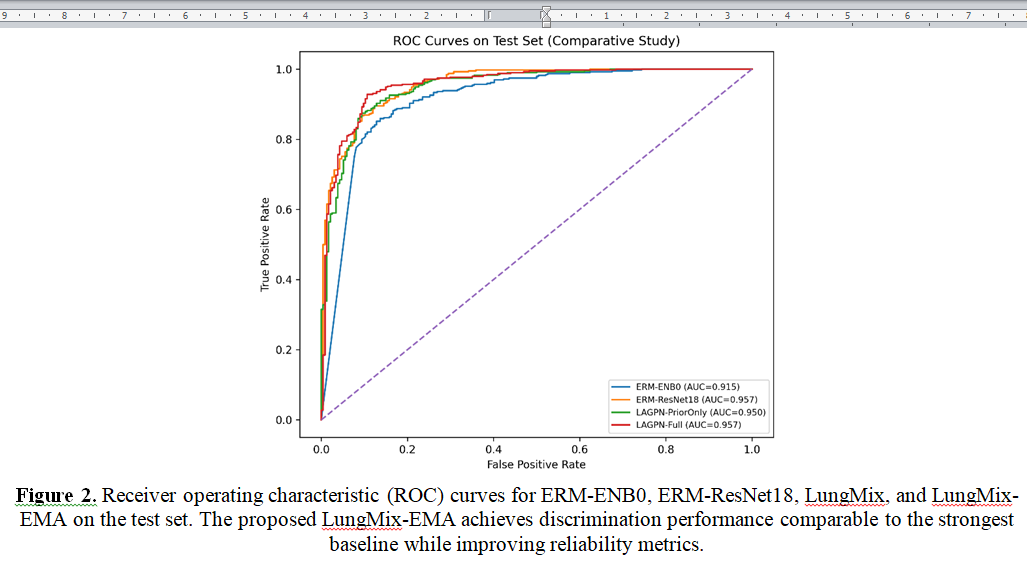
The deep learning models which detect pneumonia through chest X-ray analysis show exceptional ability to differentiate between medical conditions yet the models experience problems with shortcut learning and their probability outputs lack accurate calibration. This study presents LungMix-EMA as an enhancement of anatomy-preserving augmentation which serves as an optimization framework to boost predictive performance while delivering reliable results without requiring segmentation data. The uses a computationally efficient approximation method which produces weak anatomical prior information to restrict their training process by reducing region-level mixing. The system of ConvNeXt-Tiny backbone applies binary cross-entropy loss with label smoothing during training while maintaining an exponential moving average of network weights to support stable inference operations. The clinical experiments which used a publicly available chest X-ray dataset showed that LungMix-EMA reaches an area under the curve value of 0.957 which has a 95% confidence interval from 0.943 to 0.969 and an average precision score of 0.966 which has a 95% (CI: 0.953-0.977) which demonstrates performance equal to top convolutional neural network baselines. The method produces better calibration outcomes because it reduces Expected Calibration Error (ECE) from 0.221 (95% confidence interval: 0.198–0.245) to 0.083 (95% confidence interval: 0.072–0.096) and decreases Brier score from 0.180 (95% CI: 0.162–0.198) to 0.088 (95% CI: 0.078–0.101). The ablation studies demonstrate that the combination of LungMix and EMA provides better calibration results than their individual components. This study shows the ability to boost model reliability when they use anatomically constrained augmentation methods alongside optimization stabilization techniques which preserve their ability to divide different categories of data.
Downloads
Published
Issue
Section
License
Copyright (c) 2026 Al-Noor Journal of Engineering Management and Computer Science

This work is licensed under a Creative Commons Attribution-NonCommercial-ShareAlike 4.0 International License.
How to Cite