Beyond Segmentation: Bridging the Synthetic-to-Real Gap in Computer Vision A Systematic Review, Taxonomy, and Research Agenda
DOI:
https://doi.org/10.71229/8chpd013Keywords:
synthetic-to-real gap, sim-to-real transfer, synthetic data, domain adaptation, domain randomisation, generative data synthesis, test-time adaptation, evaluation protocols, systematic review, PRISMA 2020Abstract
Background. Synthetic imagery produced by simulators, graphics engines and generative models is now widely used in place of real annotation that is costly, privacy-restricted or unobtainable. Models trained on synthetic data nevertheless underperform when deployed on real data, a discrepancy known as the synthetic-to-real gap. The relevant literature is dispersed across domain adaptation, generative data synthesis, domain randomisation, feature alignment, test-time adaptation and evaluation methodology, and no prior synthesis has treated these strands as a single problem space.
Objectives. This review (i) identifies and classifies the sources of the synthetic-to-real gap; (ii) consolidates bridging methods within a common taxonomy in which domain adaptation is one of six families rather than the organising principle of the field; (iii) compares the tasks, datasets, simulators and evaluation protocols used to measure the gap; (iv) appraises the methodological quality and reproducibility of the primary evidence; and (v) proposes an evidence-based research agenda.
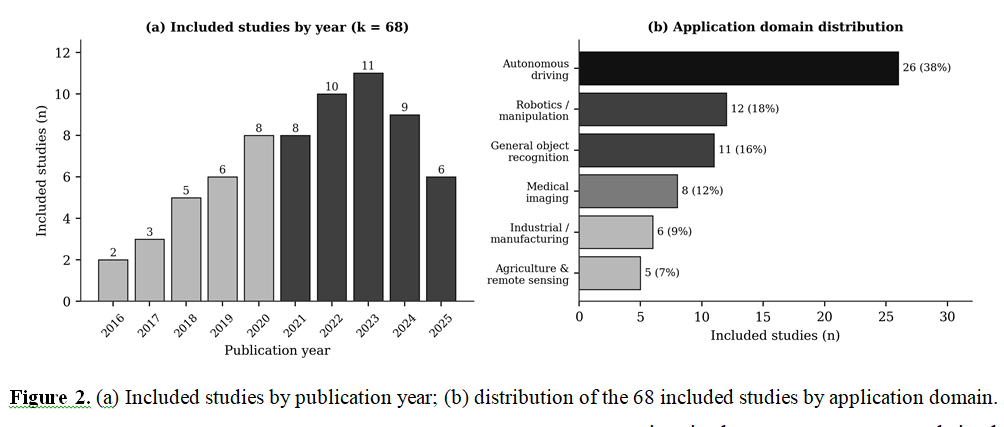
Methods. The review was conducted in accordance with the PRISMA 2020 statement [1]. Six bibliographic databases and two preprint repositories were searched to 31 December 2025. Records were screened in duplicate; 68 studies met the eligibility criteria and 34 contributed to the quantitative synthesis. Because no established risk-of-bias instrument is applicable to computer-vision transfer studies, RoB 2 [2] was adapted to this setting. Reported gains are presented descriptively in a forest-style display and are not pooled meta-analytically, because the primary studies report no variance estimates.
Results. On the canonical GTA5 → Cityscapes benchmark, the median improvement over a source-only baseline was +12.9 mIoU (IQR 9.4 to 18.9; k = 10) for convolutional backbones and +28.2 mIoU (IQR 25.4 to 29.2; k = 3) for transformer backbones. Changing the backbone alone, with the adaptation procedure held fixed, raises source-only performance from 34.3 to 45.6 mIoU [3], indicating that a substantial share of the reported "adaptation" gain is architectural. The strongest current method attains 75.9 mIoU against an oracle of 76.4 [4], so the canonical benchmark is effectively saturated while the deployment failures it was intended to predict remain unaddressed. Appearance and feature-level gaps are comparatively well studied, whereas contextual, annotation and sensor gaps are not. Only 13% of studies reported run-to-run variance, and only 25% released the synthetic assets or generation configurations required to regenerate their data.
Conclusions. The synthetic-to-real gap has not been solved; it has been optimised away on a single benchmark. The outstanding challenges are no longer the design of new alignment losses, but the generation of data selected for utility rather than realism, the isolation of architectural from adaptational effects, evaluation in open-world and multi-domain settings, and the release of open simulation pipelines.
References
[1] M. J. Page et al., "The PRISMA 2020 statement: An updated guideline for reporting systematic reviews," BMJ, vol. 372, art. n71, 2021.
[2] J. A. C. Sterne et al., "RoB 2: A revised tool for assessing risk of bias in randomised trials," BMJ, vol. 366, art. l4898, 2019.
[3] L. Hoyer, D. Dai, and L. Van Gool, "DAFormer: Improving network architectures and training strategies for domain-adaptive semantic segmentation," in Proc. IEEE/CVF Conf. Comput. Vis. Pattern Recognit. (CVPR), 2022, pp. 9924–9935.
[4] L. Hoyer, D. Dai, H. Wang, and L. Van Gool, "MIC: Masked image consistency for context-enhanced domain adaptation," in Proc. IEEE/CVF Conf. Comput. Vis. Pattern Recognit. (CVPR), 2023, pp. 11721–11732.
[5] S. R. Richter, V. Vineet, S. Roth, and V. Koltun, "Playing for data: Ground truth from computer games," in Proc. Eur. Conf. Comput. Vis. (ECCV), 2016, pp. 102–118.
[6] G. Ros, L. Sellart, J. Materzynska, D. Vazquez, and A. M. Lopez, "The SYNTHIA dataset: A large collection of synthetic images for semantic segmentation of urban scenes," in Proc. IEEE Conf. Comput. Vis. Pattern Recognit. (CVPR), 2016, pp. 3234–3243.
[7] D. J. Butler, J. Wulff, G. B. Stanley, and M. J. Black, "A naturalistic open source movie for optical flow evaluation," in Proc. Eur. Conf. Comput. Vis. (ECCV), 2012, pp. 611–625.
[8] K. Greff et al., "Kubric: A scalable dataset generator," in Proc. IEEE/CVF Conf. Comput. Vis. Pattern Recognit. (CVPR), 2022, pp. 3749–3761.
[9] A. Dosovitskiy, G. Ros, F. Codevilla, A. López, and V. Koltun, "CARLA: An open urban driving simulator," in Proc. Conf. Robot Learn. (CoRL), 2017, pp. 1–16.
[10] M. Denninger et al., "BlenderProc," 2019, arXiv:1911.01911.
[11] A. Prakash et al., "Structured domain randomization: Bridging the reality gap by context-aware synthetic data," in Proc. IEEE Int. Conf. Robot. Autom. (ICRA), 2019, pp. 7249–7255.
[12] R. J. Chen, M. Y. Lu, T. Y. Chen, D. F. K. Williamson, and F. Mahmood, "Synthetic data in machine learning for medicine and healthcare," Nature Biomed. Eng., vol. 5, no. 6, pp. 493–497, 2021.
[13] A. Kazerouni et al., "Diffusion models in medical imaging: A comprehensive survey," Med. Image Anal., vol. 88, art. 102846, 2023.
[14] M. Frid-Adar, I. Diamant, E. Klang, M. Amitai, J. Goldberger, and H. Greenspan, "GAN-based synthetic medical image augmentation for increased CNN performance in liver lesion classification," Neurocomputing, vol. 321, pp. 321–331, 2018.
[15] N. Mayer et al., "A large dataset to train convolutional networks for disparity, optical flow, and scene flow estimation," in Proc. IEEE Conf. Comput. Vis. Pattern Recognit. (CVPR), 2016, pp. 4040–4048.
[16] A. Dosovitskiy et al., "FlowNet: Learning optical flow with convolutional networks," in Proc. IEEE Int. Conf. Comput. Vis. (ICCV), 2015, pp. 2758–2766.
[17] S. Ben-David, J. Blitzer, K. Crammer, A. Kulesza, F. Pereira, and J. W. Vaughan, "A theory of learning from different domains," Mach. Learn., vol. 79, no. 1–2, pp. 151–175, 2010.
[18] M. Cordts et al., "The Cityscapes dataset for semantic urban scene understanding," in Proc. IEEE Conf. Comput. Vis. Pattern Recognit. (CVPR), 2016, pp. 3213–3223.
[19] J. Tobin, R. Fong, A. Ray, J. Schneider, W. Zaremba, and P. Abbeel, "Domain randomization for transferring deep neural networks from simulation to the real world," in Proc. IEEE/RSJ Int. Conf. Intell. Robots Syst. (IROS), 2017, pp. 23–30.
[20] W. Zhao, J. P. Queralta, and T. Westerlund, "Sim-to-real transfer in deep reinforcement learning for robotics: A survey," in Proc. IEEE Symp. Ser. Comput. Intell. (SSCI), 2020, pp. 737–744.
[21] H. Guan and M. Liu, "Domain adaptation for medical image analysis: A survey," IEEE Trans. Biomed. Eng., vol. 69, no. 3, pp. 1173–1185, 2022.
[22] M. Wang and W. Deng, "Deep visual domain adaptation: A survey," Neurocomputing, vol. 312, pp. 135–153, 2018.
[23] G. Csurka, "Domain adaptation for visual applications: A comprehensive survey," 2017, arXiv:1702.05374.
[24] M. Toldo, A. Maracani, U. Michieli, and P. Zanuttigh, "Unsupervised domain adaptation in semantic segmentation: A review," Technologies, vol. 8, no. 2, art. 35, 2020.
[25] K. Zhou, Z. Liu, Y. Qiao, T. Xiang, and C. C. Loy, "Domain generalization: A survey," IEEE Trans. Pattern Anal. Mach. Intell., vol. 45, no. 4, pp. 4396–4415, 2023.
[26] J. Liang, R. He, and T. Tan, "A comprehensive survey on test-time adaptation under distribution shifts," Int. J. Comput. Vis., vol. 133, pp. 31–64, 2024.
[27] S. I. Nikolenko, Synthetic Data for Deep Learning. Cham, Switzerland: Springer, 2021.
[28] B. Kitchenham and S. Charters, "Guidelines for performing systematic literature reviews in software engineering," Keele Univ. and Univ. Durham, Tech. Rep. EBSE-2007-01, 2007.
[29] C. Wohlin, "Guidelines for snowballing in systematic literature studies and a replication in software engineering," in Proc. Int. Conf. Eval. Assess. Softw. Eng. (EASE), 2014, pp. 1–10.
[30] M. Ouzzani, H. Hammady, Z. Fedorowicz, and A. Elmagarmid, "Rayyan — a web and mobile app for systematic reviews," Syst. Rev., vol. 5, art. 210, 2016.
[31] M. L. McHugh, "Interrater reliability: The kappa statistic," Biochem. Med., vol. 22, no. 3, pp. 276–282, 2012.
[32] J. A. C. Sterne et al., "ROBINS-I: A tool for assessing risk of bias in non-randomised studies of interventions," BMJ, vol. 355, art. i4919, 2016.
[33] J. P. T. Higgins and S. G. Thompson, "Quantifying heterogeneity in a meta-analysis," Statist. Med., vol. 21, no. 11, pp. 1539–1558, 2002.
[34] E. Xie, W. Wang, Z. Yu, A. Anandkumar, J. M. Alvarez, and P. Luo, "SegFormer: Simple and efficient design for semantic segmentation with transformers," in Adv. Neural Inf. Process. Syst. (NeurIPS), vol. 34, 2021, pp. 12077–12090.
[35] R. Rombach, A. Blattmann, D. Lorenz, P. Esser, and B. Ommer, "High-resolution image synthesis with latent diffusion models," in Proc. IEEE/CVF Conf. Comput. Vis. Pattern Recognit. (CVPR), 2022, pp. 10684–10695.
[36] A. Gaidon, Q. Wang, Y. Cabon, and E. Vig, "Virtual worlds as proxy for multi-object tracking analysis," in Proc. IEEE Conf. Comput. Vis. Pattern Recognit. (CVPR), 2016, pp. 4340–4349.
[37] A. Geiger, P. Lenz, and R. Urtasun, "Are we ready for autonomous driving? The KITTI vision benchmark suite," in Proc. IEEE Conf. Comput. Vis. Pattern Recognit. (CVPR), 2012, pp. 3354–3361.
[38] J. Tremblay et al., "Training deep networks with synthetic data: Bridging the reality gap by domain randomization," in Proc. IEEE/CVF Conf. Comput. Vis. Pattern Recognit. Workshops, 2018, pp. 969–977.
[39] A. Kar et al., "Meta-Sim: Learning to generate synthetic datasets," in Proc. IEEE/CVF Int. Conf. Comput. Vis. (ICCV), 2019, pp. 4551–4560.
[40] J.-Y. Zhu, T. Park, P. Isola, and A. A. Efros, "Unpaired image-to-image translation using cycle-consistent adversarial networks," in Proc. IEEE Int. Conf. Comput. Vis. (ICCV), 2017, pp. 2223–2232.
[41] J. Hoffman et al., "CyCADA: Cycle-consistent adversarial domain adaptation," in Proc. Int. Conf. Mach. Learn. (ICML), 2018, pp. 1989–1998.
[42] Y. Yang and S. Soatto, "FDA: Fourier domain adaptation for semantic segmentation," in Proc. IEEE/CVF Conf. Comput. Vis. Pattern Recognit. (CVPR), 2020, pp. 4085–4095.
[43] S. R. Richter, H. A. Al Haija, and V. Koltun, "Enhancing photorealism enhancement," IEEE Trans. Pattern Anal. Mach. Intell., vol. 45, no. 2, pp. 1700–1715, 2023.
[44] Y.-H. Tsai, W.-C. Hung, S. Schulter, K. Sohn, M.-H. Yang, and M. Chandraker, "Learning to adapt structured output space for semantic segmentation," in Proc. IEEE/CVF Conf. Comput. Vis. Pattern Recognit. (CVPR), 2018, pp. 7472–7481.
[45] Y.-H. Tsai, K. Sohn, S. Schulter, and M. Chandraker, "Domain adaptation for structured output via discriminative patch representations," in Proc. IEEE/CVF Int. Conf. Comput. Vis. (ICCV), 2019, pp. 1456–1465.
[46] T.-H. Vu, H. Jain, M. Bucher, M. Cord, and P. Pérez, "ADVENT: Adversarial entropy minimization for domain adaptation in semantic segmentation," in Proc. IEEE/CVF Conf. Comput. Vis. Pattern Recognit. (CVPR), 2019, pp. 2517–2526.
[47] K. Saito, K. Watanabe, Y. Ushiku, and T. Harada, "Maximum classifier discrepancy for unsupervised domain adaptation," in Proc. IEEE/CVF Conf. Comput. Vis. Pattern Recognit. (CVPR), 2018, pp. 3723–3732.
[48] Y. Zou, Z. Yu, B. V. K. V. Kumar, and J. Wang, "Unsupervised domain adaptation for semantic segmentation via class-balanced self-training," in Proc. Eur. Conf. Comput. Vis. (ECCV), 2018, pp. 289–305.
[49] Y. Li, L. Yuan, and N. Vasconcelos, "Bidirectional learning for domain adaptation of semantic segmentation," in Proc. IEEE/CVF Conf. Comput. Vis. Pattern Recognit. (CVPR), 2019, pp. 6936–6945.
[50] W. Tranheden, V. Olsson, J. Pinto, and L. Svensson, "DACS: Domain adaptation via cross-domain mixed sampling," in Proc. IEEE/CVF Winter Conf. Appl. Comput. Vis. (WACV), 2021, pp. 1379–1389.
[51] Q. Wang, D. Dai, L. Hoyer, L. Van Gool, and O. Fink, "Domain adaptive semantic segmentation with self-supervised depth estimation," in Proc. IEEE/CVF Int. Conf. Comput. Vis. (ICCV), 2021, pp. 8515–8525.
[52] Y. Liu, J. Deng, X. Gao, W. Li, and L. Duan, "BAPA-Net: Boundary adaptation and prototype alignment for cross-domain semantic segmentation," in Proc. IEEE/CVF Int. Conf. Comput. Vis. (ICCV), 2021, pp. 8801–8811.
[53] P. Zhang, B. Zhang, T. Zhang, D. Chen, Y. Wang, and F. Wen, "Prototypical pseudo label denoising and target structure learning for domain adaptive semantic segmentation," in Proc. IEEE/CVF Conf. Comput. Vis. Pattern Recognit. (CVPR), 2021, pp. 12414–12424.
[54] L. Hoyer, D. Dai, and L. Van Gool, "HRDA: Context-aware high-resolution domain-adaptive semantic segmentation," in Proc. Eur. Conf. Comput. Vis. (ECCV), 2022, pp. 372–391.
[55] D. Wang, E. Shelhamer, S. Liu, B. Olshausen, and T. Darrell, "Tent: Fully test-time adaptation by entropy minimization," in Proc. Int. Conf. Learn. Represent. (ICLR), 2021.
[56] V. Prabhu, S. Khare, D. Kartik, and J. Hoffman, "Augmentation consistency-guided self-training for source-free domain adaptive semantic segmentation," 2022, arXiv:2107.10140.
[57] Q. Wang, O. Fink, L. Van Gool, and D. Dai, "Continual test-time domain adaptation," in Proc. IEEE/CVF Conf. Comput. Vis. Pattern Recognit. (CVPR), 2022, pp. 7201–7211.
[58] J. Liang, D. Hu, and J. Feng, "Do we really need to access the source data? Source hypothesis transfer for unsupervised domain adaptation," in Proc. Int. Conf. Mach. Learn. (ICML), 2020, pp. 6028–6039.
[59] T. Hodaň et al., "BOP challenge 2020 on 6D object localization," in Proc. Eur. Conf. Comput. Vis. Workshops, 2020, pp. 577–594.
[60] M. Sundermeyer et al., "BOP challenge 2022 on detection, segmentation and pose estimation of specific rigid objects," in Proc. IEEE/CVF Conf. Comput. Vis. Pattern Recognit. Workshops, 2023, pp. 2784–2795.
[61] V. Zavrtanik, M. Kristan, and D. Skočaj, "DRAEM: A discriminatively trained reconstruction embedding for surface anomaly detection," in Proc. IEEE/CVF Int. Conf. Comput. Vis. (ICCV), 2021, pp. 8330–8339.
[62] P. Bergmann, M. Fauser, D. Sattlegger, and C. Steger, "MVTec AD — A comprehensive real-world dataset for unsupervised anomaly detection," in Proc. IEEE/CVF Conf. Comput. Vis. Pattern Recognit. (CVPR), 2019, pp. 9592–9600.
[63] M. B. Sarıyıldız, K. Alahari, D. Larlus, and Y. Kalantidis, "Fake it till you make it: Learning transferable representations from synthetic ImageNet clones," in Proc. IEEE/CVF Conf. Comput. Vis. Pattern Recognit. (CVPR), 2023, pp. 8011–8021.
[64] S. Azizi, S. Kornblith, C. Saharia, M. Norouzi, and D. J. Fleet, "Synthetic data from diffusion models improves ImageNet classification," Trans. Mach. Learn. Res., 2023.
[65] L. Fan, K. Chen, D. Krishnan, D. Katabi, P. Isola, and Y. Tian, "Scaling laws of synthetic images for model training … for now," in Proc. IEEE/CVF Conf. Comput. Vis. Pattern Recognit. (CVPR), 2024, pp. 7382–7392.
[66] B. Mildenhall, P. P. Srinivasan, M. Tancik, J. T. Barron, R. Ramamoorthi, and R. Ng, "NeRF: Representing scenes as neural radiance fields for view synthesis," in Proc. Eur. Conf. Comput. Vis. (ECCV), 2020, pp. 405–421.
[67] B. Kerbl, G. Kopanas, T. Leimkühler, and G. Drettakis, "3D Gaussian splatting for real-time radiance field rendering," ACM Trans. Graph., vol. 42, no. 4, pp. 1–14, 2023.
[68] L. Zhang, A. Rao, and M. Agrawala, "Adding conditional control to text-to-image diffusion models," in Proc. IEEE/CVF Int. Conf. Comput. Vis. (ICCV), 2023, pp. 3836–3847.
[69] I. Shumailov, Z. Shumaylov, Y. Zhao, N. Papernot, R. Anderson, and Y. Gal, "AI models collapse when trained on recursively generated data," Nature, vol. 631, pp. 755–759, 2024.
[70] S. Alemohammad et al., "Self-consuming generative models go MAD," in Proc. Int. Conf. Learn. Represent. (ICLR), 2024.
[71] P. Isola, J.-Y. Zhu, T. Zhou, and A. A. Efros, "Image-to-image translation with conditional adversarial networks," in Proc. IEEE Conf. Comput. Vis. Pattern Recognit. (CVPR), 2017, pp. 1125–1134.
[72] S. James et al., "Sim-to-real via sim-to-sim: Data-efficient robotic grasping via randomized-to-canonical adaptation networks," in Proc. IEEE/CVF Conf. Comput. Vis. Pattern Recognit. (CVPR), 2019, pp. 12627–12637.
[73] Y. Ganin et al., "Domain-adversarial training of neural networks," J. Mach. Learn. Res., vol. 17, no. 59, pp. 1–35, 2016.
[74] E. Tzeng, J. Hoffman, K. Saenko, and T. Darrell, "Adversarial discriminative domain adaptation," in Proc. IEEE Conf. Comput. Vis. Pattern Recognit. (CVPR), 2017, pp. 7167–7176.
[75] M. Long, Y. Cao, J. Wang, and M. I. Jordan, "Learning transferable features with deep adaptation networks," in Proc. Int. Conf. Mach. Learn. (ICML), 2015, pp. 97–105.
[76] B. Sun and K. Saenko, "Deep CORAL: Correlation alignment for deep domain adaptation," in Proc. Eur. Conf. Comput. Vis. Workshops, 2016, pp. 443–450.
[77] Y. Sun, X. Wang, Z. Liu, J. Miller, A. Efros, and M. Hardt, "Test-time training with self-supervision for generalization under distribution shifts," in Proc. Int. Conf. Mach. Learn. (ICML), 2020, pp. 9229–9248.
[78] S. Niu et al., "Towards stable test-time adaptation in dynamic wild world," in Proc. Int. Conf. Learn. Represent. (ICLR), 2023.
[79] D. Hendrycks and T. Dietterich, "Benchmarking neural network robustness to common corruptions and perturbations," in Proc. Int. Conf. Learn. Represent. (ICLR), 2019.
[80] B. Recht, R. Roelofs, L. Schmidt, and V. Shankar, "Do ImageNet classifiers generalize to ImageNet?" in Proc. Int. Conf. Mach. Learn. (ICML), 2019, pp. 5389–5400.
[81] P. W. Koh et al., "WILDS: A benchmark of in-the-wild distribution shifts," in Proc. Int. Conf. Mach. Learn. (ICML), 2021, pp. 5637–5664.
[82] R. Ranftl, K. Lasinger, D. Hafner, K. Schindler, and V. Koltun, "Towards robust monocular depth estimation: Mixing datasets for zero-shot cross-dataset transfer," IEEE Trans. Pattern Anal. Mach. Intell., vol. 44, no. 3, pp. 1623–1637, 2022.
[83] L. Yang, B. Kang, Z. Huang, X. Xu, J. Feng, and H. Zhao, "Depth Anything: Unleashing the power of large-scale unlabeled data," in Proc. IEEE/CVF Conf. Comput. Vis. Pattern Recognit. (CVPR), 2024, pp. 10371–10381.
[84] K. Bernardin and R. Stiefelhagen, "Evaluating multiple object tracking performance: The CLEAR MOT metrics," EURASIP J. Image Video Process., vol. 2008, art. 246309, 2008.
[85] E. Ristani, F. Solera, R. Zou, R. Cucchiara, and C. Tomasi, "Performance measures and a data set for multi-target, multi-camera tracking," in Proc. Eur. Conf. Comput. Vis. Workshops, 2016, pp. 17–35.
[86] J. Luiten et al., "HOTA: A higher order metric for evaluating multi-object tracking," Int. J. Comput. Vis., vol. 129, no. 2, pp. 548–578, 2021.
[87] R. Barth, J. IJsselmuiden, J. Hemming, and E. J. Van Henten, "Data synthesis methods for semantic segmentation in agriculture: A Capsicum annuum dataset," Comput. Electron. Agric., vol. 144, pp. 284–296, 2018.
[88] Y. Lu, D. Chen, E. Olaniyi, and Y. Huang, "Generative adversarial networks (GANs) for image augmentation in agriculture: A systematic review," Comput. Electron. Agric., vol. 200, art. 107208, 2022.
[89] C. Sakaridis, D. Dai, and L. Van Gool, "ACDC: The adverse conditions dataset with correspondences for semantic driving scene understanding," in Proc. IEEE/CVF Int. Conf. Comput. Vis. (ICCV), 2021, pp. 10765–10775.
[90] C. Sakaridis, D. Dai, and L. Van Gool, "Semantic foggy scene understanding with synthetic data," Int. J. Comput. Vis., vol. 126, no. 9, pp. 973–992, 2018.
[91] F. Yu et al., "BDD100K: A diverse driving dataset for heterogeneous multitask learning," in Proc. IEEE/CVF Conf. Comput. Vis. Pattern Recognit. (CVPR), 2020, pp. 2636–2645.
[92] H. Caesar et al., "nuScenes: A multimodal dataset for autonomous driving," in Proc. IEEE/CVF Conf. Comput. Vis. Pattern Recognit. (CVPR), 2020, pp. 11621–11631.
[93] M. Wrenninge and J. Unger, "Synscapes: A photorealistic synthetic dataset for street scene parsing," 2018, arXiv:1810.08705.
[94] M. Roberts et al., "Hypersim: A photorealistic synthetic dataset for holistic indoor scene understanding," in Proc. IEEE/CVF Int. Conf. Comput. Vis. (ICCV), 2021, pp. 10912–10922.
[95] Y. Cabon, N. Murray, and M. Humenberger, "Virtual KITTI 2," 2020, arXiv:2001.10773.
[96] L. Hoyer, D. Dai, and L. Van Gool, "Domain adaptive and generalizable network architectures and training strategies for semantic image segmentation," IEEE Trans. Pattern Anal. Mach. Intell., vol. 46, no. 1, pp. 220–235, 2024.
[97] Y. Tian, L. Fan, P. Isola, H. Chang, and D. Krishnan, "StableRep: Synthetic images from text-to-image models make strong visual representation learners," in Adv. Neural Inf. Process. Syst. (NeurIPS), vol. 36, 2023.
[98] M. Heusel, H. Ramsauer, T. Unterthiner, B. Nessler, and S. Hochreiter, "GANs trained by a two time-scale update rule converge to a local Nash equilibrium," in Adv. Neural Inf. Process. Syst. (NeurIPS), vol. 30, 2017.
[99] J. Pineau et al., "Improving reproducibility in machine learning research," J. Mach. Learn. Res., vol. 22, no. 164, pp. 1–20, 2021.
[100] C. Guo, G. Pleiss, Y. Sun, and K. Q. Weinberger, "On calibration of modern neural networks," in Proc. Int. Conf. Mach. Learn. (ICML), 2017, pp. 1321–1330.
[101] Y. Ovadia et al., "Can you trust your model’s uncertainty? Evaluating predictive uncertainty under dataset shift," in Adv. Neural Inf. Process. Syst. (NeurIPS), vol. 32, 2019.
Downloads
Published
Issue
Section
License
Copyright (c) 2026 Al-Noor Journal of Engineering Management and Computer Science

This work is licensed under a Creative Commons Attribution-NonCommercial-ShareAlike 4.0 International License.
How to Cite