Design and Numerical Investigation of a Double Magnetic Superconducting Quantum Well for Coupled Majorana Bound States
DOI:
https://doi.org/10.71229/787k3e70Keywords:
Majorana bound states, , topological superconductivity, , double quantum well,, semiconductor–superconductor, , Bogoliubov–de,, heterostructures, , Gennes HamiltonianAbstract
This paper focuses on a theoretical examination of a double magnetic superconducting quantum well made from a hybrid InAs/AlSb heterostructure with an aluminum superconducting layer in order to understand Majorana bound states in semiconductor-superconductor hybrid systems. Through the superconducting proximity effect, the aluminum layer induces superconducting correlations. Cooperation between spin-orbit coupling and an external magnetic field allows for the occurrence of topological superconductivity.
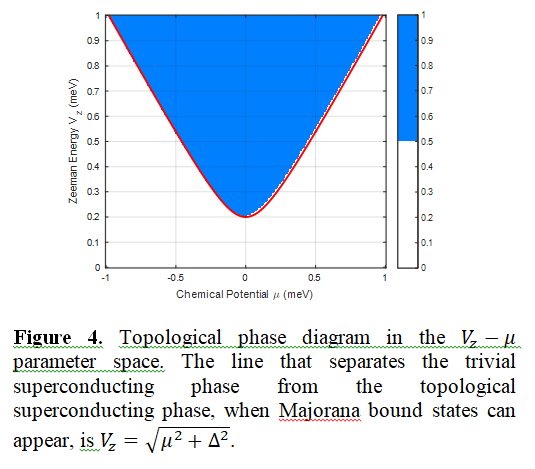
The physical properties of the proposed structure were investigated using the BdG formalism. This formalism incorporates superconducting pairing, Zeeman splitting, and spin-orbit interaction. We performed numerical simulations using MATLAB employing the tight-binding discretization approach. These simulations were conducted to obtain the quasiparticle energy spectrum, the topological invariant, and the topological phase diagram as a function of the magnetic field and chemical potential. We also employed the Landauer formalism to study the electronic transport properties. The simulation results indicate that the superconducting energy gap initially shrinks and later expands with the increase of the magnetic field. It means that the transition is topological in nature. Within the topological regime, the quasiparticle spectra give rise to modes that possess an energy of essentially zero. This illustrates the emergence of Majorana bound states that can only be detected at the edges of the system.
When two quantum wells are linked, tunnelling interactions may arise. Mixing of Majorana modes may lead to the attenuation of its intensity a bit. Transport calculations demonstrate the emergence of a zero-bias conductance peak, an important experimental signature of Majorana states. These results indicate that the suggested structure offers a viable framework for investigating topological superconductivity and Majorana physics in hybrid nanostructures.
References
[1] Ahmed, E., et al. (2025). Anomalous proximity effect in Rashba nanowires. Journal of Superconductivity and Novel Magnetism.
https://doi.org/10.1007/s10948-025-07057-9 DOI: https://doi.org/10.1007/s10948-025-07057-9
[2] Puglia, D., et al. (2020). Closing of the induced gap in hybrid nanowires. Physical Review Letters, 125, 087701.
https://doi.org/10.1103/PhysRevLett.125.087701 DOI: https://doi.org/10.1103/PhysRevLett.125.087701
[3]Mubarak Oglah, The roadmap experiment of CdO films to heterojunction of photodetectors and solar cells. International Journal of Mechanical and Thermal Engineering 2025; 6(1): 21-29. https://dx.doi.org/10.22271/27078043.2025.v6.i1a.74.
[4] Zhang, P., Wang, Z., & Lutchyn, R. M. (2022). Majorana zero modes in superconductors. Nature Reviews Physics, 4, 634–648. https://doi.org/10.1038/s42254-022-00471-5
[5] Oreg, Y., Refael, G., & von Oppen, F. (2010). Helical liquids and Majorana bound states in quantum wires. Physical Review Letters, 105(17), 177002.
https://doi.org/10.1103/PhysRevLett.105.177002 DOI: https://doi.org/10.1103/PhysRevLett.105.177002
[6]Mubarak Oglah. Structural Characterization and Electrical Properties of Barium Titanate Nanorod Crystals Synthesized via Hydrothermal Methods. Tikrit Journal of Pure science, 30(4). 2025. DOI: 10.22271/27078043.2025.v6.i1a.74
[7]Stanescu, T. D., & Tewari, S. (2013). Majorana fermions in semiconductor nanowires. Journal of Physics: Condensed Matter, 25(23), 233201.
https://doi.org/10.1088/0953-8984/25/23/233201 DOI: https://doi.org/10.1088/0953-8984/25/23/233201
[8] Gao, Y. M., et al. (2025). Negative differential conductance induced by Majorana bound states. Nanomaterials, 15, 1359.https://doi.org/10.3390/nano15171359 DOI: https://doi.org/10.3390/nano15171359
[9] Fan, X., et al. (2025). Interaction of charge order with Majorana bound states. National Science Review.https://doi.org/10.1093/nsr/nwae312 DOI: https://doi.org/10.1093/nsr/nwae312
[10] Kouwenhoven, L. (2024). Perspective on Majorana bound states in hybrid nanowires. Modern Physics Letters B.https://doi.org/10.1142/S0217984925400020 DOI: https://doi.org/10.1142/S0217984925400020
[11] Kornich, V., et al. (2020). Majorana bound states in nanowire–superconductor hybrids. Physical Review B, 101, 125414. https://doi.org/10.1103/PhysRevB.101.125414 DOI: https://doi.org/10.1103/PhysRevB.101.125414
[12] Kobiałka, A., & Ptok, A. (2021). Majorana bound states in a superconducting Rashba nanowire. Physical Review B, 103, 125110.
https://doi.org/10.1103/PhysRevB.103.125110 DOI: https://doi.org/10.1103/PhysRevB.103.125110
[13] Yu, P., et al. (2020). Non-Majorana states yield nearly quantized conductance. Physical Review Letters, 124, 107701.
https://doi.org/10.1103/PhysRevLett.124.107701
[14] Liu, C. X., Zhang, J., & Das Sarma, S. (2021). Majorana zero modes in hybrid structures. Annual Review of Condensed Matter Physics, 12, 153–179.
https://doi.org/10.1146/annurev-conmatphys-031119-050745 DOI: https://doi.org/10.1146/annurev-conmatphys-031119-050745
[15] Neverov, V. D., et al. (2026). Revealing Majorana zero modes in vortex cores. Superconductor Science and Technology. DOI: https://doi.org/10.34133/research.1087
https://doi.org/10.1088/1361-6668/adXXXX
[16] Liu, C. X., Sau, J. D., & Das Sarma, S. (2017). Role of dissipation in Majorana nanowires. Physical Review B, 95, 054502.
https://doi.org/10.1103/PhysRevB.95.054502 DOI: https://doi.org/10.1103/PhysRevB.95.054502
[17] Oglah, M. H. The roadmap experiment of CdO films to heterojunction of photodetectors and solar cells. International Journal of Mechanical and Thermal Engineering, 6(1):21-29.DOI: 10.22271/27078043.2025.v6.i1a.74 DOI: https://doi.org/10.22271/27078043.2025.v6.i1a.74
[18] Oglah, M. H. Analyzing the Time Evolution of a Particle by Decomposes the Initial State Confinement in 1D Well into the Lowest Eigenstates Energy. Journal for Research in Applied Sciences and Biotechnology 3(2):103-107, (2024).DOI:10.55544/jrasb.3.2.17 DOI: https://doi.org/10.55544/jrasb.3.2.17
[19]Beenakker, C. W. J. (2013). Search for Majorana fermions in superconductors. Annual Review of Condensed Matter Physics, 4, 113–136.
https://doi.org/10.1146/annurev-conmatphys-030212-184337 DOI: https://doi.org/10.1146/annurev-conmatphys-030212-184337
[20] Maji, S., et al. (2025). Signatures of Majorana bound states in scanning-gate microscopy. Physical Review B. DOI: https://doi.org/10.1103/bc9x-lswp
https://doi.org/10.1103/PhysRevB.112.XXXXX (link.aps.org)
[21] Oglah, M. H. Structural Characterization and Electrical Properties of Barium Titanate Nanorod Crystals Synthesized via Hydrothermal Methods. Tikrit Journal of Pure Science Vol.30 (4) 2025. DOI: https://doi.org/10.25130/tjps.v30i4.1780 DOI: https://doi.org/10.25130/tjps.v30i4.1780
[22] Das Sarma, S., Freedman, M., & Nayak, C. (2015). Majorana zero modes and topological quantum computation. npj Quantum Information, 1, 15001.
https://doi.org/10.1038/npjqi.2015.1
[23]Potter, A. C., & Lee, P. A. (2011). Multichannel Majorana wires. Physical Review B, 83, 184520. DOI: https://doi.org/10.1103/PhysRevB.83.094525
https://doi.org/10.1103/PhysRevB.83.184520 DOI: https://doi.org/10.1103/PhysRevB.83.184520
[24] Nadj-Perge, S., et al. (2014). Observation of Majorana fermions in ferromagnetic atomic chains. Science, 346, 602–607.
https://doi.org/10.1126/science.1259327 DOI: https://doi.org/10.1126/science.1259327
[25] Mourik, V. et al. (2012). Signatures of Majorana fermions in hybrid superconductor–semiconductor nanowire devices. Science. DOI: https://doi.org/10.1126/science.1222360
[26]Oglah, M. H., Mohammed, S. J., & El-Daher, M. S. (2020). Determine the Lower-State Energy of (GaMn) As/GaAs Quantum Well using Localization Landscape Method. Tikrit Journal of Pure Science, 25(6), 96-102. DOI:10.25130/tjps.v25i6.318 DOI: https://doi.org/10.25130/tjps.v25i6.318
[27] Alicea, J. (2012). New directions in the pursuit of Majorana fermions in solid state systems. Reports on Progress in Physics, 75(7), 076501. https://doi.org/10.1088/0034-4885/75/7/076501 DOI: https://doi.org/10.1088/0034-4885/75/7/076501
[28] Aguado, R. (2017). Majorana quasiparticles in condensed matter. Rivista del Nuovo Cimento.
[29] Hell, M., Flensberg, K., & Leijnse, M. (2017). Two-dimensional platform for networks of Majorana bound states. Physical Review Letters, 118(10), 107701. https://doi.org/10.1103/PhysRevLett.118.107701 DOI: https://doi.org/10.1103/PhysRevLett.118.107701
[30] Zhang, H., Liu, C. X., Gazibegovic, S., Xu, D., Logan, J. A., Wang, G., van Loo, N., Bommer, J. D. S., de Moor, M. W. A., Car, D., et al. (2018). Quantized Majorana conductance. Nature, 556, 74–79. https://doi.org/10.1038/nature26142 DOI: https://doi.org/10.1038/nature26142
[31]Oglah, M. H., Hasan, A. A., & Mahmood, W. I. (2025, February). Quantum confinement Bohr radius effects of quantum dots using Brus mathematical model. In AIP Conference Proceedings (Vol. 3162, No. 1, p. 020007). AIP Publishing LLC. https://doi.org/10.1063/5.0241782 DOI: https://doi.org/10.1063/5.0241782
[32] Oglah, M. H., Mahmood, W. I., & Adday, N. B. (2023). Tracking of Gaussian pulse release length inside mode-locked semiconductor laser amplifier. Indonesian Journal of Electrical Engineering and Computer Science, 32(1), 260-268. http://doi.org/10.11591/ijeecs.v32.i1.pp260-268 DOI: https://doi.org/10.11591/ijeecs.v32.i1.pp260-268
[33] Kitaev, A. (2001). Unpaired Majorana fermions in quantum wires. Physics-Uspekhi, 44, 131. https://doi.org/10.1070/1063-7869/44/10S/S29 DOI: https://doi.org/10.1070/1063-7869/44/10S/S29
[34] Rainis, D., & Loss, D. (2012). Majorana qubit decoherence. Physical Review B, 85, 174533.https://doi.org/10.1103/PhysRevB.85.174533 DOI: https://doi.org/10.1103/PhysRevB.85.174533
[35] Stanescu, T., et al. (2011). Majorana fermions in semiconductor nanowires. Physical Review B, 84, 144522.https://doi.org/10.1103/PhysRevB.84.144522 DOI: https://doi.org/10.1103/PhysRevB.84.144522
[36] Tewari, S., et al. (2012). Topological superconductivity in semiconductor nanowires. Physical Review Letters, 108, 207001.https://doi.org/10.1103/PhysRevLett.108.207001 DOI: https://doi.org/10.1103/PhysRevLett.108.207001
[37] Fu, L., & Kane, C. (2008). Superconducting proximity effect and Majorana fermions. Physical Review Letters, 100, 096407.
https://doi.org/10.1103/PhysRevLett.100.096407 DOI: https://doi.org/10.1103/PhysRevLett.100.096407
[38] Das Sarma, S., et al. (2012). Splitting of Majorana modes due to overlap. Physical Review B, 86, 220506. https://doi.org/10.1103/PhysRevB.86.220506 DOI: https://doi.org/10.1103/PhysRevB.86.220506
[39] Read, N., & Green, D. (2000). Paired states of fermions in two dimensions. Physical Review B, 61, 10267. https://doi.org/10.1103/PhysRevB.61.10267 DOI: https://doi.org/10.1103/PhysRevB.61.10267
[40] Sau, J. D., et al. (2010). Generic new platform for topological quantum computation. Physical Review Letters, 104, 040502. https://doi.org/10.1103/PhysRevLett.104.040502 DOI: https://doi.org/10.1103/PhysRevLett.104.040502
[41] Sato, M., & Ando, Y. (2017). Topological superconductors. Reports on Progress in Physics, 80(7), 076501. https://doi.org/10.1088/1361-6633/aa6ac7 DOI: https://doi.org/10.1088/1361-6633/aa6ac7
[42] Leijnse, M., & Flensberg, K. (2012). Introduction to topological superconductivity and Majorana fermions. Semiconductor Science and Technology, 27(12), 124003. https://doi.org/10.1088/0268-1242/27/12/124003 DOI: https://doi.org/10.1088/0268-1242/27/12/124003
[43] Das Sarma, S., Freedman, M., & Nayak, C. (2015). Majorana zero modes and topological quantum computation. npj Quantum Information, 1, 15001. https://doi.org/10.1038/npjqi.2015.1 DOI: https://doi.org/10.1038/npjqi.2015.1
[44] Prada, E., San-Jose, P., et al. (2020). From Andreev to Majorana bound states in hybrid nanowires. Nature Reviews Physics, 2, 575–594.
https://doi.org/10.1038/s42254-020-0228-y DOI: https://doi.org/10.1038/s42254-020-0228-y
[45]Lutchyn, R. M., et al. (2011). Search for Majorana fermions in multiband nanowires. Physical Review Letters, 106, 127001.
https://doi.org/10.1103/PhysRevLett.106.127001 DOI: https://doi.org/10.1103/PhysRevLett.106.127001
[46] Chen, J., Yu, P., Stenger, J., Hocevar, M., Car, D., Plissard, S., Bakkers, E. P. A. M., Stanescu, T. D., & Frolov, S. M. (2017). Experimental phase diagram of a Majorana wire. Science Advances, 3(9), e1701476. https://doi.org/10.1126/sciadv.1701476 DOI: https://doi.org/10.1126/sciadv.1701476
[47] Albrecht, S. M., Higginbotham, A. P., Madsen, M., Kuemmeth, F., Jespersen, T. S., Nygård, J., Krogstrup, P., & Marcus, C. M. (2016). Exponential protection of Majorana qubits. Nature, 531(7593), 206–209. https:/doi.org/10.1038/nature17162 DOI: https://doi.org/10.1038/nature17162
[48] Deng, M. T., Vaitiekėnas, S., Hansen, E. B., Danon, J., Leijnse, M., Flensberg, K., Nygård, J., Krogstrup, P., & Marcus, C. M. (2016). Majorana bound state in a coupled quantum-dot–nanowire system. Science, 354(6319), 1557–1562. https://doi.org/10.1126/science.aaf3961 DOI: https://doi.org/10.1126/science.aaf3961
[49] Nichele, F., Drachmann, A. C. C., Whiticar, A. M., O’Farrell, E. C. T., Suominen, H. J., Fornieri, A., Wang, T., Gardner, G. C., Thomas, C., Hatke, A. T., Krogstrup, P., Manfra, M. J., & Marcus, C. M. (2017). Scaling of Majorana zero-bias conductance peaks. Physical Review Letters, 119(13), 136803. https://doi.org/10.1103/PhysRevLett.119.136803 DOI: https://doi.org/10.1103/PhysRevLett.119.136803
[50] Pan, H., Cole, W. S., Sau, J. D., & Das Sarma, S. (2023). Topological superconductivity in hybrid semiconductor–superconductor structures. Physical Review B, 107(12), 125417. https://doi.org/10.1103/PhysRevB.107.125417 DOI: https://doi.org/10.1103/PhysRevB.107.125417
[51] Song, H., Li, J., Wang, Y., & Xu, J. (2023). Majorana bound states in hybrid nanostructures. Nano Letters, 23(8), 3456–3463. https://doi.org/10.1021/acs.nanolett.3c00215
[52] Das Sarma, S., Freedman, M., & Nayak, C. (2020). Majorana zero modes and topological quantum computation. npj Quantum Information, 6, 23. https://doi.org/10.1038/s41534-020-0251-1
[53] Kitaev, A. Y. (2020). Topological quantum computation with Majorana fermions. Reviews of Modern Physics, 92(3), 035005. https://doi.org/10.1103/RevModPhys.92.035005 DOI: https://doi.org/10.1103/RevModPhys.92.035005
Downloads
Published
Issue
Section
License
Copyright (c) 2026 Al-Noor Journal of Engineering Management and Computer Science

This work is licensed under a Creative Commons Attribution-NonCommercial-ShareAlike 4.0 International License.
How to Cite