Experimental Evaluation of Hot-Water Thermal Storage with Auxiliary PV Heating in a Solar-Driven Absorption Cooling System
DOI:
https://doi.org/10.71229/5rqtjy49Keywords:
Solar Energy, , Thermal Energy Storage,, Absorption Cooling System, , Hot Water Storage Tank,, System Performance OptimizationAbstract
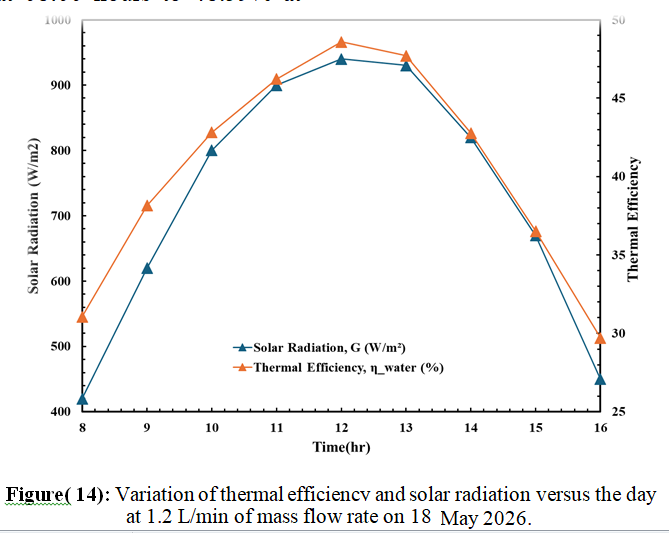
Solar-powered Absorption Cooling system is one of the promising options for sustainable refrigeration; however, their performance suffers due to thermal lag from intermittency of solar energy and thermal storage medium. In this paper, a novel approach to thermal regulation that integrates PTC collector, hot water thermal energy storage with an auxiliary PV heating loop, which operates under extreme environmental conditions of up to 38.9 °C air temperature and irradiance up to 940 W/m², is investigated through experimental research. The main innovation of this technology is that the auxiliary heating process is implemented directly from PV source. As per experimental observations, water running through the system at the rate of 1.2 L/min was able to achieve the maximum useful heat gain (Qu,water) of 2800 W and efficiency ηwater of 48.59% at 12:00 hours. On the other hand, thermal oil running through the system at the flow rate of 2.7 L/min showed significant thermal lag, which reached the point of maximum useful heat gain (Qu,oil) of 2336 W and efficiency ηoil of 41.50% after an hour of lag, i.e., 13:00 hours. However, with the help of the active PV heating unit, constant increase in temperature was experienced for the hot-water storage tank, ranging from 3 to 8°C. This way, a steady thermal effect helped in increasing the temperature inside the storage tank to 87°C (versus 79°C in PTC-only system) at 14:00 hours, while increasing generator temperature (Tg) to 108°C at 13:30 hours. Thus, the complete system reached COP of 0.79. As seen in the present study, incorporation of active PV heating along with hot-water thermal storage could prove to be a novel passive-active strategy against storage inertia.
References
[1] C. Zhang, S. Shi, Y. Lu, Y. Qiang, Y. Wu, and C. Ma, “Heat discharging and natural convection heat transfer performance of coil heat exchanger in single molten salt tank,” Appl. Therm. Eng., vol. 166, p. 114689, 2020. DOI: https://doi.org/10.1016/j.applthermaleng.2019.114689
[2] K. S. Reddy and C. Ananthsornaraj, “Design, development and performance investigation of solar Parabolic Trough Collector for large-scale solar power plants,” Renew. Energy, vol. 146, pp. 1943–1957, 2020. DOI: https://doi.org/10.1016/j.renene.2019.07.158
[3] M. Allam, M. Tawfik, M. Bekheit, and E. El-Negiry, “Experimental Investigation on Performance Enhancement of Parabolic Trough Concentrator with Helical Rotating Shaft Insert,” Sustain., vol. 14, no. 22, 2022, doi: 10.3390/su142214667. DOI: https://doi.org/10.3390/su142214667
[4] R. K. Singh and P. Chandra, “Parabolic trough solar collector: A review on geometrical interpretation, mathematical model, and thermal performance augmentation,” Eng. Res. Express, vol. 5, no. 1, p. 12003, 2023. DOI: https://doi.org/10.1088/2631-8695/acc00a
[5] K. Gaurav and S. K. Verma, “Heat transfer and fluid flow characteristics of ring inserted riser tube in solar water heater,” Proc. Inst. Mech. Eng. Part E J. Process Mech. Eng., 2024. DOI: https://doi.org/10.1177/09544089241296633
[6] R. Naveenkumar et al., “Thermal performance analysis of a parabolic trough collector based solar water heater using revolving absorber tube,” Results Eng., vol. 25, p. 104270, 2025. DOI: https://doi.org/10.1016/j.rineng.2025.104270
[7] N. D. Kaushika, S. Reddy, and K. Kaushik, “Solar Thermal Energy and Power Systems,” 2016, pp. 85–105. doi: 10.1007/978-3-319-29446-9_7. DOI: https://doi.org/10.1007/978-3-319-29446-9_7
[8] H. U. Helvaci and Z. A. Khan, “Mathematical modelling and simulation of multiphase flow in a flat plate solar energy collector,” Energy Convers. Manag., vol. 106, pp. 139–150, 2015. DOI: https://doi.org/10.1016/j.enconman.2015.09.028
[9] S. N. Singh, P. Tiwari, and S. Tiwari, Fundamentals and innovations in solar energy, vol. 10. Springer, 2021. DOI: https://doi.org/10.1007/978-981-33-6456-1
[10] M. El, H. Assad, M. Sadeghzadeh, and M. Hossein, “Space cooling using geothermal single- effect water / lithium bromide absorption chiller,” no. June 2020, pp. 1747–1760, 2021, doi: 10.1002/ese3.946. DOI: https://doi.org/10.1002/ese3.946
[11] S. A. Kalogirou, Solar energy engineering: processes and systems. Elsevier, 2023.
[12] M. I. Hasan and S. M. Hadi, “A Review for Solar Powered Absorption Air Conditioning System.,” Libr. Progress-Library Sci. Inf. Technol. Comput., vol. 44, 2024.
[13] R. Hirmiz, M. F. Lightstone, and J. S. Cotton, “Performance enhancement of solar absorption cooling systems using thermal energy storage with phase change materials,” vol. 223, no. January, pp. 11–29, 2018. DOI: https://doi.org/10.1016/j.apenergy.2018.04.029
[14] X. Q. Zhai, M. Qu, Y. Li, and R. Z. Wang, “A review for research and new design options of solar absorption cooling systems,” Renew. Sustain. energy Rev., vol. 15, no. 9, pp. 4416–4423, 2011. DOI: https://doi.org/10.1016/j.rser.2011.06.016
[15] D. Moreno et al., “Absorption refrigeration cycles based on ionic liquids: Refrigerant/absorbent selection by thermodynamic and process analysis,” Appl. Energy, vol. 213, pp. 179–194, 2018. DOI: https://doi.org/10.1016/j.apenergy.2018.01.034
[16] K. Kumar and S. Singh, “Investigating thermal stratification in a vertical hot water storage tank under multiple transient operations,” Energy Reports, vol. 7, pp. 7186–7199, 2021. DOI: https://doi.org/10.1016/j.egyr.2021.10.088
[17] C. Zhu et al., “Study on thermal performance of single-tank thermal energy storage system with thermocline in solar thermal utilization,” Appl. Sci., vol. 12, no. 8, p. 3908, 2022. DOI: https://doi.org/10.3390/app12083908
[18] D. S. Ayou and A. Coronas, “New developments and progress in absorption chillers for solar cooling applications,” Appl. Sci., vol. 10, no. 12, p. 4073, 2020. DOI: https://doi.org/10.3390/app10124073
[19] L. Lin, Y. Tian, Y. Luo, C. Chen, and L. Jiang, “A novel solar system integrating concentrating photovoltaic thermal collectors and variable effect absorption chiller for flexible co-generation of electricity and cooling,” Energy Convers. Manag., vol. 206, p. 112506, 2020. DOI: https://doi.org/10.1016/j.enconman.2020.112506
[20] M. Shehram, M. N. Hamidi, A. A. Abdul Wahab, and M. K. Mat Desa, “Comprehensive review of hybrid solar cooling systems for buildings: integrating PV and thermal energy storage in phase change materials,” J. Therm. Anal. Calorim., vol. 150, no. 7, pp. 4873–4906, 2025. DOI: https://doi.org/10.1007/s10973-025-14119-6
[21] E. Chen, M. Xie, T. Jia, Y. Zhao, and Y. Dai, “Performance assessment of a solar-assisted absorption-compression system for both heating and cooling,” Appl. Energy, vol. 328, p. 120238, 2022. DOI: https://doi.org/10.1016/j.apenergy.2022.120238
Downloads
Published
Issue
Section
License
Copyright (c) 2026 Al-Noor Journal of Engineering Management and Computer Science

This work is licensed under a Creative Commons Attribution-NonCommercial-ShareAlike 4.0 International License.
How to Cite