Engineering Optimization of Safranin Dye Removal from Aqueous Solutions by Sodium Carboxymethyl Cellulose
DOI:
https://doi.org/10.71229/c78hwh27Keywords:
Batch treatment, , Decolorization,, Operating envelope, , Polyelectrolyte association, , Resource efficiencyAbstract
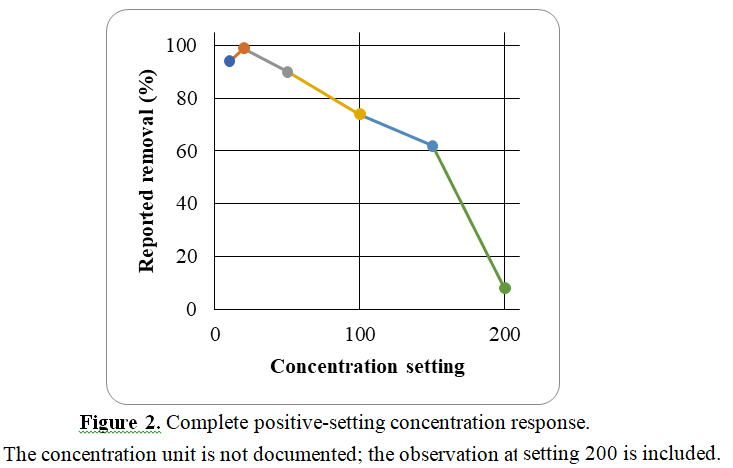
We evaluated the engineering performance of safranin-treated sodium carboxymethyl cellulose (NaCMC) through five batch-treatment screening series with 26 positive-setting observations. We assessed the engineering performance of safranin treatment with sodium carboxymethyl cellulose using four different methods: descriptive response analysis, discrete feasibility screening, resource-performance comparison, and monotonicity diagnostic. Different series showed a maximum removal of 99% at concentration set point 20, contact time 10 min, dose 0.5 g/L, pH 8, and mixing set point 120, respectively. These are individual maxima and were not mutually confirmed as an operating condition. Reported removal for a dose of 0.3 g/L was 96%, and 40% less polymer was used than for a dose of 0.5 g/L. The contact-time response dropped from 99% at 10 min to 83% at 90 min, with a minimum root-mean-squared difference of 5.09 percentage points from any nondecreasing sequence, challenging a simple irreversible-uptake interpretation. This concentration series also showed a high-setting response of only 8%, which significantly altered the inferred loading behavior. Raw absorbance data and dimensional and statistical inferences were hindered by missing concentration and mixing units and replicate measurements. As the treatment polymer is water soluble, the percentages given are operational removal responses, because the amount of dye removal was not explained and verified separately. The analysis identifies candidates for further testing, clarifies the dose-performance trade-off, and distinguishes among apparent decolorization, association in the polymer, and physical separation requirements.
References
[1] M. U. Sadiq, A. Shah, J. Nisar, and I. Shah, "Photoelectrocatalytic detection and degradation studies of a hazardous textile dye Safranin T," Nanomaterials, vol. 13, no. 15, Art. no. 2218, 2023, doi: 10.3390/nano13152218.
[2] H. H. A. M. Hassan and M. Abdel Fattah, "Efficient removal of safranin from aqueous solution using a new type of metalated highly self-doped polyaniline nanocomposite," Functional Composite Materials, vol. 4, Art. no. 1, 2023, doi: 10.1186/s42252-023-00038-y.
[3] K. Mohammad Sharifi, A. Poursattar Marjani, and P. Gozali Balkanloo, "Enhanced dye removal using montmorillonite modified with graphene quantum dots in sustainable salep nanocomposite hydrogel," Scientific Reports, vol. 14, Art. no. 7011, 2024, doi: 10.1038/s41598-024-57729-0.
[4] E. A. Abdelrahman and M. T. Basha, "Novel carbonate, oxide, and hydroxide nanohybrids based on Mg, Ba, and Ca for efficient Safranin O dye adsorption," Scientific Reports, vol. 16, Art. no. 2624, 2026, doi: 10.1038/s41598-026-36376-7.
[5] A. Hamdy, H. Nageh, S. A. Hassan, M. A. Mekewi, and A. S. Darwish, "Carboxymethyl cellulose assisted reforming of poly acrylic acid co methyl methacrylate composite for wastewater treatment and effective hosting of antimicrobial silver," Scientific Reports, vol. 15, Art. no. 4731, 2025, doi: 10.1038/s41598-025-86214-5.
[6] A. M. Aljeboree, H. H. Ghazi, S. A. Hussein, M. A. Jawad, S. A. Khuder, and A. F. Alkaim, "Facile fabrication of a low-cost carboxymethyl cellulose-polyacrylamide composite for the highly efficient removal of cationic dye: optimization, kinetic and reusability," Journal of the Iranian Chemical Society, vol. 22, pp. 91-111, 2025, doi: 10.1007/s13738-024-03132-5.
[7] W. M. Najem, "Synthesis and structural characterization of a zeolite-incorporated carboxymethyl cellulose hydrogel for Safranin O adsorption: Equilibrium, kinetics, thermodynamics and reusability," Journal of Nanostructures, vol. 16, no. 4, pp. 4890-4900, 2026, doi: 10.22052/JNS.2026.04.035.
[8] L. Soullard et al., "Optimization of the methacrylation of carboxymethylcellulose and use for the design of hydrogels and cryogels with controlled structure and properties," Cellulose, vol. 30, pp. 6203-6217, 2023, doi: 10.1007/s10570-023-05266-w.
[9] H. Zhang, G. Guan, T. Lou, and X. Wang, "High performance, cost-effective and ecofriendly flocculant synthesized by grafting carboxymethyl cellulose and alginate with itaconic acid," International Journal of Biological Macromolecules, vol. 231, Art. no. 123305, 2023, doi: 10.1016/j.ijbiomac.2023.123305.
[10] A. Ben Fradj, R. Lafi, S. Ben Hamouda, L. Gzara, A. H. Hamzaoui, and A. Hafiane, "Investigation on the interaction of Safranin T with anionic polyelectrolytes by spectrophotometric method," Spectrochimica Acta Part A: Molecular and Biomolecular Spectroscopy, vol. 131, pp. 169-176, 2014, doi: 10.1016/j.saa.2014.04.028.
[11] D. Yılmaz Aykut, Ö. Yolaçan, H. Kaşgöz, and H. Deligoz, "Tunable safranine T release from LbL films of single/blend polyanions," Colloid and Polymer Science, vol. 299, pp. 1605-1616, 2021, doi: 10.1007/s00396-021-04883-w.
[12] V. Czitrom, "One-factor-at-a-time versus designed experiments," The American Statistician, vol. 53, no. 2, pp. 126-131, 1999, doi: 10.1080/00031305.1999.10474445.
[13] I. Ahmad et al., "Application of response surface methodology for modeling adsorption of janus green and safranin-O on magnetic nanocomposite from aqueous solutions," Scientific Reports, vol. 15, Art. no. 31252, 2025, doi: 10.1038/s41598-025-02644-1.
[14] K. H. Chu, M. A. Hashim, and A. A. Basirun, "Pseudo-first-order kinetics in water contaminant adsorption: A cautionary note," Water, Air, & Soil Pollution, vol. 237, Art. no. 55, 2026, doi: 10.1007/s11270-025-08774-6.
[15] M. Ayer, H. D. Brunk, G. M. Ewing, W. T. Reid, and E. Silverman, "An empirical distribution function for sampling with incomplete information," The Annals of Mathematical Statistics, vol. 26, no. 4, pp. 641-647, 1955, doi: 10.1214/aoms/1177728423.
[16] N. Zaghbani, A. Hafiane, and M. Dhahbi, "Removal of Safranin T from wastewater using micellar enhanced ultrafiltration," Desalination, vol. 222, nos. 1-3, pp. 348-356, 2008, doi: 10.1016/j.desal.2007.01.148.
Downloads
Published
Issue
Section
License
Copyright (c) 2026 Al-Noor Journal of Engineering Management and Computer Science

This work is licensed under a Creative Commons Attribution-NonCommercial-ShareAlike 4.0 International License.
How to Cite