Structural, Optical, Electrical, and Magnetic Characterization of Fe2O3 and ZnO Nanoparticles Synthesized by Pulsed Laser Ablation in Liquid for River Water Treatment
DOI:
https://doi.org/10.71229/a59jp182Keywords:
Fe2O3 nanoparticles , ZnO nanoparticles, laser ablation in liquid (PLAL)Abstract
This study aimed to prepare iron oxide (Fe2O3) and zinc oxide (ZnO) nanoparticles using pulsed laser ablation in liquid (PLAL) technology, investigate their physical properties, and evaluate their potential use in treating polluted river water. This technique is advantageous because it allows for the preparation of nanoparticles without the need to add chemicals during the preparation process, making it an important method for producing nanomaterials with properties suitable for environmental applications.
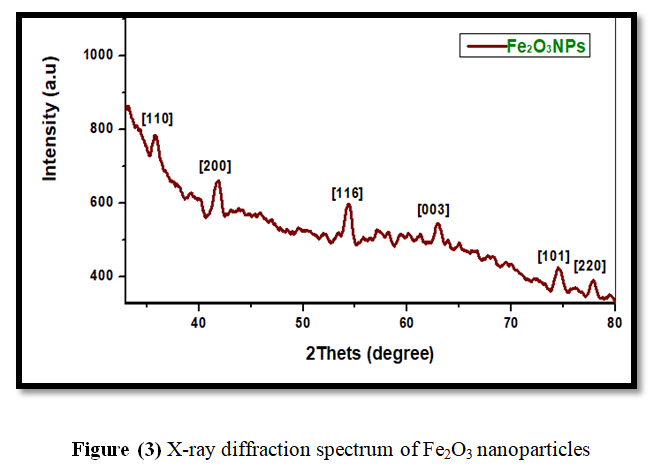
X-ray diffraction (XRD) results showed the formation of the hexagonal crystalline phase of ZnO and the hematite (α-Fe2O3) phase of Fe2O3, with characteristic peaks for each material, confirming the formation of the required crystalline structure of the prepared particles. UV-Vis measurements also showed characteristic absorption peaks at 375 nm for ZnO and 230 nm for Fe2O3 . FTIR spectra confirmed the presence of characteristic bonds for both materials, particularly Zn-O and Fe-O bonds. FESEM images showed the formation of nanoparticles with predominantly spherical morphology, averaging 33.47 nm for Fe₂O₃ and 35.69 nm for ZnO, confirming the successful preparation and formation of materials at the nanoscale.Electrical measurements showed that both Fe₂O₃ and ZnO exhibit n-type semiconducting behavior, with a clear difference in charge carrier mobility and concentration between the two materials. VSM measurements showed that Fe₂O₃ exhibits superferro magnetic behavior at room temperature, while ZnO exhibited weak diamagnetic behavior. These properties provide a suitable basis for utilizing the prepared materials in environmental and functional applications. The measured electrical properties demonstrate that the synthesized nanostructures possess strong electrical characteristics, making them highly efficient in facilitating the redox reactions required for breaking down water pollutants To evaluate the efficiency of the prepared materials in river water treatment, samples were analyzed before and after treatment Using nanoparticles by EDX, the river water before treatment showed a high weight percentage of zinc, reaching 53.76%. After treatment with Fe2O3 particles, the detected percentage of zinc decreased to 40.21%, while it decreased to 32.08% after treatment with ZnO particles. These results indicate a clear effect of the prepared nanoparticles in altering the elemental composition of the water sample, with ZnO showing a greater response than Fe2O3 under the experimental conditions. Based on the results obtained, it can be concluded that pulsed laser ablation in liquid provides an efficient method for preparing Fe2O3 and ZnO nanoparticles with distinctive structural, morphological, and physical properties, and that these materials have promising applicability in the treatment of polluted water. The results also showed that ZnO was more effective than Fe2O3 in reducing the weight percentage of zinc detected in the treated water samples, which supports
References
1-Mohammed, H.K. (2016). "Osmotic Membrane Bioreactor for Refinery wastewater Treatment " .( Ph.D dissertation) . Department of Chemical Engineering , College of Engineering , University of Baghdad .
2-Valdman, E.L.et . al ., (2001) . " Continuous Biosorotion of Cu and Zn Immobilized waste Biomass Sargassum " , Process Biochemistry , 869-873. DOI: https://doi.org/10.1016/S0032-9592(00)00288-0
3-Nur-Nadia , A., Mohammad , S., and Suzylawati , I., (2017) ." Formulation study for softening of hard water using surfactant modifited bentonite adsorbent coating " Applied science, V:137,PP : 168-175 . DOI: https://doi.org/10.1016/j.clay.2016.12.025
4-Gowen, A. A., Tsenkova, R., Bruen, M., and O Donnell, C.,(2012). “ Vibrational spectroscopy for analysis of water for human use and in aquatic ecosystems “ , Critical reviews in environmental science and technology , 42(23) ,2546-2573. DOI: https://doi.org/10.1080/10643389.2011.592758
5-Feifei ,W. Xiaolin ,Yu. Maofa, Ge. Sujun , Wu. Juan, Gu. Gunwang , Tang , Tang .Xiao. Xiao ,Wu and Robert , O (2019) , "Facile self- assembly synthesis of ᵧ -Fe2o3/grapheme oxide for enhanced photo Fenton reaction " Environmental pollution , 248, 229-237. DOI: https://doi.org/10.1016/j.envpol.2019.01.018
6 -F.Y. Mohammed, ch.H. Kareem , F.G. Hammoodi . (2025) .” Study of properties of CuO:CR nanostructures thin films “ . Digest Journal of nanomaterials and Biostructures , 20 (3) , 965-973. DOI: https://doi.org/10.15251/DJNB.2025.203.965
7 - Kadhima R.M., Al-Abodib E. E. Al-Alawy A. F., (2018). " Citrate-coated
magnetite nanoparticles as osmotic agent in a forward osmosis process"
Desalination and Water Treatment,115,45-52.
8 -Khan, I., Saeed, K., & Khan, I. , (2019), ”Nanoparticles :Properties, applications and toxicities “ . Arabian journal of chemistry, 12(7). 908-931. DOI: https://doi.org/10.1016/j.arabjc.2017.05.011
9- Bucak, S., Yavuztürk, B., & Sezer, A. D. ,(2012). “Magnetic nanoparticles:
Synthesis, surface modifications and application in drug delivery” In A. D. Sezer (Ed), Recent Advances in Novel Drug Carrier Systems.(pp. 35-60), IntechOpen.
10- Sun, J., Zhou, S., Hou, P., Yang, Y., Weng, J., Li, X., & Li, M. ,(2006).
“Synthesis and characterization of biocompatible Fe3O4 nanoparticles” Journal of Biomedical Materials Research, Part. A, 80(2), 333-341.
11-Faraji, M., Yamini, Y., & Rezaee, M., (2010) ." Magnetic nanoparticles : Synthesis , stabilization , functionalization , characterization , and applications " Journal of the Iranian Chemical Society, 7(1), 1-37. DOI: https://doi.org/10.1007/BF03245856
12-Hong, R. Y., Li, J. H., Li, H. Z., Ding, J., Zheng, Y., & Wei, D. G. ,(2008).
“Synthesis of Fe3O4 nanoparticles without inert gas protection used as precursors of magnetic fluids”. Journal of Magnetism and Magnetic Materials 320(9), 1605-1614. DOI: https://doi.org/10.1016/j.jmmm.2008.01.015
13- Ling, M. M., & Chung, T. -S. ,(2011). “Desalination process using super
hydrophilic nanoparticles via forward osmosis integrated with ultrafiltration
regeneration” Desalination, 278(1-3), 194-202
14-Rimsha , A., Jingjing , L ., Xue ,Q., (2024) . " Silver Nanoparticles : Synthesis , structure , properties and Applications " . MDPI . 14(17), 1425. DOI: https://doi.org/10.3390/nano14171425
15-J.Akoijam et al., (2026) , "Green Synthesis of ZnO/Fe3O4/Ag Ternary Nanocomposite for Enhanced 4‐Nitrophenol Catalytic Reduction and Antibacterial Activity. ChemistrySelect 11(7), e06823 DOI: https://doi.org/10.1002/slct.202506823
16- G. H. Jihad, (2021), Synthesis and characterization of α-Fe2O3 nanoparticles prepared by PLD at different laser energies ". Iraqi Journal of Science 62(11), 3901-3910 . DOI: https://doi.org/10.24996/ijs.2021.62.11.11
17-Halas, N. J., Lal, S., Chang, W. S., Link, S., & Nordlander, P., (2011), “ Plasmons in strongly coupled metallic nanostructures, “ , Chem. Rev., 111(6) . 3913-3961 . DOI: https://doi.org/10.1021/cr200061k
18-Kravets, V. G., Kabashin, A. V., Barnes, W. L., & Grigorenko, A. N. (2018), “ Plasmonic surface lattice resonances : a review of properties and applications “ , Chem. Rev . 118(12) . 5912-5951. DOI: https://doi.org/10.1021/acs.chemrev.8b00243
19 -Singh , K. K. ,(2022), “Role of nanotechnology and nanomaterials for water treatment and environmental remediation “ . International Journal of New Chemistry , 9(3) .165-190 .
20 -Ding, S. Y., You, E. M., Tian, Z. Q., & Moskovits, M., (2017), “Electromagnetic theories of surface enhanced Raman spectroscopy “ . Chem. Soc. Rev., 46(13) . 4042-4076. DOI: https://doi.org/10.1039/C7CS00238F
21-McMahon, J. M., Li, S., Ausman, L. K., & Scgatz, G. C., (2012),“Modeling the effect of small gaps in surface enhanced Raman spectroscopy” . J. Phys Chem. ,116(2) . 1627-1637. DOI: https://doi.org/10.1021/jp207661y
22-Shvalya, V., Filipic , G., Zavasnik, J., Abdulhalim, I., &Cvelbar, U. (2020), “Surface enhanced Raman spectroscopy for chemical and biological sensing using nanoplasmonic : The relevance of interparticle spacing and surface morphology “ . Appl. Phys. Rev., 7(3). DOI: https://doi.org/10.1063/5.0015246
23- Moyano, P. M. (2025). "Advanced materials: Introduction to nanotechnology" . In Life Cycle Analysis Based on Nanoparticles Applied to the Construction Industry (pp. 61–73). Springer. DOI: https://doi.org/10.1007/978-3-031-79115-4_4
24-Gaikwad, R. W. (2004). " Removal of Cd (II) from aqueous solution by activated charcoal derived from coconut shell ". Electronic Journal of Environmental, Agricultural and Food Chemistry (EJEAFChe), 3(4), 702–709.
25-Chiamaka ,P,O., Azubuike , J,E., Adaora , L,O., (2024) ." Structural , Optical , Magnetic and Electrical properties of Zinc oxide Doped with Iron : A Review:” .Asian Journal of Physical and Chemical Sciences . 12(4), 29-40. DOI: https://doi.org/10.9734/ajopacs/2024/v12i4234
26-Babu B.V.and Gupta S., (2005). “Modeling And Simulation of Fixed bed
Adsorption Column:Effect Of Velocity Variation”, J.Eng. Technol,1(1):60-66. DOI: https://doi.org/10.26634/jfet.1.1.966
27- Khan,S. H.,Pathak, B.,and Fulekar, M. H. ,(2017).“Spherical Surfaced Magnetic (Fe3O4) Nanoparticles as Nano Adsorbent Material for Treatment of Industrial Dye Effluents”.International Journal of Nanoscience and Nanotechnology,13(2),169- 175.
28-- Alwash,N.H. ,(2009). " The effect of sintering time on the magnetic properties (Ni1-xZnxFe2O4) for the syntheses", The Iraqi Journal For Mechanical And Material Engineering, Special Issue (0), 499-511.
Downloads
Published
Issue
Section
License
Copyright (c) 2026 Al-Noor Journal of Engineering Management and Computer Science

This work is licensed under a Creative Commons Attribution-NonCommercial-ShareAlike 4.0 International License.
How to Cite