Chemical Oxidative Synthesis of Polypyrrole Nanoparticles: Morphological and Structural Characterization by FESEM, and FTIR Spectroscopy
DOI:
https://doi.org/10.71229/0m2n7n74Keywords:
Conducting polymer, FTIR , FESEM, Nano composite , PPyAbstract
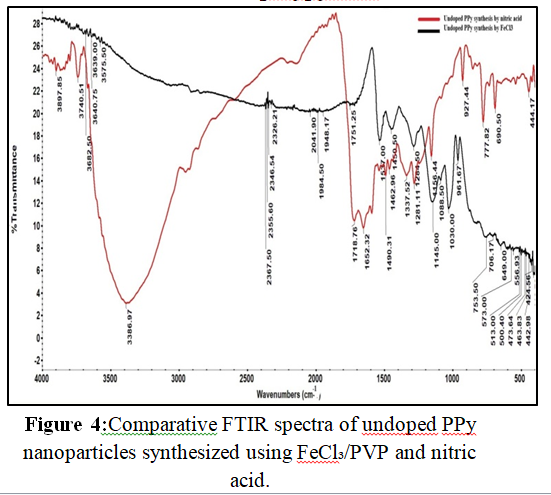
Polypyrrole (PPy) is a synthetic conducting polymer with promising electrical, environmental, and technological properties. In this study, PPy nanoparticles were synthesized by chemical oxidative polymerization using FeCl₃/PVP and HNO₃, while ZnO and Cu₂O nanoparticles were incorporated at 0.5, 0.8, and 1.0 wt%. The structural and morphological properties were investigated using Fourier-transform infrared spectroscopy (FTIR) and field-emission scanning electron microscopy (FESEM). The results showed that both the oxidation method and additive concentration significantly affected the morphology of the PPy nano composites. Lower concentrations promoted a more uniform nanoparticle distribution, whereas higher concentrations resulted in agglomeration and irregular clusters. FTIR confirmed the characteristic chemical structure of PPy and the successful incorporation of ZnO and Cu₂O through the corresponding metal–oxygen vibrational bands. These findings demonstrate that controlling the synthesis route and nanoparticle concentration is an effective strategy for tailoring PPy-based nanocomposites for potential electronic, sensing, optoelectronic, and thermoelectric applications.
References
[1] K. Namsheer and C. S. Rout, “RSC Advances Conducting polymers : a comprehensive review on recent advances in synthesis , properties and,” pp. 5659–5697, 2021, doi: 10.1039/d0ra07800j.
[2] K. Namsheer and C. S. Rout, “Conducting polymers: a comprehensive review on recent advances in synthesis, properties and applications,” RSC Adv., vol. 11, no. 10, pp. 5659–5697, 2021, doi: 10.1039/d0ra07800j. DOI: https://doi.org/10.1039/D0RA07800J
[3] A. L. Pang, A. Arsad, and M. Ahmadipour, “Synthesis and factor affecting on the conductivity of polypyrrole: a short review,” Polym. Adv. Technol., vol. 32, no. 4, pp. 1428–1454, 2021. DOI: https://doi.org/10.1002/pat.5201
[4] J. Mahmood, N. Arsalani, S. Naghash-Hamed, Z. Hanif, and K. E. Geckeler, “Preparation and characterization of hybrid polypyrrole nanoparticles as a conducting polymer with controllable size,” Sci. Rep., vol. 14, no. 1, p. 11653, 2024. DOI: https://doi.org/10.1038/s41598-024-61587-1
[5] J. Wen, Y. Tian, Z. Mei, W. Wu, and Y. Tian, “Synthesis of polypyrrole nanoparticles and their applications in electrically conductive adhesives for improving conductivity,” RSC Adv., vol. 7, no. 84, pp. 53219–53225, 2017. DOI: https://doi.org/10.1039/C7RA09725E
[6] S. Mondal and M. V Sangaranarayanan, “A novel, rapid synthetic protocol for controllable sizes, conductivities and monomer units of soluble polypyrrole,” Eur. Polym. J., vol. 71, pp. 596–611, 2015, doi: https://doi.org/10.1016/j.eurpolymj.2015.08.027. DOI: https://doi.org/10.1016/j.eurpolymj.2015.08.027
[7] A. Batool, F. Kanwal, M. Imran, T. Jamil, and S. A. Siddiqi, “Synthesis of polypyrrole/zinc oxide composites and study of their structural, thermal and electrical properties,” Synth. Met., vol. 161, no. 23–24, pp. 2753–2758, 2012. DOI: https://doi.org/10.1016/j.synthmet.2011.10.016
[8] K. Harpale et al., “Multifunctional characteristics of polypyrrole-zinc oxide (PPy-ZnO) nanocomposite: Field emission investigations and gas sensing application,” Synth. Met., vol. 269, p. 116542, 2020. DOI: https://doi.org/10.1016/j.synthmet.2020.116542
[9] A. El Attar, L. Oularbi, S. Chemchoub, and M. El Rhazi, “Preparation and characterization of copper oxide particles/polypyrrole (Cu2O/PPy) via electrochemical method: application in direct ethanol fuel cell,” Int. J. Hydrogen Energy, vol. 45, no. 15, pp. 8887–8898, 2020. DOI: https://doi.org/10.1016/j.ijhydene.2020.01.008
[10] A. Aziz, H. Shaikh, A. Abbas, K. E. Zehra, and B. Javed, “Microscopic techniques for nanomaterials characterization: a concise review,” Microsc. Res. Tech., vol. 88, no. 5, pp. 1599–1614, 2025. DOI: https://doi.org/10.1002/jemt.24799
[11] P. Wadhwa, S. Sharma, S. Sahu, A. Sharma, and D. Kumar, “A review of nanoparticles characterization techniques,” Curr. Nanomater., vol. 7, no. 3, pp. 202–214, 2022. DOI: https://doi.org/10.2174/2405461507666220405113715
[12] H. Kim, J. Han, and T. Y.-J. Han, “Machine vision-driven automatic recognition of particle size and morphology in SEM images,” Nanoscale, vol. 12, no. 37, pp. 19461–19469, Oct. 2020, doi: 10.1039/d0nr04140h. DOI: https://doi.org/10.1039/D0NR04140H
[13] F. N. Diauudin et al., “Preparation and Characterisation of Polypyrrole‐Iron Oxyhydroxide Nanocomposite as Sensing Material,” Adv. Mater. Sci. Eng., vol. 2020, no. 1, p. 8762969, 2020. DOI: https://doi.org/10.1155/2020/8762969
[14] M. Jurča et al., “Conducting and magnetic hybrid polypyrrole/nickel composites and their application in magnetorheology,” Materials (Basel)., vol. 17, no. 1, p. 151, 2023. DOI: https://doi.org/10.3390/ma17010151
[15] A. Dianatdar, M. Miola, O. De Luca, P. Rudolf, F. Picchioni, and R. K. Bose, “All-dry, one-step synthesis, doping and film formation of conductive polypyrrole,” J. Mater. Chem. C, vol. 10, no. 2, pp. 557–570, 2022. DOI: https://doi.org/10.1039/D1TC05082F
[16] N. Ahmad, S. Sultana, S. M. Faisal, A. Ahmed, S. Sabir, and M. Z. Khan, “Zinc oxide-decorated polypyrrole/chitosan bionanocomposites with enhanced photocatalytic, antibacterial and anticancer performance,” RSC Adv, vol. 9, no. 70, pp. 41135–41150, 2019. DOI: https://doi.org/10.1039/C9RA06493A
[17] V. S. Shanthala, S. N. Shobha Devi, and M. V Murugendrappa, “Synthesis, characterization and DC conductivity studies of polypyrrole/copper zinc iron oxide nanocomposites,” J. Asian Ceram. Soc., vol. 5, no. 3, pp. 227–234, 2017. DOI: https://doi.org/10.1016/j.jascer.2017.02.005
[18] F. Hamidouche, Z. Ghebache, J.-C. Lepretre, and N.-E. Djelali, “Montmorillonite/Poly (Pyrrole) for Low-Cost supercapacitor electrode hybrid materials,” Polymers (Basel)., vol. 16, no. 7, p. 919, 2024. DOI: https://doi.org/10.3390/polym16070919
[19] P. Phukan, R. Chetia, R. Boruah, S. Konwer, and D. Sarma, “Fabrication of polypyrrole/Cu(ii) nanocomposite through liquid/liquid interfacial polymerization: a novel catalyst for synthesis of NH-1,2,3-triazoles in PEG-400††Electronic supplementary information (ESI) available: Analytical data of the synthesized compounds including copies of 1H and 13C NMR spectra are included in the supporting information. See DOI: 10.1039/d1ma00700a,” Mater. Adv., vol. 2, no. 21, pp. 6996–7006, 2021, doi: https://doi.org/10.1039/d1ma00700a. DOI: https://doi.org/10.1039/D1MA00700A
[20] H. Ren et al., “Preparation of a Z-scheme BiVO4/Cu2O/PPy heterojunction and studying its CO2 reducing properties††Electronic supplementary information (ESI) available. See DOI: https://doi.org/10.1039/d4ra08130g,” RSC Adv., vol. 15, no. 17, pp. 13313–13322, 2025, doi: https://doi.org/10.1039/d4ra08130g. DOI: https://doi.org/10.1039/D4RA08130G
[21] G. R. Surikanti, P. Bajaj, and M. V Sunkara, “g-C3N4-mediated synthesis of Cu2O to obtain porous composites with improved visible light photocatalytic degradation of organic dyes,” ACS omega, vol. 4, no. 17, p. 17301, 2019. DOI: https://doi.org/10.1021/acsomega.9b02031
[22] A. El Attar, L. Oularbi, S. Chemchoub, and M. El Rhazi, “Effect of electrochemical activation on the performance and stability of hybrid (PPy/Cu2O nanodendrites) for efficient ethanol oxidation in alkaline medium,” J. Electroanal. Chem., vol. 885, p. 115042, 2021, doi: https://doi.org/10.1016/j.jelechem.2021.115042. DOI: https://doi.org/10.1016/j.jelechem.2021.115042
[23] M. Huang et al., “Synthesis of Cu2O-modified reduced graphene oxide for NO2 sensors,” Sensors, vol. 21, no. 6, p. 1958, 2021. DOI: https://doi.org/10.3390/s21061958
Downloads
Published
Issue
Section
License
Copyright (c) 2026 Al-Noor Journal of Engineering Management and Computer Science

This work is licensed under a Creative Commons Attribution-NonCommercial-ShareAlike 4.0 International License.
How to Cite