Defect engineering in TiO2 thin films: Recent advances in optical and electronic properties and sensing applications
DOI:
https://doi.org/10.71229/7vtx0k86Keywords:
Titanium dioxide, , thin films, , defect engineering,, oxygen gaps,, Ti3+ statesAbstract
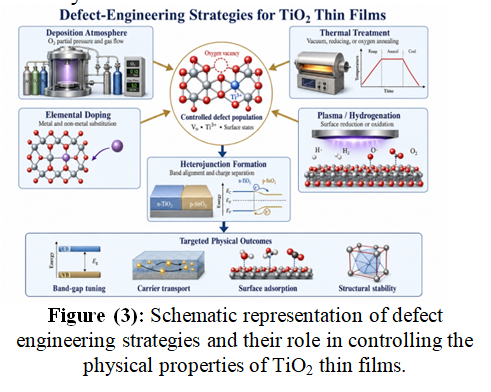
Variable Amount of Nitrogen Doping of TiO2 To create a Variable amount of defects (05 by oxidizing nitrogen, and the resulting N-defect pairs can significantly modulate both its physical and functional properties, especially for gas sensor applications. Here, we critically evaluate progress reported in the literature between 2024 and 2026 which investigate features such as oxygen gaps, Ti3+ states and doping defects and how these phenomena can affect crystal structure, optical attributes and electronic properties. Defects can be modulated through the manipulation of deposition parameters, heat treatment, iron and non-metal doping, plasma or hydrogen treatment and heterojunction fabrication. Low interstitial and substitutional defect concentrations can alter phase stability, affect the stresses at a microscale level, determine crystal sizes, establish midgap states in between the bands gap or broaden its absorption response towards wavelengths ranging from 400 to 950 nm (visible light), as well as shift position of the Fermi level and control the charge carrier density/transport of carriers. Gas Sensors: Oxygen vacancies and defects on the sensor surface are potential active sites where oxygen and gas molecules gets adsorbed, increasing resistivity change when exposed to reducing or oxidizing gases. Increasing control of membrane thickness, surface porosity, photoactivation and interface geometry is also helpful for enhanced sensitivity and a lower operational temperature. On the contrary, an excessive defect density is responsible for borrowing oxygen atoms from the lattice, resulting in secondary phases, deep-level charge trapping centers and instability in general. The aim of the review is to identify defect types, concentrations, locations and charge states with optimal performance but also focuses on developing reproducible and quantitative techniques for accurate characterization of the defects and testing them under real-life conditions including humid environment, interfered gases and long-run operation.
References
[1] Shukla, Shivam, Soham Shirodkar, and Emila Panda. "Anatase to rutile transition in TiO2 thin films: Role of tantalum and oxygen." Journal of Alloys and Compounds 1006 (2024): 176242. DOI: https://doi.org/10.1016/j.jallcom.2024.176242
[2] Manna, Dip, et al. "Deposition pressure assisted vacancy engineering of rf sputtered TiO2− x thin-films in argon plasma leading to smaller optical band gap and room temperature resistive switching properties." Applied Surface Science 703 (2025): 163343. DOI: https://doi.org/10.1016/j.apsusc.2025.163343
[3] Solís-Casados, D. A., et al. "Characterization of Pd-modified TiO2-based thin films and their effect on photocatalytic activity." Journal of Materials Science: Materials in Engineering 20.1 (2025): 62. DOI: https://doi.org/10.1186/s40712-025-00279-8
[4] Dahiya, Sukriti, et al. "Thickness dependent NO2 gas sensing properties of sputtered grown nanostructured TiO2 thin films." Applied Physics A 132.1 (2026): 51. DOI: https://doi.org/10.1007/s00339-025-09207-1
[5] Rzaij, Jamal M., and Omar S. Shawki. "Tailoring TiO2 thin films with Fe2O3 for rapid and sensitive CO2 gas detection." Applied Physics A 132.7 (2026): 588. DOI: https://doi.org/10.1007/s00339-026-09788-5
[6] Li, Zhirui, et al. "UV-activated room temperature oxygen gas sensor based on TiO2-decorated bridging GaN nanowires." Sensors and Actuators B: Chemical 401 (2024): 135015. DOI: https://doi.org/10.1016/j.snb.2023.135015
[7] Deb, Moumita, et al. "Highly Efficient UV-Activated TiO2/SnO2 Surface Nano-Matrix Gas Sensor: Enhancing Stability for Ppb-Level NO x Detection at Room Temperature." ACS Applied Materials & Interfaces 17.9 (2025): 14670-14681. DOI: https://doi.org/10.1021/acsami.4c19998
[8] Al Amin, Syed Muhammad, and Md Arefin Kowser. "Influence of Ag doping on structural, morphological, and optical characteristics of sol-gel spin-coated TiO2 thin films." Heliyon 10.18 (2024). DOI: https://doi.org/10.1016/j.heliyon.2024.e37558
[9] Sassi, Syrine, et al. "Cu-doped TiO2 thin films by spin coating: investigation of structural and optical properties." Inorganics 12.7 (2024): 188. DOI: https://doi.org/10.3390/inorganics12070188
[10] Khedulkar, Akhil Pradiprao, et al. "Synergistic effects of Fe and Ag doping on the structural and optical properties of a TiO 2 thin film: a dual function platform for hydrogen generation and dye degradation." Dalton Transactions 53.46 (2024): 18592-18606. DOI: https://doi.org/10.1039/D4DT01803F
[11] Singh, Manish K., et al. "Optical and microstructural studies of erbium-doped TiO2 thin films on silicon, SrTiO3, and sapphire." Journal of Applied Physics 136.12 (2024). DOI: https://doi.org/10.1063/5.0224010
[12] Al-Jawad, Selma MH, Mohammed Rasheed, and Zahraa Yassar Abbas. "Effect of doping on the structural, optical and electrical properties of TiO2 thin films for gas sensor." Journal of Optics 54.5 (2025): 3342-3363. DOI: https://doi.org/10.1007/s12596-024-01913-y
[13] Sun, Zhigang, et al. "Homojunction TiO2 thin film-based room-temperature working H2 sensors with non-noble metal electrodes." Sensors and Actuators B: Chemical 398 (2024): 134675. DOI: https://doi.org/10.1016/j.snb.2023.134675
[14] Zhao, Jiahui, et al. "The challenges and opportunities for TiO2 nanostructures in gas sensing." ACS sensors 9.4 (2024): 1644-1655. DOI: https://doi.org/10.1021/acssensors.4c00137
[15] Mulus, D’April Sabriantie, et al. "A current review of TiO2 thin films: synthesis and modification effect to the mechanism and photocatalytic activity." Applied Surface Science Advances 27 (2025): 100746. DOI: https://doi.org/10.1016/j.apsadv.2025.100746
[16] Ghosh, Sondip, et al. "Tailoring the structural and optical properties of TiO2 thin films: a study of undoped, N-doped, and Fe-doped variants via sol-gel spin coating." Next Materials 8 (2025): 100757. DOI: https://doi.org/10.1016/j.nxmate.2025.100757
[17] Shirpay, Ali. "Liquid phase deposition of TiO2 thin films: influence of annealing temperature on ultraviolet response." Discover Applied Sciences 7.7 (2025): 683. DOI: https://doi.org/10.1007/s42452-025-07283-9
[18] Feng, Dahui, et al. "Oxygen vacancies and CDs synergistically mediated CD/TiO 2 composite materials: investigation of electronic energy band structure modulation, photocatalytic performances, and mechanisms." Journal of Materials Chemistry C 13.27 (2025): 13787-13802. DOI: https://doi.org/10.1039/D5TC01322D
[19] Petrov, Victor V., et al. "Excellent Room-Temperature NO2 Gas-Sensing Properties of TiO2-SnO2 Composite Thin Films Under Light Activation." Nanomaterials 15.11 (2025): 871. DOI: https://doi.org/10.3390/nano15110871
[20] Murugesan, Muthukumar, and S. R. Meher. "Chemiresistive gas sensors based on TiO2 polymorphs–challenges, opportunities, and future outlook: A comprehensive review." Micro and Nanostructures (2025): 208430. DOI: https://doi.org/10.1016/j.micrna.2025.208430
[21] Issa, Hiba H., and Bushra A. Hasan. "Gas sensing characteristics of (TiO2) 1− x (ZnO: MgO) x thin films doped and undoped with Au NPs for NO2 and H2S detection prepared by spray pyrolysis." Applied Physics A 131.12 (2025): 1026. DOI: https://doi.org/10.1007/s00339-025-09162-x
[22] Ahmad, Aliyu A., et al. "Tuning the Reactivity of Al@ TiO2 Antenna–Reactor Plasmonic Photocatalysts by Controlling Oxygen Vacancies." Nano Letters 25.35 (2025): 13307-13314. DOI: https://doi.org/10.1021/acs.nanolett.5c03450
[23] Pérez, Tania Arelly Tinoco, et al. "Photocatalytic Oxidation of Pesticides with TiO2-CeO2 Thin Films Using Sunlight." Catalysts 15.1 (2025): 46. DOI: https://doi.org/10.3390/catal15010046
[24] Li, Xinli, et al. "Unveiling the Role of Oxygen Vacancies in BiVO4/TiO2 Thin Films for Photocatalytic Cr (VI) Reduction: DFT and Experimental Study." The Journal of Physical Chemistry C 130.22 (2026): 7563-7574. DOI: https://doi.org/10.1021/acs.jpcc.6c01796
[25] Daood, Amel H., et al. "Preparation of gaseous sensor of nano zno: TiO2 thin films to detect CO2 gas." Applied Physics A 132.3 (2026): 218. DOI: https://doi.org/10.1007/s00339-026-09422-4
[26] Alaya, Yassine, et al. "Influence of tetragonal and mixed-phase transitions in TiO2 on fast hydrogen gas sensing." Applied Physics A 132.7 (2026): 667. DOI: https://doi.org/10.1007/s00339-026-09858-8
[27] Faddouli, Ali, et al. "Facile elaboration of TiO2-ZnO-based low-cost H2 gas sensors." Coatings 16.3 (2026): 375. DOI: https://doi.org/10.3390/coatings16030375
[28] Adhikari, Ashok, et al. "Green synthesis of TiO2 nanoparticles and investigating their material properties for CO gas sensing characteristics." Journal of Materials Science (2026): 1-23. DOI: https://doi.org/10.1007/s10853-026-12844-3
[29] Yousaf, Ammar Bin, et al. "The significance of oxygen-deficient metal oxides based on their synthesis and applications perspectives." Emergent Materials 9.6 (2026): 134. DOI: https://doi.org/10.1007/s42247-026-01414-7
[30] Subramanian, Sivaramakrishnan, et al. "Room temperature ammonia gas sensor based on Ti-doped CeO2 thin films prepared by nebulizer spray pyrolysis method: S. Subramanian et al." Applied Physics A 131.6 (2025): 457. DOI: https://doi.org/10.1007/s00339-025-08569-w
Downloads
Published
Issue
Section
License
Copyright (c) 2026 Al-Noor Journal of Engineering Management and Computer Science

This work is licensed under a Creative Commons Attribution-NonCommercial-ShareAlike 4.0 International License.
How to Cite