Performance Enhancement of Downlink NOMA Systems Using LDPC Coding and Advanced SIC Receiver
DOI:
https://doi.org/10.71229/w6hk6c05Keywords:
Bit error rate, Low-Density Parity-Check, Non-orthogonal multiple access , Successive interference cancellation, Spectral efficiencyAbstract
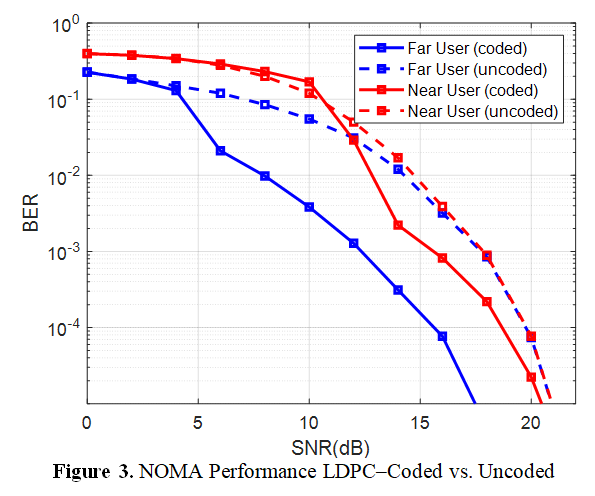
Using power-domain multiplexing and successive interference cancellation (SIC) at the receiver, Non-Orthogonal Multiple Access (NOMA) enables multiple users to share the same time, frequency, and code resources at the same time. However, error propagation in successive interference cancellation (SIC) often degrades the performance of power-domain Non-Orthogonal Multiple Access (NOMA), reducing reliability and throughput. In this paper, a Low-Density Parity-Check (LDPC) - aided SIC receiver was proposed for NOMA systems to improve the decoding reliability and reduce the residual interference. The proposed receiver combines LDPC coding with an improved SIC algorithm that shares soft information between the decoder and the interference cancellation step to improve the accuracy of signal detection. The performance of the proposed scheme is evaluated in terms of bit error rate (BER), outage probability, and spectral efficiency. The simulation results show that the proposed receiver achieves BER gains of up to 8–9 dB for the far user and 7 dB for the near user over the uncoded system. In addition, the outage probability is improved by as much as 10 dB, and the proposed SIC provides a further 2-3 dB performance gain over the conventional LDPC-coded SIC receiver. The proposed method also achieves the highest spectral efficiency of 8.5 bps/Hz at an average SNR of 30 dB, demonstrating superior bandwidth utilization and throughput. The results verify that the proposed LDPC-aided SIC receiver can significantly improve the reliability and spectral efficiency of NOMA-VLC systems and hence is a promising candidate for future high-speed indoor optical wireless communications.
References
[1] M. S. Alam, S. T. Siddiqui, K. A. Qidwai, A. Aftab, M. S. Kamal, and F. I. Shahi, "Evolution of wireless communication networks from 5G to 6G: future perspective," Radioelectronics and Communications Systems, vol. 66, no. 5, pp. 213-222, 2023.
[2] M. Shafi, R. K. Jha, and S. Jain, "6G: Technology evolution in future wireless networks," IEEE Access, vol. 12, pp. 57548-57573, 2024.
[3] J. Kasumu, A. Airoboman, and I. Ogbodick, "Performance Analysis of NOMA in 5 G Networks: MATLAB-Based Simulation of Spectral Efficiency and Fairness," International Journal of Engineering Processing and Safety Research, 2025.
[4] S. R. Islam, N. Avazov, O. A. Dobre, and K.-S. Kwak, "Power-domain non-orthogonal multiple access (NOMA) in 5G systems: Potentials and challenges," IEEE Communications Surveys & Tutorials, vol. 19, no. 2, pp. 721-742, 2016.
[5] L. Dai, B. Wang, Z. Ding, Z. Wang, S. Chen, and L. Hanzo, "A survey of non-orthogonal multiple access for 5G," IEEE Communications Surveys & Tutorials, vol. 20, no. 3, pp. 2294-2323, 2018.
[6] D. Rehmat, "Spectrum Efficiency Improvement in 5G Network using NOMA," International Journal of Advanced Engineering, Management and Science, vol. 11, no. 4, p. 619401, 2025.
[7] R. Dipinkrishnan and V. B. Kumaravelu, "Spectral efficiency enhancement in multiuser NOMA over Nakagami-m fading channels through power allocation and pairing strategies under hardware and SIC imperfections," Scientific Reports, vol. 15, no. 1, p. 38211, 2025.
[8] A. Falloun and A. Ait Madi, "Successive interference cancellation in NOMA for 5G communication system," in 2025 5th International Conference on Innovative Research in Applied Science, Engineering and Technology (IRASET), 2025: IEEE, pp. 1-6.
[9] S. Bisen, V. Bhatia, and P. Brida, "Successive interference cancellation with multiple feedback in NOMA-enabled massive IoT network," EURASIP Journal on Wireless Communications and Networking, vol. 2024, no. 1, p. 71, 2024.
[10] N. Iswarya and L. Jayashree, "A survey on successive interference cancellation schemes in non-orthogonal multiple access for future radio access," Wireless Personal Communications, vol. 120, no. 2, pp. 1057-1078, 2021.
[11] S. Herfiah, "Effect of imperfect SIC in non-orthogonal multiple access (noma) over Rayleigh fading channels," in 2021 7th International Conference on Wireless and Telematics (ICWT), 2021: IEEE, pp. 1-4.
[12] B. Panda and P. Singh, "Performance analysis of NOMA systems in Rayleigh and Rician fading channels," in 2021 Advanced Communication Technologies and Signal Processing (ACTS), 2021: IEEE, pp. 1-6.
[13] A. Kumar, A. Nanthaamornphong, M. H. Alsharif, and M. Masud, "SIC-based RL for massive MIMO NOMA signal detection for different modulation schemes under diverse channel conditions," Scientific Reports, vol. 15, no. 1, p. 24641, 2025.
[14] A. K. Garg, V. Tiwari, T. Kumar, S. Varshney, and A. Kumar, "Analysis of forward error correction schemes for different coding rates in free-space communication," in Sixth International Conference on Optical and Wireless Technologies (OWT 2025), 2026, vol. 14168: SPIE, pp. 416-421.
[15] W. A. Sajid, N. B. Hassan, L. F. Abdulrazak, Y. Khlaponin, A. I. Ahmed, and A. Yashchuk, "Performance comparison of low-density parity-check (LDPC) codes for reliable communication in noisy channels," in 2024 35th Conference of Open Innovations Association (FRUCT), 2024: IEEE, pp. 614-624.
[16] L. Yuan, J. Pan, N. Yang, Z. Ding, and J. Yuan, "Successive interference cancellation for LDPC-coded nonorthogonal multiple access systems," IEEE Transactions on Vehicular Technology, vol. 67, no. 6, pp. 5460-5464, 2018.
[17] S. Chaturvedi, Z. Liu, V. A. Bohara, A. Srivastava, and P. Xiao, "A tutorial on decoding techniques of sparse code multiple access," IEEE Access, vol. 10, pp. 58503-58524, 2022.
[18] R. Campello, G. Carlini, C. E. Souza, C. Pimentel, and D. P. Chaves, "Successive interference cancellation decoding with adaptable decision regions for NOMA schemes," IEEE Access, vol. 10, pp. 2051-2062, 2021.
[19] L. Lusvarghi and M. L. Merani, "Fundamental Limits on the Uplink Performance of the Dynamic-Ordered SIC Receiver," IEEE Access, vol. 10, pp. 73178-73189, 2022.
[20] S. Beddiaf et al., "A unified performance analysis of cooperative NOMA with practical constraints: Hardware impairment, imperfect SIC and CSI," IEEE Access, vol. 10, pp. 132931-132948, 2022.
[21] D. Liu et al., "An LDPC encoder architecture with up to 47.5 Gbps throughput for DVB-S2/S2X standards," IEEE Access, vol. 10, pp. 19022-19032, 2022.
[22] M. Sun et al., "Joint digital analogue DVB-S2 (X) link optimization in non-linear channel," IEEE Access, vol. 10, pp. 40794-40805, 2022.
[23] M. Asif, A. Ihsan, W. U. Khan, A. Ranjha, S. Zhang, and S. X. Wu, "Energy-efficient backscatter-assisted coded cooperative NOMA for B5G wireless communications," IEEE Transactions on Green Communications and Networking, vol. 7, no. 1, pp. 70-83, 2022.
[24] Y. Qi, X. Zhang, and M. Vaezi, "Over-the-air implementation of NOMA: New experiments and future directions," IEEE Access, vol. 9, pp. 135828-135844, 2021.
[25] D. Fernandes, D. N. K. Jayakody, and M. Beko, "Extending Low-Complexity Coded NOMA Systems: Power Optimization and Channel Performance on Rayleigh and Nakagami Fading," IEEE Access, vol. 13, pp. 194115-194126, 2025.
[26] D. Fernandes, D. N. K. Jayakody, and M. Beko, "Extending Low-Complexity Coded NOMA Systems," 2025.
[27] R. Seetharaman, D. Rahul, H. M. Lakshmanan, K. Anandan, and S. Gayathri, "Analysis of power allocation for non-orthogonal multiple access," in Journal of Physics: Conference Series, 2021, vol. 1916, no. 1: IOP Publishing, p. 012059.
[28] S. Chebbi, O. Habachi, J.-P. Cances, V. Meghdadi, and E. Sabir, "Efficient resource allocation in 5G massive MIMO-NOMA networks: Comparative analysis of SINR-aware power allocation and spatial correlation-based clustering," Computer Networks, vol. 263, p. 111216, 2025.
[29] M. Jain, S. Soni, N. Sharma, and D. Rawal, "Performance analysis at far and near user in NOMA based system in presence of SIC error," AEU-International Journal of Electronics and Communications, vol. 114, p. 152993, 2020.
[30] M. AlaaEldin, E. Alsusa, M. Al-Jarrah, K. G. Seddik, and M. Matthaiou, "Generalized BER Performance Analysis for SIC-Based Uplink NOMA," IEEE Open Journal of the Communications Society, vol. 6, pp. 1246-1265, 2025.
[31] C. Ngene, P. Thakur, and G. Singh, "Perfect and imperfect successive interference cancellation for channel decoding in downlink visible light non-orthogonal multiple access network," Optik, vol. 287, p. 171129, 2023.
[32] S.-H. Lin, J.-Y. Wang, and X. Hua, "Analysis of Outage Probability and Average Bit Error Rate of Parallel-UAV-Based Free-Space Optical Communications," Entropy, vol. 27, no. 6, p. 650, 2025.
[33] D. Singh et al., "A generalized approach on outage performance analysis of dual-hop decode and forward relaying for 5G and beyond scenarios," Sustainability, vol. 14, no. 19, p. 12870, 2022.
Downloads
Published
Issue
Section
License
Copyright (c) 2026 Al-Noor Journal of Engineering Management and Computer Science

This work is licensed under a Creative Commons Attribution-NonCommercial-ShareAlike 4.0 International License.
How to Cite