Perceived Contributions of Smart-Campus Dimensions to Architectural Education: A Case Study of the University of Babylon, Iraq
DOI:
https://doi.org/10.71229/q63thn09Keywords:
Smart Campus, Architectural Education, Smart Buildings, Smart Learning Environment, , Digital Transformation,Abstract
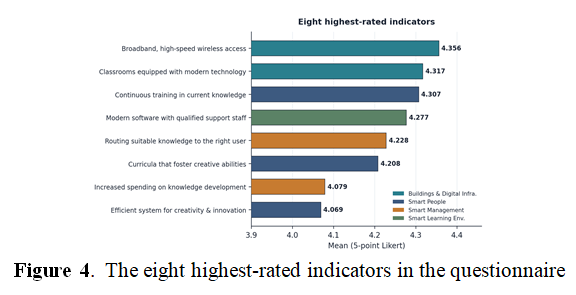
Abstract The smart campus is one of the interconnected socio-technical systems, in which digital infrastructure, responsive buildings, data-informed administration, and technology-enabled learning environments coordinate with each other. It is an emerging trend throughout the world, but the priorities for architectural education in Iraqi Universities have not been clearly defined. In design-studio education, the relevance is even stronger, as the teaching and learning of this type are connected by the concepts of connectivity, digital modelling, visual communication, collaboration, simulation, and the exchange of large files. This study examines the perception of students and faculty members of the contribution of the smart-campus dimensions in the Architecture education in the University of Babylon. A descriptive, cross-sectional case-study design involved 101 respondents (74 students, 27 faculty). An 18-item instrument covered four dimensions: smart people; smart buildings and digital infrastructure; smart management; and the smart learning environment (Cronbach's alpha = 0.87). Smart buildings and digital infrastructure ranked first (mean = 4.224, very high), whereas smart people (4.006), the smart learning environment (3.997), and smart management (3.990) were rated high. Broadband wireless access, equipped classrooms, continuous training, and up-to-date software with qualified staff emerged as immediate priorities. These results represent perceived priorities rather than evidence of a causal effect on achievement. An expanded planning framework of six dimensions and 30 indicators with a five-level maturity scale is introduced to inform future smart-campus development for architectural education in Iraqi universities.
References
[1] Z. Y. Dong, Y. Zhang, C. Yip, S. Swift, K. Beswick. Smart campus: definition, framework, technologies, and services, IET Smart Cities, Vol.2, No.1, 43-54, 2020. https://doi.org/10.1049/iet-smc.2019.0072 DOI: https://doi.org/10.1049/iet-smc.2019.0072
[2] K. Polin, T. Yigitcanlar, M. Limb, T. Washington. The making of smart campus: a review and conceptual framework, Buildings, Vol.13, No.4, 891, 2023. https://doi.org/10.3390/buildings13040891 DOI: https://doi.org/10.3390/buildings13040891
[3] M. Haggag, A. Oulefki, A. Amira, F. Kurugollu, E. S. Mushtaha, B. Soudan, K. Hamad, S. Foufou. Integrating advanced technologies for sustainable smart campus development: a comprehensive survey of recent studies, Advanced Engineering Informatics, Vol.66, 103412, 2025. https://doi.org/10.1016/j.aei.2025.103412 DOI: https://doi.org/10.1016/j.aei.2025.103412
[4] R. Sneesl, Y. Y. Jusoh, M. A. Jabar, S. Abdullah. Revising technology adoption factors for IoT-based smart campuses: a systematic review, Sustainability, Vol.14, No.8, 4840, 2022. https://doi.org/10.3390/su14084840 DOI: https://doi.org/10.3390/su14084840
[5] F. Kharvari, L. E. Kaiser. Impact of extended reality on architectural education and the design process, Automation in Construction, Vol.141, 104393, 2022. https://doi.org/10.1016/j.autcon.2022.104393 DOI: https://doi.org/10.1016/j.autcon.2022.104393
[6] M. Darwish, S. Kamel, A. Assem. Extended reality for enhancing spatial ability in architecture design education, Ain Shams Engineering Journal, Vol.14, No.6, 102104, 2023. https://doi.org/10.1016/j.asej.2022.102104 DOI: https://doi.org/10.1016/j.asej.2022.102104
[7] S. Jin, H. Tu, J. Li, Y. Fang, Z. Qu, F. Xu, K. Liu, Y. Lin. Enhancing architectural education through artificial intelligence: a case study of an AI-assisted architectural programming and design course, Buildings, Vol.14, No.6, 1613, 2024. https://doi.org/10.3390/buildings14061613 DOI: https://doi.org/10.3390/buildings14061613
[8] W. Villegas-Ch, X. Palacios-Pacheco, S. Lujan-Mora. Application of a smart city model to a traditional university campus with a big data architecture: a sustainable smart campus, Sustainability, Vol.11, No.10, 2857, 2019. https://doi.org/10.3390/su11102857 DOI: https://doi.org/10.3390/su11102857
[9] K. Polin, T. Yigitcanlar, M. Limb, T. Washington. Smart campus performance assessment: framework consolidation and validation through a Delphi study, Buildings, Vol.14, No.12, 4057, 2024. https://doi.org/10.3390/buildings14124057 DOI: https://doi.org/10.3390/buildings14124057
[10] K. Polin, T. Yigitcanlar, T. Washington, M. Limb. Unpacking smart campus assessment: developing a framework via narrative literature review, Sustainability, Vol.16, No.6, 2494, 2024. https://doi.org/10.3390/su16062494 DOI: https://doi.org/10.3390/su16062494
[11] N. Samancioglu, S. Nuere. A determination of the smartness level of university campuses: the Smart Availability Scale (SAS), Journal of Engineering and Applied Science, Vol.70, 10, 2023. https://doi.org/10.1186/s44147-023-00179-8 DOI: https://doi.org/10.1186/s44147-023-00179-8
[12] K. Polin, T. Yigitcanlar, M. Limb, T. Washington, F. Golbabaei, A. Paz. Reframing smart campus assessment for the Global South: insights from Papua New Guinea, Sustainability, Vol.17, No.14, 6369, 2025. https://doi.org/10.3390/su17146369 DOI: https://doi.org/10.3390/su17146369
[13] M. Garcia-Monge, B. Zalba, R. Casas, E. Cano, S. Guillen-Lambea, B. Lopez-Mesa, I. Martinez. Is IoT monitoring key to improve building energy efficiency? Case study of a smart campus in Spain, Energy and Buildings, Vol.285, 112882, 2023. https://doi.org/10.1016/j.enbuild.2023.112882 DOI: https://doi.org/10.1016/j.enbuild.2023.112882
[14] D. Das, N. D. Lim, P. Aravind. Developing a smart and sustainable campus in Singapore, Sustainability, Vol.14, No.21, 14472, 2022. https://doi.org/10.3390/su142114472 DOI: https://doi.org/10.3390/su142114472
[15] P. I. Silva-da-Nobrega, A. F. Chim-Miki, M. Castillo-Palacio. A smart campus framework: challenges and opportunities for education based on the Sustainable Development Goals, Sustainability, Vol.14, No.15, 9640, 2022. https://doi.org/10.3390/su14159640 DOI: https://doi.org/10.3390/su14159640
[16] P. A. De Moraes, F. Pisani, J. F. Borin. Smart University: a pathway for advancing Sustainable Development Goals, Internet of Things, Vol.27, 101246, 2024. https://doi.org/10.1016/j.iot.2024.101246 DOI: https://doi.org/10.1016/j.iot.2024.101246
[17] V. Ahmed, S. Saboor, N. Ahmad, M. Ghaly. A multi-attribute utility decision support tool for a smart campus - UAE as a case study, Frontiers in Built Environment, Vol.8, 1044646, 2022. https://doi.org/10.3389/fbuil.2022.1044646 DOI: https://doi.org/10.3389/fbuil.2022.1044646
[18] K. Ozacar, Y. Ortakci, M. Y. Kucukkara. VRArchEducation: redesigning building survey process in architectural education using collaborative virtual reality, Computers & Graphics, Vol.113, 1-9, 2023. https://doi.org/10.1016/j.cag.2023.04.008 DOI: https://doi.org/10.1016/j.cag.2023.04.008
[19] M. Presente de Souza, B. Campos Fialho, R. C. Ferreira, M. M. Fabricio, R. Codinhoto. Modelling and coordination of building design: an experience of BIM learning/upskilling, Architectural Engineering and Design Management, Vol.19, No.1, 74-91, 2023. https://doi.org/10.1080/17452007.2021.1970506 DOI: https://doi.org/10.1080/17452007.2021.1970506
[20] M. M. Saleh, M. Abdelkader, S. S. Hosny. Architectural education challenges and opportunities in a post-pandemic digital age, Ain Shams Engineering Journal, Vol.14, No.8, 102027, 2023. https://doi.org/10.1016/j.asej.2022.102027 DOI: https://doi.org/10.1016/j.asej.2022.102027
[21] C. Gunaydin Donduran, A. Kasali, F. Dogan. Artificial intelligence as a pedagogical tool for architectural design education, Journal of Design Studio, Vol.6, No.2, 219-229, 2024. https://doi.org/10.46474/jds.1533480 DOI: https://doi.org/10.46474/jds.1533480
[22] D. Komatina, M. Miletic, M. Mosurovic Ruzicic. Embracing artificial intelligence (AI) in architectural education: a step towards sustainable practice?, Buildings, Vol.14, No.8, 2578, 2024. https://doi.org/10.3390/buildings14082578 DOI: https://doi.org/10.3390/buildings14082578
[23] J. Wang, Y. Shi, X. Chen, Y. Lan, S. Liu. Teaching with artificial intelligence in architecture: embedding technical skills and ethical reflection in a core design studio, Buildings, Vol.15, No.17, 3069, 2025. https://doi.org/10.3390/buildings15173069 DOI: https://doi.org/10.3390/buildings15173069
[24] M. B. Huh, M. Miri, T. Tracy. Students' perceptions of generative AI image tools in design education: insights from architectural education, Education Sciences, Vol.15, No.9, 1160, 2025. https://doi.org/10.3390/educsci15091160 DOI: https://doi.org/10.3390/educsci15091160
[25] S. Chen, Q. Li, T. Wang. Smart campus and student learning engagement, International Journal of Information and Communication Technology Education, Vol.20, No.1, 1-22, 2024. https://doi.org/10.4018/IJICTE.337611 DOI: https://doi.org/10.4018/IJICTE.337611
Downloads
Published
Issue
Section
License
Copyright (c) 2026 Al-Noor Journal of Engineering Management and Computer Science

This work is licensed under a Creative Commons Attribution-NonCommercial-ShareAlike 4.0 International License.
How to Cite