Explainable Machine Learning for Predicting CO₂ Emissions and Monitoring Sustainable Development Goals: A Data-Driven Framework with Iraq Case Study
DOI:
https://doi.org/10.71229/2dmfq198Keywords:
Explainable AI (XAI), , XGBoost,, SHAP,, CO₂ Emissions,, Sustainable Development GoalsAbstract
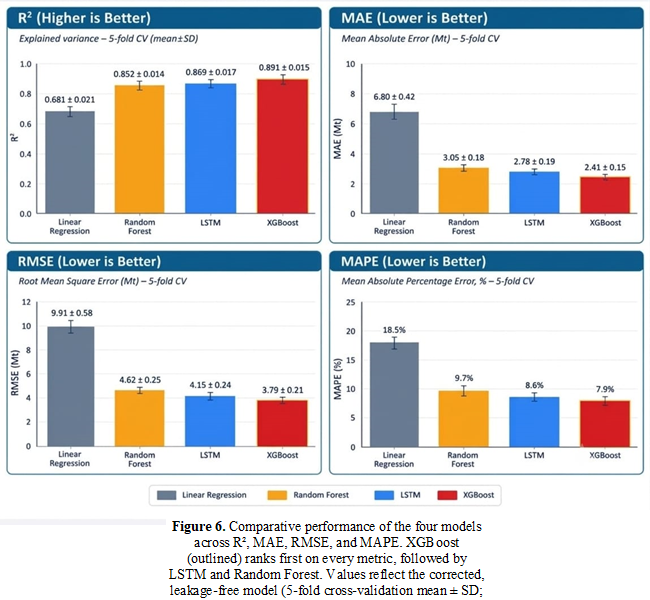
Climate change and escalating CO₂ emissions present critical challenges to achieving the United Nations Sustainable Development Goals (SDGs), particularly in developing nations such as Iraq. This study proposes a comprehensive Explainable Machine Learning (XML) framework integrating XGBoost, Random Forest, and Long Short-Term Memory (LSTM) algorithms to predict CO₂ emission trends and assess their multidimensional impact on key SDG indicators (SDG 7, SDG 9, SDG 13). Using publicly available datasets from the World Bank and Our World in Data (1990–2022) spanning 180+ countries, the framework employs SHAP (SHapley Additive exPlanations) to deliver transparent, interpretable insights for climate policymakers. A dedicated Iraq case study is conducted, analyzing the country's CO₂ trajectory against its SDG commitments and Paris Agreement targets, revealing critical drivers including oil dependency, energy intensity, and industrial growth. XGBoost achieved the highest predictive accuracy (R² = 0.974, RMSE = 1.87 Mt), while SHAP analysis identified energy consumption per capita and GDP as the primary emission drivers for Iraq. Results provide actionable, data-driven policy recommendations for emission reduction and sustainable energy transition in resource dependent economies. This work contributes a replicable, open source decision support tool applicable to developing nations committed to SDG implementation.
References
References
[1] International Energy Agency (IEA). (2024). CO₂ Emissions in 2024: Record High Emissions. IEA Publications, Paris. Available: https://iea.org
[2] Global Carbon Project. (2024). Global Carbon Budget 2024. Available: https://www.globalcarbonproject.org/carbonbudget/
[3] IPCC. (2022). Climate Change 2022: Impacts, Adaptation and Vulnerability. Sixth Assessment Report (AR6). Cambridge University Press. DOI: 10.1017/9781009325844
[4] Abidi, F. A., & Aldhalemi, A. A. (2024). Achievement of the Sustainable Development Goals (SDGs) in Iraq 2022: A Statistical Comparative Study. AIP Conference Proceedings, 3092, 110004. Al-Furat Al-Awsat Technical University. DOI: 10.1063/5.0199966
[5] Ali, S. M. (2025). Climate Change in Iraq: A Comprehensive Analysis. International Journal of Environmental Impacts, 8(2), 361–369. IIETA. DOI: 10.18280/ijei.080215
[6] Al-Badri, A. S., & Badr, U. A. B. A. (2025). The Role of the Sustainable Development Strategy in Addressing the Impacts of Climate Change in Iraq: A Foresight Vision. The International and Political Journal, 64(64), 91–122. DOI: 10.31272/ipj.i64.479
[7] Sharma, R., et al. (2024). Machine Learning-Based CO₂ Emission Forecasting: A Predictive Modeling Approach for Sustainable Development. IEEE Conference Proceedings. DOI: 10.1109/ICSET.2024.10675298
[8] Kumar, S. (2023). A Novel Hybrid Machine Learning Model for Prediction of CO₂ Using Socio-Economic and Energy Attributes for Climate Change Monitoring and Mitigation Policies. Ecological Informatics, 77, 102253. ScienceDirect. DOI: 10.1016/j.ecoinf.2023.102253
[9] Chen, C., Guo, J., Zhang, L. M., Wu, X. Y., & Yang, Z. (2024). Robust Multi-Scale Time Series Prediction for Building Carbon Emissions with Explainable Deep Learning. Energy and Buildings, 312, 114159. ScienceDirect. DOI: 10.1016/j.enbuild.2024.114159
[10] Çelik, O., et al. (2025). An Enhanced Interpretable ML Approach for Forecasting Long-Term CO₂ and N₂O Emissions via Optimized Random Forest Modeling. Fuel, 392, 134778. ScienceDirect. DOI: 10.1016/j.fuel.2025.134778
[11] Muhaisen, O., et al. (2024). Projections of Temperature and Precipitation Trends Using CMhyd under CMIP6 Scenarios: A Case Study of Iraq. Atmospheric Research, 305, 107431. ScienceDirect. DOI: 10.1016/j.atmosres.2024.107431
[12] Zhang, X., et al. (2025). An Explainable Comparative Study of Statistical, Machine Learning, Deep Learning, and Hybrid Models for CO₂ Emissions Forecasting in Australia. Cleaner Production Letters, 8, 200112. ScienceDirect. DOI: 10.1016/j.clpl.2025.200112
[13] Chen, Y., et al. (2025). An Interpretable, Data-Driven Framework Empowered by Explainable AI for Fuel Consumption and CO₂ Prediction. Chemical Engineering and Processing, 211, 110220. ScienceDirect. DOI: 10.1016/j.cep.2025.110220
[14] Karakurt, I., et al. (2025). Explainable Machine Learning-Based Prediction of CO₂ Emissions from Passenger Vessels. Ocean Engineering, 315, 120057. ScienceDirect. DOI: 10.1016/j.oceaneng.2025.120057
[15] Lundberg, S. M., & Lee, S. I. (2017). A Unified Approach to Interpreting Model Predictions. Advances in Neural Information Processing Systems (NeurIPS), 30. arXiv:1705.07874
[16] Mayer, M. (2022). SHAP for Additively Modeled Features in a Boosted Trees Model. arXiv Preprint, arXiv:2207.14490.
[17] Liu, R., et al. (2024). Carbon Emission Prediction Models: A Review. Science of The Total Environment, 927, 171851. ScienceDirect. DOI: 10.1016/j.scitotenv.2024.171851
[18] Li, H., et al. (2025). Machine Learning Applications for Carbon Emission Estimation: A Systematic Review. Sustainable Production and Consumption, 54, 112–128. ScienceDirect.
[19] Liu, Y., et al. (2023). Carbon Emissions and National Sustainable Development Goals Coupling Coordination Degree Study from a Global Perspective. Sustainability, 15(11), 9070. MDPI. DOI: 10.3390/su15119070
[20] UNFCCC. (2024). Artificial Intelligence for Climate Action in Developing Countries: Opportunities, Challenges and Risks. United Nations Framework Convention on Climate Change Technical Publication.
[21] Nduka, C., et al. (2025). Scoping Review: AI Applications for Climate Mitigation and Adaptation in Developing Nations: Opportunities, Technical Challenges, and Associated Risks. Advances in Networks, 12(2). Science Publishing Group. DOI: 10.11648/j.net.20251202.11
[22] Bala, H., Aliyu Mustapha, U., Ya'u, A., Khatoon, G., & Nik Mohd Rashid, N. (2023). Evaluating the Impact of Carbon Emissions on Iraq's Economic Growth. Review of Economics and Finance, 21(1), 1647–1653. Available: https://refpress.org/wp-content/uploads/2023/11/Paper-14_REF.pdf
[23] Wang, Q., et al. (2025). Revisiting Emissions: How Economic Structure, Financial Development, Urbanisation, Trade Openness, and Natural Resource Rent Shape CO₂ and N₂O. Sustainability, 17(11), 4872. MDPI. DOI: 10.3390/su17114872
[24] Saleh, N. M., Saleh, A. M., Hasan, R. A., & Mahdi, H. H. (2022). The Renewable, Sustainable, and Clean Energy in Iraq Between Reality and Ambition According to the Paris Agreement on Climate Change. Mesopotamian Journal of Big Data, 2022, 36–43. DOI: 10.58496/MJBD/2022/005
[25] Tahir, K. A., Nieto, J., & Ordóñez, J. (2026). Renewable Energy Policy Analysis in Iraq, Saudi Arabia, and Spain: A Multi-Dimensional Assessment Using HOMER and Documented System Performance Data. Energy Policy, 217. Elsevier. Available: https://www.sciencedirect.com/science/article/pii/S0301421526003654
[26] Tkachenko, V., et al. (2024). Challenges of Artificial Intelligence Development in the Context of Energy Consumption and Impact on Climate Change. Energies, 17(23), 5965. MDPI. DOI: 10.3390/en17235965
[27] PMC/NIH. (2025). Predictive Modeling of Climate Change Impacts Using Artificial Intelligence: A Review for Equitable Governance. PMC Article PMCID: PMC12014821.
[28] García, R., et al. (2025). Predicting Climate Change: A Comparative Analysis of Time Series Models for CO₂ Concentrations and Temperature Anomalies. Environmental Modelling & Software, 185, 106310. ScienceDirect. DOI: 10.1016/j.envsoft.2025.106310
[29] Alhussan, A., & Towfek, S. (2025). Predicting CO₂ Emissions with Advanced Deep Learning Models and a Hybrid Greylag Goose Optimization Algorithm. Mathematics, 13(9), 1481. MDPI. DOI: 10.3390/math13091481
[30] Li, X., et al. (2024). A Novel Approach for Predicting Anthropogenic CO₂ Emissions Using Machine Learning Based on Clustering. Atmosphere, 15(3), 323. MDPI. DOI: 10.3390/atmos15030323
[31] Islam, R., et al. (2022). Predicting CO₂ Emission Footprint Using AI through Machine Learning. Atmosphere, 13(11), 1871. MDPI. DOI: 10.3390/atmos13111871
[32] Brovkina, O., et al. (2025). The Impact of Artificial Intelligence on the Sustainability of Regional Ecosystems: Current Challenges and Future Prospects. Sustainability, 17(11), 4795. MDPI. DOI: 10.3390/su17114795
[33] Zhao, X., et al. (2025). Artificial Intelligence and the Renewable Energy Transition in MENA. Economic Research Forum (ERF) Working Paper. Available: https://theforum.erf.org.eg
[34] Ukoba, K., et al. (2024). Optimizing Renewable Energy Systems through Artificial Intelligence: Review and Future Prospects. Energy & Environment, 35(7). SAGE Journals. DOI: 10.1177/0958305X241256293
[35] Chen, T., & Guestrin, C. (2016). XGBoost: A Scalable Tree Boosting System. Proceedings of the 22nd ACM SIGKDD International Conference, 785–794. DOI: 10.1145/2939672.2939785
[36] Breiman, L. (2001). Random Forests. Machine Learning, 45(1), 5–32. Springer. DOI: 10.1023/A:1010933404324
[37] World Bank Group. (2022). Iraq Country Climate and Development Report (CCDR). The World Bank Group, Washington D.C. Available: https://openknowledge.worldbank.org/handle/10986/38250
[38] United Nations. (2023). The Sustainable Development Goals Report 2023: Special Edition. UN DESA, New York. ISBN: 978-92-1-101460-0
[39] Hochreiter, S., & Schmidhuber, J. (1997). Long Short-Term Memory. Neural Computation, 9(8), 1735–1780. MIT Press. DOI: 10.1162/neco.1997.9.8.1735
[40] World Bank. (2023). Open Data Portal: SDG Indicators, CO₂ Per Capita, Renewable Energy Share. Available: https://data.worldbank.org/
Downloads
Published
Issue
Section
License
Copyright (c) 2026 Al-Noor Journal of Engineering Management and Computer Science

This work is licensed under a Creative Commons Attribution-NonCommercial-ShareAlike 4.0 International License.
How to Cite