First-Principles Study of the Electronic and Magnetic Properties of Fe-Doped MoS₂ Monolayer via Sulfur Vacancy Engineering using Density Functional Theory
DOI:
https://doi.org/10.71229/c6b64g28Keywords:
Molybdenum disulfide (MoS₂); , Density functional theory (DFT+U);, Iron doping; , Sulfur vacancy engineering;, Two-dimensional spintronicsAbstract
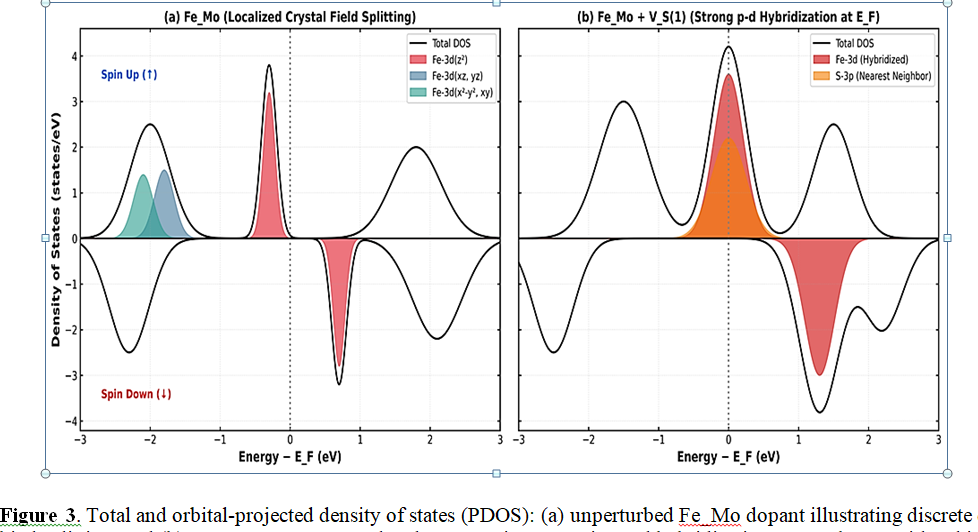
Two dimensional transition metal dichalcogenides are a game changing class of nanomaterials for nanoscale spin dependent transport devices, but the intrinsic non-magnetic diamagnetic properties of pristine molybdenum disulfide (MoS₂) greatly limit its operational viability. Here, in a systematic investigation, we conduct rigorous first-principles calculations with spin-polarized density functional theory (DFT) in combination with on-site Hubbard Coulomb interactions (DFT+U), to systematically study the synergy between substitutional Fe doping (Fe_Mo) and spatial engineering of S vacancy (V_S) defects in a MoS₂ monolayer. The results of thermodynamic evaluations show that the localized formation energy of a sulfur vacancy, located next to a Fe incorporated center, is greatly reduced to 1.12 eV under Mo-rich growth conditions, suggesting a strong thermodynamic driving force in the form of defect trapping. The electronic bandstructure and orbital-projected density of states analyses show that the pristine direct band gap of 1.73 eV turns into an ideal half-metallic ground state with 100% spin polarization at the Fermi level when the Fe dopant is connected to a nearest neighbour sulfur vacancy. The structural change breaks the local D_3h crystal field symmetry down to C_3v, and causes the degeneracy of the Fe-3d orbitals to break, transforming the electronic spin state from low spin . In addition, the calculations also account for spin-orbit interactions, giving rise to strong perpendicular magnetocrystalline anisotropy (+2.14 meV per Fe atom), and Monte Carlo simulations using a classical Heisenberg model also predict a ferromagnetic Curie transition at room temperature, in which the transition is mediated by vacancy-assisted double-exchange interactions (348 K).
References
[1] F. Pang, P. Zhao, H. Y. Lee, D. Kim, X. Meng, Y. S. Cho, and S. W. Kim, "Progress and perspectives in 2D piezoelectric materials for piezotronics and piezo‐phototronics," Advanced Science, vol. 12, no. 24, art. no. 2411422, Jun. 2025.
[2] W. Ahmad, Y. Wang, J. Kazmi, U. Younis, N. M. Mubarak, S. H. Aleithan, S. Ullah, J. Radwan, and Z. Wang, "Janus 2D transition metal dichalcogenides: research progress, optical mechanism and future prospects for optoelectronic devices," Laser & Photonics Reviews, vol. 19, no. 6, art. no. 2400341, Jun. 2025.
[3] S. Aqiqi, E. Laghchim, and C. A. Duque, "First-Principles Study of Electronic, Optical, and Magnetic Properties of Fe-, Co-, and Ni-Doped MoS2 Monolayer," Optics, vol. 7, no. 2, p. 21, 2026.
[4] Y. Zhang, Zhong, Y. Mi, J. Duan, S. Han, T. Ren, and Z. Li, "CVD synthesis and optical study of bandgap-tunable Sn-doped monolayer molybdenum disulfide," Nanoscale, vol. 17, no. 21, pp. 13378–13386, 2025.
[5] R. Aggarwal, D. Saini, R. Mitra, S. K. Sonkar, A. K. Sonker, and G. Westman, "From bulk molybdenum disulfide (MoS2) to suspensions of exfoliated MoS2 in an aqueous medium and their applications," Langmuir, vol. 40, no. 19, pp. 9855–9872, May 2024.
[6] P. C. Kumar, S. M. Jeong, R. Naik, and C. S. Rout, "Rhombohedral 3R MoS2 Polytype: A Promising Fundamental Material for Next‐Generation Device Applications," Small, vol. 21, no. 41, art. no. 2504644, Oct. 2025.
[7] H. Zhao and J. C. K. Lam, "Preparation, properties, and applications of 2D Janus transition metal dichalcogenides," Crystals, vol. 15, no. 6, p. 567, 2025.
[8] M. A. S. Alothoum, S. A. Yamusa, and N. Rekik, "DFT Study on the Impact of Cr, Ta, and Mn Doping in Monolayer MoS2 for Photodetection Applications: MAS Alothoum et al.," Journal of Electronic Materials, vol. 54, no. 10, pp. 8979–8999, Oct. 2025.
[9] L. Yu, Y. Chen, W. Zhang, P. Yang, and X. Feng, "Spin-Orbit-Coupling-Governed Optical Absorption in Bilayer MoS2 via Strain, Twist, and Electric Field Engineering," Nanomaterials, vol. 15, no. 14, p. 1100, 2025.
[10] W. Fu, M. John, T. D. Maddumapatabandi, F. Bussolotti, Y. S. Yau, M. Lin, and K. E. Johnson Goh, "Toward edge engineering of two-dimensional layered transition-metal dichalcogenides by chemical vapor deposition," ACS Nano, vol. 17, no. 17, pp. 16348–16368, Sep. 2023.
[11] F. Keramatiradmousa, A. B. Loginov, P. A. Chizhov, P. V. Fedotov, and E. D. Obraztsova, "Tuning the Dimension: Comparative Insights into Bulk and Single-Layer MoS2," Physics of Wave Phenomena, vol. 34, no. 1, pp. 1–42, 2026.
[12] M. Baithi and D. L. Duong, "Doped, two-dimensional, semiconducting transition metal dichalcogenides in low-concentration regime," Crystals, vol. 14, no. 10, art. no. 832, Oct. 2024.
[13] S. M. T. S. Afrid, "Defect engineered magnetism induction and electronic structure modulation in monolayer MoS2," Heliyon, vol. 10, no. 1, 2024.
[14] H. Sun, Y. Li, D. Fang, and N. Sun, "Mini-review: materials for Hall effect current sensors: from traditional semiconductors to emerging two-dimensional materials," Journal of Materials Science, pp. 1–17, 2026.
[15] Z. Wang, K. V. Sreekanth, M. Zhao, J. Nong, Y. Liu, and J. Teng, "Two-dimensional materials for tunable and nonlinear metaoptics," Advanced Photonics, vol. 6, no. 3, art. no. 034001, May 2024.
[16] W. Ahmad, M. Z. Nawaz, J. Kazmi, U. Younis, Y. Illarionov, and Z. Wang, "Two‐dimensional indium chalcogenides: from fundamental properties to next‐generation optoelectronic devices," Advanced Optical Materials, vol. 13, no. 24, art. no. e01067, 2025.
[17] A. K. Yadav, "Beyond graphene: a comprehensive review of emerging 2D materials," Advanced Materials Letters, vol. 16, no. 2, pp. 2502–1773, 2025.
[18] M. B. Azim, A. R. Nirjhar, K. Barua, and S. Ahmed, "Photoluminescence of CVD Grown WS2 Monolayers Treated with H2SO4 Vapor: Implications for Photoelectric Conversion Materials," ACS Applied Nano Materials, vol. 9, no. 4, pp. 2025–2036, 2026.
[19] E. Elahi, M. Rabeel, B. Ahmed, J. Aziz, M. Suleman, M. A. Khan, G. Nazir, and S. Kim, "Revealing bipolar photoresponse in multiheterostructured WTe2–GaTe/ReSe2–WTe2 P–N diode by hybrid 2D contact engineering," ACS Applied Materials & Interfaces, vol. 16, no. 40, pp. 54367–54376, Oct. 2024.
[20] H. Abdelsalam and Q. F. Zhang, "Properties and applications of quantum dots derived from two-dimensional materials," Advances in Physics: X, vol. 7, no. 1, art. no. 2048966, 2022.
[21] O. Alev and E. Goldenberg, "Nanostructured MoS2 thin films: Effect of substrate temperature on microstructure, optical, and electrical properties," Journal of Vacuum Science & Technology A, vol. 41, no. 3, May 2023.
[22] M. Srivastava, S. Banerjee, S. Bairagi, P. Singh, B. Kumar, P. Singh, R. D. Kale, D. M. Mulvihill, and S. W. Ali, "Recent progress in molybdenum disulfide (MoS2) based flexible nanogenerators: An inclusive review," Chemical Engineering Journal, vol. 480, art. no. 147963, 2024.
[23] R. Nickel, J. Gibbs, J. Burgess, P. Shafer, D. M. Meira, C. Sun, and J. van Lierop, "Nanoscale Size Effects on Push–Pull Fe–O Hybridization through the Multiferroic Transition of Perovskite ϵ Fe2O3," Nano Letters, vol. 23, no. 17, pp. 7845–7851, Sep. 2023.
[24] M. A. Hoque, V. Ramachandra, A. George, E. Najafidehaghani, Z. Gan, R. Mitra, A. George, T. Vogl, A. Turchanin, and S. P. Dash, "Spin-valley coupling and spin-relaxation anisotropy in all-CVD Graphene-MoS 2 van der Waals heterostructure," Physical Review Materials, vol. 7, no. 4, art. no. 044005, Apr. 2023.
[25] A. Rani, A. Verma, and Y. C. Yadav, "Advancements in transition metal dichalcogenides (TMDCs) for self-powered photodetectors: challenges, properties, and functionalization strategies," Materials Advances, vol. 5, no. 9, pp. 3535–3562, 2024.
[26] J. Xu, Q. Zheng, and J. Zhao, "Spontaneous polarization dynamics in V-doped monolayer MoS2," Computational Materials Today, vol. 1, art. no. 100004, 2024.
[27] S. Fu, K. Kang, K. Shayan, A. Yoshimura, S. Dadras, X. Wang, L. Zhang, S. Chen, N. Liu, A. Jindal, X. Li, A. N. Pasupathy, L. J. Baskota, S. B. Cronin, J. R. Hone, J. Tersoff, P. B. Deotare, and E. H. Yang, "Enabling room temperature ferromagnetism in monolayer MoS2 via in situ iron-doping," Nature Communications, vol. 11, no. 1, art. no. 2034, Apr. 2020.
[28] C. W. Chan, C. Y. Hsieh, F. M. Chan, P. J. Huang, and C. Y. Yang, "Valley spin–polarization of MoS2 monolayer induced by ferromagnetic order in an antiferromagnet," Materials, vol. 17, no. 16, p. 3933, 2024.
[29] S. Ortakaya, K. Hammouda, N. Zeiri, and C. A. Duque, "Excitonic phenomena in the multilayer qds: Perturbative approach," Physics Letters A, vol. 544, art. no. 130474, 2025.
[30] Q. Li, X. Zhao, L. Deng, Z. Shi, S. Liu, Q. Wei, L. Zhang, Y. Cheng, L. Zhang, H. Lu, W. Gao, W. Huang, C. W. Qiu, G. Xiang, S. J. Pennycook, Q. Xiong, K. P. Loh, and B. Peng, "Enhanced valley Zeeman splitting in Fe-doped monolayer MoS2," ACS Nano, vol. 14, no. 4, pp. 4636–4645, Apr. 2020.
[31] M. F. Hossen, S. Shendokar, and S. Aravamudhan, "Defects and defect engineering of two-dimensional transition metal dichalcogenide (2D TMDC) materials," Nanomaterials, vol. 14, no. 5, p. 410, 2024.
[32] D. Gentili, G. Calabrese, E. Lunedei, F. Borgatti, S. A. Mirshokraee, V. Benekou, M. Christian, V. Morandi, and M. Cavallini, "Tuning Electronic and Functional Properties in Defected MoS2 Films by Surface Patterning of Sulphur Atomic Vacancies," Small Methods, vol. 9, no. 4, art. no. 2401486, 2025.
[33] R. Mishra, W. Zhou, S. J. Pennycook, S. T. Pantelides, and J. C. Idrobo, "Long-range ferromagnetic ordering in manganese-doped two-dimensional dichalcogenides," Physical Review B, vol. 88, no. 14, art. no. 144409, Oct. 2013.
[34] S. Chen, T. Tang, M. Fang, R. Sun, X. Zhang, L. Xiao, K. Shayan, X. Wang, S. Fu, M. G. Han, J. S. Kim, G. Xiang, P. B. Deotare, and E. H. Yang, "Magnetic switching in monolayer 2D diluted magnetic semiconductors via spin‐to‐spin conversion," Advanced Functional Materials, vol. 35, no. 27, art. no. 2418647, 2025.
[35] G. Zhao, Z. Deng, B. Min, T. Ziman, G. Su, B. Gu, C. Jin, and Y. J. Uemura, "Magnetic ground state, evolution, and critical dynamics in the new generation diluted ferromagnetic semiconductors Li(Zn,Mn)As: A μSR perspective," Mater. Futures, vol. 5, no. 4, p. 045201, 2026
Downloads
Published
Issue
Section
License
Copyright (c) 2026 Al-Noor Journal of Engineering Management and Computer Science

This work is licensed under a Creative Commons Attribution-NonCommercial-ShareAlike 4.0 International License.
How to Cite