Computational Modeling and Performance Evaluation of Optical Imaging Systems with Different Aperture Geometries under Atmospheric Turbulence Filtering
DOI:
https://doi.org/10.71229/s0k6ca90Keywords:
imaging systems,, optical system, , point spread function, , atmospheric turbulence filter, , pupil functionAbstract
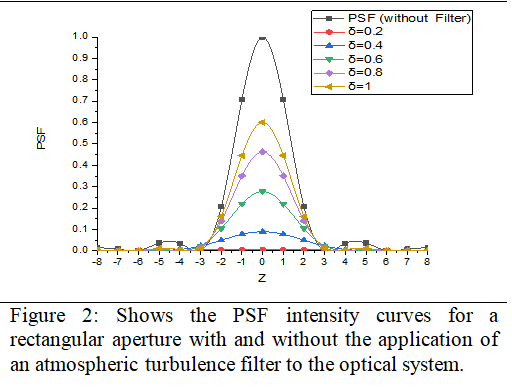
Analyzing the functionality of optical systems following their production holds considerable scientific and practical relevance. It provides a wide range of possibilities for research and the advancement of novel methodologies to furnish thorough data regarding the optical system; the point spread function (PSF) is a vital component for measuring the effectiveness of such systems. Core pictorial information is usually interwoven throughout an image's arrangement characteristics and ambient context. These factors demand tailored processing strategies to maintain appropriate image resolution. This study presents a formulation aimed at substantially increasing image sharpness and clarity by employing the PSF equation for optical systems having circular, rectangular, square, and triangular apertures. Utilizing Mathcad software, we executed an atmospheric turbulence filter characterized by parameters δ=0.2, 0.4, 0.6, 0.8 and 1 on all optical systems as a way of enhancing images. Situated at the system's entrance, this filter replicates or reduces the influence of atmospheric turbulence on light and the resulting image, particularly in extended-range systems. The filter's function is not explicitly for enhancing images; rather, it replicates the influence of air turbulence on the system, enabling the assessment of the system's (or filters') proficiency in sustaining resolution under diverse turbulence scenarios.
The study focuses on a diffraction-limited (ideal) optical system. Four types of apertures were compared both with and without a filter, and full width at half its widest point (FWHM). Was measure the results were analyzed using origin software, presented graphically, and discussed in detail.
References
[1] B. H. A. AlrueshdyM, "Deriving And Calculation Of Point Spread Function For Array Of Obscured Circular Synthetic Apertures," Journal of University of Babylon, vol. 21, no. 5, pp. 1819-1827, 2013.
[2] J. P. Desai, "Multiple Incoherent Deconvolutions for Improving the Image Resolution of Diffraction‐Limited Imaging Systems," Advanced Photonics Research, vol. 6, no. 5, p. 2400141, 2025. DOI: https://doi.org/10.1002/adpr.202400141
[3] J. Lindberg, "Mathematical concepts of optical superresolution," Journal of Optics, vol. 14, no. 8, p. 83001, 2012. DOI: https://doi.org/10.1088/2040-8978/14/8/083001
[4] Y.-T. Cheng, "Bright-field microscopic image resolution enhancement using a novel PSF calibration target and PSF-based Multi-channel Deconvolution U-Net for improving the optical diffraction limit," Measurement, p. 120039, 2025. DOI: https://doi.org/10.1016/j.measurement.2025.120039
[5] F. S. Zainulabdeen, "Intensity Analysis for Optical System Apodized with Hanning Amplitude Filter," International Journal of Mechanical Engineering, vol. 7, no. 1, pp. 1990-1996, 2022.
[6] A. Narsaiah, "Point Spread Functions Of Aberrated Optical Systems With Annular Apertures".
[7] J. E. Sheedy, "The optics of occupational progressive lenses," Optometry-Journal of the American Optometric Association, vol. 76, no. 1, pp. 432-441, 2005. DOI: https://doi.org/10.1016/j.optm.2005.06.012
[8] A. I. MOHAMMED, "TRANSLATING ENGLISH JOURNALISTIC HYPERBOLE INTO ARABIC: CHALLENGES AND STRATEGIES," TPM–Testing, Psychometrics, Methodology in Applied Psychology, vol. 32, no. S8 (2025): Posted 05 November, pp. 2148-2154, 2025.
[9] M. S. Tawfek, "Low contrast image enhancement by implementation optical filter techniques," Journal of Information and Optimization Sciences, vol. 47, no. 7, pp. 2511-2520, 2026. DOI: https://doi.org/10.47974/JIOS-1937
[10] N. Qasim, "Calculation of ensquared energy of the diffraction-limited optical system with Higher-order parabolic filter," Journal of Physics: Conference Series, vol. 1963, no. 1, p. 12078, 2021. DOI: https://doi.org/10.1088/1742-6596/1963/1/012078
[11] I. Gligonov, "Universal approach to wave-optical calculations of point spread functions in microscopy (and beyond)," Methods in Microscopy, no. 0, 2026. DOI: https://doi.org/10.64898/2026.04.28.721333
[12] A. N. Kumar Reddy, "Half-width at half-maximum, full-width at half-maximum analysis for resolution of asymmetrically apodized optical systems with slit apertures," Pramana, vol. 84, pp. 117-126, 2015. DOI: https://doi.org/10.1007/s12043-014-0828-0
[13] C. E. Mungan, "Optical Images Due To Lenses And Mirrors," Journal of the Washington Academy of Sciences, pp. 1-8, 2008.
[14] N. Q. Jouad, "Image Resolution Enhancement for Parabolic Apodized Optical System," International Journal of Mechanical Engineering, vol. 7, no. 1, pp. 1970-1977, 2022.
[15] J. Campos, "Pupil filters in optical systems. Implementation in liquid crystal spatial light modulators," Asian Journal of Physics, vol. 23, no. 3, pp. 363-402, 20214.
[16] K. V. Kumar, "Point spread functions of defocused optical systems with hanning amplitude filters," Int. J. Innov. Res. Sci. Eng. Technol, vol. 2, pp. 4293-4297, 2013.
[17] F. Song, "Analytical model of point spread function under defocused degradation in diffraction-limited systems: confluent hypergeometric function," Photonics, vol. 11, no. 5, p. 455, 2024. DOI: https://doi.org/10.3390/photonics11050455
[18] I. Chyzh, "Calculation of RMS Radiuses of the Point Spread Function Using Zernike Fringe Coefficients," Advanced System Development Technologies II, pp. 41-65, 2025. DOI: https://doi.org/10.1007/978-3-031-82035-9_2
[19] A. N. K. Reddy, "A few PSF-based corollaries of optical systems apodized asymmetrically with two-dimensional complex pupil filters," Armanian Journal of Physics, vol. 4, no. 4, pp. 200-205, 2011.
[20] P. Hill, "Deep learning techniques for atmospheric turbulence removal: a review," Artificial Intelligence Review, vol. 58, no. 4, p. 101, 2025. DOI: https://doi.org/10.1007/s10462-024-11086-6
[21] Z. Wang, "Point spread function decoupling in computational fluorescence microscopy," Light: Science & Applications, vol. 15, no. 1, p. 26, 2026. DOI: https://doi.org/10.1038/s41377-025-02112-5
[22] M. Zabic, "Point spread function estimation with computed wavefronts for deconvolution of hyperspectral imaging data," Scientific Reports, vol. 15, no. 1, p. 673, 2025. DOI: https://doi.org/10.1038/s41598-024-84790-6
[23] P. Thirupathi, "Strehl Ratio with Higher-Order Parabolic Filter''," International OPEN ACCESS Journal Of Modern Engineering Research (IJMER) ISSN, pp. 2249-6645, 2014.
[24] M. Venkanna, "PSF with Partial and Variable Apodization along with CPF," International Journal of Engineering Technology, Management and Applied Sciences, vol. 5, no. 6, 2017.
[25] W. H. Tarkhan, "The Effect of Astigmatism Aberration on Point Spread Function for Optical System Using Different Apertures," AL-Qadisiyah Journal of Pure Science, vol. 23, no. 3, pp. 100-110, 2018. DOI: https://doi.org/10.29350/jops.2018.23.3.895
[26] F. R. Kalaf, "Improving the efficiency of thermal cameras using an optical filter," AIP Conference Proceedings, vol. 3211, no. 1, p. 60018, 2025. DOI: https://doi.org/10.1063/5.0257279
[27] Neil, "A wavefront generator for complex pupil function synthesis and point spread function engineering," Journal of Microscopy, vol. 197, no. 3, pp. 219-223, 2000. DOI: https://doi.org/10.1046/j.1365-2818.2000.00680.x
[28] J. Luo, "Correcting optical aberration via depth-aware point spread functions," IEEE transactions on pattern analysis and machine intelligence, 2024. DOI: https://doi.org/10.1109/TPAMI.2024.3370794
[29] M. K. Devi, "Point Spread Function of Symmetrical Optical System Apodised with Gaussian Filte," International Journal of Pure and Applied Physics. ISSN, pp. 973-1776, 2018.
Downloads
Published
Issue
Section
License
Copyright (c) 2026 Al-Noor Journal of Engineering Management and Computer Science

This work is licensed under a Creative Commons Attribution-NonCommercial-ShareAlike 4.0 International License.
How to Cite