Hybrid Tunicate Swarm - Manta Ray Foraging Optimized Ensemble Learning for Photovoltaic Power Generation Forecasting
DOI:
https://doi.org/10.71229/sm3azd71Keywords:
Deep Learning Ensemble, Metaheuristic Optimization , Manta Ray Foraging Optimized PV Power Forecasting, Renewable Energy, Tunicate Swarm AlgorithmAbstract
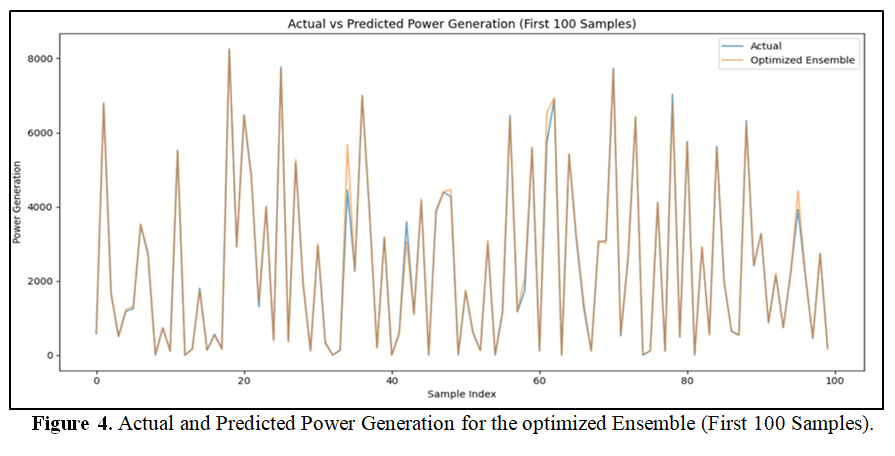
Predicting the amount of photovoltaic (PV) power generated accurately has been regarded as essential for maintaining grid stability and integrating renewables into electrical systems. To overcome such challenges, this article introduces a novel hybrid ensemble of Bidirectional gated recurrent unit (BiGRU), Bidirectional long short-term memory (BiLSTM), and Deep Neural Network (DNN) based on a Tunicate Swarm Algorithm (TSA) and Manta Ray Foraging Optimization (MRFO) hybrid algorithm. The proposed architecture addresses shortcomings inherent within standalone deep learning (DL) models that result from their inability to adequately weight each individual component's contribution towards overall accuracy, instead relying upon more dynamic techniques involving metaheuristically optimized weightings applied across various sources contributing toward final forecasts. In experiments performed against real world datasets representing actual conditions encountered within operational environments. The proposed approach achieves an impressive Mean Squared Error (MSE) of just 39729.9242, Root Mean Square Error )RMSE( of only199.3237 and a fantastic coefficient of determination (R²) value of 0.9939 which indicates extremely good performance levels relative even some top tiered alternatives currently available today. Such results indicate significant potential for applying similar strategies, paving the way for promising prospects regarding future developments in sustainable energy solutions.
References
1] Huang, L., Jaharadak, A. A. B., Ahmad, N. I., & Wang, J. (2025). A hybrid decomposition and deep learning model for photovoltaic power forecasting under variable meteorological conditions. International Journal of Data Warehousing and Mining, 21(1), 1–22. https://doi.org/10.4018/ijdwm.388673 DOI: https://doi.org/10.4018/IJDWM.388673
[2] Hassan, Q., Viktor, P., Al-Musawi, T. J., Mahmood Ali, B., Algburi, S., & Alzoubi, H. M. (2024). The renewable energy role in the global energy transformations. Renewable Energy Focus, 48, Article 100545. https://doi.org/10.1016/j.ref.2024.100545 DOI: https://doi.org/10.1016/j.ref.2024.100545
[3] Apeh, O. O., Meyer, E. L., & Overen, O. K. (2022). Contributions of solar photovoltaic systems to environmental and socioeconomic aspects of national development—A review. Energies, 15(16), Article 5963. https://doi.org/10.3390/en15165963 DOI: https://doi.org/10.3390/en15165963
[4] Usman, Z., Tah, J., Abanda, H., & Nche, C. (2020). A critical appraisal of PV-systems’ performance. Buildings, 10(11), Article 192. https://doi.org/10.3390/buildings10110192 DOI: https://doi.org/10.3390/buildings10110192
[5] Zhang, Y., Qin, C., Srivastava, A. K., Jin, C., & Sharma, R. K. (2020). Data-driven day-ahead PV estimation using autoencoder-LSTM and persistence model. IEEE Transactions on Industry Applications, 56(6), 7185–7192. https://doi.org/10.1109/tia.2020.3025742 DOI: https://doi.org/10.1109/TIA.2020.3025742
[6] Shin, J., & Kim, J. (2020). On-line diagnosis and fault state classification method of photovoltaic plant. Energies, 13(17), Article 4584. https://doi.org/10.3390/en13174584 DOI: https://doi.org/10.3390/en13174584
[7] Zgraggen, J., Guo, Y., Notaristefano, A., & Goren Huber, L. (2022). Physics informed deep learning for tracker fault detection in photovoltaic power plants. Annual Conference of the PHM Society, 14(1). https://doi.org/10.36001/phmconf.2022.v14i1.3235 DOI: https://doi.org/10.36001/phmconf.2022.v14i1.3235
[8] Kurukuru, V. S. B., Blaabjerg, F., Khan, M. A., & Haque, A. (2020). A novel fault classification approach for photovoltaic systems. Energies, 13(2), Article 308. https://doi.org/10.3390/en13020308 DOI: https://doi.org/10.3390/en13020308
[9] Boubaker, S., Kamel, S., Ghazouani, N., & Mellit, A. (2023). Assessment of machine and deep learning approaches for fault diagnosis in photovoltaic systems using infrared thermography. Remote Sensing, 15(6), Article 1686. https://doi.org/10.3390/rs15061686 DOI: https://doi.org/10.3390/rs15061686
[10] Rodrigues, S., Mütter, G., Ramos, H. G., & Morgado-Dias, F. (2020). Machine learning photovoltaic string analyzer. Entropy, 22(2), Article 205. https://doi.org/10.3390/e22020205 DOI: https://doi.org/10.3390/e22020205
[11] Radhi, S. M., Al-Majidi, S. D., Abbod, M. F., & Al-Raweshidy, H. S. (2024). Machine learning approaches for short-term photovoltaic power forecasting. Energies, 17(17), Article 4301. https://doi.org/10.3390/en17174301 DOI: https://doi.org/10.3390/en17174301
[12] Aldosari, O., Batiyah, S., Elbashir, M., Alhosaini, W., & Nallaiyagounder, K. (2024). Performance evaluation of multiple machine learning models in predicting power generation for a grid-connected 300 MW solar farm. Energies, 17(2), Article 525. https://doi.org/10.3390/en17020525 DOI: https://doi.org/10.3390/en17020525
[13] Wang, F., Xuan, Z., Zhen, Z., Li, K., Wang, T., & Shi, M. (2020). A day-ahead PV power forecasting method based on LSTM-RNN model and time correlation modification under partial daily pattern prediction framework. Energy Conversion and Management, 212, Article 112766. https://doi.org/10.1016/j.enconman.2020.112766 DOI: https://doi.org/10.1016/j.enconman.2020.112766
[14] Jung, Y., Jung, J., Kim, B., & Han, S. (2020). Long short-term memory recurrent neural network for modeling temporal patterns in long-term power forecasting for solar PV facilities: Case study of South Korea. Journal of Cleaner Production, 250, Article 119476. https://doi.org/10.1016/j.jclepro.2019.119476 DOI: https://doi.org/10.1016/j.jclepro.2019.119476
[15] Qu, J., Qian, Z., & Pei, Y. (2021). Day-ahead hourly photovoltaic power forecasting using attention-based CNN-LSTM neural network embedded with multiple relevant and target variables prediction pattern. Energy, 232, Article 120996. https://doi.org/10.1016/j.energy.2021.120996 DOI: https://doi.org/10.1016/j.energy.2021.120996
[16] Song, N., Chang-Silva, R., Lee, K., & Park, S. (2025). Dynamic model selection in a hybrid ensemble framework for robust photovoltaic power forecasting. Sensors, 25(14), Article 4489. https://doi.org/10.3390/s25144489 DOI: https://doi.org/10.3390/s25144489
[17] Darvishi, M., & Abhari, A. (2024). Advanced solar power forecasting: A hybrid/ensemble approach utilizing geographic and meteorological data. In 2024 Winter Simulation Conference (WSC) (pp. 714–725). IEEE. https://doi.org/10.1109/wsc63780.2024.10838865 DOI: https://doi.org/10.1109/WSC63780.2024.10838865
[18] Sabri, M., & El Hassouni, M. (2022). A novel deep learning approach for short term photovoltaic power forecasting based on GRU-CNN model. E3S Web of Conferences, 336, Article 00064. https://doi.org/10.1051/e3sconf/202233600064 DOI: https://doi.org/10.1051/e3sconf/202233600064
[19] Mohammadi Lanbaran, N., Naujokaitis, D., Kairaitis, G., & Radziukynas, V. (2025). Hybrid hourly solar energy forecasting using BiLSTM networks with attention mechanism, general type-2 fuzzy logic approach: A comparative study of seasonal variability in Lithuania. Applied Sciences, 15(17), Article 9672. https://doi.org/10.3390/app15179672 DOI: https://doi.org/10.3390/app15179672
[20] Zheng, S., Li, D., Li, Y., Zeng, Z., Zhou, Y., Li, C., & Wang, Y. (2025). An adaptive weighted stacking ensemble framework for photovoltaic power generation forecasting with joint optimization of features and hyperparameters. Engineering Applications of Artificial Intelligence, 144, Article 110075. https://doi.org/10.1016/j.engappai.2025.110075 DOI: https://doi.org/10.1016/j.engappai.2025.110075
[21] Alcañiz, A., Grzebyk, D., Ziar, H., & Isabella, O. (2023). Trends and gaps in photovoltaic power forecasting with machine learning. Energy Reports, 9, 447–471. https://doi.org/10.1016/j.egyr.2022.11.208 DOI: https://doi.org/10.1016/j.egyr.2022.11.208
[22] Khouili, O., Hanine, M., Louzazni, M., Flores, M. A. L., Villena, E. G., & Ashraf, I. (2025). Evaluating the impact of deep learning approaches on solar and photovoltaic power forecasting: A systematic review. Energy Strategy Reviews, 59, Article 101735. https://doi.org/10.1016/j.esr.2025.101735 DOI: https://doi.org/10.1016/j.esr.2025.101735
[23] Kumar Dhaked, D., Narayanan, V. L., Gopal, R., Sharma, O., Bhattarai, S., & Dwivedy, S. K. (2025). Exploring deep learning methods for solar photovoltaic power output forecasting: A review. Renewable Energy Focus, 53, Article 100682. https://doi.org/10.1016/j.ref.2025.100682 DOI: https://doi.org/10.1016/j.ref.2025.100682
[24] Sulaiman, M. H., & Mustaffa, Z. (2024). Forecasting solar power generation using evolutionary mating algorithm-deep neural networks. Energy and AI, 16, Article 100371. https://doi.org/10.1016/j.egyai.2024.100371 DOI: https://doi.org/10.1016/j.egyai.2024.100371
[25] Chen, Z., Bai, Y., Ding, L., Qin, H., & Bi, Q. (2025). Intra-hour photovoltaic power point-interval prediction using a dual-view deep neural network. Expert Systems with Applications, 260, Article 125368. https://doi.org/10.1016/j.eswa.2024.125368 DOI: https://doi.org/10.1016/j.eswa.2024.125368
[26] Udenze, P. I., Gong, J., Soltani, S., & Li, D. (2025). A deep neural network with two-step decomposition technique for predicting ultra-short-term solar power and electrical load. Applied Energy, 382, Article 125212. https://doi.org/10.1016/j.apenergy.2024.125212 DOI: https://doi.org/10.1016/j.apenergy.2024.125212
[27] Dai, Y., Yu, W., & Leng, M. (2024). A hybrid ensemble optimized BiGRU method for short-term photovoltaic generation forecasting. Energy, 299, Article 131458. https://doi.org/10.1016/j.energy.2024.131458 DOI: https://doi.org/10.1016/j.energy.2024.131458
[28] Wang, Q., & Li, L. (2025). Research on photovoltaic power prediction method based on dynamic similar selection and bidirectional gated recurrent unit. Advanced Theory and Simulations, 8(6). https://doi.org/10.1002/adts.202401423 DOI: https://doi.org/10.1002/adts.202401423
[29] Liu, Q., Li, Y., Jiang, H., Chen, Y., & Zhang, J. (2024). Short-term photovoltaic power forecasting based on multiple mode decomposition and parallel bidirectional long short term combined with convolutional neural networks. Energy, 286, Article 129580. https://doi.org/10.1016/j.energy.2023.129580 DOI: https://doi.org/10.1016/j.energy.2023.129580
[30] Herrera-Casanova, R., Conde, A., & Santos-Pérez, C. (2024). Hour-ahead photovoltaic power prediction combining BiLSTM and Bayesian optimization algorithm, with bootstrap resampling for interval predictions. Sensors, 24(3), Article 882. https://doi.org/10.3390/s24030882 DOI: https://doi.org/10.3390/s24030882
[31] Zhao, W., Zhang, Z., & Wang, L. (2020). Manta ray foraging optimization: An effective bio-inspired optimizer for engineering applications. Engineering Applications of Artificial Intelligence, 87, Article 103300. https://doi.org/10.1016/j.engappai.2019.103300 DOI: https://doi.org/10.1016/j.engappai.2019.103300
[32] Li, S., Kong, X., Yue, L., Liu, C., Khan, M. A., & Yang, Z. (2023). Short-term electrical load forecasting using hybrid model of manta ray foraging optimization and support vector regression. Journal of Cleaner Production, 388, Article 135856. https://doi.org/10.1016/j.jclepro.2023.135856 DOI: https://doi.org/10.1016/j.jclepro.2023.135856
[33] Kaur, S., Awasthi, L. K., Sangal, A. L., & Dhiman, G. (2020). Tunicate Swarm Algorithm: A new bio-inspired based metaheuristic paradigm for global optimization. Engineering Applications of Artificial Intelligence, 90, Article 103541. https://doi.org/10.1016/j.engappai.2020.103541 DOI: https://doi.org/10.1016/j.engappai.2020.103541
[34] Wang, J., Wang, S., & Li, Z. (2021). Wind speed deterministic forecasting and probabilistic interval forecasting approach based on deep learning, modified tunicate swarm algorithm, and quantile regression. Renewable Energy, 179, 1246–1261. https://doi.org/10.1016/j.renene.2021.07.113 DOI: https://doi.org/10.1016/j.renene.2021.07.113
[35] Abdelsattar, M., AbdelMoety, A., & Emad-Eldeen, A. (2025). Advanced machine learning techniques for predicting power generation and fault detection in solar photovoltaic systems. Neural Computing and Applications, 37(15), 8825–8844. https://doi.org/10.1007/s00521-025-11035-6 DOI: https://doi.org/10.1007/s00521-025-11035-6
[36] Pedram, O., Soares, A., & Moura, P. (2025). A review of methodologies for photovoltaic energy generation forecasting in the building sector. Energies, 18(18), Article 5007. https://doi.org/10.3390/en18185007 DOI: https://doi.org/10.3390/en18185007
[37] Iheanetu, K. J. (2022). Solar photovoltaic power forecasting: A review. Sustainability, 14(24), Article 17005. https://doi.org/10.3390/su142417005 DOI: https://doi.org/10.3390/su142417005
Downloads
Published
Issue
Section
License
Copyright (c) 2026 Al-Noor Journal of Engineering Management and Computer Science

This work is licensed under a Creative Commons Attribution-NonCommercial-ShareAlike 4.0 International License.
How to Cite