Assessment of Properties of Fiber-Modified Asphalt Mixtures
DOI:
https://doi.org/10.71229/0v1bg422Keywords:
Asphalt Mixtures, , Steel Fiber,, Glass Fiber, , Polypropylene Fiber,, Indirect tensile strengthAbstract
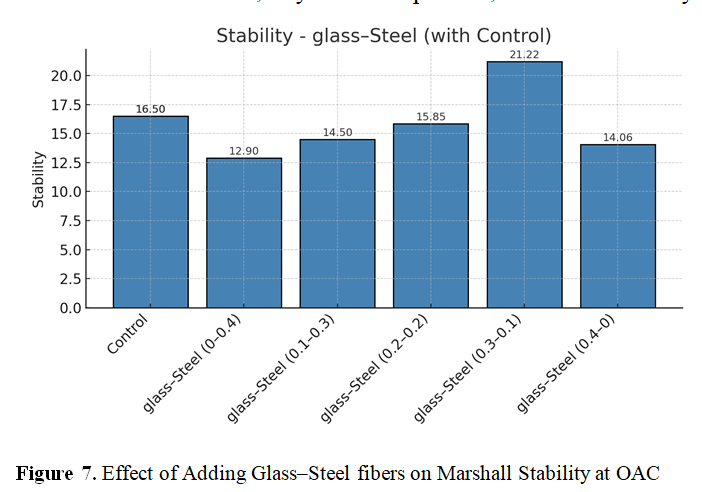
The performance of hot mix asphalt (HMA) pavements is significantly affected by heavy traffic loading and high-temperature conditions, particularly in regions with hot climates such as Iraq. Fiber reinforcement has been investigated as an effective approach to improving the mechanical properties of asphalt mixtures. This study experimentally evaluates the effects of hybrid combinations of steel, glass, and polypropylene fibers on the performance of HMA prepared using 40–50 penetration-grade asphalt binder obtained from Al-Daurah refinery. Three hybrid fiber systems were investigated: glass–steel, polypropylene–glass, and polypropylene–steel. Each system was evaluated using five fiber proportions, namely 0.4–0, 0.3–0.1, 0.2–0.2, 0.1–0.3, and 0–0.4%, based on the total weight of the asphalt mixture. The optimum asphalt content was determined to be 5%. The experimental programme included Marshall Stability, Marshall Flow, and Indirect Tensile Strength (ITS) tests to assess the influence of fiber type and proportion on mixture performance. The results demonstrated that hybrid fiber reinforcement improved the mechanical properties of HMA, although the degree of improvement varied depending on the fiber combination and proportion. The polypropylene–steel combination exhibited the highest overall performance, achieving a maximum Marshall Stability of 23.86 kN and an ITS of 2.47 MPa at a fiber proportion of 0.3–0.1%, representing increases of approximately 44.7% and 27.3%, respectively, compared with the control mixture. The polypropylene–glass combination also showed considerable improvements, while the glass–steel combination provided moderate enhancements. Marshall Flow values exhibited relatively small variations among the investigated mixtures. Overall, the findings highlight the potential of hybrid fiber reinforcement, particularly polypropylene–steel fibers, for enhancing the stability and tensile strength of HMA under the investigated laboratory conditions.
References
[1] Guo, Y., Tataranni, P., & Sangiorgi, C. (2023). The use of fibres in asphalt mixtures: A state of the art review. Construction and Building Materials, 390, Article 131754. https://doi.org/10.1016/j.conbuildmat.2023.131754
[2] Jia, H., et al. (2023). Effect of synthetic fibers on the mechanical performance of asphalt mixture: A review. Journal of Traffic and Transportation Engineering (English Edition), 10(3), 331–348. https://doi.org/10.1016/j.jtte.2023.02.002
[3] Alnadish, A. M., Singh, N. S. S., & Alawag, A. M. (2023). Applications of synthetic, natural, and waste fibers in asphalt mixtures: A citation-based review. Polymers, 15(4), Article 1004. https://doi.org/10.3390/polym15041004
[4] Baqadeem, A. O. A., & Masri, K. A. (2023). Fibers in asphalt mixture: A state-of-the-art review. Construction, 3(1), 115–122. https://doi.org/10.15282/construction.v3i1.9215
[5] Li, J., et al. (2023). Research progresses of fibers in asphalt and cement materials: A review. Journal of Road Engineering, 3(1), 35–70. https://doi.org/10.1016/j.jreng.2022.09.002
[6] Ali, A., Mehta, Y., & Alfalah, M. (2021). Evaluating the impact of fiber type and dosage rate on laboratory performance of fiber-reinforced asphalt mixtures. Construction and Building Materials, 310, Article 125217. https://doi.org/10.1016/j.conbuildmat.2021.125217
[7] Enieb, M., Diab, A., & Yang, X. (2021). Short- and long-term properties of glass fiber reinforced asphalt mixtures. International Journal of Pavement Engineering, 22(1), 64–76. https://doi.org/10.1080/10298436.2019.1577421
[8] Guo, F., Li, R., Lu, S., Bi, Y., & He, H. (2020). Evaluation of the effect of fiber type, length, and content on asphalt properties and asphalt mixture performance. Materials, 13(7), Article 1556. https://doi.org/10.3390/ma13071556
[9] Mohammed, M., Parry, T., Thom, N., & Grenfell, J. (2020). Microstructure and mechanical properties of fibre reinforced asphalt mixtures. Construction and Building Materials, 240, Article 117932. https://doi.org/10.1016/j.conbuildmat.2019.117932
[10] Takaikaew, T., Hoy, M., Horpibulsuk, S., Arulrajah, A., Mohammadinia, A., & Horpibulsuk, J. (2021). Performance improvement of asphalt concretes using fiber reinforcement. Heliyon, 7(5), Article e07015. https://doi.org/10.1016/j.heliyon.2021.e07015
[11] Liu, K., Li, T., Wu, C., Jiang, K., & Shi, X. (2021). Bamboo fiber has engineering properties and performance suitable as reinforcement for asphalt mixture. Construction and Building Materials, 290, Article 123240. https://doi.org/10.1016/j.conbuildmat.2021.123240
[12] Noorvand, H., Mamlouk, M., & Kaloush, K. (2022). Evaluation of optimum fiber length in fiber-reinforced asphalt concrete. Journal of Materials in Civil Engineering, 34(3). https://doi.org/10.1061/(ASCE)MT.1943-5533.0004128
[13] Hui, Y., et al. (2022). Recent advances in basalt fiber reinforced asphalt mixture for pavement applications. Materials, 15(19), Article 6826. https://doi.org/10.3390/ma15196826
[14] Al-Hosainat, A., Nazzal, M. D., Obaid, A., Kim, S. S., & Abbas, A. (2023). Evaluation of the factors affecting the performance of fiber-reinforced asphalt mixtures. Journal of Materials in Civil Engineering, 35(2). https://doi.org/10.1061/(ASCE)MT.1943-5533.0004610
[15] Yucel, A. O. (2023). An evaluation of the cracking resistance of steel- and glass-fiber-reinforced asphalt mixtures produced at different temperatures. Sustainability, 15(18), Article 13356. https://doi.org/10.3390/su151813356
[16] AlSaadi, I., Tayh, S. A., Jasim, A. F., & Yousif, R. (2023). The use of natural fibers in stone mastic asphalt mixtures: A review of the literature. Archives of Civil Engineering, 69(3). https://doi.org/10.24425/ace.2023.146085
[17] Abd, N. I., & Latief, R. H. (2024). The effects of fibers on the properties of local hot asphalt mixtures. Tikrit Journal of Engineering Sciences, 31(4), 146–157. https://doi.org/10.25130/tjes.31.4.15
[18] Abd, N. I., & Latief, R. H. (2024). Assessment of rutting resistance for fiber-modified asphalt mixtures. Journal of Engineering. https://doi.org/10.31026/j.eng.2024.05.07
[19] Akram, H., Hozayen, H. A., Abdellah, M. Y., & Khodary, F. (2024). Unraveling the strength secrets: How polypropylene fiber-reinforced asphalt mixtures defy fracture. Journal of Failure Analysis and Prevention, 24(6), 2649–2668. https://doi.org/10.1007/s11668-024-02020-7
[20] Leiva-Villacorta, F., & Cerdas-Murillo, A. (2024). Performance evaluation of recycled fibers in asphalt mixtures. Construction Materials, 4(4), 839–855. https://doi.org/10.3390/constrmater4040045
[21] Tayh, S. A., Jasim, A. F., Mughaidir, A. M., & Yousif, R. A. (2024). Performance enhancement of asphalt mixture through the addition of recycled polymer materials. Discover Civil Engineering, 1. https://doi.org/10.1007/s44290-024-00071-1
[22] Ben Ameur, A., Valentin, J., & Baldo, N. (2025). A review on the use of plastic waste as a modifier of asphalt mixtures for road constructions. CivilEng, 6(2), Article 17. https://doi.org/10.3390/civileng6020017
[23] Akram, H., Hozayen, H. A., Abdelfatah, A., & Khodary, F. (2025). Investigating fracture stiffness of fiber asphalt mixtures with various mixing processes under modes I/II using SBB geometry at low and intermediate temperatures. International Journal of Pavement Research and Technology. https://doi.org/10.1007/s42947-025-00551-2
[24] Khan, M. U., & Tariq, M. (2025). Transforming plastic and glass waste into high-performance hot mix asphalt additives. International Journal of Pavement Research and Technology. https://doi.org/10.1007/s42947-025-00656-8
[25] Williams, C. G., Ezemenike, C. S., & Ikumawoyi, R. (2025). Thermochemical and microstructural assessment of polypropylene modified asphalt concrete for sustainable pavement applications. Discover Civil Engineering, 2, Article 194. https://doi.org/10.1007/s44290-025-00350-5
[26] Mohammed, I. A., Rashed, A. M., Khalid, S. W., & Khawaja Al Harki, B. Q. (2023). Mechanical performance of asphalt mixtures reinforced with polypropylene fibers. Dasinya Journal for Engineering and Informatics, 2(2). https://doi.org/10.65542/djei.v2i2.55
[27] Suksiripattanapong, C., et al. (2022). Performance of asphalt concrete pavement reinforced with high-density polyethylene plastic waste. Infrastructures, 7(5), Article 72. https://doi.org/10.3390/infrastructures7050072
[28] Noor, A., & Rehman, M. A. U. (2022). A mini-review on the use of plastic waste as a modifier of the bituminous mix for flexible pavement. Cleaner Materials, 4, Article 100059. https://doi.org/10.1016/j.clema.2022.100059
[29] Yoo, P. J., & Kim, K. H. (2014). Thermo-plastic fiber's reinforcing effect on hot-mix asphalt concrete mixture. Construction and Building Materials, 59, 136–143. https://doi.org/10.1016/j.conbuildmat.2014.02.038
[30] Usman, N., & Masirin, M. I. M. (2018). Performance of asphalt concrete with plastic fibres. In Use of Recycled Plastics in Eco-efficient Concrete (pp. 427–440). Elsevier. https://doi.org/10.1016/B978-0-08-102676-2.00020-7
Downloads
Published
Issue
Section
License
Copyright (c) 2026 Al-Noor Journal of Engineering Management and Computer Science

This work is licensed under a Creative Commons Attribution-NonCommercial-ShareAlike 4.0 International License.
How to Cite