Missingness-Aware Selection of Time-Series Imputation Methods: External Validation of a Decision-Tree Selector across Missingness Patterns and Rates
DOI:
https://doi.org/10.71229/wttpw673Keywords:
Missing data Time-series imputation Imputation-method selection Decision tree External validationAbstract
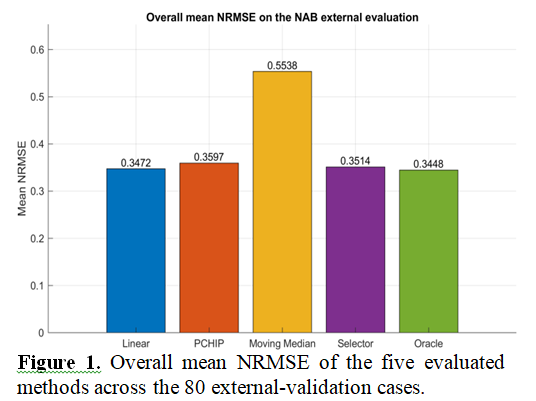
Missing-value imputation performance can vary with both the amount and temporal structure of missingness. This study evaluates a lightweight, missingness-aware decision-tree selector for choosing among established time-series imputation methods. The selector was trained using UCI Air Quality data and externally evaluated on an independent NAB ambient-temperature time series without retraining or parameter adjustment. Linear interpolation, piecewise cubic Hermite interpolation (PCHIP), and a moving-median method were evaluated under four missingness patterns and four missingness rates, with five repetitions per condition, yielding 80 paired evaluation cases. The selector achieved a mean normalized root mean square error (NRMSE) of 0.3514, compared with 0.3472 for linear interpolation, 0.3597 for PCHIP, and 0.5538 for the moving median. Its selected method varied with missingness structure: PCHIP was selected for random and short-burst missingness, whereas linear interpolation was selected for medium- and long-burst missingness. Statistical comparisons indicated lower NRMSE for the selector than for PCHIP and the moving median, while linear interpolation achieved slightly better overall performance. These findings suggest that missingness-aware method selection can provide a practical alternative to using a single fixed imputation method, although the external evaluation on one time series limits the scope of generalization. Further validation across additional datasets and application domains is needed.
References
[1] Gao, X., Liu, Z., Xu, L., Ma, F., Wu, C., & Zhang, K. (2025). Sensor data imputation for industry reactor based on temporal decomposition. Processes, 13(5), Article 1526. https://doi.org/10.3390/pr13051526
[2] Bejani, M., Mauri, M., & Mariani, S. (2025). Self-attention-based deep learning for missing sensor data imputation in real-time probe card monitoring. Sensors, 25(23), Article 7194. https://doi.org/10.3390/s25237194
[3] Shin, H., Park, T., Jo, S.-K., & Jung, J. Y. (2025). Enhancing flow-through aquaculture system monitoring: A comparative study of machine learning algorithms for missing-data imputation. Aquaculture, 601, Article 742303. https://doi.org/10.1016/j.aquaculture.2025.742303
[4] Decorte, T., Mortier, S., Lembrechts, J. J., Meysman, F. J. R., Latré, S., Mannens, E., & Verdonck, T. (2024). Missing value imputation of wireless sensor data for environmental monitoring. Sensors, 24(8), Article 2416. https://doi.org/10.3390/s24082416
[5] Kazijevs, M., & Samad, M. D. (2023). Deep imputation of missing values in time series health data: A review with benchmarking. Journal of Biomedical Informatics, 144, Article 104440. https://doi.org/10.1016/j.jbi.2023.104440
[6] Alejo-Sanchez, L. E., Márquez-Grajales, A., Salas-Martínez, F., Franco-Arcega, A., López-Morales, V., Acevedo-Sandoval, O. A., González-Ramírez, C. A., & Villegas-Vega, R. (2025). Missing data imputation of climate time series: A review. MethodsX, 15, Article 103455. https://doi.org/10.1016/j.mex.2025.103455
[7] Huang, S.-C., Liang, T., & Tsay, R. S. (2026). Missing values in time series: A brief review and a new versatile imputation method. International Statistical Review. Advance online publication. https://doi.org/10.1111/insr.70049
[8] Zahmatkesh, S., & Zech, P. (2026). Spatio-temporal missing data imputation: A systematic literature review with a focus on statistical and machine learning-based approaches. ACM Computing Surveys, 58(10), Article 267. https://doi.org/10.1145/3797903
[9] Poette, M., Mouysset, S., Ruiz, D., Pey, V., Alliot, J.-M., & Minville, V. (2026). Benchmarking imputation strategies for missing time-series data in critical care using real-world-inspired scenarios. Scientific Reports, 16, Article 8116. https://doi.org/10.1038/s41598-026-39035-z
[10] Haile, T. T., Tian, F., & Tian, B. (2026). Robust univariate missing data imputation in time series for air quality data. Communications in Statistics—Theory and Methods, 55(5), 1602–1622. https://doi.org/10.1080/03610926.2025.2531400
[11] Wu, R., Hamshaw, S. D., Yang, L., Kincaid, D. W., Etheridge, R., & Ghasemkhani, A. (2022). Data imputation for multivariate time series sensor data with large gaps of missing data. IEEE Sensors Journal, 22(11), 10671–10683. https://doi.org/10.1109/JSEN.2022.3166643
[12] Ahmed, H. M., Abdulrazak, B., Blanchet, F. G., Aloulou, H., & Mokhtari, M. (2022). Long gaps missing IoT sensors time series data imputation: A Bayesian Gaussian approach. IEEE Access, 10, 116107–116119. https://doi.org/10.1109/ACCESS.2022.3218785
[13] Wongoutong, C. (2025). Performance comparison of various imputation methods for missing data mechanisms (MAR, MCAR, and MNAR) in a nonstationary time series. International Journal of Mathematics and Mathematical Sciences, 2025(1), Article 3031708. https://doi.org/10.1155/ijmm/3031708
[14] Pereira, R. C., Abreu, P. H., Rodrigues, P. P., & Figueiredo, M. A. T. (2024). Imputation of data missing not at random: Artificial generation and benchmark analysis. Expert Systems with Applications, 249, Article 123654. https://doi.org/10.1016/j.eswa.2024.123654
[15] Shah, R., & Matam, R. (2026). Gap complexity score (GCS): A unified evaluation framework for time series missing data imputation. Sustainable Energy Technologies and Assessments, 92, Article 105147. https://doi.org/10.1016/j.seta.2026.105147
[16] Giesa, N., Zhumagambetov, R., Sekutowitcz, M., Piper, S. K., Sikora, V., Balzer, F., Haufe, S., & Boie, S. D. (2026). Benchmarking imputation methods on real-world clinical time series with simulated spatio-temporal missingness. Nature Communications, 17, Article 10491. https://doi.org/10.1038/s41467-026-77303-8
[17] Fatyanosa, T. N., Firdausanti, N. A., Prayoga, P. H. N., Kuriu, M., Aritsugi, M., & Mendonça, I. (2024). Meta-learning for vessel time series data imputation method recommendation. Expert Systems with Applications, 251, Article 124016. https://doi.org/10.1016/j.eswa.2024.124016
[18] Hemanth, G. R., & Charles Raja, S. (2022). Proposing suitable data imputation methods by adopting a stage wise approach for various classes of smart meters missing data—Practical approach. Expert Systems with Applications, 187, Article 115911. https://doi.org/10.1016/j.eswa.2021.115911
[19] Afkanpour, M., Hosseinzadeh, E., & Tabesh, H. (2024). Identify the most appropriate imputation method for handling missing values in clinical structured datasets: A systematic review. BMC Medical Research Methodology, 24, Article 188. https://doi.org/10.1186/s12874-024-02310-6
[20] Riley, R. D., Archer, L., Snell, K. I. E., Ensor, J., Dhiman, P., Martin, G. P., Bonnett, L. J., & Collins, G. S. (2024). Evaluation of clinical prediction models (part 2): How to undertake an external validation study. BMJ, 384, Article e074820. https://doi.org/10.1136/bmj-2023-074820
[21] Gallitto, G., Englert, R., Kincses, B., Kotikalapudi, R., Li, J., Hoffschlag, K., Bingel, U., & Spisak, T. (2025). External validation of machine learning models—Registered models and adaptive sample splitting. GigaScience, 14, Article giaf036. https://doi.org/10.1093/gigascience/giaf036
[22] Numenta. (n.d.). Numenta Anomaly Benchmark (NAB) [Data set]. GitHub. https://github.com/numenta/NAB
[23] Kumar, H. K. Y., & Varija, K. (2024). Revitalizing temperature records: A novel framework towards continuous data reconstruction using univariate and multivariate imputation techniques. Atmospheric Research, 312, Article 107754. https://doi.org/10.1016/j.atmosres.2024.107754
[24] Gama, P. H. T., Faria, J., Sena, J., Neves, F., Riffel, V. R., Perez, L., Korenchendler, A., Sobreira, M. C. A., & Machado, A. M. C. (2025). Imputation in well log data: A benchmark for machine learning methods. Computers & Geosciences, 196, Article 105789. https://doi.org/10.1016/j.cageo.2024.105789
[25] Sahin, S. O., & Kozat, S. S. (2025). An end-to-end optimized feature specific data imputation for recurrent neural networks under missing data. Digital Signal Processing, 166, Article 105349. https://doi.org/10.1016/j.dsp.2025.105349
[26] Jiang, D., & Zhang, S. (2025). An explainable missing data imputation method and its application in soft sensing. Measurement, 253, Article 117692. https://doi.org/10.1016/j.measurement.2025.117692
[27] Almeida, M. M., Almeida, J. D. S., Quintanilha, D. B. P., Júnior, G. B., & Silva, A. C. (2025). A meta-learning based neural network and LSTM for univariate time series missing data imputation. Applied Soft Computing, 172, Article 112845. https://doi.org/10.1016/j.asoc.2025.112845
[28] Almeida, A., Brás, S., Sargento, S., & Pinto, F. C. (2024). Focalize K-NN: An imputation algorithm for time series datasets. Pattern Analysis and Applications, 27, Article 39. https://doi.org/10.1007/s10044-024-01262-3
[29] Utama, A. B. P., Wibawa, A. P., Handayani, A. N., & Nafalski, A. (2026). A duel-inspired analytics framework for dynamic imputation in decision-making. Decision Analytics Journal, 19, Article 100694. https://doi.org/10.1016/j.dajour.2026.100694
[30] Ahmad, A., Rose, E. J., Roy, M. S., & Valachovic, E. (2026). Enhancing data completeness in time series: Imputation strategies for missing data using significant periodically correlated components. PLOS ONE, 21(7), Article e0350666. https://doi.org/10.1371/journal.pone.0350666
[31] Xiao, C., Jiang, X., Du, X., Yang, W., Lu, W., Wang, X., & Chetty, K. (2025). Boundary-enhanced time series data imputation with long-term dependency diffusion models. Knowledge-Based Systems, 310, Article 112917. https://doi.org/10.1016/j.knosys.2024.112917
[32] Hu, R., Li, D., Lou, J., Jin, R., Lin, B., Li, W., Ng, S. K., & Zheng, Z. (2026). Restoring missing gaps and intervals via global consistency and local coherence. Expert Systems with Applications, 301, Article 129862. https://doi.org/10.1016/j.eswa.2025.129862
[33] Ahmed, N., & Schmidt-Thieme, L. (2024). Structure-aware decoupled imputation network for multivariate time series. Data Mining and Knowledge Discovery, 38, 1006–1026. https://doi.org/10.1007/s10618-023-00987-9
[34] Liu, C., Zhu, Z., Hao, W., & Sun, G. (2025). Heterogeneous multivariate time series imputation by transformer model with missing position encoding. Expert Systems with Applications, 271, Article 126435. https://doi.org/10.1016/j.eswa.2025.126435
[35] Du, W., Côté, D., & Liu, Y. (2023). SAITS: Self-attention-based imputation for time series. Expert Systems with Applications, 219, Article 119619. https://doi.org/10.1016/j.eswa.2023.119619
[36] Li, Y., Du, M., & He, S. (2022). Attention-based sequence-to-sequence model for time series imputation. Entropy, 24(12), Article 1798. https://doi.org/10.3390/e24121798
[37] Wang, Y., Xu, X., Hu, L., Fan, J., & Han, M. (2024). A time series continuous missing values imputation method based on generative adversarial networks. Knowledge-Based Systems, 283, Article 111215. https://doi.org/10.1016/j.knosys.2023.111215
[38] Jacobsen, M., & Tropmann-Frick, M. (2024). Imputation strategies in time series based on language models. Datenbank-Spektrum, 24, 197–207. https://doi.org/10.1007/s13222-024-00488-z
[39] Ghorbani, V., Ghorbani, A., & Yoo, C. (2025). Evaluating deep learning data imputation for subway indoor air quality: Accuracy, efficiency, and implications for downstream tasks. Building and Environment, 286, Article 113713. https://doi.org/10.1016/j.buildenv.2025.113713
[40] Jiang, D., Yang, H., Cao, H., & Xu, D. (2025). A missing data imputation method for industrial soft sensor modeling. Journal of Process Control, 152, Article 103485. https://doi.org/10.1016/j.jprocont.2025.103485
[41] Qin, C., Yang, L., Peng, L., Zhang, W., & Wei, M. (2026). STMoE: A structured mixture-of-experts framework for robust spatiotemporal series imputation. Expert Systems with Applications, 319, Article 132137. https://doi.org/10.1016/j.eswa.2026.132137
[42] Chen, Y., Hu, R., Li, Z., Yang, C., Wang, X., Long, G., & Xu, G. (2024). Exploring explicit and implicit graph learning for multivariate time series imputation. Engineering Applications of Artificial Intelligence, 127, Article 107217. https://doi.org/10.1016/j.engappai.2023.107217
[43] Sun, Z., Lai, X., Liu, Q., & Zhang, L. (2026). Dynamic correlations modeling and imputation of incomplete time series based on multi-scale adaptive graph neural network. Expert Systems with Applications, 320, Article 132151. https://doi.org/10.1016/j.eswa.2026.132151
[44] Su, X., Li, P., Cai, Z., & Du, Y. (2026). Spatiotemporal data imputation based on spatiotemporal feature fusion network. Neurocomputing, 672, Article 132753. https://doi.org/10.1016/j.neucom.2026.132753
[45] Mo, S., Ruan, H., Yuan, K., Teng, X., & Liu, J. (2026). Bias-corrected multi-scale spatiotemporal networks for multivariate time series imputation. Neurocomputing, 684, Article 133571. https://doi.org/10.1016/j.neucom.2026.133571
[46] Jing, S., Li, Z., Pan, C., Wu, Q., Guo, Q., & Xu, J. (2026). IMU data imputation with diffusion models and spatiotemporal consistency constraints for inertial navigation. Measurement, 259, Article 119589. https://doi.org/10.1016/j.measurement.2025.119589
[47] Liu, R., Teng, M., Ma, J., & Wu, K. (2026). A multi-scale feature embedding framework using grouped and parametric convolutions for efficient time series imputation. Knowledge-Based Systems, 336, Article 115175. https://doi.org/10.1016/j.knosys.2025.115175
[48] Wang, H., Zhang, F., Cai, Y., & Chen, Y. (2025). A novel imputation approach for power load time series data based on tsDatawig. Scientific Reports, 15, Article 20863. https://doi.org/10.1038/s41598-025-05481-4
[49] Peng, Y., & Li, E. (2024). Basis expansion imputation network for incomplete multivariate sensor data in wastewater treatment system. Journal of Water Process Engineering, 63, Article 105536. https://doi.org/10.1016/j.jwpe.2024.105536
[50] Ma, L., Wang, M., & Peng, K. (2024). A missing manufacturing process data imputation framework for nonlinear dynamic soft sensor modeling and its application. Expert Systems with Applications, 237, Article 121428. https://doi.org/10.1016/j.eswa.2023.121428
[51] Xu, A., Ostfeld, A., Shao, Y., Zhang, T., Chu, S., Tian, Y., & Jian, D. (2025). Leveraging spatiotemporal redundancy for sensor data imputation in water distribution networks. Water Resources Research, 61(9), Article e2025WR040528. https://doi.org/10.1029/2025WR040528
[52] Simethy, G., Ortiz Arroyo, D., & Durdevic, P. (2026). STDiff: A state transition diffusion framework for time series imputation in industrial systems. Expert Systems with Applications, 302, Article 130592. https://doi.org/10.1016/j.eswa.2025.130592
[53] Sheidaei, A., Gohari, K., Harari, H., Yitshak-Sade, M., Kavouras, I., Wright, R. J., Wright, R., & Kloog, I. (2025). Imputation approaches for missing data in non-reference sites in short-term air quality studies: Case study from NYC community air survey. Urban Climate, 59, Article 102294. https://doi.org/10.1016/j.uclim.2025.102294
[54] Park, J., Müller, J., Arora, B., Faybishenko, B., Pastorello, G., Varadharajan, C., Sahu, R., & Agarwal, D. (2023). Long-term missing value imputation for time series data using deep neural networks. Neural Computing and Applications, 35, 9071–9091. https://doi.org/10.1007/s00521-022-08165-6
[55] Khattab, A. A. R., Elshennawy, N. M., & Fahmy, M. (2023). GMA: Gap imputing algorithm for time series missing values. Journal of Electrical Systems and Information Technology, 10, Article 41. https://doi.org/10.1186/s43067-023-00094-1
[56] Xu, X., Hu, L., Miao, X., Xiao, P., Yan, X., & Liu, J. (2026). Imputation of continuous missing values in water quality data using a temporal embedding-based self-attention variational autoencoder. Journal of Hydrology, 668, Article 134937. https://doi.org/10.1016/j.jhydrol.2026.134937
[57] Bikše, J., Retike, I., Haaf, E., & Kalvāns, A. (2023). Assessing automated gap imputation of regional scale groundwater level data sets with typical gap patterns. Journal of Hydrology, 620, Article 129424. https://doi.org/10.1016/j.jhydrol.2023.129424
[58] El Hachimi, C., Belaqziz, S., Khabba, S., Ousanouan, Y., Sebbar, B.-E., Kharrou, M. H., & Chehbouni, A. G. (2023). ClimateFiller: A Python framework for climate time series gap-filling and diagnosis based on artificial intelligence and multi-source reanalysis data. Software Impacts, 18, Article 100575. https://doi.org/10.1016/j.simpa.2023.100575
[59] Fu, C., Quintana, M., Nagy, Z., & Miller, C. (2024). Filling time-series gaps using image techniques: Multidimensional context autoencoder approach for building energy data imputation. Applied Thermal Engineering, 236, Article 121545. https://doi.org/10.1016/j.applthermaleng.2023.121545
[60] Chakraborty, S., Ide, K., & Balachandran, B. (2025). Missing values imputation in ocean buoy time series data. Ocean Engineering, 318, Article 120145. https://doi.org/10.1016/j.oceaneng.2024.120145
[61] Hua, V., Nguyen, T., Dao, M.-S., Nguyen, H. D., & Nguyen, B. T. (2024). The impact of data imputation on air quality prediction problem. PLOS ONE, 19(9), Article e0306303. https://doi.org/10.1371/journal.pone.0306303
[62] Niako, N., Melgarejo, J. D., Maestre, G. E., & Vatcheva, K. P. (2024). Effects of missing data imputation methods on univariate blood pressure time series data analysis and forecasting with ARIMA and LSTM. BMC Medical Research Methodology, 24, Article 320. https://doi.org/10.1186/s12874-024-02448-3
[63] Toller, M. B., Geiger, B. C., & Kern, R. (2025). Detecting abrupt changes in missing time series data. Information Sciences, 717, Article 122322. https://doi.org/10.1016/j.ins.2025.122322
[64] Ling, Y., Shahmoon, E., Brandeau, M. L., et al. (2026). Missing data imputation for wearable time series. Scientific Reports. https://doi.org/10.1038/s41598-026-71659-z
[65] Galdelli, A., Narang, G., Tomassini, S., D’Agostino, L., Tassetti, A. N., & Mancini, A. (2025). Data imputation in large and small-scale spatiotemporal time series gaps using BackForward Bi-LSTM. Journal of Big Data, 12, Article 115. https://doi.org/10.1186/s40537-025-01163-0
[66] Xu, X., Hu, L., Liu, J., Miao, X., & Yan, X. (2026). T-LSTM-VAE: A random missing data imputation model for multivariate time series. Journal of the Franklin Institute, 363(1), Article 108231. https://doi.org/10.1016/j.jfranklin.2025.108231
[67] Feng, Y., Liu, Z., Liu, H., Jiang, X., Liu, X., Sun, J., & Tan, J. (2026). GTEE: A global timestamp encoding enhanced method for robust time series imputation in complex missing scenarios. Information Fusion, 133, Article 104220. https://doi.org/10.1016/j.inffus.2026.104220
[68] Surakhi, O., Hossein Motlagh, N., Iturrate-Garcia, M., Abu Tabbaneh, A., Saleh, S., et al. (2026). DeepSIP: A deep learning approach for sensor data imputation and time series forecasting. Aerosol and Air Quality Research, 26, Article 62. https://doi.org/10.1007/s44408-026-00145-y
[69] Laeeq, A., Li, J., & Adeel, U. (2026). A hybrid LSTM–attention model for multivariate time series imputation: Evaluation on environmental datasets. Machine Learning and Knowledge Extraction, 8(1), Article 18. https://doi.org/10.3390/make8010018
[70] Stockton, B., & Harel, O. (2026). Incomplete angular time series imputation with a projected normal autoregressive process and exogenous predictors. Journal of Applied Statistics. Advance online publication. https://doi.org/10.1080/02664763.2026.2718688
[71] El-Hay, T., Reps, J. M., & Yanover, C. (2025). Extensive benchmarking of a method that estimates external model performance from limited statistical characteristics. npj Digital Medicine, 8, Article 59. https://doi.org/10.1038/s41746-024-01414-z
[72] The MathWorks, Inc. (2022). MATLAB (Version 9.12.0.1884302 [R2022a]) [Computer software]. https://www.mathworks.com/products/matlab.html
Downloads
Published
Issue
Section
License
Copyright (c) 2026 Al-Noor Journal of Engineering Management and Computer Science

This work is licensed under a Creative Commons Attribution-NonCommercial-ShareAlike 4.0 International License.
How to Cite